


Uncategorized
Jury finds Pittsburgh synagogue shooter guilty on all counts
PITTSBURGH (JTA) — The gunman who committed the worst antisemitic attack in U.S. history is guilty of all charges he faced, according to the verdict delivered by a federal jury on Friday morning.
Robert Bowers, who killed 11 worshippers at a Pittsburgh synagogue on Oct. 27, 2018, was charged on 63 counts in total. Those include 22 capital charges — two for each of his victims: 11 charges of the federal crime of “obstruction of the free exercise of religious beliefs resulting in death,” and 11 charges of the federal crime of “willfully causing bodily injury because of actual or perceived religion resulting in death,” which is a hate crime.
The sentencing phase of the trial will begin next week, during which the jury of seven women and five men will consider whether to give the defendant the death penalty.
The verdict is a milestone in one of the most significant court proceedings in American Jewish history. It provides a a determination of legal accountability in a tragedy that has reshaped American Jews’ sense of security in Pittsburgh and beyond in the nearly five years since it occurred.
The trial opened with jury selection in April, and lawyers delivered their opening statements on May 30, beginning 11 days of harrowing testimony from survivors of the shooting and first responders who described the attack and its aftermath.
On Friday, families of the victims and survivors packed the courtroom and an overflow room where they were able to monitor the proceedings over video. Staff from the 10.27 Healing Partnership, a counseling service housed at the local Jewish Community Center, were on hand to assist them.
The victims of the attack were Joyce Fienberg, Richard Gottfried, Rose Mallinger, Jerry Rabinowitz, Cecil Rosenthal, David Rosenthal, Bernice Simon, Sylvan Simon, Daniel Stein, Melvin Wax and Irving Younger. They worshipped at three congregations housed in the building at the time: Tree of Life, Dor Hadash and New Light.
The trauma of the shooting was evident when survivors spoke in the courtroom. Andrea Wedner, one of two worshippers who were shot and survived, asked not to be on the stand during the playback of her 911 call. Another shooting victim, Daniel Leger, and the Tree of Life rabbi, Jeffrey Myers, became emotional as each recounted reciting the Shema, the Torah verse and central Jewish prayer that Jews have traditionally recited at times of mortal peril.
The defense team never contested that their client committed the shooting, electing to call no witnesses and present no evidence at the trial. Their sole argument, articulated by Elisa Long in her brief closing statement on Thursday, was to rebut the capital charge that Bowers was guilty of “obstruction of the free exercise of religious beliefs resulting in death”. The defense attorneys, headed by a prominent death row lawyer, Judy Clarke, are expected to argue that their suffered from mental illness in their effort to keep him from being sentenced to death.
Long said Bowers was under the delusion that Jews were facilitating the entry of immigrants into the United States to commit genocide, and that his goal was to prevent them from doing so, not to keep Jews from worshipping. But she did not contest the hate crime charge. There is no question, she said, that “his statements that day reflected animosity and hatred toward Jews.”
Prosecutors anticipated that the defense would argue that the gunman did not intent to obstruct worship. Government attorneys concluded each survivors’ testimony with some form of the same question: “Did the defendant prevent you from praying?”
At times, the testimony doubled as a kind of crash course on American Jewish worship, with witnesses explaining the differences between Reconstructionist and Conservative Judaism as well as the use of ritual objects, like a prayer shawl or ritual fringes.
Prosecutors used visuals to make the point that the attack interrupted an exercise of religion: prayer books were stained with blood, a kippah was split into two by gunfire. Bernice Simon used a prayer shawl to stanch the wound that killed her husband, Sylvan, before she was killed.
Another theme pervading the proceedings was the political polarization that has beset the United States in recent years. Ahead of the shooting, the gunman posted hateful messages and signaled his intent to commit the attack on Gab, a social media site that is a redoubt of far-right extremists. The site’s founder, Andrew Torba, testified in the trial, as did Mark Hetfield, the CEO of HIAS, the Jewish refugee aid group. The gunman chose to attack the Tree of Life building because Dor Hadash partnered with HIAS on its National Refugee Shabbat the previous week.
The non-death penalty charges the defendant faced are related to the injuries suffered by Wedner and Leger as well as police personnel who engaged with Bowers when they raided the synagogue, in addition to gun charges. The shooter was an avid collector of guns.
—
The post Jury finds Pittsburgh synagogue shooter guilty on all counts appeared first on Jewish Telegraphic Agency.
Uncategorized
Nithya Raman, LA mayoral candidate who clashed with DSA on Israel, wins their endorsement
Ever since Councilmember Nithya Raman’s last-minute entry into the Los Angeles mayoral race, questions have loomed about her relationship with the Democratic Socialists of America — and whether her stance on Israel would chill the group’s support for her underdog campaign.
Raman, a dues-paying DSA member, had criticized the group for a statement the national organization made after Oct. 7. In 2024, she was censured by the LA chapter for courting a pro-Israel group in her campaign for re-election to city council.
But following weeks of debate in the local chapter, Raman won its official endorsement Wednesday, paving the way for the leftist group to organize for her campaign to unseat incumbent Mayor Karen Bass.
The endorsement, which reportedly came with the support of more than 60 percent of some 1,400 voting members, vindicated Raman’s breaking with the group on Israel and other issues. It also comes after the councilmember stated definitively that she believed the war in Gaza constituted a genocide — a basic litmus test inside the hardline anti-Zionist group.
Raman, 45, seemed to allude to the conflict in a statement thanking the organization.
“This endorsement means something because of what it represents: a coalition of people who don’t always agree on every question, but who agree that LA needs real change,” Raman wrote on Instagram, adding. “It’s not about everyone thinking alike. It’s about building power together toward the same goal.”
The contentious endorsement process around Raman, one of the group’s national success stories and its first member to win citywide office in Los Angeles — three more have since joined her on city council — underscored the fierce ideological commitments in the DSA. Yet its outcome may not be entirely in her favor, as mainstream Jewish groups have come to hold DSA and its candidates in contempt.
Raman has rarely fit neatly into the group’s political conventions. On Oct. 7, 2023, when more than 1,200 people were killed in Israel, the national DSA club publicly blamed Israel for incurring the Hamas-led attack. Raman — whose district included heavily Jewish neighborhoods like Hancock Park and Sherman Oaks — had quickly issued a statement standing with her Jewish and Israeli constituents. A few days later, she also disavowed the DSA response, calling it “unacceptably devoid of empathy.”
Her positions on the Middle East frustrated Israel’s supporters, too. In June 2024, she helped pass a resolution calling for a ceasefire and release of hostages, infuriating the local Jewish federation and other Jewish groups, which said she was selling out Israel’s ability to defend itself.
Nevertheless, she earned the backing of Democrats for Israel-Los Angeles in her run for re-election that year, with the president of the liberal Zionist group crediting her statement that Israel had a right to exist and her general engagement with Jewish constituents. Outraged, DSA’s members voted to censure her.
In the runup to June’s mayoral primary, Raman joined the livestream of leftist firebrand Hasan Piker, telling him she agreed that it was committing genocide in Gaza. But DSA did not endorse any candidate in the June 2026 primary — even as Raman was locked in a tight race with the conservative reality star Spencer Pratt for a spot in the November runoff. (Another DSA candidate, Rae Huang, placed a distant fifth.)
Asked whether she believed Israel was an apartheid state, Raman said, “Yeah, I think that they’re treating people unfairly, that they’re not treating people equally, and I’m critical of that.”
Israel is not the only wedge issue for Raman in DSA. She split with the group — and her democratic socialist peers on city council — on a local “mansion tax,” saying that it discouraged new multifamily housing construction. And she was one of only two councilmembers who railed against a controversial multibillion-dollar expansion of the LA convention center — even as the other DSA members, who have strong backing from the building trades unions, voted for it.
The debate within DSA was framed as ideological purity versus political pragmatism. Bass, a historically unpopular incumbent whose tenure included the most catastrophic wildfire the city had seen in decades, has governed as a centrist Democrat; though Raman is broadly aligned with DSA policy, some of the group’s members who opposed the endorsement wrote in a communist magazine this week that it should not be “rewarded based on ideological proximity.”
The DSA’s endorsement was the second major pickup for Raman in the last week; the powerful hospitality workers union, Unite Here Local 11, officially threw its support behind Raman Tuesday, though organized labor still largely backs Bass.
Now a new question emerges: whether the endorsement of a group with a few thousand members came too late. Peer-to-peer betting markets currently have Bass as a roughly 2-to-1 favorite.
Sean Wakasa, co-chair of the Los Angeles DSA chapter, told The New York Times the group was warming to the challenge.
“We have thousands of members who are ready to organize, talk to their neighbors, knock on doors and build power to shake up Los Angeles and build a brighter future,” Mr. Wakasa said.
The post Nithya Raman, LA mayoral candidate who clashed with DSA on Israel, wins their endorsement appeared first on The Forward.
Uncategorized
Why is this chef opening a kosher Israeli restaurant in LA right now?
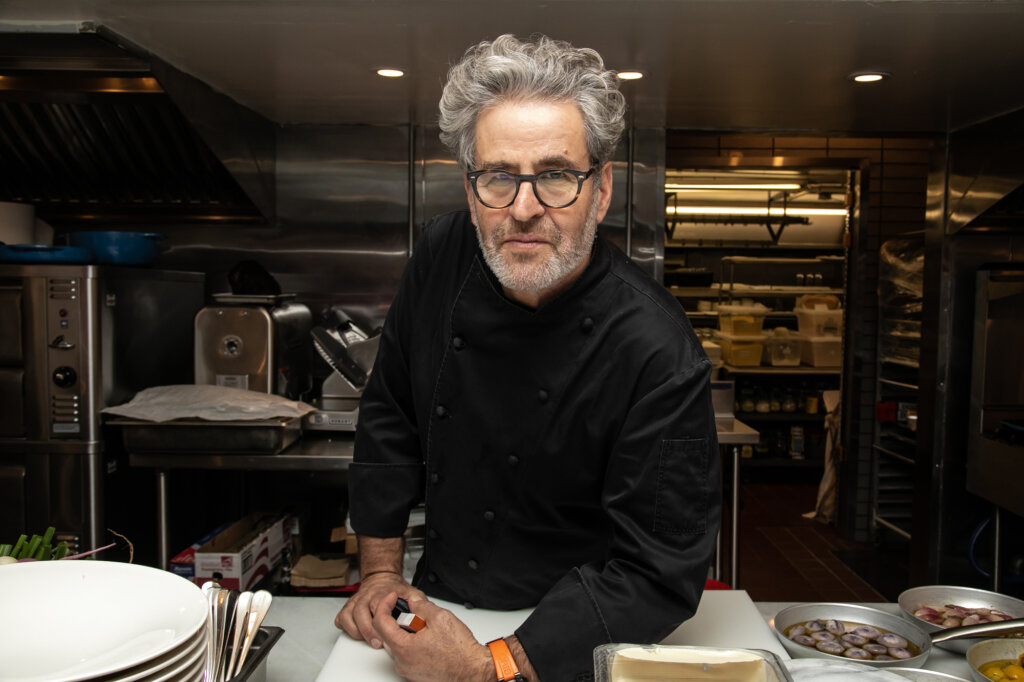
How do you explain Malka, the new kosher Israeli restaurant in Beverly Hills?
I’m not talking about the food — I haven’t eaten there yet — I’m talking about the fact that it’s opening at all. Why would Eyal Shani — many of whose restaurants worldwide have faced protests, vandalism and physical attacks — dare to open another restaurant at this particularly fraught time?
“The whole situation is leading me to open more, more, more,” Shani told me when we met last week. “That is my reaction as a Jewish man. If they are trying to kill you, you should make a lot of children. And these are my children.”
We were sitting in the empty restaurant on the ground floor of the boutique SIXTY Hotel. Shani, who is 67, wore a T-shirt and dark khakis. With his stubbly beard and unruly gray hair, he could pass for an intense, very post-grad philosophy major. He put a plate of farmers market green grapes between us.
The night before, at a pre-opening event for journalists, influencers and, it seemed, models, the same space was packed. Piles of fresh raw vegetables — a Shani signature — filled the long bar counter along with perfect rectangles of toasted focaccia topped with either steak tartare or smoky eggplant caviar. The crowd swelled, the music blared, trays of mojitos and palomas disappeared. It was signature Shani — a frolic of nature, noise and Israeli food.
Now, the large, modern space — a rare high-end restaurant in Los Angeles’ ever-struggling kosher restaurant scene — was quiet. Shani leaned back into an earth-toned banquette and reflected for a moment on how those two words, “Israeli food,” have become so toxic, especially following Oct. 7.
Demonstrators accuse Israeli chefs of passing Palestinian food off as Israeli and of being complicit in their government’s actions. Shani’s business partner, Shahar Segal, did engage in marketing work with the Gaza Humanitarian Foundation, the controversial U.S.-Israeli organization established to feed Gazans. But Israeli restaurants around the world with no such involvements have faced similar protests, as have Jewish-owned restaurants with no ties to Israel.
Malka’s opening follows the closure of Shani’s restaurants Miznon in Melbourne and Gila & Nancy in Berlin, both targeted by mobs chanting anti-Israel slogans.
The rioters in Melbourne entered MIznon, threw chairs, chanted “Death to the IDF!” and only stopped when the two owners of a nearby pizza place — both Lebanese — confronted them.
“In the end, they succeeded to kill the restaurant,” Shani said. “They almost killed our staff there.”
Shani happened to be at the restaurant in Berlin when dozens of protesters surrounded it, shouting, “Stop feeding genocide!”
He raced into the kitchen, put together some food platters and went outside to offer the demonstrators the opportunity to eat and talk.
“They didn’t want to eat,” he said. To them, he added, “Eating from an Israeli is like eating from Satan.”
Shani rejected the charge commonly leveled at Israeli chefs — that they have stolen Palestinian foods and recast them as Israeli.

“I always declare that I took a lot of inspiration from the Palestinians,” he said.
In 1989, Shani opened his first restaurant, Oceanus in Jerusalem. He was 29 and, he said, he knew nothing about food except that he loved bringing people together around it. He wanted to make something like the fresh focaccia an Italian Jewish neighbor once served him. The closest thing to it was the Arabic laffa Shani would buy from a closet-sized bakery in West Jerusalem.
“I had a cook, a Palestinian man from Hebron, a very talented man,” Shani said. “I loved him. He said, ‘Eyal, no problem, my grandmother makes it every day.’ He showed me.”
Shani brushed the finished bread with olive oil and showered it with fresh rosemary.
I told Shani that I ate at the now-closed Oceanus at the tim and to this day remember being served, when we sat down, fragrant sheets of his focaccia-laffa.
“It was a hybrid,” Shani said, “Palestinian, Italian and new Israeli. Each one is getting influenced by the other. You can’t do it with just one brain.”
Malka, a strictly kosher restaurant, presents a different kind of challenge to Shani, who is not an observant Jew. His Michelin-starred Manhattan restaurant Shmone offers, for instance, “A mountain of grilled calamari, okra, tomatoes and yogurt.”
But the chef who turned flour, yeast and water into a hybrid Palestinian-Israeli-Italian flatbread revels in facing constraints like kashrut.
“Each culture leads with its limitations,” he said. “These limitations are a blessing — they’re shaping your creation.”
The kosher stricture against cooking meat together with dairy products didn’t faze him.
“Take me off dairy, put a beautiful bottle of olive oil in front of me — what are the limitations?” he said. “And if there would be no olive oil anymore in the world, I would quit, I would not cook.”
Beyond the kitchen, Shani said he wanted to reach more Israelis with his food. About 70% of Israelis are strictly kosher or prefer it.
“So how can it be that we’re only cooking for the hipsters in Tel Aviv?” Shani said. “It’s unfair.”
The marketplace has rewarded Shani’s ability to combine local ingredients and techniques with creativity and showmanship. The chef has around 70 restaurants — neither he nor his publicist knew the exact number — including Malka’s in Tel Aviv, Miami and New York.
And the backlash isn’t close to stopping him. Shani just announced a new restaurant project in, yes, Melbourne.
“It doesn’t make me frightened,” he said. “It’s the way my personality reacts. I think it’s the instinct of survival. You just keep going.”
The post Why is this chef opening a kosher Israeli restaurant in LA right now? appeared first on The Forward.
Uncategorized
An unvarnished look at Polish Hasidic life before the Holocaust
In the decades before the Holocaust, Warsaw still teemed with Hasidim. Muranowska Street was virtually lined with shtiblekh (prayer and study houses), each with its own dynastic affiliation. But one day, a young man established a new shop on the street and brazenly kept it open on the Sabbath. Modernity had arrived.
Some Hasidim didn’t seem too concerned. As we read in the new English translation of Yechiel Hofer’s Hasidic Warsaw: Reb Zalmen and the Aleksander Shtibl, the protagonist, Reb Zalman, dismissed the whole scandal. The Sabbath, he shrugged, was simply too holy to be violated by people so unworthy. And in truth, Warsaw’s Hasidic enclaves continued to thrive, albeit in a more concentrated form.
Most Yiddish authors assumed the inevitable demise of Jewish tradition. In story after story, we read about pious, aging parents watching helplessly as their sons and daughters reject their ancestors’ ways to become Zionists, revolutionaries, assimilationists and, of course, Yiddish writers. Nobody, it seemed, could hold back the tide of progress.
But many interwar Polish Hasidic leaders were actually galvanized by the challenge of secularization. They launched ambitious, transnational fundraising initiatives, refurbished thousands of heders [traditional primary schools], and built hundreds of Hasidic yeshivas and Bais Yaakov girls’ schools. And as Hofer’s book shows, their shtiblekh recovered and proliferated down to the bitter end.
Hasidic Warsaw is one of the few works of modern Yiddish literature to present Hasidism as something other than moribund. Reminiscent of I.B. Singer’s In My Father’s Court, but more gracious, Hofer’s stories bring us into one corner of this impossibly thriving world: a Warsaw shtibl attended by followers of the Aleksander Rebbe. Reb Zalman, an irritable luftmensch (unemployed dreamer), is the shtibl’s most zealous member and the Hofer family’s most frequent Sabbath guest.
Reb Zalman’s pauper’s arrogance exasperates even his fellow Hasidim, who cannot resist pranking him. They appoint him “Purim Rabbi,” ply him with liquor, and get him to accept bribes. They lure him out of his Hasidic enclave to experience Gentile taunts and glares. Some try to help him gain a livelihood, but he proudly self-sabotages. Their most lucrative scheme, a tavern in the shtibl, fails because Reb Zalman decides to give all the liquor away.
Then there is Reb Zalman’s misogyny. He disdains his kind host, Hofer’s mother, who is “strictly observant, pious and indeed a Hasid in her own right.” She tactfully challenges his prejudices by recounting stories of her Grandmother Brayndl, a passionate follower of a Hasidic group called the Porisover Hasidim, who used to travel regularly to see the Rebbe, Reb Yankev Hersh [and] was deeply respected at the Rebbe’s court.” Yet Reb Zalman scoffs at even the most revered Hasidic women.
Hofer, in short, doesn’t romanticize interwar Hasidism. But he doesn’t dismiss it either. His family’s Sabbath table, he writes, provided even the ungrateful poor with a slice of Heaven. In the Aleksander shtibl, “deep seriousness combined with high-minded joy reigned.” Reb Zalman’s gift for quirky storytelling almost redeemed him in Hofer’s eyes.
Jonathan Boyarin is among the few scholars able to grasp not only the external, quantitative significance of the Polish Hasidic shtibl but its inner life: imperfect men swaying in prayer, chants, and study, occasionally halting to make a toast with vodka and herring or recount another edifying story. Yet Boyarin remains deeply attuned to Hofer’s gentle irony.
Hasidic Warsaw, with its multitude of stories-within-stories, is in a sense a work of collective authorship. We behold a community of storytellers constantly striving to make each other better by means of humorous, cautionary tales. Secularist Yiddish writers drew liberally from such stories, stylizing and serializing them to great acclaim while assuming the demise of the very movement that sustained them. But only physical annihilation could do that.
The reader of Hasidic Warsaw is left with a deep sense of loss. Without storytelling, how can we hope to regain that kind of connectedness? How can future Jewish literature emerge as easily and naturally? In honoring the art of storytelling, Hasidic Warsaw reminds us of yet another world that was lost in the Holocaust.
The post An unvarnished look at Polish Hasidic life before the Holocaust appeared first on The Forward.
