


Uncategorized
Progressive US ‘Squad’ Lawmakers Condemn Israel’s Strikes Against Hezbollah, Silent on Nasrallah Assassination
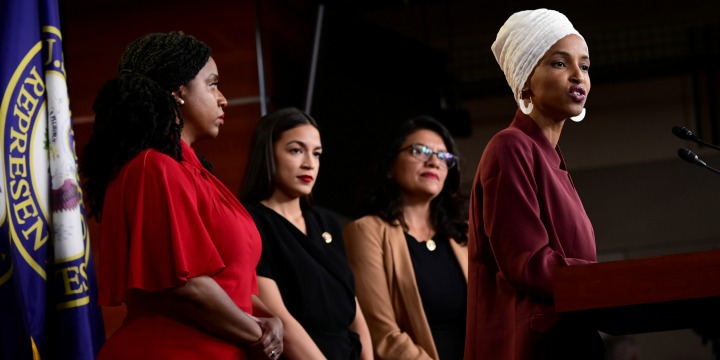
The most vocal critics of Israel in the US Congress have been silent on the death of Hezbollah leader Hassan Nasrallah, a notorious terrorist committed to the Jewish state’s destruction.
Members of the so-called “Squad” — a coalition of lawmakers with progressive policy positions on issues ranging from economics to foreign affairs — have not issued statements responding to the death of Nasrallah. However, these lawmakers — including Democratic Reps. Rashida Tlaib (MI), Ilhan Omar (MN), Alexandria Ocasio-Cortez (NY), Cori Bush (MO), Jamaal Bowman (NY), Summer Lee (PA), and Ayanna Pressley (MA)— have repeatedly ripped Israel over its defensive military operations against the Hezbollah terrorist group in Lebanon. Many of them have also called for an arms embargo to be placed on Israel amid its military operations against both Hamas in Gaza and Hezbollah in Lebanon.
Both Islamist terrorist organizations are backed by Iran, which provides them with weapons, funding, and training.
Beyond not directly addressing Nasrallah’s killing in an Israeli airstrike last week in their statements, the lawmakers also did not respond to requests for comment on his death and their silence on it.
Tlaib, the sole Palestinian American woman in Congress, has accused Israel of waging an “indiscriminate” bombing campaign in Lebanon. She slammed Israel for supposedly “expanding” its “genocidal campaign” from Gaza into Lebanon. Tlaib wrote that “the US government are conspirators to the war criminal Netanyahu’s genocidal plan,” referring to Israeli Prime Minister Benjamin Netanyahu, and urged the Biden administration to place an arms blockade on the Jewish state.
However, the anti-Israel firebrand did not mention the Jewish state’s successful elimination of Nasrallah.
Meanwhile, Omar issued a statement condemning Israel’s strikes against Hezbollah in Lebanon, arguing that they serve to escalate tensions within the region. She similarly urged the Biden administration to withhold arms from Israel, accusing the Jewish state of recklessly endangering civilian lives. Omar, like her progressive contemporaries, did not mention Hezbollah’s repeated attacks against Israel that prompted the Israeli strikes. She also did not mention Israel’s successful assassination of several Hezbollah high-ranking officials, including Nasrallah.
“It is imperative we use every single tool to de-escalate tensions. Just as President Biden stated, a ‘full-scale war is not in anyone’s interest.’ A full-scale war would have catastrophic implications for everyone, especially for Lebanese and Israeli civilians who would bear the brunt of this war and dramatically increase the risk of regional conflict involving the United States,” Omar wrote. “If we are serious about preventing the escalation of this conflict, we must use our leverage to cut off military aid to stop the violence both in Lebanon and Gaza. We cannot continue to stand idly by while innocent civilians are being bombarded with our tax dollars.”
Pressley, a congresswoman who has accused Israel of enacting “apartheid” against Palestinians, has not mentioned the death of the Hezbollah leader either. However, she has repeatedly condemned the Israeli military operations against the Iran-backed Lebanese terrorist group. Comparing Lebanon to Gaza, she urged the US federal government to prevent the Jewish state from prosecuting its war against Hezbollah.
“Israel’s indiscriminate bombing, forced displacement, & war crimes in Gaza have been beyond devastating. This must not be repeated in Lebanon. We must de-escalate and the US must stop sending offensive weapons,” Pressley posted on social media.
However, on Tuesday, in the immediate aftermath of Iran attacking Israel with a barrage of missiles, Pressley accused the Jewish state of exacerbating tensions in the Middle East by dismantling Hezbollah.
“Netanyahu’s invasion of Lebanon is putting millions of people at risk, forcing thousands to be displaced, and inciting a regional war. The escalating violence must end. In Lebanon, in Gaza, and across the region,” Pressley wrote.
Ocasio-Cortez, one of the most steadfast opponents of the Jewish state in Congress, has also not issued a statement on the killing of Nasrallah. However, Ocasio-Cortez criticized the recent attack on communications devices used by Hezbollah terrorists for “seriously injuring and killing innocent civilians.” Israel is widely believed to be behind the operation, although Jerusalem has neither confirmed nor denied responsibility. The congresswoman did not mention that the pager attack primarily harmed Hezbollah members.
“This attack clearly and unequivocally violates international humanitarian law and undermines US efforts to prevent a wider conflict,” Ocasio-Cortez wrote.
Meanwhile, Lee warned that Israel’s attacks on Hezbollah could trigger a “regional escalation of war.” She cautioned that Americans could be “dragged into another endless war abroad” and urged the US to implement an “arms embargo now.”
Bush and Bowman also made no official statements regarding the death of Nasrallah. However, each one condemned Israel’s military operations against Hezbollah.
“A ceasefire and arms embargo are urgently needed to end the violence & save lives. By failing on both fronts and sending additional troops to the Middle East, the Biden Administration is further fueling more death & destruction. Our communities do not want more endless wars,” Bush wrote.
Bowman accused Israel of arbitrarily “terrorizing” the civilians of Lebanon. The congressman notably did not mention Hezbollah.
“Israel’s playbook is all too familiar: indiscriminate bombing and widespread civilian carnage. Reports are emerging that Israel is considering a full-scale ground invasion of Lebanon. This is unacceptable,” Bowman wrote.
Bush and Bowman, two of the most virulently anti-Israel forces in Congress, lost their recent primary campaigns in races heavily defined by their opposition to the Jewish state.
Hezbollah has fired barrages of rockets, missiles, and drones at northern Israel almost daily following the Oct. 7 attacks by Hamas-led Palestinian terrorists on the Jewish state’s southern region. Since then, both sides have been exchanging fire constantly while avoiding a major escalation as war rages in Gaza to the south.
About 80,000 Israelis have been forced to evacuate their homes in northern Israel and flee to other parts of the country amid the unrelenting attacks from Hezbollah.
Israel began a blistering campaign against Hezbollah two weeks ago, launching a wave of airstrikes that have crippled the Iran-backed terrorist group’s leadership. Many observes believe Israel wants to establish a demilitarized buffer zone between the Jewish state and Lebanon, aiming to decrease violence from non-state actors such as Hezbollah.
The post Progressive US ‘Squad’ Lawmakers Condemn Israel’s Strikes Against Hezbollah, Silent on Nasrallah Assassination first appeared on Algemeiner.com.


Uncategorized
Ed Sheeran’s support acts bail on Loop Tour after Macklemore dropped
(JTA) —
All of Ed Sheeran’s opening acts and his backing band have withdrawn from his Loop Tour after the pro-Palestinian rapper Macklemore was dropped as an opening act amid pressure from Robert Kraft and other stadium owners.
Kraft, the Jewish and pro-Israel billionaire who owns the Boston-area stadium where one of the tour stops had been scheduled, said on Monday that he had told Sheeran’s team that Macklemore wouldn’t be allowed to perform there.
Macklemore was subsequently dropped from the tour following pushback from unnamed venues that “will not allow a concert to take place with Macklemore on the lineup,” Rolling Stone reported on Monday.
At a Macklemore performance at MetLife Stadium in East Rutherford, N.J., earlier this month, the rapper declared “Free Palestine” before performing his 2024 song, “Hind’s Hall,” referring to Columbia University’s Hamilton Hall. Pro-Palestinian protesters occupied the building and unofficially renamed it for Hind Rajab, a 6-year-old Palestinian girl who was killed during the war in Gaza. Israel is investigating her killing.
Sheeran said Tuesday that he wasn’t behind the tour promoter’s decision to drop Macklemore.
“I am not complicit,” Sheeran wrote in a statement on Instagram Tuesday, saying that Macklemore leaving the tour “was the promoter’s decision, it was not mine.” It was Sheeran’s first public statement on the controversy.
Hours after Sheeran’s comments, acts began pulling out of the tour.
His backing band, Beoga, said in an Instagram post that it was leaving the tour “following the silencing of Macklemore by zionist lobbies.”
“We believe in dialogue as a means of progressing the plight of the Palestinian people,” they added. Beoga’s management did not immediately respond to requests for further comment.
Kraft’s decision to bar Macklemore from performing at Gillette Stadium in Foxboro, Mass. got the backing of the Jewish Community Relations Council of Greater Boston.
“Mr. Kraft drew a clear moral line in the sand about the demonization and offensive conduct that he will not allow in ‘his home’,” Jeremy Burton, the JCRC CEO, said, referring to the stadium. “He also showed leadership and complexity … by rejecting those who would diminish the suffering of innocent Palestine people.”
“This decision is not about diminishing the suffering of innocent Palestinians or denying anyone the right to advocate on their behalf,” Kraft had said in his statement. “Their pain and loss are real.”
Other acts scheduled to support Sheeran on the Loop tour, including Aaron Rowe, Finneas and Lukas Graham, also withdrew Tuesday. Rowe and Lukas Graham were supposed to replace Macklemore on the remaining U.S. dates, AP reported.
It’s not yet clear what the fate of the tour is, given the withdrawal of his backing band. At least one Israeli musician joked that he was ready to put together a replacement band for “unlimited beer.”
Sheeran’s own note added, “I am appalled by the conflict between Israel and Palestine.” The British singer-songwriter wrote that he had been “involved in direct talks” between Kraft and various promoters “to try and find a mutual resolution for all.”
Sheeran didn’t mention Jews in his statement, but noted, “I have always used my platform and music to bring people from all backgrounds and cultures together and this won’t ever change.”
He also had some veiled criticism of his tourmate’s methods. “Those who come to my shows do not expect a political forum,” Sheeran wrote. “I respect Macklemore’s strength of purpose to stand up for what he believes. However, there is room for multiple approaches to the same end: peace… If we only focus on shouting the loudest, nothing will ever change.”
The Israeli-American Council, which organized a boycott against Macklemore following his New Jersey show, criticized Sheeran in a statement to the Jewish Telegraphic Agency.
“It’s time to take responsibility for giving a stage to antisemitic messaging,” the IAC said, of Sheeran. “This isn’t just ‘criticism of Israel.’ It’s a message that crosses the line between legitimate political criticism and antisemitism. This is Ed Sheeran’s stage, it’s the tour that carries his name — and so the responsibility for what happens on it is his too.”
The post Ed Sheeran’s support acts bail on Loop Tour after Macklemore dropped appeared first on The Forward.
Uncategorized
Vance: Trump willing to ‘part ways’ with Netanyahu when necessary, and has often opposed him
(JTA) —
President Donald Trump has an unprecedented track record of opposing Israeli Prime Minister Benjamin Netanyahu when it comes to advancing the interest of the American people, Vice President JD Vance said during a virtual address Tuesday at a Los Angeles-based technology summit.
More than any president in the last 40 years Trump “has shown a willingness to actually part ways with ‘Bibi’ Netanyahu when he feels like the interests of the American people are different from the interests of the government of Israel,” Vance told the All-In Summit on technology.
The claim that Trump is the “one president” who would differ with Netanyahu is one that would surprise many watchers of the U.S.-Israel relationship.
The most significant U.S.-Israel rupture since 2009, when Netanyahu was first elected prime minister, was with President Barack Obama in 2015 over Obama’s nuclear deal with Iran.
Vance’s comments were the latest in a series he has made emphasizing the widening gulf between Jerusalem and Washington as November midterm elections approach and at a time when Netanyahu’s popularity in the United States is at a low after three years of Middle East wars.
A Pew poll from the end of March, when the United States was actively at war with Iran, found that 60% of U.S. adults unfavorably view Israel and that 59% lacked confidence in Netanyahu’s handling of world affairs, an increase of 7% in both categories.
Republicans are scrambling to shuck off unpopular policies and associations, fearing the party will lose control of Congress in the midterms, a result that would cripple Trump’s agenda in the final two years of his presidency.
“I find it a little ironic … that you have Democrats criticizing Donald Trump for his relationship with Bibi when Donald Trump is the one president of the last 40 years who’s been willing to say, you know what, yeah, Bibi is a good partner, but also Bibi and I have a different opinion on this, or Bibi’s wrong about this, or maybe Bibi’s right about this from the perspective of Israel. But the American people need us to go in a different direction,” Vance said.
Trump has often touted himself as the president who has done the most for Israel, including relocating his country’s embassy to Jerusalem and rupturing Obama’s Iran deal, during his first term in 2018 and securing the release of the Gaza hostages in 2025 during his second, nonconsecutive term. The war he and Netanyahu launched against Iran in February is the first ever joint U.S.-Israeli military action.
The friendship between the two leaders is a highly public one, with Netanyahu enjoying more White House visits than any other world leader. Each has made the close ties central to their electoral campaigns. Netanyahu pitches himself as the world leader most influential with Trump, while Trump’s evangelical base lauds his closeness with Israel.
Vance, however, has often taken a harsher line, including accusing Israel of trying to manipulate U.S. public opinion on the Iran war.
“Israel has been an important partner when it comes to military technology, when it comes to intelligence sharing, but also sometimes the United States doesn’t always agree with Israel,” Vance said on Tuesday.
Serious differences have emerged since the joint U.S.-Israel goals in the Iran war – to change the regime and end once and for all Iran’s potential to acquire a nuclear weapon – have foundered. Among these has been the U.S. decision to end the Iran war without a clear plan to block the Islamic Republic’s path to nuclear weapons and its agreement to enter into a civilian nuclear deal with Saudi Arabia, without insisting on a normalization deal with the Jewish state.
“We cannot let our Middle Eastern foreign policy be subservient to the state of Israel,” Vance told the All In Summit.
Vance has also ruffled American Jewish feathers by refusing to disavow media personality Tucker Carlson, who has promoted conspiracy theories about Israel and Jews.
Vance’s remarks rankled pro-Israel figures who have otherwise been supportive of Trump’s policies.
“American foreign policy should be subservient to no country,” Jonathan Schanzer, the executive director of the Foundation for the Defense of Democracies, an influential think tank that backed the Iran war, wrote on X. “Why does the VP feel compelled to call out Israel in this respect? Why not call out the Qataris, or the Saudis, or Ukraine? Odd how this keeps happening.”
Heather Johnston, a Christian evangelical who founded the U.S. Israel Education Association, accused Vance on X of catering to Israel haters.
“Our U.S. foreign policy has never been subservient to Israel’s foreign policy,” she said, attaching a clip of Vance’s remarks. “He knows that. Why would he need to say that unless he’s trying to politically gain some points with Israel haters?”
The accusation hit a nerve. Vance’s communications director Taylor Van Kirk quoted Johnston’s tweet, and posted the entire exchange on X. “Let’s all take a moment to actually watch this exchange in full, where the VP was specifically asked about Israel,” Van Kirk said.
The post Vance: Trump willing to ‘part ways’ with Netanyahu when necessary, and has often opposed him appeared first on The Forward.
Uncategorized
LA Federation sues museum for custody of looted paintings once hoarded by Hermann Göring
(JTA) — The Jewish Federation of Los Angeles and the heirs to a Jewish artist filed suit against a California museum to recover a pair of 16th-century oil paintings seized by the Nazis and held in the private collection of Hermann Göring.
Also on Monday, the daughters of Holocaust survivor Dina Gottliebova Babbitt sued the Auschwitz-Birkenau Museum to recover watercolors of Roma victims she was forced to paint for Josef Mengele, the physician who tormented and experimented on inmates at Auschwitz. The artist died in 2009.
The two lawsuits were filed at the end of the filing window under a 2024 California law that permits claimants in previously dismissed lawsuits to refile for the retrieval of looted artworks. The law permits claimants to recover personal property stolen as the result of “political persecution” when earlier lawsuits were dismissed on procedural grounds.
The federation is suing the Norton Simon Museum in Pasadena for the retrieval of a life-sized oil diptych of Adam and Eve by the German painter Lucas Cranach the Elder. In 1940, the Nazis seized the pair of paintings from their Jewish owner, the art dealer Jacques Goudstikker. The art wound up in the hands of Göring, the Nazi air force commander and convicted war criminal, along with about 800 other pieces from Goudstikker’s collection. The paintings eventually made their way to the Norton Simon in 1971.
In a press release, the Jewish federation said it would use the majority of the proceeds from the sale of the art to care for Los Angeles-based Holocaust survivors living in poverty. (A 2018 study from the Jewish Federations of North America found that one-third of Holocaust survivors in the United States are living below the poverty line.)
“By pursuing the recovery of the Cranachs, we are seeking to reverse a great injustice perpetrated by the Nazi theft of a Jewish family’s property, and securing the resources that will enable us to provide for the many needs of thousands of impoverished Holocaust survivors in the greater Los Angeles area so they can live in dignity for the remainder of their lives,” Rabbi Noah Farkas, president and CEO of the Los Angeles federation, said in a statement.
Goudstikker’s daughter-in-law, Marei von Saher, first sued the Norton Simon Museum in 2007, claiming the paintings belonged to her family. A 2018 ruling determined on procedural grounds that they belong to the museum.
In addition to the 2024 California law, Congress passed a law earlier this year that eliminated “state doctrine,” the principle that acts committed by foreign countries within their territory are immune from lawsuits, strengthening the cases for the heirs of Goudstikker and Babbitt.
Dina Babbitt in 2006, at work on a recreation of the “Snow White” mural that she painted in the children’s barracks at Auschwitz. Her family is seeking the recovery of the portraits she drew of Roma inmates at the concentration camp. (Lawrence Stern for The David S. Wyman Institute for Holocaust Studies)
Also in 2024, 21 countries agreed to updated guidelines for restituting Nazi-looted art, which specifies that works sold to the Nazis under duress are also considered looted or stolen property.
“I am grateful to the Jewish Federation Los Angeles and its Chairman Daniel Gryczman for taking up this cause and pursuing the recovery of Adam and Eve by Lucas Cranach the Elder,” von Saher said in a statement shared with the Jewish Telegraphic Agency. “This effort represents a meaningful step toward justice for Holocaust survivors and victims of Nazi era atrocities.”
Jewish federations rarely file lawsuits as the plaintiffs in a Nazi-looted art restitution case. The San Diego Jewish Federation was a co-plaintiff in a lawsuit in 2015.
JTA has reached out to the attorneys for the Jewish federation for comment.
The Pasadena museum held onto the Cranachs even as other works that had been looted from Goudstikker’s collection were restituted by the Dutch government in the decades since their seizure.
“After decades of litigation, court after court including the United States Supreme Court ha confirmed that the Norton Simon Art Foundation has proper title to Adam and Eve by Lucas Cranach the Elder,” a spokesperson for the Norton Simon Museum told JTA in a statement. “We will continue to make these important artworks accessible to the public, as we have since 1971.”
The spokesperson said the museum is reviewing the complaint, and referred to a 2016 court decision that placed the artworks in their possession.
Goudstikker first acquired the paintings at a 1931 Berlin auction hosted by the Soviet authorities, which also included many works previously owned by the Russian Stroganoff family. In 1940, after Jacques Goudstikker’s death, his collection was sold to the Nazis under duress — but no cash ever came to his family.
In the Norton Simon Museum’s online catalogue, provenance cards for the works say they were “[s]aid to have been in the Stroganoff Collection” and describe the transfer from Goudstikker to Göring as “appropriated 1940.”
The quest to restitute Goudstikker’s artwork began in 1946, when his wife Désiree, an opera singer, filed a claim in the Netherlands that was initially rebuffed. Though she was able to retrieve one painting just a few years later, all of the pieces that had been seized by Göring were kept in the Dutch national collections. In later years, more than 200 artworks were returned to von Saher’s possession.
But in 1961, George Stroganoff-Scherbatoff, a descendant of the aristocratic family whose works were sold en masse along with the Cranachs, claimed the diptych from the Dutch government. He later sold the works to the Norton Simon Museum for $800,000.
In the case of the Gottliebova drawings, a spokesperson from the Auschwitz-Birkenau Museum told JTA that the memorial was their appropriate home. “The drawings of Roma victims made in the camp must remain in the Memorial as part of the documentation of the crimes of Mengele,” the spokesperson for the state-run museum said.
“We fully understand the emotional approach of Dina Gottliebova’s family,” said the spokesperson, but “we express the deep conviction that the watercolors should remain at the Memorial.”
“The portraits of Roma victims are the few remaining fragments of the documentation made by Mengele as part of his criminal experiments,” the spokesperson continued. “Therefore, they should be treated as unique documents related to the history of Auschwitz.”
Earlier this month, an Argentine court ordered the restitution to van Saher of a looted painting, after the painting was spotted on a real estate website advertising the sale of a home of the daughter of a former Nazi official. The painting came from Goudstikker’s collection.
Earlier this year, a judge ruled that a painting by Italian artist Amedeo Modigliani, once valued at more than $25 million, must be returned to the descendants of its original owner, who was forced to sell the painting to the Nazis under duress.
The post LA Federation sues museum for custody of looted paintings once hoarded by Hermann Göring appeared first on The Forward.
