


Uncategorized
In new miniseries ‘The Calling,’ an NYPD detective’s Judaism helps him solve crimes
(New York Jewish Week) — In “The Calling,” a new miniseries streaming on Peacock, a Jewish NYPD detective fights crime and solves mysteries by letting his Jewishness lead the way.
Jeff Wilbusch plays Avraham Avraham, a detective whose Judaism is both central to his character — in more than one scene he says the Mourner’s Kaddish for a murder victim — and an identity that influences the way he does his job.
“It is so beautiful that, in our profession, as actors in the storytelling business, that you can play such a character,” Wilbusch told the New York Jewish Week. “Also, in these crazy times now, to have this beautiful role and character brought to life on screen on such a big platform is a really good thing.”
“The Calling” is based on a series of detective novels by Israeli author Dror Mishani. Though Mishani’s books take place in Israel, the show, produced by David Kelley (creator of “Ally McBeal,” “Big Little Lies” and more) and directed by Barry Levinson (“Diner,” “Good Morning, Vietnam”), transports Detective Avraham to New York. Slightly reminiscent of “Law & Order,” it has less of a procedural bent, with cases that span multiple episodes and more emphasis on the character development.
Detective Avraham — whose double name is not explained in the show further than one off-hand comment “my parents liked the name, I guess” — is a bit of a mysterious and complicated figure who works with his team to solve missing persons cases and a bomb threat at a day care.
Wilbusch, who is Israeli, is best known for his role in Netflix’s “Unorthodox” as Moishe Lefkovitch — the unruly and somewhat dangerous cousin who flies to Germany to track down Esty (Shira Haas), the show’s formerly Orthodox protagonist. For the actor, who grew up in the Satmar Hasidic community of Mea Shearim in Israel until he was 13, and whose native language is Yiddish, he feels a certain responsibility to honor the Jewish characters he plays.
“As a storyteller you have a lot of responsibility, especially when it comes to playing characters that are specific. I do feel a very strong responsibility to Avi,” the 34-year-old actor said. “I’m Jewish and I’m playing Jewish and it is a strange time for us Jews. The current events don’t really leave my head.”
Avraham is considered the best interrogator in the department because of his willingness to listen and empathize in pursuit of justice. (Heidi Gutman/Peacock)
In some instances, the show seems to combine several different streams of Judaism — Detective Avraham says he grew up in Crown Heights, though in a shot of him saying morning prayers and wrapping tefillin on his roof, he appears to live in Williamsburg. He doesn’t wear a kippah save for a few scenes, and while he attends an egalitarian synagogue, he also seems to speak fluent Yiddish.
Still, the character’s Judaism is less about the external markers of Judaism on the show — the scenes of him praying, saying a blessing, or performing “shemira,” watching over the dead — and more about how he carries himself and conducts his job.
“He’s not just Jewish because his name is Avraham, or Jewish because he wears a kippah. He’s Jewish because many different things make him Jewish, storytelling-wise. He’s not a superficial character,” Wilbusch said. “He is such a deep and complex and interesting character with such a strong message of humanity. ”
Avraham is considered the best detective in the department: He knows how to ask the right questions, how to bear witness to tragedy and how to continue to advocate for justice.
“I learned many things from him — to really listen to people, to really use the senses and to fight to see the good in people,” Wilbusch told the New York Jewish Week.
“The Talmud teaches us to see every single human being as the whole world, and that each and every person is entitled to infinite respect and concern. It’s not that I didn’t believe in this before, but just to play a character who consciously embodies this in his whole way of living is a very strong thing and a very healing thing,” he added.
Though Avraham is guided by that very Jewish conscience, he still has his blind spots. He prefers to work alone, he keeps his methods to himself and he remains guarded about his background and personality, perhaps aware that his Judaism sets him apart.
Juliana Canfield as Janine Harris, Jeff Wilbusch as Avraham Avraham, Karen Robinson as Captain Kathleen Davies (Heidi Gutman/Peacock)
Upending these tendencies in Avraham is his more junior partner Janine Harris (Juliana Canfield), who is eager to learn more about Judaism in order to understand her colleague better. Throughout the series, she asks about synagogue, shiva and Sukkot in a respectful and curious way.
“The Talmud says it’s forbidden for a teacher to reject his student,” she tells him in one scene. “If I ask you, you kinda have to teach me.”
It’s a relationship not often seen on television, a non-Jewish character with an innocent curiosity about Judaism and a recognition of how it influences one’s entire being. For Wilbusch, the relationship between Avraham and Janine was one of his favorite parts of the show.
“It says in the Torah ‘Lo tov heyot l’adam l’vado,’ a person should not be alone,” Wilbusch said, quoting a line in Genesis. “Avraham thinks he works best alone, but he needs Janine badly. The relationship that they have is not just a master-student. She keeps them in line where he has blind spots.”
The relationship on screen bled into their real world interactions on set, Wilbusch said. As production went on, Canfield, who is not Jewish, would slip in Yiddish phrases like “oy gevalt” after messing up a line.
“It means a lot to me. It’s a dream come true — a dream that I never knew I had,” Wilbusch said. “I never thought I would play a Jewish detective, that this would be my first leading role in America.”
All eight episodes of “The Calling” will be available to stream on Peacock on November 10.
—
The post In new miniseries ‘The Calling,’ an NYPD detective’s Judaism helps him solve crimes appeared first on Jewish Telegraphic Agency.
Uncategorized
This isn’t just a dance group; it’s a model for what coexistence could look like
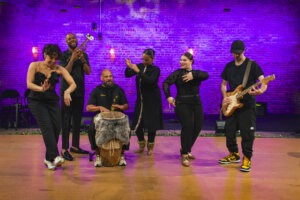
There are three of them onstage. Arielle Rosales, a Mexican Puerto-Rican Jew from the Lower East Side, is dancing flamenco. Amanda Castro, a Brooklyn-born Puerto-Rican from New Haven, is tapping. And Brinda Guha, a Bengali-Indian from New Jersey, is doing Kathak — a form of Indian classical dance. They’re three performers raised in different artistic traditions who became a trio a decade ago.
But as Soles of Duende, these artists never wanted to create a “fusion” that blurs or erases their identities, cultures, dance styles, or legacies. Nothing is stripped of its history or blended beyond recognition.
“We’re not trying to make a smoothie. We’re trying to make a fruit salad,” Rosales told me. “We want you to be able to pick up the pineapple and pick up the watermelon and pick up the mango.”
Together, the women move. They vocalize. They invent rhythms and songs with their feet. The sounds of Castro’s taps, Rosales’s heels, and Guha’s ghungroos — multi-tiered strings of bells that wrap from the ankles up toward the shins and calves — are just as much a part of the music played by their three counterparts in their band: a percussionist, an electric guitarist and a trumpeter.
You can hear these percussive dance forms and you can feel them, too, mingling and building, filling the air and shaking the room in rehearsals.
‘Carrying the blessing and burden of tradition’
The collaboration started as a one-off project. Rosales and Guha were friends, their paths having crossed at Broadway Dance Center, a popular New York City studio where Rosales taught flamenco and Guha ran what was then called the International Student Visa Program. In 2016, they applied to create a short piece and participate in a show together.

“We wanted to do a trio of three different percussive styles,” said Rosales. “We wanted a third sound.” They found it in Castro, who wowed Guha with a tap solo she performed at a competition.
“I was so enthralled with the fact that there were other women percussive dancers making space for other women percussive dancers,” Castro said. “There are still people who think percussive dance is a less-than art form,” she said. “It is something that never gets the flowers that it deserves.”
What started with an eight-minute piece at an experimental theater on the Lower East Side led to a year-long residency that culminated in a full-length production. The question explicit in its title “Can We Dance Here?” reflects the challenges they faced finding rehearsal spaces. Practitioners of percussive forms often find themselves in a perpetual search for floors they can dance on and spaces that will welcome, or at least tolerate, them.
“It was about permission,” Guha said, both literal and philosophical. Not just can we use this floor, she said, but: “Do we have permission to mess with tradition like this? Do we have permission to [have a] dialogue with each other and change a couple of rules?”
Over time, their questions evolved, Guha added: “How far can we go with this thing? How close to our humanity can we get through the form of percussive dance?” They stopped asking for permission as much, though they continue to seek a balance between honoring established practices and pushing them forward.
“All three of us are both carrying the blessing and burden of tradition,” said Guha, who started learning Kathak from her mother, an immigrant from Kolkata, India, at the small dance school she ran out of their garage. “I grew up with lots of students in the house. I grew up with ghungroos, our bells, literally jingling in our house all day long.”
Guha went on to study with other teachers, including in India, much as Rosales inherited the traditions of flamenco not only in New York City, but also in flamenco meccas in Spain and New Mexico. Castro learned about tap legacies and lineages in bits and pieces, from Fred Astaire movies to classes with icons like Jason Samuels Smith.
“The three of us are really open to breaking a lot of rules,” Guha said, “as long as we know what rules we’re breaking and why.”
They bonded fast, not only as artists with shared sensibilities, Rosales said: “We became family pretty quickly.”
‘We’re doing it in each of our own ways”
Two hours into rehearsal, Soles of Duende is floating in and out of choreography, trying steps, checking cues with the musicians, chatting and smiling, making jokes and scat singing rhythms for each other. You can see them through a glass storefront in East Harlem, an unassuming studio tucked between a corner laundromat and a stoop draped with a Puerto Rican flag, under which a few men gather around a card table.

Here at the Rhythmic Arts Center, they’re rehearsing sections from “The Kitchen,” a full-length production the group is currently developing. The show pays homage to the traditions and cultures that shaped them — all of which value gathering around food — and explores family dynamics, celebration, ritual, hardship, and connection. The kitchen, Castro said, looms large as a communal place where families show up, break bread, fight at the table, announce big news, and meet new people.
“We also have a deep, deep love of food,” Guha said, explaining that the three dancers and the band often eat together, whether they’re going out during tour dates, cooking for each other, or hanging out and talking about cooking shows on TV. “We gather around food at all times. When we’re sad, when we’re mad, when we’re creative, when we’re stuck.”
Indeed, inside the rehearsal space, there’s a plate of fruit set out on a bench. The floor vibrates, knocking over the phone Castro set up to film one of their final runs before the next day’s performance. She scurries over to prop it back up, then gives up. It’s no match for them as they dance for and with each other.
“The Kitchen” is about “nostalgia and culture and all of that, but it’s not just that,” Rosales said. “Each of our sounds, each of our instruments is an ingredient, and when you let it simmer, we literally are cooking up something live.”
Watching them close up, it’s striking to pick out moments when these three dancers are performing a phrase seemingly in unison, only to notice that they are each executing slightly different steps using distinct dance vocabularies. If the common thread for a particular step is bringing both arms up overhead and then back down to rest by the sides of the body, they have to ask themselves: What would that look like in tap, flamenco, and Kathak?
The result often looks so smooth — a 2022 New York Times review called their show “a treasure and a triumph” and they graced the March 2024 cover of Dance Magazine — that it belies the struggle it takes to compose coherent, polished choreography out of three different cultural forms and artistic languages.
“We get a lot of people that think they see the quote-unquote product and say, ‘Oh you guys you work so well together!’ And that’s true,” Rosales said. But the ultimate cohesion rarely comes easily. Sometimes they’ll spend a three-hour rehearsal choreographing just one minute of new material. “It is so hard to come up with these things, and it comes with a lot of blocks,” she said, “a lot of friction and sometimes arguments.”
They’ve learned along the way when they need to put an idea in the “parking lot” to deal with later, when they need to sit down and talk, when they need to admit their brains are mush, when they need to explain or understand something about one of their dance forms, and when they need to remember their shared goals.
“We’ve named the idea Greta,” Castro said. “So when we are not on the same page, we say, ‘Greta, what is the answer? … What does the work need?’ Then our feelings can’t get in the way.”
At about 9 p.m., it’s time to call it quits. The dancers, musicians, and Greta all seem satisfied. They’re ready for their show the following evening.
‘Talk to each other and with each other’
First they argue about rice. In an excerpt from “The Kitchen” they perform the next day, the three women congregate over an invisible pot. With all these cooks in the kitchen, Castro tells the audience, “you can imagine that each of them thinks that their pot of rice is the best pot of rice.”
“This is burnt!” one exclaims. Another slaps a hand away: “Get your hand out my pot.”
On this particular evening in August, Soles is the opening act on the opening night of the Battery Dance Festival. The annual event is held on an outdoor stage in a waterfront park at the southern tip of Manhattan, next door to the Museum of Jewish Heritage.

“Part of the mission of the festival is to break down barriers between people, between cultures, introduce new forms of dance to the audience members, and to bring people together,” said Battery Dance’s executive director Emad Salem. “They perfectly embody that mission,” he said, “coming together in this seamless way.”
Though the sky is gray and heavy with the threat of rain, the amphitheater-style seats are packed. And while it started drizzling earlier during the group’s tech rehearsal — leading to a scramble to cover equipment and altering the sound of the wooden flooring onstage — the audience is none the wiser.
Standing behind the last row of seats, Curtis Thomas can’t help but dance along as he cheers and applauds. “It’s just so vibrant. All of the energy comes right at you,” said Thomas, who is a dancer himself. “It immediately opens you up somehow. And I love the way it’s just so multidisciplinary and the way that all of the styles and forms of dance and music talk to each other and with each other.”
The symbolism of the scene is almost too much. Dancing against the backdrop of the Hudson River flowing into New York Harbor, with the Statue of Liberty and Ellis Island visible in the distance, Soles of Duende demonstrates in dance what might be possible outside of it. At a time of entrenched polarization, they show you, Castro said, “what the dreamscape could be or a current reality could be.”
“When people see us performing, it really is a true example and testament to coexistence,” Rosales said. Whether they’re onstage or off, they can converse without changing who they are or how they speak. No one has to dim or diminish themselves. And “just like any musical form, we have to listen to each other.”
The post This isn’t just a dance group; it’s a model for what coexistence could look like appeared first on The Forward.
Uncategorized
Tidbits: This Jewish couple gives homeless dogs a free makeover
Tidbits is a Forverts feature of easy news briefs in Yiddish that you can listen to or read, or both! If you read the article and don’t know a word, just click on it and the translation appears. Listen to the report here:
אַ גרויסער בלאָער משׂא־פֿור האָט זיך אָפּגעשטעלט אויף אַ גאַס אין סקיד־ראָו, אַ באַקאַנטער אָרעמער געגנט אין לאָס־אַנדזשעלעס, פֿאַר אַ היימלאָזן מענטש מיט אַ הינטל.
„אײַער הינטל וויל אפֿשר מע זאָל אים צופּוצן אַ ביסל?“ האָט דער מאַן אינעם אויטאָ געפֿרעגט. לכתּחילה האָט דער היימלאָזער אויסגעזען צעטומלט. דערנאָך האָט ער געגעבן אַ קוק אויף זײַן הינטל, וואָס ער האָט שוין ווער ווייסט ווי לאַנג נישט געבאָדן אָדער אָפּגעשוירן, און צוגעשאָקלט מיטן קאָפּ.
מיט אַ שעה שפּעטער איז דאָס הינטל אַרויס פֿונעם משׂא־פֿור, אויסזעענדיק ווי אַ גאָר אַנדער הינטל. זײַן פֿעל, וואָס איז פֿריִער געווען שמוציק און פֿאַרפּלאָנטערט, האָט מען אויסגעוואַשן, צוגעשוירן און געבערשט ביז ער איז געוואָרן ווייך און גלאַנציק. איידער ער איז אַרויס פֿון אויטאָ האָט מען אים געגעבן אַ נאַש, וואָס ער האָט פֿריילעך אײַנגעשלונגען.
די אָרגאַניזאַציע וואָס האָט אויסגעבאָדן דאָס הינטל, „האָליוווּד מאָביל גרומינג“, באַלאַנגט צו טשאָק און יעל רובין. במשך פֿון די פֿאַרגאַנגענע 11 יאָר, האָבן זיי און זייערע מיטאַרבעטער גערייניקט בערך 5,000 הינט פֿרײַ פֿון אָפּצאָל.
דאָס פּאָרפֿאָלק, וואָס האָט אימיגרירט פֿון ישׂראל, האָט אין 2001 לאַנצירט אַ געשעפֿט וואָס ברענגט אַ לוקסוס־ספּאַ צו פֿאַרמעגלעכע אייגנטימער פֿון הינט. אָבער דערנאָך האָבן זיי באַשלאָסן אַז זיי ווילן אויך העלפֿן די מענטשן מיט הינט, וואָס קענען נישט באַצאָלן דערפֿאַר: סײַ הינט וואָס געפֿינען זיך אין אַ מיקלט פֿאַר חיות, סײַ הינט וואָס וווינען מיט זייערע אייגנטימער אויף דער גאַס.
„אַ מאָל האָבן די אייגנטימער מורא אונדז איבערצוגעבן די הינט, אַפֿילו אויב זיי קענען וואַרטן אין דרויסן,“ האָט יעל געזאָגט. „מיר לאָזן זיי אַרײַנקומען און זען וואָס מיר טוען. די הינט פֿילן זיך אויך בעסער. מע קען זען וויפֿל זיי האָבן הנאה פֿון דער באַהאַנדלונג און ווי עס שפּאַנט זיי אויס. דו ווײַזט זיי ליבע, גיסט זיי אַ נאַש, וואַסער צו טרינקען, און זיי באַצאָלן דיר מיט זייערע קושן.“
אויף דער פֿראַגע, צי זיי זאָרגן זיך נישט, וואָס וועט זײַן ווען די הינט גייען צוריק צו די האַרבע באַדינגונגען פֿון דער גאַס, האָט טשאָק באַטאָנט עטלעכע זאַכן: „זייערע אייגנטימער זענען תּמיד מיט זיי און פּאַסן אויף אויף זיי וויפֿל זיי קענען נאָר. די הינטלעך זענען זייערע ׳קינדער׳. עס זענען אויך דאָ אַ סך אָרגאַניזאַציעס וואָס באַזאָרגן זיי מיט עסן אומזיסט און אַנדערע זאַכן. זיי פֿאַרמאָגן ווייניק, אָבער זיי טוען דאָס בעסטע אויפֿצופּאַסן אויף זייערע הינט.“
צו לייענען וועגן דעם אויף ענגליש גיט אַ קוועטש דאָ.
To read about this in English click here.
The post Tidbits: This Jewish couple gives homeless dogs a free makeover appeared first on The Forward.
Uncategorized
The tech worker campaigning for ‘Antisemite of the Week’ doesn’t want to talk about antisemitism
After accusations of discrimination led his San Francisco Tech Week event to be pulled from the schedule, a tech worker has decided to embrace his newfound notoriety.
Mostapha Benhenda cited security reasons last week when he denied an Israeli programmer admission to his AI hackathon event, explaining that he didn’t want the Israeli army to make participants’ electronics “explode in their faces and injure them.”
The Israeli tech worker — a former Israeli soldier named Adam Levi — posted the message online, leading sponsors to pull funding for the event. In the days since, Benhenda has begun openly campaigning for an “Antisemite of the Week” award from pro-Israel watchdog group StopAntisemitism.
“I am a competitor, I play to win, this prize will be my Ballon d’Or,” Benhenda said in a message to the Forward, referring to the annual prize for the world’s best soccer player.
Running this week through Sunday, San Francisco Tech Week draws tens of thousands of tech industry workers to hundreds of panels, competitions and parties across the Bay Area.
The saga began Sept. 29 when Levi posted a screenshot of Benhenda’s messages rejecting his RSVP to the event, called “Build Your Agentic Investment Bank Hackathon.” A page for the hackathon on the digital invitation platform Partiful claimed it had been co-sponsored by Tech Week and the convention’s founder, venture capital firm Andreessen Horowitz.
Levi’s post was reshared on X more than 1,000 times, leading to the event’s de-listing by Tech Week organizers, who said on X that the event had violated the program’s terms of service.
Levi told The Algemeiner that Andreessen Horowitz told him the company had removed its sponsorship.
Benhenda, whose LinkedIn says he attended college in France, declined to participate in phone interviews. But in messages to the Forward, his response to accusations of antisemitism appeared to shift over a manner of days from defensiveness to bemusement.
When first reached for comment, Benhenda denied that his rejection of Levi was antisemitic at all. He said he banned Levi because his LinkedIn indicated service in the Israeli military’s secretive Unit 8200 during September 2024, when the intelligence unit was linked to the simultaneous detonation of thousands of pagers owned by Hezbollah operatives across Lebanon. (Levi declined to be interviewed, but said on X that “building explosive pagers was never my thing.”)
“I understand Adam’s disappointment, and his resulting emotional accusation of antisemitism, but he perfectly knows it’s unfounded,” Benhenda wrote Sept. 29, adding, “I hope that over the next weeks he will get more clarity about this.”
However, after StopAntisemitism posted about Benhenda on X, he seemed to lose interest in contesting the claim — and began leaning into it instead.
On Saturday, Benhenda shared StopAntisemitism’s post about him with a request.
“I am competing for the ‘Antisemite of the Week’ award at the San Francisco Tech Week,” he wrote. “Can you show your support/hate with a retweet?”
Founded in 2018 by a social media influencer who goes by Liora Rez, StopAntisemitism.org frequently bestows its “Antisemite of the Week” awards to public figures — a mix of elected officials, civic leaders and celebrities — who antagonize Israel.
Recent recipients of the award — which is not actually awarded weekly — have included actor Javier Bardem and Rama Duwaji, the wife of New York City Mayor Zohran Mamdani.
Last month, StopAntisemitism sponsored an event where a speaker was later criticized for Islamophobic rhetoric. (Rez did not respond to a request for comment on that story, or for this one.)
Benhenda said in messages to the Forward on Monday afternoon that he did not know very much about the organization, but that he was pining for its distinction, given the group’s 350,000 followers on X.
“What matters isn’t the label, but who puts it,” he added. “Go big or go home, that’s the game in the Silicon Valley.”
Later, though, Benhenda insisted that he still did not understand the accusations of antisemitism against him. His refusal of Levi, he said, had been solely due to Levi’s involvement in the Israeli military.
Meanwhile, he is forging ahead with the hackathon, hosting it Tuesday on the streaming platform Discord for nearly 200 registered participants.
Benhenda blamed the “tremendous lobbying from the Zionist lobby” for the change. But the venue where he had initially planned to host the event indicated there was no change. The supposed host, a coworking space called Frontier Tower, said in an email it had never booked Benhenda’s event to begin with.
The post The tech worker campaigning for ‘Antisemite of the Week’ doesn’t want to talk about antisemitism appeared first on The Forward.
