



Uncategorized
‘It never goes away’: A former hostage describes the paradox of freedom for Israelis who returned home from Gaza

Barry Rosen knows what it means to wait for freedom.
He spent 444 days as a hostage, one of 52 Americans held prisoner at the U.S. embassy in Iran from 1979 to 1981. He described when he was reunited with his family as “one of the greatest moments” of his life.
But Rosen also knows from experience that the psychological scars of captivity endure long after that celebratory moment.
So when he heard that the remaining living hostages held by Hamas in Gaza were being released this week, he felt “overwhelmingly relieved.” But his joy was also tempered by worries of what comes next, and the memory of the difficulties he faced re-entering society after being stripped of freedom for so long.
“It never goes away,” said Rosen, now 81. “Being a hostage is part of my DNA.”
444 days of darkness
Rosen, who is Jewish and grew up in Brooklyn, fell in love with Iranian culture during his time as a Peace Corps officer there. A decade later, he returned to work as a press attaché at the U.S. Embassy in Tehran.
On November 4, 1979, he was sitting in the embassy office when men with clubs stormed in and accused him of spying for the U.S. government.
Over the next nearly year and a half, he endured brutal conditions: Rosen was kept in a cell with no windows, subjected to mock executions, starved, and beaten, he said. He often feared he would never be released, telling his prison guards he expected them to grow old together.
Small reminders of the outside world helped him. The singular time his captors allowed him outside for 15 minutes, he slipped a blade of grass into his pocket — and would think of the baseball games he attended with his father as a young boy whenever he took it out.
Meanwhile, Rosen’s wife, Barbara, became a national figure, speaking to the media and meeting with politicians to advocate for his release.
President Jimmy Carter ultimately brokered a deal. After 444 days in captivity, Rosen was blindfolded and driven to the airport in Tehran. Soon after, he was in his family’s arms.
They popped champagne, he said, and “drank as much as they possibly could.”
The road to recovery
After the initial elation of being freed, Rosen said it took several months before he was able to resume a semblance of normal life.

Following his release, he went on a speaking tour and co-wrote a book with his wife, The Destined Hour: The Hostage Crisis and One Family’s Ordeal. Writing about his experience, he said, helped him process what had occurred.
Rosen also channeled the trauma into advocacy for other hostages. He co-founded Hostage Aid Worldwide, which researches unlawful detention and maintains a database of hostages around the world. In 2022, he went on a hunger strike to raise awareness of the plight of foreign nationals held by Iran. Most recently, he turned his attention to the hostages in Gaza, helping to schedule meetings between hostage families and officials at the United Nations.
Rosen said he feels a “certain camaraderie” with the hostages returning to Israel from Gaza, many of whom were confined to underground tunnels in darkness.
“The human condition is similar when you’re held under a gun or tied up, not knowing whether you will live or die,” he said.
He emphasized that some returning hostages may not be ready to speak about their experiences and stressed the importance of respecting how different people may process trauma.
Even small choices, like deciding what to eat, can bring up emotions for returning hostages.
“You’re being held for so long without any power over anything,” Rosen said. “If you’re now given a choice to do this or do that, it could be very difficult.”
On his speaking tours, Rosen said it was often challenging to translate the experience of being a hostage to an audience. When asked, “How does it feel to be a hostage?” he would reply that the experience was too complex to describe.
“I don’t particularly think that most people want to hear the pain,” Rosen said. “It’s something that cannot really be conveyed to another person, even if you’re the most articulate person in the world.”
The post ‘It never goes away’: A former hostage describes the paradox of freedom for Israelis who returned home from Gaza appeared first on The Forward.
Uncategorized
The biggest Jewish issue in New York’s most Jewish primary wasn’t really Israel
Much of the pro-Israel world seems to have seen New York’s Tuesday Democratic primaries as bad for the Jews. When it comes to at least one race, that perspective needs revising.
Yes, Brad Lander, who is highly critical of Israel, defeated the AIPAC-backed incumbent Rep. Dan Goldman in NY-10 — which, according to the Jewish Electorate Institute, boasts the second-highest number of Jewish voters of any district in the country. But seeing that result as “bad for the Jews” misunderstands what the candidates, both of whom are Jewish and self-professed Zionists, were arguing about.
Both are motivated by a profound wish to protect Jews in the United States from rising hatred. Both understand how high the stakes are. What divided them was the question of how to govern well for Jews — a new iteration of a dispute between two robust strains of Jewish thought that extend deep into our shared history.
Both Lander and Goldman ran on their Jewish identities and built explicit plans for confronting antisemitism into their pitches to voters.
Goldman called himself a “proud Zionist,” and told the NY Jewish Week “I do think there is an undercurrent of antisemitism in the degree to which AIPAC seems to be vilified,” even as he said he’d pushed AIPAC to be more willing to criticize the Israeli government.
Lander, upon winning by an almost two-to-one margin, told supporters, “I will be one of the Jewish members of Congress most willing to stand up for Palestinian human rights, and I will stand firmly against bigotry aimed at Jews. Those are not two different jobs. They are the same job.”
Both men accepted, as a starting premise, that antisemitism is rising and real. What they disagreed about was where the danger is concentrated, and which set of political alliances will actually help contain it.
Goldman focused on concerns about the political left’s tendency to treat Zionism as suspect. He prioritized standing with Israel, staying close to its institutional defenders, and refusing to let the loudest progressive critics define what counts as acceptable Jewish politics.
Lander, instead, argued that conflating support for the Israeli government with Jewish safety leaves Jews exposed if and when that government’s policies become impossible to defend. His strategy: decouple Jewish identity from Israeli state policy, ally with the growing progressive coalition in New York politics, and fight antisemitism from inside that coalition’s ranks rather than outside and against it.
Both of these approaches draw from recognizable, longstanding strains of American Jewish thought. Goldman hewed to the camp of covenantal loyalty first and foremost to the Jewish people, and, by extension, to Israel as a sacred trust. And Lander hewed to the camp of universalist ethics and solidarity with the marginalized.
To call one of those stances worse for Jews than the other ignores the historical truth that both are deeply grounded in American Jewish life. But there is something potentially troubling for Jews about this contest: the evident truth, which it displayed, that the rift between these two schools of American Judaism is widening rather than closing.
That split isn’t really about the state of Israel. It’s a much older argument inside Jewish thought, about whether Jewish ethics point outward or inward first.
The universalist strand understands much of the Hebrew Bible, and centuries of subsequent commentary, as promoting the idea that justice is owed to everyone. It lives by the instruction to remember that we were once strangers in Egypt and the commandment that the same law applies to the stranger as to the native-born. It follows the prophets who reserved their harshest words not for the Jewish people’s enemies, but for that people’s own failures to protect the poor and the powerless.
According to this reading, Jews must practice solidarity with anyone suffering. A Jewish politics that didn’t extend itself to advocating for Palestinians, immigrants, or any other group facing state violence would be failing the tradition rather than honoring it.
The particularist strand reads the same texts and the same history and draws an opposite lesson: that universalism without a prior, unapologetic loyalty to one’s own people is exactly the moral posture that left Jews undefended for most of their history. This strand sees that loyalty as a structural condition that allows Jewish communal survival. To its gaze, a Jewish politics that can’t put Jewish safety first, especially after the Hamas attack of Oct. 7, has lost its way.
What makes the tension between these stances difficult to resolve is that both readings are genuinely supported by the textual and historical record, which is long and varied enough to furnish ammunition for either side without anyone needing to misquote it.
Goldman and Lander didn’t invent this fight. They just gave New York’s most Jewish congressional district a chance to vote on it again, in a fresh context, with the war in Gaza standing in for whatever the live test case happened to be a generation ago — and whatever it will be will be in the next crisis in Jewish history.
That divide is part of why framing progressive victories on New York’s primary night as a loss for Jews flattens something more interesting happening inside NY-10 specifically. This election was a fight between two Jewish candidates, on some of the most Jewish terrain in the entire country, with each offering a fully worked-out theory of how to keep Jews safe, and each able to point to real receipts.
That is not a fight over whether Jews matter in New York politics. It is a fight over which of two coalitions — one anchored to Israel and institutional Jewish groups, and one tied to the multiracial progressive coalition reshaping the city — is the safer harbor for American Jews going forward.
It’s fair to be concerned about how bitter that fight seems to be becoming. But it’s also fair to celebrate the fact that Jewish life can still maintain such rich ideological diversity. This was a constructive political race conducted between Jews, waged substantially in Jewish terms, over which political strategy actually protects Jewish life in a moment when antisemitism is on the rise. It’s arguable that to have the choice between candidates like Goldman and Lander, who take their own Jewishness seriously enough to fight about what it should mean in American politics, is actually very good for the Jews.
The post The biggest Jewish issue in New York’s most Jewish primary wasn’t really Israel appeared first on The Forward.
Uncategorized
Civil war’s nothing new for Jews. How do we survive this one?
I’ve perhaps arrived early to an older man’s fixation: Civil War. Not the American one. (At least not the one that took place in the 19th Century.)
This week I returned to Westeros for House of the Dragon Season 3, in which various platinum-haired nobles born of incest fight for a throne made of swords with lizards that breathe fire. I chased it with the Public Theater’s fine production of Shakespeare’s Henry VI plays, in which branches of the same family pledge their allegiance to a white or red rose corresponding to their preferred ruler of England.
Before I saw any of that, I was in the Berkshires to see S. Asher Gelman’s play The Zionists, about a Jewish house divided by (what else): Israel. In that play, there was no kingdom to inherit, but our common inheritance as Jews is a tendency to disagree that, if not approached with mutual respect, can yield disastrous results.
Jewish tradition has its own version of these stories: Last week’s parshah was Korach, in which Moses faces rebellion — and the rebels face the fate of being swallowed by the ground and dragged down to Sheol.
A while later in Tanakh time, the House of David and Saul had their factions. Then the sons of David, and on and on.
Jewish civil war, as chronicled by Josephus and other historians, most recently Barry Strauss, was perhaps at its most bitter circa 63 BCE, when the Romans intervened in a succession dispute between the Hasmoneans (leading to the end of the dynasty and the beginning of Judea as a Roman client state) and 70 CE, when rival factions among the Zealots, confronting the common foe of Rome, couldn’t put their differences aside long enough to quell the siege of Jerusalem.
In the Talmud account, it is baseless hatred between two men that sets the temple ablaze.
Recently I spoke with the historian Laura Arnold Leibman. We were discussing early American Jewry, which — surprise — was split on whether to support the Patriots fighting for independence or remain loyal to the British Crown.
Reviewing this more recent history, she remembered teaching a course on antiquity and telling the story of First Century Jerusalem.
“One of my non-Jewish students said, ‘This is so fascinating to hear that there were these different sects of Jews and that they disagreed with each other. Is it like that today?’” Leibman told me. The student, she said, had “clearly never been to a bar mitzvah.”
In Game of Thrones, Shakespeare and the Bible, internecine fighting ends — that is, when it doesn’t begin — when someone dies. Someone is crowned and gets to write the favorable history.
Looking at American Jewry today, we are relitigating the past and revisiting old arguments.
Bundism in the key of anti-Zionism is hot again — though critics say its ideas were tested and failed to the tune of millions of dead Jews between Hitler and Stalin. Supporters of Zionism cite scripture for our claim to the land, archaeology to establish our continued presence or a massacre of Jews that predated an attack on Arabs to point to who’s to blame for ongoing violence.
Given a turbulent present, we too often retreat into familiar narratives, so locked into our views that we shut out perspectives that might challenge us. The history of Am Israel, really a family story, teaches that when we close ourselves off to dissent, we face a kind of doom.
Leibman told me another story that signals a different approach.
After the Revolutionary War, Moses Seixas, the lay leader of the Jewish community in Newport, Rhode Island, paid an early morning visit to his brother-in-law Hiam Levy, accompanied by the local sheriff. Levy was a Tory, and Seixas came to confiscate his belongings for the Revolutionary government.
This all had the makings of a family feud, but researching her book Messianism, Secrecy and Mysticism, Leibman found a letter Levy wrote to Moses, conveying his safe arrival in Amsterdam and thanking him for his support getting him set up financially there.
“They may have had political differences,” Leibman said, “but those kin connections trumped other sorts of problems.”
In this, there’s a model to be emulated.
The post Civil war’s nothing new for Jews. How do we survive this one? appeared first on The Forward.
Uncategorized
Israel presses on with settler-fueled archaeology expansion, crippling Palestinian communities
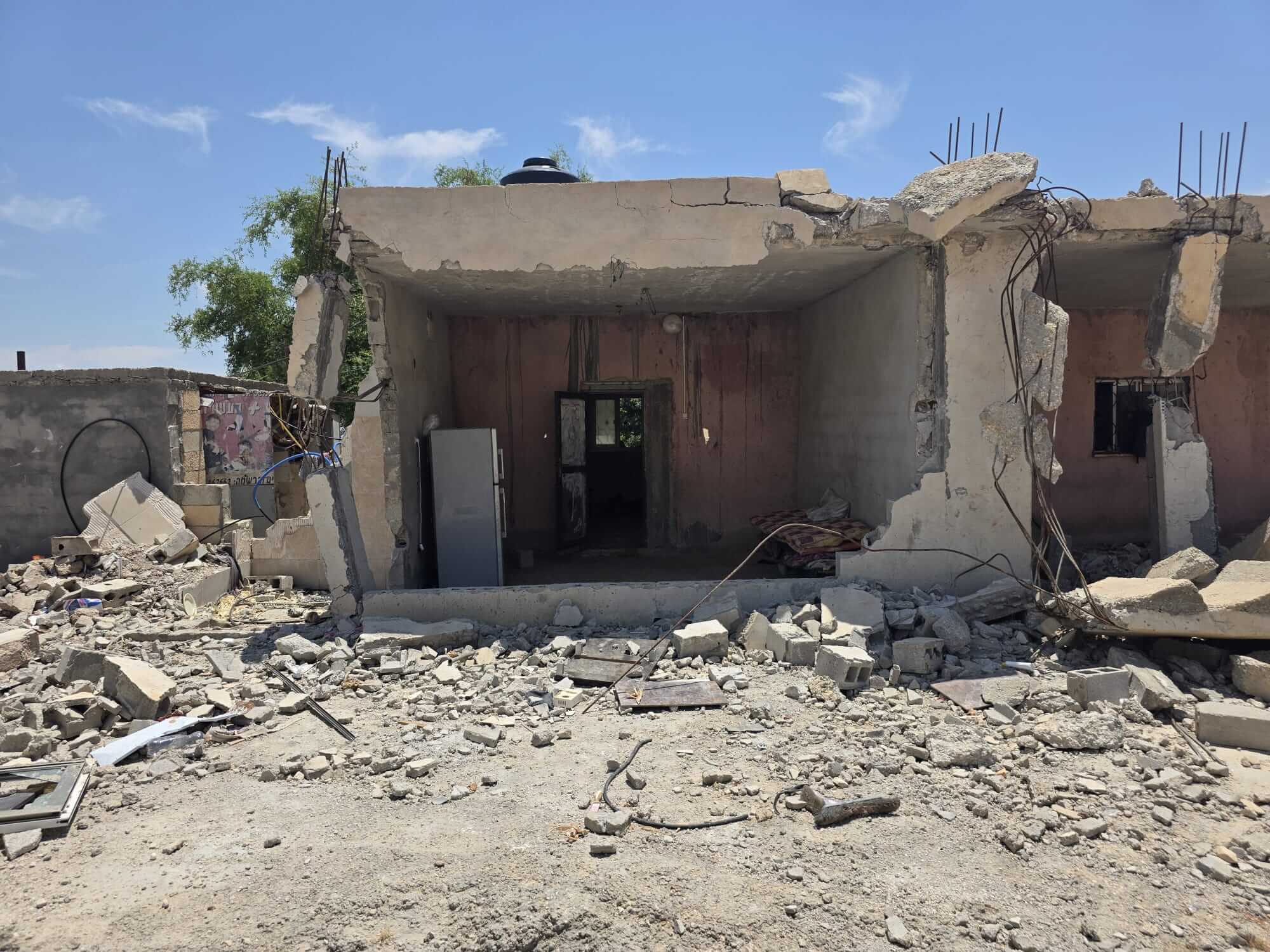
JERICHO, WEST BANK — Israel’s ultranationalist government and its backers are undertaking a major drive to develop and expand archeological sites in the occupied West Bank, with leaders stressing that it is incumbent upon Jewish citizens to connect to their history and heritage.
“He who doesn’t understand the importance of an archeological site for the preservation of the nation doesn’t understand where his future is going,” Israel Ganz, head of the Yesha Council representing more than 500,000 settlers, told the Forward in an interview on Sunday.
Funding to accelerate the push emerged in May, when the cabinet allocated 250 million shekels (approximately $86 million) to preserve, upgrade and make accessible heritage sites that show ancestral Jewish presence in Judea and Samaria — lands the settler movement contends Jews are entitled to claim.
Prime Minister Benjamin Netanyahu, linking the drive to Israel entering the 60th year since its victory in the Six Day War, told the cabinet that the funds are an investment “in preserving our past in order to secure our future, strengthen our hold on the Land of Israel and pass on to future generations the heritage, identity and historical truth of our people.”
But Palestinians and left-wing Israeli groups see this as not an innocent educational drive, but rather an intensification of efforts to displace Palestinians and annex the territory.
The archeology drive, reflected in robust budgeting and ambitious planning, including of new roads and wide expropriations of Palestinian land around sites, is moving ahead despite Netanyahu’s decision early this month not to advance a bill creating a separate antiquities authority for the West Bank, both supporters and opponents of the push say. That decision, reportedly to avert international diplomatic fallout, does not affect the allocation of funds. And Ganz notes the Judea and Samaria authority can still be created in the future.
“For sure now we are seeing the largest-scale effort ever to use archeology for annexation,” said Alon Arad, director of the organization Emek Shaveh, a left-wing group watchdogging the use of archeology by settlers as a tool for expansion. The momentum stems from plans made when the coalition took power in 2022 now coming to fruition, and a sense among right-wing parties that promoting Jewish heritage is a way to impress voters for upcoming elections, he added.
Whether this is in Israel’s interest or not is in the eye of the beholder. The flagship site of the archeology drive, the Hasmonean Palaces near Jericho, reflects all that is wrong with Israel’s harsh rule over Palestinians, critics say: settler violence, violation of international law, dispossession of helpless people and a hierarchy in which Israelis have all the rights and Palestinians none.
Digging as a tool
When the Forward visited the site recently, its most striking ruins were those of Palestinian Bedouin homes, 13 of which were destroyed by a settler bulldozer driver during a day-long raid on Feb. 10 by an estimated 50 settlers according to witnesses. Haaretz reported that at least 15 homes were destroyed.
Only 200 meters from the excavations, families are living inside the ruins of their homes. Among them is Ali Kaabnah, his wife Najiba and six children, staying in a house missing one side and with a large hole in the bedroom.
It is half a house, looking as if the driver had been interrupted in the middle of his task. Somehow a refrigerator survived, still plugged in.

“The house doesn’t have supports, it is without pillars. If there is a tremor it will collapse,” Kaabnah said. His and other families have no other place to go and remained even though settlers struck again in late April and last week warned him to leave, he said. “I do not sleep because we do shifts to see if settlers are coming,” he said.
Kaabnah said that he had repeatedly called Israeli police during the bulldozing raid but they did not come. The Israel police did not respond to an inquiry from the Forward about the incident.
Ali’s brother, Yusuf, said he had to be taken to hospital with head injuries during the first attack. and that settlers severely beat his wife, Shikha, 46, during the second attack, resulting in her being treated at a hospital in Nablus. His son Aliyan, 20, was “beaten with clubs without mercy” and his youngest son, 11-year-old Ali, was also attacked, he said: “Until now he screams at night in terror that ‘they are coming.’”

Arad views the settler violence as a state-backed method, along with demolition of homes on the grounds they were built without permits, to drive Palestinians away from the area of the site. The IDF denies siding with settlers and says troops are expected to detain Israeli citizens perpetrating violent acts.
Violence is not the only threatening aspect of the archeology uptick for Palestinians. Land expropriations around sites, which include swaths well beyond the antiquities themselves, are pulling the territory from underneath the Palestinians’ feet, critics say. In the last half year, there have been three land expropriations around sites, the largest at Sebastia in the northern West Bank; plans for roads on land seized from Palestinians to enable easier access, and forays by settlers to establish a presence or control of sites on Palestinian property.
Dror Etkes, a veteran monitor of Israeli policies in the West Bank, says the Sebastia expropriation — said by the government as intended to develop the site for visits by the public — includes the vast majority of the olive groves of the Palestinian village of Sebastia. Emek Shaveh says the expropriation separates the village from antiquities, breaking an ancient attachment central to the identity of locals and harming them economically.
“The goal of Israel’s colonial project is to dispossess and settle,” said Etkes, who heads the West Bank land monitoring group Kerem Navot. “Archeology provides an effective way of doing this.”
Ganz and Heritage Minister Amichai Eliyahu — who famously raised the idea in November 2023 of dropping a nuclear bomb on Gaza — are particularly enthusiastic about developing the Hasmonean palaces site. Harkening back to the days of Joshua, Eliyahu terms the Jericho vicinity “the gateway to the land of Israel.”
He does not appear to view the settler violence at the site as a problem. In a social media post released the day of the bulldozer raid, he declared that “in every place where there is building on Jewish heritage, we will destroy it.” Speaking from the site, he promised a mass infusion of funds to achieve the perceived revival of its past glory.
Claims of vandalism
At present the Hasmonean Palaces site looks unimpressive, lacking signage, explanations or a path. Only some of the antiquities are roped off. But Ganz describes the site as being on a par with Israel’s most important ones. “I can’t say what the breadth of the site is but it certainly doesn’t fall short of Masada,” Ganz said.
According to the IDF body dealing with civilian affairs in the West Bank, called the civil administration, the site is “of great importance to Jewish heritage as well as to the architecture of the early Roman period.”
“It was built as a winter palace for the Hasmoneans in the first century BCE and served the Hasmonean dynasty for approximately 200 years,” the civil administration wrote in a statement. Subsequently during the reign of Herod there was also significant construction including a fortified palace, a bridge and a sunken garden, it added.
Ganz says the site needs to be safeguarded from what he claims is deliberate and systematic destruction by the Palestinian Authority, which he alleges has targeted it and other sites in a bid to erase evidence of Jewish ties to the land. The Civil Administration statement also cited vandalism as a major problem, though it did not specify involvement of the Palestinian Authority.
Palestinian Authority assistant deputy minister of tourism and antiquities Jehad Yasin said in remarks to the Forward that allegations of PA culpability aim to enable Israel to take over West Bank sites. “We haven’t done that. We do our best to keep our sites and if someone does something it doesn’t mean you have the right to take this site,” he said.
Yasin stressed that for an occupying power to expand sites and carry out anything other than salvage excavations violates international law. Referring to the Israeli plans at the site near Jericho, he said: “They don’t have the right to make an archeological park or an excavation. It’s a Palestinian site.”
Arad agrees Hasmonean Palaces is an important site but stresses that this in no way justifies harming Palestinians.
Ganz’s vision for the site includes new excavations, touching up finds to preserve them and steps to “absorb the public.” A new access road is seen as essential for tourism, and he wants to see a convenience store along with state-of-the-art scanning capability enabling visitors to explore information about the site.
The land for the road has already been seized by military order from Palestinians, Etkes said, adding that when it is paved it will take less than a half hour to drive from Jerusalem to the site. What’s more, according to Etkes an illegal outpost overlooking the site and situated next to an army intelligence base is on the way to becoming a full-fledged settlement.
Arad says all of this amounts to Israel turning the site into a “touristic settlement,” something he stresses has been done previously on a large scale at the popular City of David site in occupied East Jerusalem.
“You change the identity so that from a village on the outskirts of Jericho it becomes a palace of a dynasty. You don’t need actual settlers there, it’s enough to build an access road, put up a fence and whatever comes with tourist development-a kiosk, a parking lot, someone to guard it.” Arad said.
The goal, in his view, is to woo the public to the settler view that the West Bank is part of Israel. “You start bringing in tourists and it’s a normalizing process for people to go inside the West Bank and return to Haifa or wherever they are from,” he said. “They go in and out and it was fun for them and you create the idea that this is part of Israel.”
As for the possibility of there being an Arab presence at the Hasmonean Palaces site, Ganz said: “If they don’t harm the site they will be allowed gladly. But if, God forbid, there are security incidents or harm to the site, then they can’t be there.”
Ganz stressed that the homes at the site needed to be destroyed for being illegally built, but that the demolition should have been done by the state and not what he depicted as a lone deviant. “No one is permitted to take the law into their own hands,” he said.
Etkes predicts that based on the experience of other sites, local Palestinians face an extremely bleak future. He termed the sight of Palestinians living in what is left of their houses “one of the worst things I have ever seen in the West Bank.”
But that is by no means the end of the harm Israel will cause to Palestinian civilians in the vicinity of the archeological site, he said. “We will see an area completely disconnected from its surroundings,” said Etkes. “Palestinians won’t be able to enter the area. Two roads [for Israelis] will lead to this area. Settlers will be very violent, it will be very restricted for the Palestinians, construction in the area [by Palestinians] will be completely banned, the construction that already exists is without a permit and a large part of it will be demolished by Israeli authorities.”
He declared: “It will be another national park that will tell one story — the story the Israeli radical right wants you to hear.”
The post Israel presses on with settler-fueled archaeology expansion, crippling Palestinian communities appeared first on The Forward.
