


Uncategorized
In the tunnels of Gaza, hostage Eli Sharabi found a way to be a blessing
In synagogue this past Yom Kippur, someone handed me a machzor with a bookplate that read: “Dedicated by [X] in memory of Rabba Sara Hurwitz and Josh Abraham on the birth of Natan.”
Thank God, my husband Josh and I are very much alive. Somehow “in honor of” was replaced by “in memory of.” But my son, Natan, has just turned 9 years old — so what better reminder could there be to pause and examine my life? To ask the big questions that Shmuel in the Gemara (Yoma 87b) insists that we ask in the waning hours of Yom Kippur during Neilah: Mah anu, what are we? Meh chayeinu, what are our lives?
These questions don’t end with Yom Kippur. They echo back to the very beginning of our story as a people, when God calls Avram in Genesis 12:2, to leave his home with the divine promise: “I will make your name great, and you shall be a blessing.” The structure of this verse, which will be read in most synagogues this Shabbat, is striking. God doesn’t say “I will bless you” (that comes in the previous verse). Here, God says something different: “You shall be a blessing.” Avrahram is not a passive recipient but an active agent. His very existence, his life itself, will be a source of blessing to others.
This is God’s answer to Shmuel’s questions: What are we? We are blessings. What are our lives? Our lives are meant to be a source of blessing to the world. How do we live lives that fulfill this divine mandate?
This year, I hold these questions alongside the words of Eli Sharabi, the first hostage to publish his account of captivity. To call his book “Hostage” merely an autobiography misses its essence. It is a sacred text about what it means to live in darkness and fear and still choose life, still choose to be a blessing.
In the tunnels of Gaza, stripped of everything, Eli was forced to answer Shmuel’s questions in the starkest terms imaginable: What am I? What is my life? You would expect the answer to be: I am nothing. My life is nothing. But instead, his answer reverberates with a fierce, almost defiant vitality: “I don’t want to survive just for them [his family]. I don’t want to live just for them. I want to live for myself too. For me, Eli Sharabi. I want to live. I love life. I crave it.”
If Eli, who lived for 491 days in constant hunger, dealing with the brutality of his captors, living in the filth of the tunnels, without knowing if his beloved family were alive or dead — if he can still crave life against all odds, then I too, even when I feel shrouded in darkness and fear will not take what I have for granted, and I will embrace life.
To be a blessing begins with recognizing the gift of simply being alive, of breathing freely, off walking down the street. When we crave life itself, we become capable of blessing others. Eli writes: “I want to breathe life, to walk free, to return to the open skies, to go back home, to work, to purpose…. To return to the roads, to driving, to walking down the street, to my simple regular worry-free day-to-day.”
Sadly, Eli was released to learn that his wife Lianne and daughters Noiya and Yahel were murdered on Oct. 7 and that his brother Yossi, too, had been abducted and then killed in captivity. This week, we watched as Eli and his family buried Yossi in Israel, at long last.
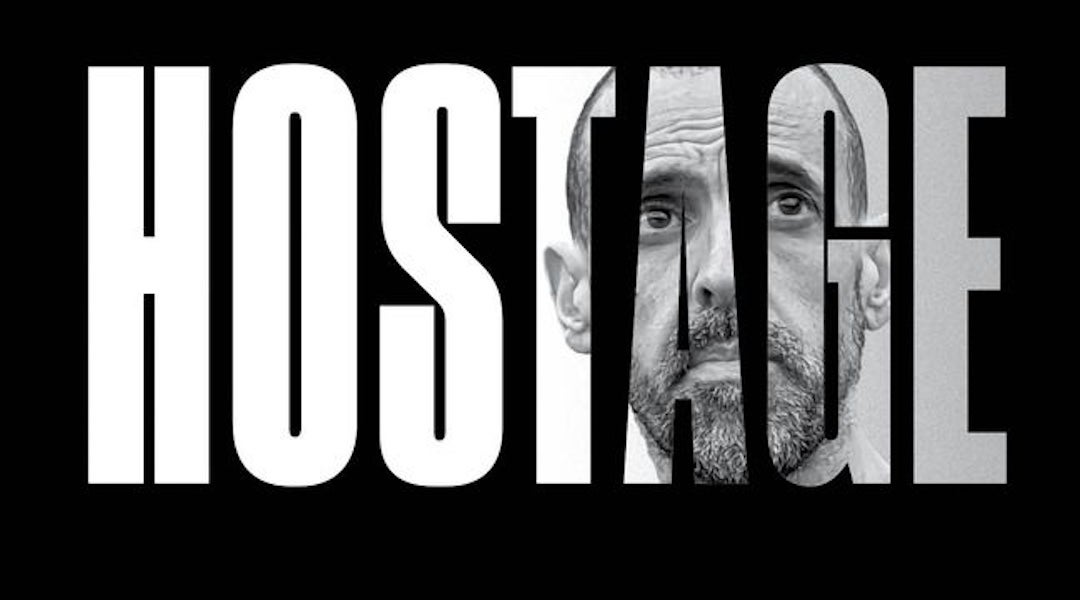
A detail of the cover of “Hostage,” Eli Sharabi’s memoir of his time in Hamas captivity. (Harper Influence)
Still, Eli’s testimony offers something even more profound about what it means to fulfill “and you shall be a blessing.” In absolute darkness, starving, and humiliated, he and his fellow hostages created a daily ritual to think of good things that happened to them each day and express gratitude — from sweet tea to a day without humiliation. In hell, they chose to find gratitude and see the tiny miniscule blessings in their lives. And in doing so, they became blessings to each other.
Hope was the hostages’ spiritual practice. Gratitude became resistance. Searching for good was an act of defiance against fear, and a way of being a blessing to those around them. In the tunnels of Gaza, Eli wasn’t just surviving, he was creating a practice of blessing. This is what God means when telling Avraham “and you shall be a blessing.” You don’t need to wait for perfect conditions. You don’t need to be free, comfortable, or secure.
As we move forward into a new year, Shmuel’s questions travel with me, now illuminated by God’s command to Avraham: Mah anu. What are we? We are called to be blessings. Like Eli, can we search for good even in difficulty? Can we be sources of hope and light for those around us, even when we ourselves are struggling?
Meh chayeinu. What are our lives? God tells Avraham that his life will be a blessing. What about ours? Do we only celebrate the extraordinary moments, or can we embrace the mundane — like walking down the street, breathing, being free to be at home with our loved ones? This is the wisdom of someone who faced death and chose, deliberately, consciously, to love life and to be a blessing, not despite the darkness, but in the darkness.
This year, I will hold Eli’s courage and search for good even when it’s hard to find. I will strive to make hope and gratitude a daily practice. I will try to fulfill “and you shall be a blessing” — to raise up those around me, in big ways and small.
—
The post In the tunnels of Gaza, hostage Eli Sharabi found a way to be a blessing appeared first on Jewish Telegraphic Agency.
Uncategorized
Recorded anti-Jewish hate crimes rise 10% in England and Wales
(JTA) — Hate crimes targeting Jewish people in England and Wales rose by 10% in the year ended in March, according to the latest data released by the British government.
Police-reported hate crime — including crime influenced by other factors such as race and sexual orientation — overall increased by 7% compared with the previous year, according to the Home Office data released last week.
British Foreign Secretary Ed Miliband posted on X on Monday, “Antisemitism has no place in our society. This morning, I hosted a crucial discussion with the J7 Global Task Force to discuss how we can work together across countries to stamp out the scourge of antisemitism.”
Following the meeting, the Board of Deputies of British Jews issued a statement explaining that Miliband and the task force had discussed, among other things, “the sharp rise in global antisemitism” and the “continued demonisation of Israel.” Representatives from the U.K., the U.S., Canada, Germany, France, Argentina and Australia make up the task force.
“In the meeting, the J7 proposed a new international intergovernmental ministerial task force on antisemitism, comprising the countries represented in the J7 and taking on the key themes discussed. We were pleased that the Foreign Secretary agreed to host an inaugural meeting of J7 countries’ ministers to start this process,” the statement sent to JTA said.
The Community Security Trust, a charity that protects the Jewish community and monitors antisemitism, said on X that the new data show “that antisemitic hate crime remains at an unacceptably high level.”
“As seen previously, Jewish people continue to experience by far the highest police-recorded rate per head of religious hate crime of any faith group,” CST said. “This shows the disproportionate scale of anti-Jewish hatred and its impact on Jewish life in Britain.”
Religious hate crime rose by 13% overall in the 12 months to March 2026, the report said. The overall figure rose from 10,067 to 11,419 offenses.
The two groups most affected were Jews and Muslims, the Home Office said. Religiously motivated hate crimes against Muslims increased 15%, the report found, with spikes reported around public protests in September 2025 and the start of the U.S. war with Iran in February.
The number of recorded offenses affecting Jews rose from 2,874 to 3,162 offenses, spiking after the attack on Heaton Park synagogue in Manchester last year on Yom Kippur.
Two men, Melvin Cravitz and Adrian Daulby, were killed on Oct. 2, 2025, after Jihad Al-Shamie, who was wearing a fake suicide bomb belt, drove into the gates of Heaton Park synagogue and began attacking congregants with a knife. Cravitz died from stab wounds; Daulby was fatally struck by a police bullet during the response.
A spate of violent antisemitic incidents followed this year, including the torching of four ambulances belonging to Jewish volunteer service Hatzola on March 23 and the stabbing of two Jewish men in separate attacks in Golders Green on April 29.
The Home Office figures, which do not include data from London’s Metropolitan Police Service because of a change in how it records crime, showed the second-highest level of religious hate crime directed at the Jewish community since the Home Office began keeping records in 2018. It was surpassed only by the year ending March 2024.
“In the last year, there were 117 police recorded religious hate crimes targeted at Jewish people per 10,000 population, the highest rate for any religious group. The next highest rate was for religious hate crimes targeted at Muslims, with 13 per 10,000 population,” said the Home Office.
The report was published on Oct. 8, at a time of heightened sensitivity. Eleven people were arrested at pro-Palestinian marches in London a day earlier, despite calls by the Metropolitan Police to avoid demonstrating on the anniversary of Hamas’ deadly 2023 raids inside Israel.
Police reported 20 arrests at Saturday’s pro-Palestinian protest in London, where many demonstrators were wearing kaffiyehs, waving Palestinian flags and brandishing banners.
The level of hate directed at the Jewish community has remained at an “elevated level” since the beginning of the Israel-Hamas conflict, the report stated.
The CST said, “There is an urgent need to reduce the amount of incitement connected to conflict overseas,” adding that “much more needs to be done across society to tackle this problem.”
Over the summer the government announced a major funding boost to support the Jewish community, promising £250 million ($335 million) over the next three years for increased policing and protection of Jewish communities.
More remains to be done, according to community organizations.
A spokesperson for the Board of Deputies of British Jews said the report’s publication “confirms the need for rigorous prosecution to ensure deterrence, and a whole of society approach to tackling hatred and extremism, and to stopping conflict in the Middle East being used to incite hatred against the Jewish community.”
The Campaign Against Antisemitism said the report was evidence that the British justice system was failing the Jewish community.
“Antisemites, emboldened by the Hamas terrorist atrocity three years ago, are not only not letting up in their hatred but are doubling down,” it said in a statement. “That’s because there is no real deterrent. So really these figures are most damning for the criminal justice system, which has utterly failed to defend British Jews.
“Even as conflict in the Middle East is easing off, antisemitism in the U.K. is rising, yet there have been essentially no changes in policing policy over the past three years and nobody has been held to account for this monumental failure,” the campaign said.
This article originally appeared on JTA.org.
The post Recorded anti-Jewish hate crimes rise 10% in England and Wales appeared first on The Forward.
Uncategorized
Hasan Piker criticizes ‘opportunists’ who accused Mamdani of genocide
(JTA) — Hasan Piker called the protesters who jeered New York Mayor Zohran Mamdani at an Oct. 7 vigil last week “opportunists,” who “tarnished” the anti-Zionist movement’s message.
Piker, the popular streamer who has campaigned for a number of democratic socialist candidates, made his remarks Sunday at Jewish Currents Live, an all-day event hosted by the left-wing magazine at the Brooklyn Academy of Music.
Speaking on a panel titled “Can the Left Wield Power?”, he said that the protesters had “valid concerns,” including demands like firing police commissioner Jessica Tisch and disbanding the NYPD’s Strategic Response Group, a heavily armed unit that often responds to protests.
But he criticized the Democratic Socialists of America — the left-wing political organization that Mamdani has called his “political home” — for not playing a bigger role in last week’s protest, which started at City Hall and later overran an Israeli peace vigil. DSA did not sponsor the protest, though some campus chapters of its student section, the Young DSA, participated.
“The DSA not being at the forefront of the anti-Zionist mobilization in New York City is what allowed that mobilization to be tarnished by opportunists, sectarians and those who actually were calling him a genocidaire — which I obviously find to be ridiculous,” Piker said, referring to protesters’ chants of “Mayor Mamdani you can’t hide, we charge you with genocide.”
Piker, who has drawn heat for his anti-Israel views, did not comment on the Hamas iconography displayed by numerous protesters, nor the decision to crash an Oct. 7 vigil that memorialized the 1,200 people killed in the Hamas-led attacks on that date in 2023, and the 74,000 Palestinians who have been killed since then, according to Gaza health ministry figures, which do not distinguish civilians from combatants.
Separately, Mahmoud Khalil, the Columbia University pro-Palestinian protest leader who was detained by ICE last year, reportedly criticized those protesters’ “purity politics” during an event in Washington, D.C.
“You don’t have to agree with someone 100 percent — 85 percent is good,” he said, provided that the end goal is “liberating Palestine and ending the unconditional support of the United States.”
Where should Democrats draw the line?
Two Democratic congressional nominees from New York, Brad Lander and Darializa Avila Chevalier, appeared on a separate panel focused on Israel and the Democratic Party.
Lander is Jewish and Darializa Avila Chevalier helped lead Columbia University’s pro-Palestinian encampment in 2024. Peter Beinart, editor-at-large at Jewish Currents, moderated the panel, which also featured Georgia state Rep. Ruwa Romman, the first Palestinian American elected to public office in her state.
Their discussion exposed some of the gaps between Lander and Avila Chevalier, both progressives who were endorsed by Mamdani this year and who appeared in a campaign ad together alongside fellow Mamdani endorsee Claire Valdez.
Beinart asked where Democrats should draw the line on what is considered legitimate Palestinian resistance. He pointed to the pro-Palestinian protest held in New York City on Oct. 8, 2023, which Avila Chevalier attended and Lander called “abominable” at the time.
“I think international law has already drawn that line,” Avila Chevalier said, arguing that U.S. protests should target Israel, which receives U.S. support, rather than Hamas.
“We could be the biggest anti-Hamas protesters, but a protest against Hamas in the U.S. isn’t going to do anything,” Avila Chevalier said. “Because we don’t fund it. We don’t have any structural power over it, there is nothing tying us to that institution other than condemning it endlessly.”
After the event, Lander did not confirm to the Jewish Telegraphic Agency whether he had spoken about that Oct. 8 protest with Avila Chevalier.
“We have talked about these issues broadly in private, and I don’t want to characterize those conversations,” Lander told JTA. “And obviously I’ve made my feelings known in public, and I stand by them. I mean, on that day, I was in mourning.”
An attendee named Mark, 29, who declined to share his last name to avoid potential workplace complications, said he felt that Avila Chevalier “didn’t really acknowledge the criticism about perhaps disregarding loss of life; despite the power imbalance, it is lost life.”
For Lander, meanwhile, Mark said it was “politically expedient” for him to not directly address Avila Chevalier’s presence at the 2023 protest. “This is a super lefty crowd that probably would eat him alive if he went against her right now,” he said.
During the panel, Avila Chevalier repeated her call for an arms embargo against Israel while Lander stopped short of doing so, consistent with his statements in the past that Israel should be able to buy defensive ware. Both said Congress must pass the Block the Bombs Act and vote to suspend the sale of offensive U.S. military weapons to Israel. Lander was the only speaker on stage who advocated for a two-state solution in the region.
Beinart asked Romman about Jon Ossoff, the Jewish Democratic senator running for reelection in her state, and how she views his stance on Palestine. She said she was pleased that both Georgia senators have been consistently voting in favor of Bernie Sanders’ resolution to block arms sales to Israel, but added that “in terms of leading, in terms of rhetoric, there’s still a lot of work to be done.”
“We’ll get everyone to where we need them to be eventually,” she said.
‘The bund is back in town’
The Jewish Labor Bund — the early 20th-century socialist movement that fought against Bolshevism, Nazism and Zionism — came up at numerous points on Sunday. One attendee doled out fliers with a website URL and the message, “Tell your bubbe the bund is back in town.” It was also a subject of a conversation that featured Molly Crabapple, whose 2026 book “Here Where We Live is Our Country” focuses on the Bund.
Arlene Geiger, an Upper West Sider and longtime activist, told JTA that she related to those conversations.
“My connection to Judaism is not to Israel, it never has been. It’s more to Eastern Europe and the Bund, so that spoke to me,” Geiger said.
Mark, who is from New Jersey, said he doesn’t come from a “staunchly pro-Zionist” family, but that he has a new interest in leftist Jewish spaces since realizing that he could no longer comfortably distance himself from the issue of Israel, which he believes is committing a genocide.
“It’s just an education for me to be immersed in this kind of space,” he said.
This article originally appeared on JTA.org.
The post Hasan Piker criticizes ‘opportunists’ who accused Mamdani of genocide appeared first on The Forward.
Uncategorized
In Israel, boy killed, hikers injured, after suspected Hezbollah cluster bomb detonates
(JTA) — An explosion during a school hiking trip killed a boy about 14 years old on Monday and injured 24 others in northern Israel, Magen David Adom, Israel’s emergency medical service, said.
Rescue teams were dispatched to the scene, and the injured were evacuated to hospitals in northern Israel.
“An initial investigation by IDF forces at the site indicates that it was likely a cluster bomb belonging to the Hezbollah terror organization that had been left in the area and exploded,” the military said in a statement.
“The injured were scattered along the route, some trying to help their wounded friends,” explained David Radko, an MDA medic who said he was the first to arrive on the scene. “Despite the horrific scenes and distress, the injured cooperated with me exceptionally well. Everyone tried to help their friends as much as they could. Some even applied tourniquets to their friends to stop the bleeding.”
Police Commissioner Danny Levy visited the scene and said authorities may ban similar school trips in the near future. “We need to examine whether we are putting students at risk by allowing them to go on these trips,” he said.
Tamir Douadi, a resident of Kibbutz Manara, described the scene in a voice cracking with emotion to Channel 12: “Look, they’re young people, children. You see them sitting there like that, holding their friends.”
The object exploded “in the hands” of one of the schoolchildren, Comm. Meir Eliyahu, commander of the Israel Police’s Northern District told reporters at the scene.
Orly Ben Simon, an MDA paramedic, said personnel identified several people with injuries of varying severity, including a 14-year-old boy who was unconscious and in critical condition. “We immediately began prolonged and intensive resuscitation efforts. Unfortunately, his injuries were critical, and we had to pronounce him dead at the scene,” she said in a statement provided by the MDA.
She added that medical teams treated two teenagers who were seriously injured, as well as other injured people who were able to walk.
In an initial statement, the Ma’alot-Tarshiha municipality said the explosion occurred during an annual hiking trip by students from the ORT Ma’alot religious high school, located in the mixed Jewish-Arab town, about five miles from the Lebanese border. The entire area has come under heavy fire from Hezbollah since Oct. 7, 2023, and some of the munitions have failed to detonate.
MDA said the injured included 22 teenagers and two adults in their 50s. Two of the injured were in serious condition and 10 were in moderate condition. They were evacuated by ambulance and helicopter to hospitals in Haifa, Safed and Nahariya.
Israel’s Education Ministry described the incident as “extremely serious.” According to the ministry, the trip was properly approved in accordance with established procedures. Ma’alot-Tarshiha Mayor Moti Ben David told Israeli media that the route was a popular hiking trail.
This article originally appeared on JTA.org.
The post In Israel, boy killed, hikers injured, after suspected Hezbollah cluster bomb detonates appeared first on The Forward.
