


Uncategorized
Afghanistan and Pakistan Exchange Fire as Peace Talks Begin

People inspect houses and vehicles destroyed during an airstrike, following a temporary ceasefire, amid the conflict between Afghanistan and Pakistan, in Spin Boldak district of Kandahar Province, Afghanistan, Oct. 16, 2025. Photo: REUTERS/Stringer
Afghan and Pakistani troops briefly exchanged fire along their shared border on Thursday, both nations said, on the same day talks to find a lasting peace restarted in Istanbul.
Each nation blamed the other for starting the exchange of gunfire near Spin Boldak, an Afghan border town towards the south of their 2,600-km (1,600-mile) frontier.
There were no reports of casualties, and spokespeople for both sides said they remained committed to a ceasefire and continued dialogue in Istanbul.
Militaries from the South Asian neighbors previously clashed last month, with dozens killed in the worst such violence since the Taliban returned to power in Kabul in 2021.
Both sides signed a ceasefire in Doha on Oct. 19, but a second round of negotiations in Istanbul last week ended without a long-term deal, due to a disagreement over militant groups hostile to Pakistan operating inside Afghanistan.
“We hope that wisdom prevails and peace is restored in the region,” Pakistan‘s Defense Minister Khawaja Asif told reporters on Wednesday.
He said Islamabad was pursuing a “one-point agenda” of convincing Afghanistan to rein in militants attacking Pakistani forces across their shared border, allegedly with the Taliban’s knowledge.
Two government sources said the head of Pakistan‘s military intelligence wing, Asim Malik, was leading the Pakistani delegation.
The Afghan delegation is led by intelligence chief Abdul Haq Wasiq, Taliban spokesperson Zabihullah Mujahid told state broadcaster RTA.
TALKS AIMED AT PREVENTING REPEAT OF VIOLENCE
Pakistan and the Taliban had for decades enjoyed warm ties, but relations have deteriorated sharply in recent years.
Islamabad accuses the Taliban of harboring the Pakistani Taliban, a separate militant group that has clashed repeatedly with the Pakistani military. Kabul denies this, saying it has no control over the group.
The October clashes began after Pakistani airstrikes earlier in the month on Kabul, the Afghan capital, among other locations, targeting the head of the Pakistani Taliban.
The Afghan Taliban administration responded with attacks on Pakistani military posts along the length of the border, which remains closed to trade.
While the ceasefire between the two nations’ militaries had held until Thursday’s exchanges, clashes have continued between the Pakistani military and the Pakistani Taliban throughout the period, with multiple deaths reported on both sides.
Uncategorized
All Jewish eyes are on Michigan as heated El-Sayed-Rogers Senate campaign draws to a close
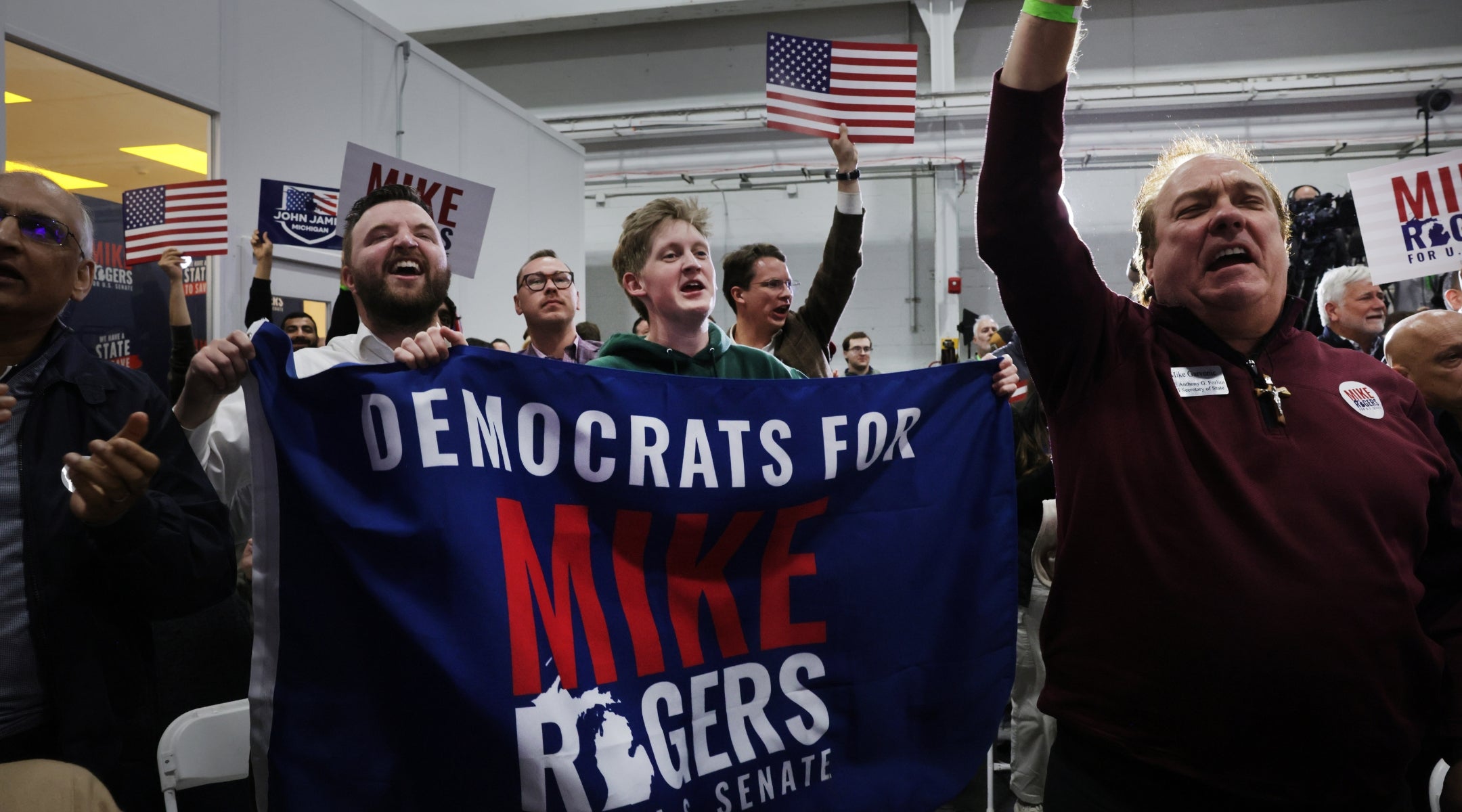
(JTA) — DETROIT – The U.S. Senate race in Michigan, a deeply contentious contest that has strained Jewish relationships with the Democratic Party, drew to a bitter close Tuesday as voters headed to the polls in a race that could shape which party controls the chamber.
At its center is Abdul El-Sayed, the former county health director and Democratic nominee whose anti-corporate, Medicare For All candidacy has become a rallying cry for the national progressive movement.
His uncompromising stances on Israel have also made him a target among pro-Israel groups, including AIPAC, which has spent heavily against him in both the primary and general election. AIPAC’s rare entry into a general election race came to support El-Sayed’s opponent, Republican former congressman Mike Rogers.
One of El-Sayed’s positions on Israel — to end all U.S. military aid — was once thought a far-left pipe dream. But that has changed. On Election Day morning, Trump announced that, under his watch, nearly $4 billion in annual U.S. military aid to Israel would wind down by the end of the year. Trump said Israeli Prime Minister Benjamin Netanyahu was in agreement with the need to end aid and deny Democratic critics a point of attack.
In his announcement of the plan, Trump cited El-Sayed.
“Why should we suffer the slings like lunatics like an El-Sayed when they don’t need it?” Trump said on Fox News, referring to Israel’s financial strength.
Representatives for the El-Sayed and Rogers campaigns, and for the Republican Jewish Coalition, did not immediately return requests for comment on Trump’s new pledge. It is unclear whether it will be straightforward for the White House to halt the funding by the end of 2026, given that the existing memorandum of understanding that governs it extends to 2028.
El-Sayed’s campaign has galvanized young voters and a range of other constituencies, and he pulled ahead in the polls in the race’s final stretch. But his questioning of Israel’s existence as a Jewish state and whether it or Iran posed a greater threat to the United States, as well as his prior associations with figures such as Hasan Piker, the streamer who has spread extreme rhetoric about American Jews, have sparked concern among Jewish Michiganders.
So, too, did comments the candidate made following the March terror attack on Temple Israel, a major synagogue in the state, in which El-Sayed appeared to link the attack to Israel’s war in Lebanon after reports that the attacker lost family in an Israeli strike. Hostile behavior from some of El-Sayed’s supporters toward pro-Israel Democrats, most prominently on display at the state party’s spring convention, have also alarmed Jews. El-Sayed has pledged to stand up to antisemitism.
Some Jews who had long considered themselves Democrats, including several local Jewish leaders, have cited such controversies in pledging to vote for Rogers. In some Michigan Jewish neighborhoods, yard signs proclaim that a vote for Rogers is a vote “against antisemitism.”

Accordingly, Rogers has made a play for the Jewish vote. He told the Jewish Telegraphic Agency in October that his opponent is “anti-Jew,” while running ads that played up El-Sayed’s tenuous family associations with the Muslim Brotherhood.
Top Republicans have seized on the narrative, with President Donald Trump calling Jews “crazy” if they back El-Sayed, and Texas Sen. Ted Cruz calling him a national security threat. A Trump administration event to address antisemitism was held at a Michigan synagogue weeks before the election, though El-Sayed’s name was not mentioned there.
Jewish Democrats who had broken with El-Sayed found major validation in the race’s dramatic closing days. Democrat Haley Stevens, a strongly pro-Israel congresswoman who had narrowly lost to El-Sayed in the primary, flipped sides to endorse Rogers days after her Jewish fiancé, a Democratic megadonor, did the same.
The surprise move, which Jewish Democratic leaders joined many other prominent Democrats in criticizing, came after days of back-and-forth between Stevens and El-Sayed as she sought to publicly pressure him to condemn a PAC ad that had linked rising grocery prices to U.S. aid to Israel.
Meanwhile, some prominent Jewish Democrats in the state either avoided endorsing El-Sayed or did so with heavy reservations. Michigan’s Jewish Democratic Caucus, whose leadership has been deeply divided on El-Sayed, issued a statement Monday declaring the caucus would never vote for a Republican.
“Our commitment to the Democratic ticket remains resolute as we work to build a more inclusive coalition,” the caucus stated.

Throughout the campaign, El-Sayed has sought to reassure Jewish voters. He apologized for his Temple Israel comments; distanced himself from Piker; hired a Jewish outreach director; said in a recent “60 Minutes” interview that Israel has a right to exist; and sent mailers to Jewish households stating, “I am committed to protecting all Michigan Jews against hatred and injustice.” He told JTA in August that “the prerequisite of Jewish safety is never in question to me.”
More than 1,000 Michigan Jews have signed an open letter pledging to vote for El-Sayed, compared to 560 who have done the same for Rogers. Progressive Jewish figures of note have held salons throughout the state in a bid to convince on-the-fence Jews to back him.
Yet El-Sayed also has continued to stake out positions many Jews find alienating. He asserted in the campaign’s closing weeks that Israel was “not actually our friend” and declined during a debate to say whether Israel or Iran was the bigger danger to the U.S. His campaign also released an ad, designed to appeal to conservatives, that featured a brief clip of Tucker Carlson, the right-wing pundit who has promoted conspiracy theories about Israel. In addition, El-Sayed’s careful sidestepping of objectionable material about Jews and Israel from his ostensible allies, such as Piker and his uncle, left-wing anti-Israel pundit Cenk Uygur, has continued up to Election Day.
Ahead of Election Day, some liberal-leaning Zionist Jews tried to put pressure on El-Sayed to speak more directly to their concerns. A group of rabbis and other Jewish leaders launched Nonnegotiable Michigan in a bid to have him affirm what they called five core principles of Jewish participation in the Democratic Party, including “Jewish sovereignty in Israel.” After silence from the campaign, some of Nonnegotiable’s figureheads urged their followers to write in the 19th-century Jewish poet “Emma Lazarus” instead of voting for either candidate.
Michigan’s already small Jewish population, which numbers around 105,000 adults, has further splintered over El-Sayed’s candidacy. But it could prove pivotal to the outcome of a race that may determine control of the chamber. In 2024, the state’s Senate race was decided by fewer than 20,000 votes.
Either way, the race has crystallized the Democratic Party’s shifting fault lines over Israel — and many Jews’ growing uneasiness with their place in the liberal coalition.
This article originally appeared on JTA.org.
The post All Jewish eyes are on Michigan as heated El-Sayed-Rogers Senate campaign draws to a close appeared first on The Forward.
Uncategorized
Trump says US aid to Israel will stop at end of year
(JTA) — President Donald Trump on Tuesday morning said that the United States would halt billions of dollars in annual aid to Israel by the end of 2026, potentially ending decades of military support for one of America’s closest allies in the Middle East.
“We were giving them $4 billion. We are. But it gets cut off at the end of the year,” Trump declared during a call-in appearance on the “Fox & Friends” morning program on Fox News. Israel’s 10-year memorandum of understanding with the United States, which currently gives Israel $3.8 billion annually, runs through 2028 so it’s unclear how easy it would be for the White House to stop the funding this year.
Referencing Israeli Prime Minister Benjamin Netanyahu’s statement in January that he wanted to taper off aid to zero at some point in the future, Trump questioned why Republicans should have to deal with criticism from hardline pro-Palestinian Democrats like Michigan Democratic Senate candidate Abdul El-Sayed when “we give them more than anybody else and they no longer need it.”
“It’s a bad talking point,” he added. His comments came as Americans across the country are voting Tuesday in midterm elections that will determine control of the U.S. House and Senate.
“We reached an agreement on that” and Netanyahu “brought it up,” Trump continued. “He said: ‘I think it would be appropriate if we do not receive aid,’ because he understands that this is one of their points of contention.”
A growing number of Democratic congressional candidates across the United States have campaigned on a platform of reducing or halting military aid to Israel during the run-up to today’s midterm elections. This April, dozens of senators — almost all of them Democrats — voted in favor of a failed motion to block the sales of certain weapons to Israel.
Yair Golan, chairman of Israel’s liberal Democrats party, slammed Netanyahu in the wake of Trump’s statement, tweeting that “precisely at a time when Israel’s defense spending has reached enormous proportions, when Israel needs to replenish its offensive weapons stockpiles, and after air defense capabilities have been depleted following such a long war—Netanyahu logs another massive failure under his name.”
“The cessation of U.S. aid is heavy damage to Israel’s security” and “a responsible prime minister would have fought to increase American aid, not eliminate it,” added Golan, whose party opposes Netanyahu’s and is trying to form a coalition to oust Netanyahu from power following Israel’s own elections last Tuesday.
This article originally appeared on JTA.org.
The post Trump says US aid to Israel will stop at end of year appeared first on The Forward.
Uncategorized
A ‘unique 20th Century Israelite’ who always made sure we got it right
It’s fitting that I first met Rabbi Capers Funnye in a television studio. And it should surprise no one that the topic that brought us together — by no means accidentally — was a discussion about Black Jews.
We never stopped talking about it. And making sure others got it right.
The spiritual leader for decades of Chicago’s Beth Shalom B’nai Zaken Ethiopian Hebrew Congregation and since 2016 the Chief Rabbi of the International Israelite Board of Rabbis, Funnye died Nov. 2 at 74.
Our friendship spanned decades, beginning before we co-founded the Alliance of Black Jews with Michelle Stein-Evers Frankl in 1995. With Stein-Evers, then in Los Angeles, and me in Boston, the organization brought together Jews of African descent from around the country to celebrate our dual affiliations as normative.
Although the organization did not last beyond its early years, it spawned numerous other groups that exist today. Most significantly, it mainstreamed the fact that Blackness and Judaism are not mutually exclusive.
That’s the message we had been imparting five years earlier, on the Black Entertainment Television show Our Voices in 1990. Having filed a story mentioning Black Jews while a reporter for BET’s news division, I was asked by the network to co-produce a special on the subject. In addition to me, they asked who else should appear.
“There’s a rabbi in Chicago,” I said unhesitatingly, though I had yet to meet him, “and the police chief in Charleston, South Carolina” — Reuben Greenberg, who passed away in 2014.

Each of us came to Judaism differently: me, the child of a non-Jewish African-American father and non-Black Jewish mother; Greenberg, via conversion first through Reform, then Conservative Judaism (and also “reversion” in that he was reaching back to the religion of his grandfather), and Funnye, who had been Methodist before joining the Ethiopian Hebrew denomination (of African Americans, not Ethiopians) and later underwent a Conservative conversion.
Although his smicha was granted by the Ethiopian Hebrew group (now more broadly termed Israelite) and not by the Conservative body, he was invited to join the Chicago Board of Rabbis as its first African American member in 1997.
His dual affiliations as both Conservative and Israelite — and indeed, that of his largely Black and increasingly Hispanic Chicago shul, which also had merged with an aging Ashkenazi congregation — allowed him to serve as a bridge between many strains of Judaic practices.
“He accomplished what he wanted,” said Rabbi Baruch A. Yehudah of Congregation B’nai Adath Kol Beth Yisrael in New York. “He wanted to be a bridge builder and he built many — into the Ethiopian community, the Nigerian community, South Africa, Ghana, Uganda. He was the first one of us to be on a mainstream board of rabbis.”
“I loved him,” Yehudah added. “He wasn’t just my boss.”
Bruce Haynes, author of The Soul of Judaism, called Funnye “the most unique 21st Century Israelite” because of his role as chief rabbi. “To my knowledge, that (position) was the first of its kind. It elevated him institutionally as the premiere figure among modern-day Hebrew Israelites.”
Yet that outreach went beyond the bima. “Having chosen to move his whole family toward Conservative Judaism was an important step in cementing a personal relationship between Israelite congregations and rabbinic Judaism,” Haynes said.
Rabbi Tamar Manasseh, a protégé of Funnye who in 2021 became the first woman ordained by the Israelite body, said Funnye was “doing the whole bridge thing before anybody knew that they wanted a bridge.
“There were Black Jews who didn’t like that. There were white Jews who didn’t like that, either. It was uncomfortable for everybody until it wasn’t uncomfortable for anybody.”
She praised him for enduring “all of the stuff he had to go through to get us to a point where I can complain about things now, which is remarkable.”
I too find it difficult to separate the personal from the bridge-building. In addition to our numerous Black Jewish campaigns and initiatives — we literally traveled the world together, from Chicago to Boston to San Francisco to Uganda — he served as the rabbi for my mother’s funeral and my daughter’s wedding.
In my ever-diverse family, both were examples of bridge-building in their own right. During the wedding, my now son-in-law, whose native language is Russian, recited the line “I concentrate you to me as my wife,” prompting Funnye to break from the prepared liturgy to correct him.
“No, no. Consecrate. We gotta get this right.”
“I consecrate you to me as my wife,” the groom said, appreciative of the gentle but authoritative guidance.
Because Capers made sure to get it right.
The post A ‘unique 20th Century Israelite’ who always made sure we got it right appeared first on The Forward.
