


Uncategorized
On final visit to Israel as mayor, Adams makes a closing argument against Mamdani
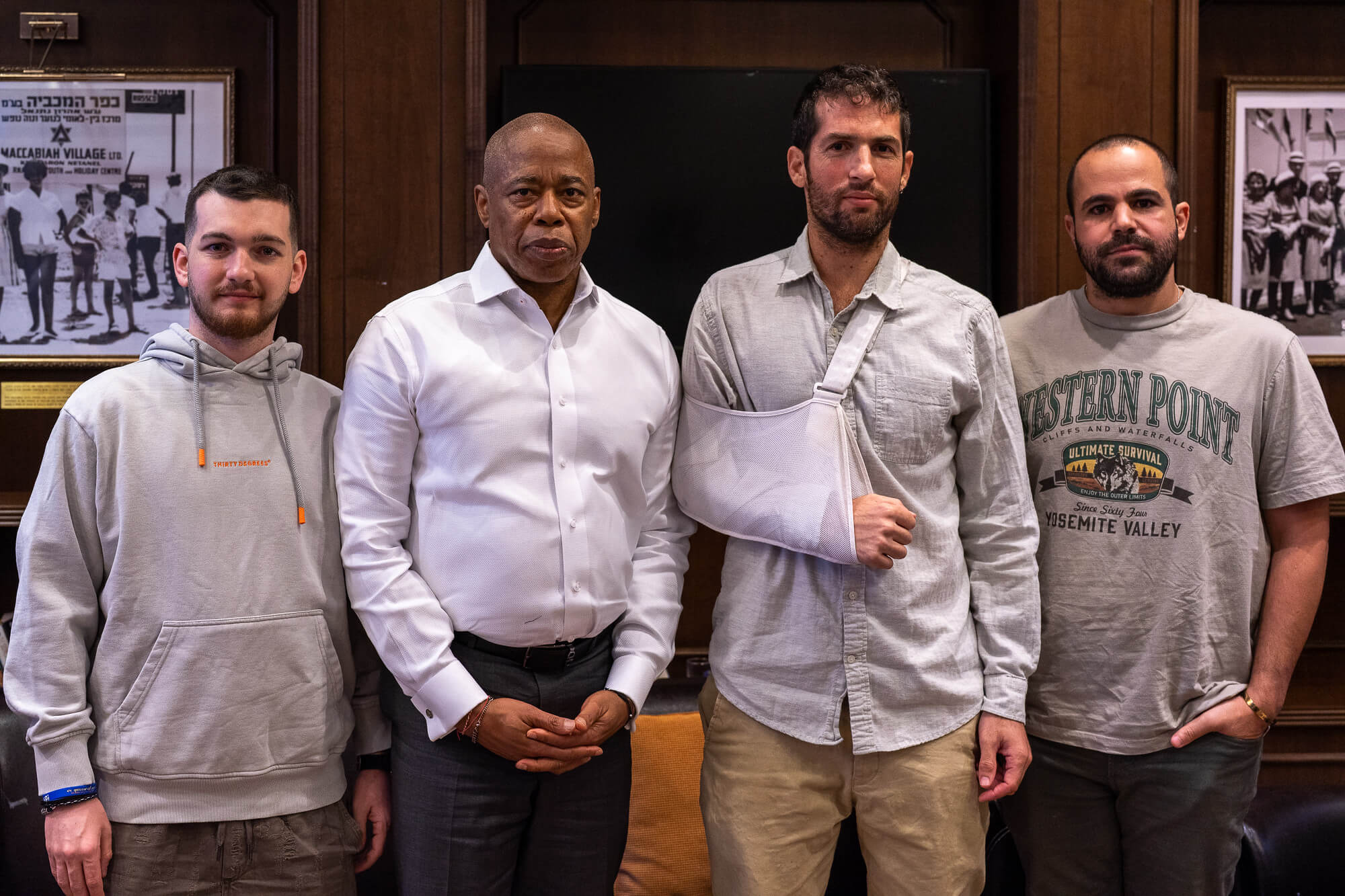
JERUSALEM — Outgoing New York City Mayor Eric Adams embarked on a multi-day swing through Israel, billed as both a show of solidarity amid rising antisemitism and a farewell visit. But it was also something else: likely the last international trip a New York City mayor will take for years, a point Adams wanted to underscore.
Mayor-elect Zohran Mamdani, a strident critic of Israel, has pledged not to visit the country, breaking with a tradition upheld by every mayor since 1951 to demonstrate solidarity with Jewish constituents at home. He has also vowed to end the city’s decades-long practice of investing millions in Israeli government debt securities and has said he would order the arrest of Prime Minister Benjamin Netanyahu if he lands in New York.
“I think he has to have the level of political maturity to understand that government is not protesting,” Adams said in a fireside chat at an event hosted in his honor by the Combat Antisemitism Movement (CAM) in Tel Aviv on Sunday evening. “And all those who are in his midst, like the Democratic Socialists of America, he needs to explain to them that he’s now the mayor. He’s no longer someone that is just protesting in the city of New York. He has to protect the city of New York.”
In the 30-minute conversation, moderated by Sacha Roytman, chief executive of CAM, Adams repeatedly alluded to the impact of Mamdani’s political rise and victory in the mayoral election earlier this month. The outgoing mayor said he told his team a year ago that Mamdani was on track to win the Democratic primary and that he expected to face him in a general election showdown, believing he could beat him.
Adams made combating antisemitism central to his reelection effort. Elected as a Democrat in 2021, he later lost key support after striking a deal with the Trump administration to drop his corruption case, prompting him to run for a second term on an independent line dubbed “End Antisemitism.” He became popular in Israel after delivering a forceful speech at a New York City rally in the days following the Oct. 7, 2023 Hamas attack on Israel, in which he declared, “We are not alright.” He also resisted progressive pressure to distance himself from Israel and faced backlash for his crackdown on pro-Palestinian protests at colleges and across the city. Adams recently signed an executive order adopting the International Holocaust Remembrance Alliance definition of antisemitism, which labels most forms of anti-Zionism as antisemitic.
Mamdani, who attended some of the pro-Palestinian protests, faced the most scrutiny for refusing to outright condemn the slogan “globalize the intifada” and for saying he doesn’t recognize Israel as a Jewish state.
At the Sunday event, Adams took several shots at Mamdani, calling his election “abnormal” and questioning whether outside actors had influenced the race by shaping social-media algorithms. He suggested that the seeds of Mamdani’s campaign, powered by youthful energy and a promise of unconventional change, were planted during the protests against Israel.
“He had a ready-made army,” Adams said. “He had the Free Palestine movement that was heavily in place. He had the war that was going on, and then he had a group of angry youth on our college campuses. So when he emerged and said he was going to run on one issue, the Free Palestine movement, he already had the army that responded to him.” (Mamdani also ran on issues of affordability, universal childcare, and free buses.)
Adams said the Jewish community in New York “must prepare itself” to respond to any antisemitic attacks that might come. “I think this is a period where they need to be very conscious that there’s a level of global hostility towards the Jewish community,” he said, adding, “If I was a Jewish New Yorker with children, I would be concerned right now.”
Speaking with the Forward on Monday, Adams said he is being truthful about the situation. “I’m not going to lie to New Yorkers, I know what I’m seeing,” he said. “Other people will sugarcoat this moment, and I’m not going to do that. I’m not going to lie. I’m not going to pretend as though everything is fine.” To his critics, Adams said, “Those who want to interpret my candid view of what’s playing out now in our city and across the globe, they can do so. That is not up to me to try to convince them of what I am seeing and what I am hearing and what is playing out.”
The outgoing mayor is expected to meet with Israeli Prime Minister Benjamin Netanyahu at his office on Tuesday. Netanyahu said in an interview last week, commenting on Mamdani’s win, “If that’s the future of New York, I think New York has a very dim future.” Adams said he’ll assure Netanyahu and other leaders he is meeting with the “49% of New Yorkers did not buy into the rhetoric of the hatred towards Israel.” Madani won with 50.4% of the more than two million votes cast.
Other highlights of Adams’ Israel trip
Earlier in the day, Adams held an emotional 30-minute meeting with three former Israeli hostages — Yarden Bibas, whose wife Shiri and young sons Kfir and Ariel were murdered in captivity; Sagi Dekel-Chen, an American-Israeli released in a ceasefire deal in January; and Bar Kuperstein, who was among the last 20 living hostages freed last month.
Held at the World Jewish Sports Museum at Kfar Maccabiah, Dekel-Chen described his time in captivity and the slow and painful process of healing. Bibas described his life in grief, adding that his only purpose is “to stay alive and remember my wife and kids.”
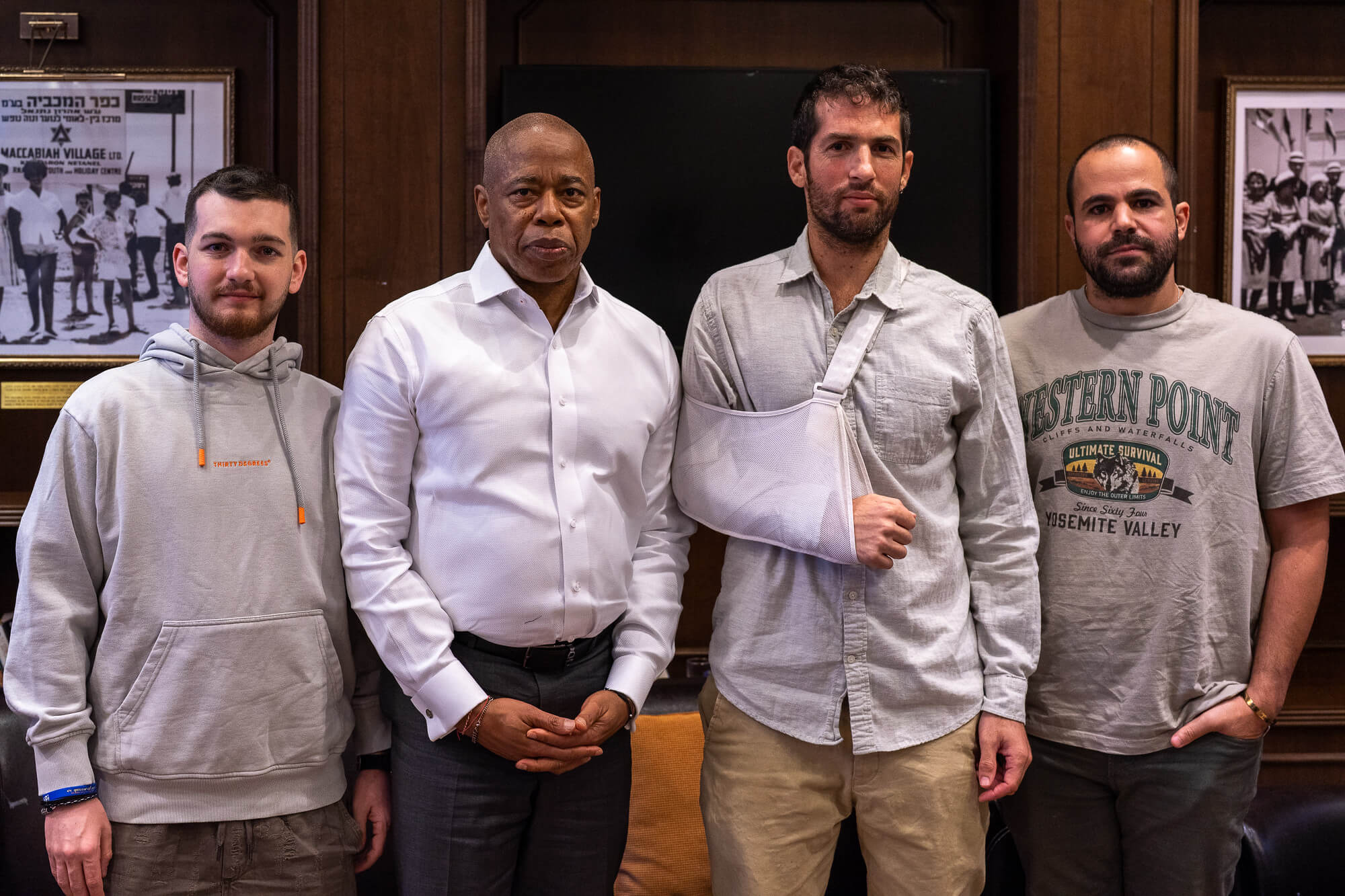
Adams, visibly shaken, told the former hostages that he admired their resilience and that New Yorkers needed to hear these stories firsthand. He offered to host them for the ball drop in Times Square on New Year’s Eve.
At the museum, Roy Hessing, deputy CEO of the Maccabiah movement, invited Adams to serve as an honorary guest at the next Maccabiah Games, now scheduled to resume in June, after delays due to the war. The event is expected to draw 30,000 participants, including 15,000 from abroad.
Adams also paid a visit to the Western Wall on Sunday night, where he placed a note in the wall and prayed. In the guestbook, Adams wrote that “God is real and life has shown us this.”
Shortly after landing on Saturday, Adams walked through the Nachalat Binyamin neighborhood with Tel Aviv’s deputy mayor, Asaf Zamir, who was Israel’s consul general in New York from 2021 to 2023. Zamir was outspoken against Mamdani throughout the mayoral campaign. Adams has long referred to New York as the “Tel Aviv of America.”
In tours closed to the press, Adams visited the IMI Academy, where Israeli instructors provide tactical and emergency-response training, and the Aerial Systems facility, where he was shown the latest drone and surveillance technologies. He also addressed the annual mayors’ conference hosted by the American Jewish Congress at Jerusalem’s King David Hotel.
At many of his stops, Adams said about his farewell: “I’m not just the mayor that’s leaving office, I’m your brother.”
The post On final visit to Israel as mayor, Adams makes a closing argument against Mamdani appeared first on The Forward.
Uncategorized
She was elected the first Jewish president of the Catholic Biblical Association. Then came the hate.
When Amy-Jill Levine was elected president of the Catholic Biblical Association earlier this month, she faced vicious backlash.
Those who opposed her election couldn’t exactly point to a lack of qualifications. Levine has written dozens of books on the New Testament, taught a New Testament course at the prestigious Pontifical Biblical Institute in Rome, served on the editorial board of Catholic Biblical Quarterly and spoken privately with Pope Francis three times.
Instead, her critics fixated on one trait they apparently consider disqualifying: She’s Jewish.
“Your Zionist ass doesn’t belong in our religion. Keep yourself to the Talmud and keep eating babies. STAY THE FUCK AWAY FROM CHRISTIANITY,” someone wrote in an email to Levine, which she shared with the Forward.
Levine’s Facebook page was bombarded with so much hate that she asked her daughter to moderate the comments. Online critics called Levine “anti-Christian,” denounced her as “Zionist,” and attacked her efforts to push back against antisemitic interpretations of the Bible.
On its face, a Jew at the helm of a professional association devoted to the study of Christian scripture might seem odd. After all, the Catholic Bible Association, unlike some other academic associations for the study of scripture, promotes study of the Bible “within a context of faith,” and most of the association’s presidents in its 90-year history have been priests. Levine attends an Orthodox Jewish synagogue.
Some more even-keeled critics of Levine’s presidency focused on this argument. “At some point, we have to ask: what is the word ‘Catholic’ actually doing?” Mark Lambert, co-host of the podcast Catholic Unscripted, posted to X.
Levine, meanwhile, argues that the Catholic Biblical Association is a professional society, not a church. People of all faiths are eligible for membership, as long as they hold an advanced degree in biblical studies.
“An academic society, like a hospital, museum or university, is not the same thing as being a member of the clergy,” Levine wrote in an email to the Forward.
In fact, while Levine is the first Jewish president of the Catholic Biblical Association, she is not the first non-Catholic. Several Protestants have served in the role, according to chair of the executive board Gregory Sterling.
Levine was nominated by a committee and then ran unopposed for the presidency, Sterling said. It is an unpaid, one-year position.
“She was not elected because she is Jewish, but because she is an exceptional scholar and has played a very important role in Catholic-Jewish dialogue,” Sterling and the association’s executive director, Archie Wright, wrote in a joint statement. “The vitriol of some of the comments only reinforces the need to address the problem of Anti-Semitism.”
Several Catholic clergy also wrote letters of support for Levine amid the pushback.
Levine, for her part, said she has “no interest in undermining the Church.” The 70-year-old grew up in North Dartmouth, Massachusetts, in a predominantly Portuguese Roman Catholic neighborhood, where she would occasionally go to Mass with her friends.
She preferred Mass to synagogue because “there were snacks, except you got the snacks in the church during the service, and you got the snacks in synagogue after the service,” she joked in an August interview on Nashville Public Radio.
Levine recalled that when she was 7 years old, a classmate told her she had killed Jesus — an accusation the elementary schooler had picked up from her priest. Levine, confused, went to her mother, who assured her that “God was doing just fine.”
That incident inspired Levine to attend Catholic catechism classes as a child, in addition to Hebrew School.
She went on to get a PhD in religion from Duke University and teach at Vanderbilt University as a professor of both the New Testament and Jewish Studies. Much of her scholarly work revolves around the Jewish context of Jesus and dispelling what she sees as antisemitic misinterpretations of the Bible.
“We do not need to make Judaism look bad in order to make Jesus look good,” Levine posted on Facebook after she was elected.
Catholic-Jewish relations
Sixty years ago, Levine’s election “would have been an astonishing thought,” said Philip Cunningham, director of the Institute for Jewish-Catholic Relations at Saint Joseph’s University in Philadelphia.
Though the Catholic church has a long history of antisemitism— including violent conversion efforts and teaching the theological belief that Jews were condemned by God — that has all changed in recent decades.
In the 1960s, Pope John XXIII took on the task of modernizing the Church, convening the Second Vatican Council to produce a theological document reconsidering many teachings and practices. The resulting document, often referred to as Vatican II, is perhaps most famous for allowing priests to host Mass in the local vernacular language of their parish instead of Latin. But it also changed Catholicism’s teachings about Jews.
Nostra Aetate, the section of Vatican II most famously concerned with Jews, shifted Catholic teachings about other religions enormously; while still maintaining that the Catholic Church is the “one true religion,” it also affirmed that other religions contain a “ray of truth,” a massive theological shift from the belief that any non-Catholic religion was false or even harmful.
Nostra Aetate spends significant time on Jews, specifically, including rejecting the belief that Jews should be held collectively responsible for killing Jesus. The document calls out antisemitism both theologically and politically.
“What happened in His passion cannot be charged against all the Jews, without distinction, then alive, nor against the Jews of today,” it reads. “The Jews should not be presented as rejected or accursed by God, as if this followed from the Holy Scriptures.”
Since Vatican II, popes have continued to advance dialogue with Jews, and with members of other religions. And the Church has forcefully rejected antisemitism, continuing to change its teachings on Judaism and Jewishness. That includes removing the term “perfidious Jews” from a Good Friday prayer, updating Catholic school classes on Judaism and even releasing statements acknowledging the legitimacy of Judaism alongside Christianity, placing Jews into a special and elevated relationship with the Church.
“The council set in motion a process of rapprochement between Jews and Catholics that took root particularly effectively in the United States, because the world’s largest Jewish diaspora community lives here and frequently alongside Catholics in cities and suburbs,” Cunningham said.
Levine, too, highlighted the importance of Nostra Aetate to her career, writing in an email that the document’s acceptance of Jews “opened the door for me to work in New Testament studies.”
But not all Catholics embraced the teachings of Vatican II. A diffuse movement often referred to as traditionalist Catholics, or tradcaths, felt that the efforts toward modernization had gone too far. Some tradcath groups simply sought to preserve the rituals of Latin Mass.
Others, however, including the recently excommunicated Society of Saint Pius X, or SSPX, take issue with the council’s teachings, believing that acknowledging the freedom and legitimacy of other religions takes away from the centrality of the Catholic Church’s teachings. In short, if the Catholic Church’s teachings are true, they argue, then no other religion can be legitimate.
The French-language account of SPPX posted to X, calling Levine an “objectively scandalous choice” and denouncing her “relativist interpretation of the texts condemning homosexuality,” as well as the fact that “a person who refuses to recognize Jesus Christ as Lord and Savior is placed at the head of an institution that claims to be Catholic.”
Despite the newer Catholic teachings about Judaism, some tradcath groups, as well as individual Catholic influencers such as Nick Fuentes, Candace Owens and Carrie Prejean Boller, have been endorsing antisemitic beliefs including supersessionism and deicide, as well as conspiracy theories about Jewish devil worship or government control. Though the Vatican has chastised these figures and repudiated their stances, they have continued to spread antisemitic dogma, including the belief that Jews hate and seek to oppress Christians and that Kabbalah endorses pedophilia. Many also endorse Christian nationalism, which the Vatican opposes.
This antisemitic subgroup within Catholicism is relatively small, but extremely visible thanks to influencers like Fuentes and Owens with millions of followers, and their understanding of Catholicism spreads to people both inside and outside the church. Their antisemitic version of Catholic ideology, as well as the conspiracy theories they spread, can be seen in some of the hate emails Levine received, such as references to eating babies, a version of the age-old blood libel that Jews used Christian children’s blood to make matzo.
Still, while the antisemitic fringe of the Catholic church is loud, the institutions are stalwart in their support for Vatican II’s acceptance of Judaism.
Levine’s election is an indication “that the changes that Vatican II sought to inspire have been happening,” Cunningham said. “That does not mean that all the issues between Jews and Catholics have been resolved — but at least amongst the much of the leadership in the Catholic community, the old stereotypes and caricatures are recognized for what they are.”
The post She was elected the first Jewish president of the Catholic Biblical Association. Then came the hate. appeared first on The Forward.
Uncategorized
Northeast Philadelphia says goodbye to its last Jewish deli
(JTA) — PHILADELPHIA — After running the family deli for several decades, Steve Stein says his 83-year-old legs were telling him it was time to call it quits. But it wasn’t only that.
The neighborhood has totally changed since his dad, Mike, first took over the business more than 60 years ago. Back then Northeast Philadelphia was an epicenter of Jewish life, packed with synagogues and other Jewish establishments. Most of them are gone. And now — with the close of Steve Stein’s Famous Deli and Restaurant — the area just lost its last Jewish deli.
But only after an outpouring of affection from longtime customers, who flocked to the place once news spread in the last few weeks. “It’s overwhelming,” Stein said. “The amount of people that came in here in the last 10 days, two weeks. Their comments are very touching. I knew I was liked. I didn’t know I was loved.”
To be sure, several customers told the Jewish Telegraphic Agency that they’ll miss Stein, but they also bemoaned the fact there aren’t many Jewish food options left. Certainly none with prices as low as Famous.
“I’ve been going there my whole life, “ said Rebecca Asheuer, who grew up a few miles away from Famous’ current location — its third since the Steins took over the business. “I feel surprise and sadness, because it’s the last one in the Northeast.
“I think the Jewish people are moving out of the city and also the businesses used to be passed down in families. Now with the economy and other stuff, people don’t want to take over the family business anymore,” she said.
Another longtime customer mourned the closing of the deli, but also the disappearance of Jewish life in the area.
“I kind of expected it to go sooner or later,” said Aileen Owens, who remembered going to Famous when the Auspitz family ran over six decades ago. “There’s nobody around. Synagogues and all that stuff, it’s all fading out. They went to the suburbs.”
According to Steve’s account, his father Mike Stein, his brother Arnold and cousin Jack began running the produce concession at the Famous Deli in Philly’s Castor Gardens neighborhood in the late 1950s. Around 1960, they bought the deli from the Auspitz family, which had operated a chain of Philadelphia delis dating to the 1920s.
Steve and his brother Arnie eventually ran the deli together. As Jewish families moved farther into Northeast Philadelphia, the deli moved as well — first to Krewstown Road in the mid-1970s, eventually having two locations there, and then about 14 years ago to its final location at 1619 Grant Ave.
If all goes right, Steve’s 57-year-old son Lee hopes to continue the migration and resurrect the family business in the suburbs. Sort of.
“I’m looking to have a place of my own,” said Lee, who started off as an eight-year-old taking out the trash, but would occasionally try to cut the lox when no one was looking. “I have a lot of experience in this business.
“I call myself multi-talented, not just in the deli business, but in cooking and baking, I would probably downsize and not do fruit and produce like we do here. It’s just not worth, you know, the space for what you’re paying. I would do a similar situation to here. Deli, prepared foods, a little bit of bakery, a small sit down. But what I’ve told the people that come in here, ‘You’ll never, ever see some of this product again. And you’ll probably never, ever see these prices ever again.’”
Still, he wants his new venture to be affordable.
“My father always liked being a people-pleaser,” the younger Stein said. “So he tries to please people with a price. But that price affects you eventually.”
As for Steve, he wishes his son well, but knows it won’t be the same. “Lee wants to try something, but not here,” Stein said.
He added that some remaining establishments in the wider region – “they do 90% restaurant and 10% deli, I do 90% deli and 10% restaurant” – will “benefit from me not being here.”
One former competitor isn’t so sure. “I’m upset another Jewish deli has closed and he’s been in business a long time and certainly has his whole clientele,” said Michael Young, longtime owner of Ben & Irv’s, a deli restaurant in Huntingdon Valley, a suburb about 20 minutes northwest of Famous. “But it’s a different world today; a different area. So I don’t know if it will help us.”
Lee Stein said he actually tried to stay put, but needed a little help.“The real problem is the landlord never took care of the building,” said Lee, who wishes his dad had been more assertive on that front. “I tried to make it work here with them, figuring this would be an easy fix. I asked them for some renovations; to put a new roof on. The roof has several holes in it. When it rains outside, it pours in here. So, I tried to negotiate with them first before I did anything else, but that wasn’t going anywhere.”
JTA’s attempts to reach the landlord for comment were unsuccessful. Regardless, Steve Stein, who was forced to close the deli for a short while last year due to health code issues, says he is ready to turn the page.
The first thing he’ll do once things settle down is get therapy on his aching legs. And he’s excited to have more time to devote to his wife of 61 years, Sheila, along with his children, Lee and Mindy, seven grandchildren and two great-grandchildren. “But I’ll miss my customers. They’re like family.”
Already he’s feeling the difference “It’s devastating,” he said on Aug. 24, the day after the store officially closed, amid a final “blowout sale” to get rid of what little was left. “I’m usually the first one in the store.
“It’s going to be very much missed by me.”
He’s not the only one.
“Nothing lasts forever,” said one customer before heading into Famous one last time. “But it’s very sad.”
This article originally appeared on JTA.org.
The post Northeast Philadelphia says goodbye to its last Jewish deli appeared first on The Forward.
Uncategorized
For graphic novelist Joann Sfar, drawing after Oct. 7 was a way to put stones on Jewish graves
For many Jews, the morning of Oct. 7 remains seared into memory. In Joann Sfar’s case, it was also the day of his birthday party, which included “as many Muslims as Jews,” he told me. Amidst tragedy, Sfar felt a profound gratitude for life, which seemed especially precious. It was a day of fear and uncertainty, followed by many more over the following months. For Sfar, drawing was the only way out.
To Life is Sfar’s illustrated journal of his experience after Oct. 7, a reflection of his fierce peace advocacy coupled with a profound connection to Israel. It follows several previous books by Sfar, who is a French Jewish graphic novelist best known for The Rabbi’s Cat. His works touch on his Sephardic heritage, highlighting a history of friendship and brotherhood between Arabs and Jews.
To Life is the English translation of Nous Vivrons, which was published in June 2024 as the first of a three-part series. It was followed by Que Faire Des Juifs? (What To Do with the Jews?), a nearly 600-page graphic novel that chronicles the history of the Jewish people. Sfar concluded the series with Terre de Sang: Le Temps du Désespoir (Land of Blood: The Time of Despair), which shares Palestinian voices and which Sfar describes as the “saddest” volume of the trilogy.
I spoke with Sfar in July after reading To Life, which will be officially released on September 8. At present, the translations of the second and third volumes are not yet scheduled to be published. Our conversation has been edited for length and clarity.
Now that you’re expanding To Life’s audience to English speakers, what do you expect non-French audiences to learn? What do you hope that they take from your piece?
What I would really love is a new vision on the Middle East. I’m really surprised how New York has made the Middle East American, using it in the Trump and Mamdani debate, which I have to say has very little interest from Europe. What I would love is for people to see real lives from the Middle East to see how similar people are. I come from a part Ukrainian and part Algerian Jewish family. When I went to Palestinian cities, I was surprised how many Palestinian seniors look like my father, and how many Moroccan Jews from Israel look Palestinian.
These are people who are very similar and who are trapped in a conflict which is older than them. I really would love readers to dig into personal experience, rather than abstractions. I think embracing this region is really putting hope into individuals, because if you start to put faith into narrative, you’re lost.
In your work, you make an interesting distinction between individuals denying each other’s peoplehood on both sides — Israelis saying there was never a Palestine, anti-Zionists saying Israel never existed — and your emphasis on interviews in your piece. Why was it important for you to have such a connection to real humans throughout the process?
It’s a very strange thing to say because there was real tragedy, but it made me happy because I love these people. I’ve been lucky enough to spend a lot of time in Palestinian and Israeli cities. If you take it from an individual level, I believe in them and I have a hope for them. Something beautiful is that even if they don’t want it, they are interconnected. Their economies are interconnected; no one is going to exterminate anyone. They’ll be there still.
In this region, no one ever talks to me about Zionism. People deal with their everyday issues; they have no idea what’s going to occur in two months. I know people who are smarter than me have a big political essay about this region, but that’s not my job. My job is to do what I love, like an adventure novel, where you go to the place, you meet the people, and you bring back a story.
Were there any illustrations in the book that you found particularly interesting or meaningful?
There are some photographs that are so shocking you cannot see them in the news, and making a drawing makes it more acceptable. One picture that blew me away is the burial of a father who was killed during October 7. His kid is crying on the grave, and there are the small stones you put on Jewish Ashkenazi tombs. This kid is a Jew, but he could be an Arab, and he mourns his father with a stone. I did a very simple drawing, and somehow that’s what war is about. War is not about heroism, it’s not about glory, it’s not about victory, it’s about kids who are going to mourn their fathers or mothers or family.
This reminds me of a quote from the book where you say that your writing “is like putting little rocks on top of Jewish graves.” Are there any moments in the book that you feel are the most important to hear and remember?
In some fields of France today, and especially among artists, it’s almost forbidden to recall October 7 because of the mass murder of Gaza. But my feeling is you need to be able to cry for both. October 7 was the worst murdering of Jews after WWII, and the mass massacre in Gaza is something we shall remember in 100 years. We should be able not only to cry for both, but also to consider the situation as a whole and to say, okay, what’s next? Are we waiting for the next slaughter or can we do better than this?
As an American, I know about the Jewish experience in the U.S. over the past few years, but I didn’t know exactly what was going on in France and the antisemitism there that you described in your book. Can you tell me more about your experience?
I’m more worried about America because for French Jews, we never let people harass us without responding. We still have a very strong connection to the Arab world, so when people try to oppose Jews and Arabs in France, it somehow doesn’t work. I would love to say that in an optimistic way, but there’s also a lot of violence and harassment. The minute a Jewish artist starts to work, there’s a threat of boycott and everyone starts to treat him like a ‘genocidal Zionist.’
I’ve been talking of Palestine for 30 years, doing reporting in Palestinian towns for two years, but somehow it’s not enough. But we really fight back, because violence here is very often. I had a performance in Marseille, and people gathered at the front to prevent me from drawing on stage. Luckily, many people showed up to defend me, because they knew my show was humane, about peace. At some point, it’s because I’m a Jew that pisses them off. But we know it’s a fight, and we’re ready for it.
What were people’s reactions to your book when it first came out in France? I’m especially curious about the non-Jewish and anti-Zionist population, and whether they read your work.
Everything online is hell. In bookstores, it’s heaven. For To Life, it’s been two years of performing in huge bookstores. I also went to all the universities in France which were blocked by the pro-Gaza crowd, like Columbia, but in France I went to talk in front of them and they were very nice talks. The book sold more than 60,000 copies in France, which is huge. It has a very mainstream audience, not just a Jewish audience. When you go to bookstores, people are very okay to talk, and especially when you go to my meetings, it’s okay to disagree. At my meetings, you can be pro-Palestine — you’re welcome. You can be pro-Israel — you’re welcome, and you can know nothing and you’re welcome also.
I’ve been dealing with Arab and Jewish topics for more than 30 years, and I have a huge amount of readers in France. The Arabs and Jews of my age know what they lost, in the real brotherhood and friendship we had fighting against the extreme right party. We have political history together, and many people remember that. I have a lot of hope, but we need to stay vocal.
Since the book was written in 2023, are there any moments that feel surprising or strange for you to read today?
One thing which is really surprising is that October 7 is less than three years ago, and it’s almost as if everyone forgot. Somehow, people have made political use of this slaughter by any means. The historical moment is almost forgotten. If my book is worth something, it is as an immediate report on the immediate aftermath of October 7 on site. I was in the south of Israel, I was with kibbutzniks, I was with the military, I was with Arab people. One thing we risk is to forget what occurred on October 7, and then forget what occurred during the Shoah, because in France today all the memory sites for WWII are being attacked as pro-Israel. So, we need to keep our memory. Without memory, there’ll be no peace.
One moment in your book that I found very powerful was when you parallel a famous image of Jews being shot in the Holocaust to one of two teenagers being killed on October 7. I’d love to hear more about your thoughts connecting October 7 to previous tragedies, especially with how you refer to the events as a pogrom.
In France, most of the people don’t know about the Jewish oppression in the Arab world, how many of us had to leave the Arab countries after the fall of the Ottoman Empire. When October 7 occurred, in many Sephardic families and Jewish families from Israel, it recalled what occurred in many oriental countries. There’s a history of killing Jews in the Arab world, and it’s as if people awake to that. We have memories — nothing is the same — but we have a history. Amongst the things that really terrify me today is the dislocation of the link between Israeli Jews, American Jews, and European Jews. I was sad to see how many young American Jewish readers have no connection at all to Israel. You can criticize Israel, it’s okay, but pretending you have no connection to Israel is a lie to the face of your family.
In your opinion, why do you feel like this is the case for so many American Jews? Is there a way that you feel like this changes?
I would say Israel is also to blame because Israel has taught the diaspora Jews that it should be a constant exchange. You cannot raise a child making him guilty about not being pro-Israel enough. I’m not asking anyone to be pro-Israel — it’s a very dysfunctional country with an extreme right government. But the connection exists through your parents, your grandparents, their history. Pretending there is no connection is a lie. In the Jewish story, every moment a Jew tries to pretend he’s not part of the Jewry is going to be the first to be slaughtered. I’m not an Israeli, but I’m part of this history and I’m really proud to be part of this history.
Throughout the book, you imagine many conversations with your late grandfather, and I was interested in why this was something that felt so connected to you at this time. Why did you want to include this dialogue in your book?
He really raised me, and everything I do or say is considering what my grandfather would have said. He did not believe in any narrative. He was not a nationalist; he would not believe in all the right wing crap about pride, country, anything. It was only about survival. Regarding Europe, he was very pessimistic. He was saying that we’ll have some decades of peace after Auschwitz, and then it’s going to go back to normal Jew hatred. I’m afraid to say he was right.
The post For graphic novelist Joann Sfar, drawing after Oct. 7 was a way to put stones on Jewish graves appeared first on The Forward.
