


Uncategorized
Growing Danger: Why Iran’s Nuclear Defiance Demands a New Strategy
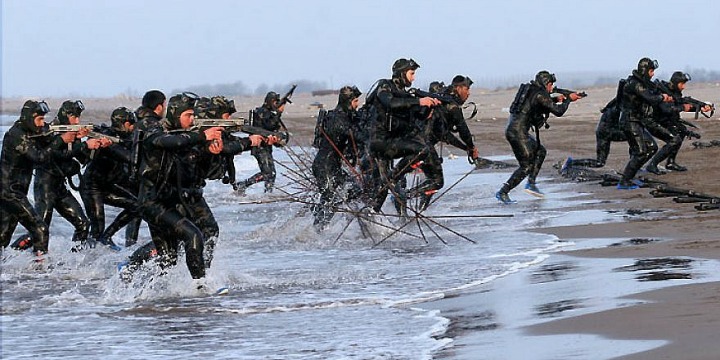
Navy forces of the Army of the Guardians of the Islamic Revolution commandos and missile boats in Great Prophet IX Maneuver in the general area of Strait of Hormuz, Persian Gulf. Photo: Sayyed Shahab Odin Vajedi/Wikimedia Commons.
The International Atomic Energy Agency (IAEA) confirmed this past week that Iran has not allowed its inspectors access to the nuclear sites bombed by Israeli and American forces in June. This sustained, deliberate obstruction has persisted for five months, rendering the verification of its nuclear material inventories long overdue.
Iran’s action is no mere technical violation; it is the creation of strategic ambiguity. Iran is actively denying the international community the ability to pinpoint the location and status of the 440.9 kilograms of uranium it had enriched to 60 percent purity, a quantity the IAEA itself assesses as potentially sufficient for 10 nuclear bombs if further refined.
The gravest threat is not just the volume of material, but the intentional collapse of verification. By keeping the IAEA blind, Iran ensures that any future military action will carry exponentially higher risks of striking a facility closer to weaponization than previously verifiable. Tehran is deliberately hedging its bets, creating a permanent deterrent shield of uncertainty.
The Synchronized Strike: Nuclear Threat Meets Naval Aggression
This nuclear defiance is not occurring in isolation. It is strategically synchronized with Iran’s kinetic threats in vital waterways.
The seizure of a Marshall Islands–flagged oil tanker in the Strait of Hormuz last week by the Islamic Revolutionary Guards Corps is a clear act of economic and military blackmail. This move directly targets a vessel operated by British and German interests, sending a hostile message to the E3 nations — France, Britain, and Germany — that any diplomatic pressure, like the new anti-Iran resolution they are planning at the IAEA, will be met with immediate, tangible military retaliation in the Persian Gulf.
Iran is attempting to dictate the diplomatic price of its own proliferation. It is leveraging its strategic nuclear advantage and its tactical naval aggression simultaneously. When the E3 countries threaten diplomatic action, Tehran responds not with words but with seized ships. This is an integrated campaign designed to impose asymmetric costs on the West, forcing economic decisions to override security principles.
The Allied Betrayal and the Failure of Pressure
The deepest source of vulnerability lies in the exposure of systemic differences within the allied camp itself. The US Treasury sanctions announced last week exposed a critical failure: entities operating within key allied countries — specifically Turkey — are actively running procurement networks that supply Iran’s ballistic missile and UAV programs.
This exposure is a profound betrayal of the maximum pressure campaign. It proves that, despite diplomatic assurances, allied nations are prioritizing transactional gains over the existential security of the international community. Iran’s ability to exploit the financial systems of NATO members and crucial Gulf partners confirms that the campaign against Tehran is critically compromised by internal sabotage and greed.
This internal compromise is what gives Iran the confidence to engage in its dual-domain aggression. When Turkey insists on maintaining its Russian S-400 system, defying US security mandates, and simultaneously enables Iran’s missile growth, it is acting as a strategic liability, not a partner.
The Mandate for Decisive Action
Israel, with the full backing of the United States, cannot afford to wait for the consensus-driven paralysis of the United Nations. The current diplomatic landscape offers little comfort: Russia and China are actively undermining the US-led stabilization plan for Gaza, and Saudi Arabia is holding normalization hostage to impossible political demands. The enemy is exploiting the West’s focus on internal squabbles.
Iran is at the 10-bomb threshold and actively preventing the verification required to pull it back; Iran is using military seizures to retaliate against diplomatic pressure; and allied nations are enabling Iran’s most destructive weapons programs.
Diplomatic pressure should be immediately paired with credible joint military deterrence in the Strait of Hormuz to secure the free flow of commerce. Furthermore, Washington must enforce strict accountability on its allies, making it clear that funding Iran’s missile program is an act of geopolitical sabotage that will incur severe and immediate penalties.
The window for a diplomatic solution is closing rapidly. If the current trend of non-compliance and synchronized defiance continues, the world will soon have to face the fact that Iran’s pursuit of nuclear capability has crossed the point of no return.
Uncategorized
‘Israel is politics’: Was a woman kicked out of a salon for supporting Israel or being Israeli-American?
An Israeli-American woman who was denied service at a Northern Virginia eyebrow salon is now taking legal action against the business.
The Brandeis Center for Human Rights Under Law is filing a civil rights complaint on behalf of Jessica Walton, who was at Karimi Brows in Alexandria, Virginia, on Aug. 6 when Fatana Karimi, the shop’s owner, recorded and posted a video of her telling Walton to leave the store. The video has received more than 270,000 likes and garnered concern from antisemitism watchdog groups.
“This case is about a basic civil rights principle,” says Omer Wiczyk, senior counsel at the Brandeis Center. “A business that is open to the public cannot reclassify a customer’s Israeli identity as objectionable politics.”
The two sides disagree about whether Karimi’s decision was made based on Walton’s ethnicity, identity or politics.
Karimi said in a TikTok video that her decision to deny service to Walton was not about Walton’s identity but her politics. “Any ethnicity or nationality or person who comes from a certain religion, any religion, comes to me and tells me that they support Israel, I would kick them,” she said.
Karimi said she “would have, you know, let it slide by” if Walton had denounced the Israeli government and called the Israel-Hamas war a genocide.
Walton, in the video taken at Karimi Brows, characterized the dispute as being about her identity. “I had no idea that you would do this based on my ethnicity,” she said.
According to the complaint, Walton said she did not discuss politics and only mentioned she was Israeli-American before Karimi asked her to leave the studio.
In another video, Karimi explained that Walton said she was Israeli-American “three different times” before Karimi started “throwing shots back at her.” Karimi said that in that moment, she was imagining Palestinian people, “looking at me saying, ‘But I thought you supported us? Why are you playing nice with the girl that is the reason we’re going through this?’”
“I was like, ‘the gloves are f—ing off,’” Karimi said. “‘I’m not doing your f—ing brows. Get out of my f—ing face.’”
The complaint also says that before the camera started rolling, “Ms. Karimi stated that, for her, ‘Israel is politics.’ ”
Politics-based discrimination would not necessarily constitute a civil rights violation, said Michael Helfand, a professor at the Pepperdine Caruso School of Law. However, if Karimi was placing special scrutiny on Walton’s beliefs because of her Israeli identity, it would — facts that the parties dispute.
“I think this gets you into the question of how you want to classify anti-Zionism,” says Helfand. “I think that’s a bigger question that the law hasn’t fully wrapped its head around.”
Both women said they have received violent messages online following the incident, including death and rape threats. Karimi said her Yelp reviews were spammed with negative comments from users she doubted had been to the store.
The post ‘Israel is politics’: Was a woman kicked out of a salon for supporting Israel or being Israeli-American? appeared first on The Forward.
Uncategorized
Vance meets with Temple Israel rabbi on Michigan visit
(JTA) — Vice President JD Vance recently met with representatives of Temple Israel in Michigan to offer “his support in the wake of the attack on our community,” clergy from the synagogue told the Jewish Telegraphic Agency.
Vance’s Monday meeting with representatives of the suburban Detroit synagogue that had been attacked by a terrorist in March came as the vice president has upped his outreach to Jewish voters ahead of a likely 2028 presidential run. He also invited a rabbi and security guard to a rally Monday in the Detroit suburb of Sterling Heights, where he called them out from the podium and said he was “honored” to have them attend.
The Reform synagogue’s clergy later offered more details about his outreach, telling JTA that he had met with one rabbi, as well as with a security officer who had stopped the assailant from harming anyone at the preschool that was in session.
The meeting was held at Vance’s request, Rabbi Jen Lader told JTA, and the vice president did not visit the synagogue itself.
“This was an important opportunity to ask for the Vice President’s support in the fight against antisemitism, and for additional security funding through the Jewish American Security Act,” Lader wrote in an email to JTA, referring to a bipartisan bill introduced in the U.S. House this summer to increase federal funds for both Jewish organizations and synagogue security.
Lader continued, “We’ve made the same requests to elected officials on both sides of the political aisle.”
Later that day the vice president traveled to Las Vegas, where he met in a closed-door session with members of the Republican Jewish Coalition, who have been riled by his close relationship with podcaster Tucker Carlson and other points of contention.
Vance sought to draw a contrast with Abdul El-Sayed, Michigan’s Democratic U.S. Senate candidate, who spent the weekend offering apologies for his earlier comments about the temple attack, when he appeared to describe the attack as a response to Israel’s incursion in Lebanon.
Some Michigan Jewish leaders are publicly mobilizing against El-Sayed, a harsh critic of Israel: As of press time, more than 400 Jews in the state, including some who hold prominent community positions, have signed a petition pledging to vote for the GOP candidate, former U.S. Rep. Mike Rogers, in the Senate race.
A representative for Vance did not respond to a request for comment on the vice president’s Temple Israel meeting or for his views on the Jewish American Security Act.
At the RJC meeting, where he also received a standing ovation but did not address his Carlson ties, attendees told JTA that Vance highlighted his outreach to Temple Israel.
The nation’s largest Reform synagogue, Temple Israel was attacked in March by a man who had recently lost family in an Israeli strike on a Hezbollah position in Lebanon. In two statements following the attack, El-Sayed initially condemned it outright. He then changed his wording to include what he now says was “context” about Israel’s war in Lebanon, including the phrase, “Hurt people hurt people.”
Speaking with the state Democratic Party’s Jewish caucus at the party convention on Saturday, El-Sayed apologized for those remarks, saying, “I made a mistake.” He also attended the caucus’s “Summer Simcha” fundraiser the next day, where he repeated his apology and asked for forgiveness. He told JTA the “context” he’d sought to include in his initial remarks was related to “violence in all its forms, in all circumstances.”
Temple Israel clergy have declined to comment to JTA on El-Sayed’s two apologies for his past comments. Lader had penned an op-ed in The Free Press criticizing his response.
Vance’s Michigan visit also included a rally in Sterling Heights, where he discussed the synagogue attack and called it “a terrible, antisemitic terrorist attack.”
“It could have been so much worse, ladies and gentlemen,” Vance told the crowd, who had given the Temple Israel personnel a standing ovation. “That guy showed up at that synagogue, at that school with a desire to kill a lot of children, and he killed precisely zero children because of the brave security guards who did their job and did it very well.”
Vance also called El-Sayed, a progressive and a Muslim, “very, very evil” from the podium.
“Abdul El-Sayed made an apology for the very people who would perpetrate violence against hundreds of innocent American school children,” Vance told the crowd. “You’ve got to ask yourself, if he’s willing to empathize, not with the children who almost had their lives destroyed at the most innocent and what should be the safest place in the world, their school, what is he going to do when he goes to Washington, D.C. when the cameras aren’t on?”
Vance added, “What I see is a man who has sympathy and compassion for people who share his religion, but have nothing for people who don’t. A person who will apologize for a murderer so long as he looks the right way, but will not understand the plight of an innocent child if that person has the wrong faith.”
The Jewish voters petition, titled “Michigan Jews Against Extremism,” was spearheaded prior to El-Sayed’s apologies but has picked up more signatures in their aftermath.
The petition’s language states that “many” of the signatories “have been fiercely supportive of Democratic candidates and principles,” but that all of them “declare our intent to vote for Mike Rogers for US Senate in 2026.”
“If El-Sayed were to win the general election in this important swing state, we fear the far-left and anti-Jewish elements in the Democratic Party would become dominant, including in the imminent 2028 presidential race,” the petition says. “We cannot allow him to become the Democratic standard-bearer or Michigan’s senator.”
The petition specifies that their vote for Rogers “does not require that we agree with him on every issue or that we support President Trump.”
Benji Rosenzweig, a real-estate agent and music podcaster based in West Bloomfield, was one of the letter’s signers.
“I’ve watched Abdul El-Sayed, for the last number of months, surround himself with people who cheer for the destruction of our families and the annihilation of our community,” Rosenzweig told JTA. He signed the petition before El-Sayed’s apologies but wasn’t swayed by them: “What he said was, ‘I’m sorry that you were hurt.’ That’s not an apology.”
Rosenzweig describes himself as a “centrist” who holds “liberal values,” and who would have voted for El-Sayed’s primary opponent, U.S. Rep. Haley Stevens, in the general November election if she had won the nomination. He recently met Rogers at an event, he said, and told him that “I will be holding him accountable to the liberal values that I still value.”
As of press time, the petition’s signatories include Brian Hermelin, current president of the Jewish Federation of Metropolitan Detroit; Mark Davidoff, CEO of the Michigan Israel Business Accelerator; Rabbi Eli Mayerfeld, CEO of the Zekelman Holocaust Center in Farmington Hills; Amy Newman, CEO of Jewish Family Service of Metro Detroit; and David Victor, past president of the pro-Israel American Israel Public Affairs Committee.
The petition included their names but not their titles, suggesting they were signing as individuals and not as representatives of their organizations. The list also includes the names of several people who had previously told JTA they would commit to fundraising for Rogers if El-Sayed won the Democratic primary.
Local rabbi Asher Lopatin, currently on leave from his role as community relations director for the Ann Arbor Jewish federation, has stumped for Rogers but told JTA he does not have a formal role with the campaign. In the Forward this week, Lopatin again urged the state’s Jewish Democrats to back Rogers over El-Sayed.
“To show the Democrats that such candidates should never be nominated, we must show them that such candidates can never win,” the rabbi wrote on Monday.
The El-Sayed campaign did not return a request for comment from JTA about the petition.
For the approximately 100,000 Jews in Michigan, the question of whether to vote for El-Sayed has proven hugely divisive. At the same Sunday event that hosted the candidate, state Attorney General Dana Nessel, who is Jewish and has publicly sparred with El-Sayed over his rhetoric, implored the crowd to “place the needs of the world above even our own self-interest and, yes, even our own survival” — suggesting that Jewish voters should put their own feelings of personal safety aside in order to elect a Democrat.
Nessel’s comment, coming one day after she sat out a state Democratic convention over what she said was fear of antisemitic harassment, has sparked some backlash outside of Michigan. Ron Halber, CEO of the Jewish Community Relations Council of Greater Washington, called the attorney general “an absolute embarrassment.”
Mark Goldfeder, who runs the litigation group National Jewish Advocacy Center, wrote on the social network X, “Jewish voters can care deeply about democracy, climate, health care and the welfare of their neighbors while still treating Jewish safety as entirely nonnegotiable.”
Rosenzweig said he had once been an admirer of Nessel but that he was “really sad” over what he interpreted as her suggestion that voting for Abdul “may put Jewish people in danger, but do it anyways.”
“If Abdul wins she gets to say, ‘Well, Jews are endangered,’” he said. “It’s just such a crazy place to put people in.”
This article originally appeared on JTA.org.
The post Vance meets with Temple Israel rabbi on Michigan visit appeared first on The Forward.
Uncategorized
Spain’s prime minister blames Israel, Russia for disinformation around Ceuta border crisis
(JTA) — MADRID — Spanish Prime Minister Pedro Sánchez said on Monday that Israel and Russia spread disinformation about Spain’s migration policy after a rush of migrants arrived in Ceuta, a Spanish exclave in North Africa.
Over 72,000 migrants crossed into Ceuta between July 30 and July 31, with at least 100 people dying in the attempt, according to local authorities. Sánchez, along with Morocco’s Interior Ministry, have blamed the surge on human trafficking networks that exploited misinterpretations of a change in Spain’s border policy.
In Sánchez’s first interview since the border crisis, he also said that Israel and Russia organized internet campaigns to undermine Spain’s government during the chaotic aftermath. Online theories proliferated widely after the Ceuta crossings, including some that said Israel orchestrated the crisis.
“After July 30th and 31st, there was an expansion of these hoaxes and this disinformation by social networks associated with both Russia and Israel, and with an international far-right movement that always uses migration, not only to attack Spain, but also to attack Europe and divide it,” Sánchez said in an interview with the Spanish radio network Cadena SER.
Sánchez said research from the European Union’s European External Action Service showed that Israel and Russia were behind disinformation campaigns, without giving further details on the evidence. The EEAS did not immediately respond to the Jewish Telegraphic Agency’s request for comment.
He added that it was “evident” that Israel and Russia were motivated by Spain’s political positions “regarding the genocide in Gaza and Putin’s invasion of Ukraine.”
Sánchez is among Europe’s most vocal critics of Israel’s conduct in Gaza and Iran.
Israeli Foreign Minister Gideon Sa’ar said Monday that Sánchez was “lying shamelessly,” adding that the statements “will not distract from Sánchez’s disgraceful failure to manage his country’s affairs.”
Kremlin spokesperson Dmitry Peskov also told the Russian state broadcaster RBC that Russia had no involvement in the migrant crisis or disinformation campaigns.
Spanish-Israeli diplomatic ties, first established in 1986, have deteriorated since the start of the Gaza war in 2023, with Madrid since recognizing Palestine as a state and banning ships carrying arms to Israel from docking in its ports. By 2026, both countries had recalled their ambassadors.
This article originally appeared on JTA.org.
The post Spain’s prime minister blames Israel, Russia for disinformation around Ceuta border crisis appeared first on The Forward.
