


Uncategorized
An Emerging Crisis: Fighting Antisemitism in the Mental Health Professions

The personal belongings of festival-goers are seen at the site of an attack on the Nova Festival by Hamas terrorists from Gaza, near Israel’s border with the Gaza Strip, in southern Israel, Oct. 12, 2023. Photo: REUTERS/Ronen Zvulun
In a mental health professional network, an article was posted about how Jews faced discrimination in the profession.
There were over 250 comments in less than 8 hours, mostly attacking Jews and/or Zionists.
In an announcement for a training session being led by one of us, there were over 500 explicitly antisemitic comments in an hour on Reddit.
An article published about the impact of antisemitism on the mental health of Jews in America received hundreds of political comments about the Israel-Hamas war, rather than any discussion of clinical implications
An Orthodox Jewish psychologist organized a series of speakers, and one invited professional demanded that all attendees sign a declaration condemning the current Israeli government.
And, at the annual meeting of the American Psychological Association (APA), professional listserv postings urged attendees to wear keffiyehs and read a “land and genocide statement” before their presentations. Some presentations included Hamas propaganda.
These examples are not indicative of legitimate academic rhetoric — they are evidence of the field’s growing animus towards Jews.
Two factors help explain how mental health professionals feel comfortable discriminating against Jewish colleagues.
The first is the rapid embrace of a widely endorsed but empirically unsupported treatment model, decolonial therapy (DT). DT emphasizes the role of historical oppression on the development and perpetuation of intergenerational trauma. It explicitly blends clinical work with activism, urging clinicians and clients to engage politically in and out of therapy.
The activism in DT frames Zionism as oppression and psychopathology. For example, one of the leading proponents of DT has tied Zionism to genocidal intent, misogynoir, and fascism. Another prominent figure has referred to Zionism as psychosis and defended the murder of two Israeli Embassy employees in May.
Instead of condemnation from members of the profession, these practitioners have been celebrated by the leaders of the DT movement, hold leadership positions, and receive speaking invitations.
Left-wing identitarianism has also led to the explosion of antisemitism in the mental health professions. Unlike the purity demands of white European identity that are the basis of right-wing identitarianism, left-wing identitarianism demands strict ideological purity. This includes framing Jews as oppressors and Zionism as a form of mental illness and oppression.
This framework justifies aggression against Jews while also valorizing violence and terrorism committed by Hamas. These patterns within the mental health field prompted a sitting Democratic congressman to condemn the APA. It was also the impetus for a complaint filed with the Department of Education’s Office of Civil Rights during the Biden administration against an anti-Zionist DT leader who characterized Zionism as psychosis.
Mental health professionals who are anti-Zionist, including Jewish members of the profession, are embraced as ethical scholars and professionals, damaging collegiality and harming the profession. But when a professional defends the right for Israel to exist, regardless of their view of the current Israeli government, they are met with condemnation and scorn.
Left-wing identitarianism in the mental health professions extends to the demand that practitioners accept DT. While DT lacks empirical support, it is presented as if it were settled psychological science, to be applied to all individuals from historically marginalized backgrounds, while identifying specific other groups deemed responsible for these intergenerational woes.
This guiding philosophy commits rhetorical, interpersonal, political, and in some cases physical violence against Jewish members of the profession. It contributes to traumatic invalidation, wherein a Jewish client’s grief or fear is mocked, minimized, or made contingent on denouncing aspects of their identity. It is associated with avoidance, hypervigilance, shame, and ruptured help-seeking. As clinicians, we would never tell a survivor, “You’re safe here — as long as you recant a core part of who you are.”
We must not say it to Jews either. Whatever one’s politics, professional codes are clear: avoid discrimination and harm, be accurate in teaching, and avoid false or deceptive statements
The new identitarianism poses a serious public health risk. Clients have been rejected by professionals simply for being Jewish or expressing distress over the war between Israel and Hamas.
This risk extends beyond Jewish clinicians and clients. Fusing treatment with politics creates a profound public health crisis, as more clients will receive care that is based on activism and invalid conceptualizations of mental illness. Given the influence mental health professionals have on the public, this movement actively contributes to the rise of left-wing antisemitism
This is not a plea to shield Israeli policy from critique, nor erase Palestinian trauma. Patients and trainees deserve freedom from ideological coercion and discrimination because of their Jewish and/or Zionist identity. Good care is rigorous and grounded: validate distress, explore meaning, and apply tested tools. Keep the hour centered on patient goals, not clinician activism. We can hold multiple truths: Palestinian suffering, Israeli suffering, diaspora Jewish fear — without coercing political statements from patients, trainees, or colleagues.
We recommend professional reforms at every level. Mental health associations must require continuing education (CE) providers to disclose when the content is advocacy versus evidence-based clinical training. Safeguards must be instituted for reporting discrimination based on Jewish/Zionist identity, with clear remedies.
Antisemitism literacy must be adopted at every level of professional education. Assessment of traumatic invalidation needs to be incorporated into intake procedures when identity-related stressors are evident. When teaching emerging and untested methods (such as DT), clear disclaimers about the available evidence must be made explicit. And regulatory bodies need reform to swiftly and transparently address claims of retaliation against trainees and colleagues for Jewish/Zionist identity, and enforce anti-discrimination policies.
Our field knows how to hold complexity. We can grieve for Palestinians and Israelis, critique policies, and still protect patients, trainees, and colleagues from ideological coercion. Jewish clinicians and clients deserve the same ethical care we promise everyone else. Let’s replace purity tests with professional standards, and return the therapy room to what it’s for: healing.
Dean McKay is a Professor of Psychology at Fordham University and Miri Bar-Halpern is a Lecturer at Harvard Medical School.
Uncategorized
These Bundist pioneers were heroes in their time. Would they be in ours?
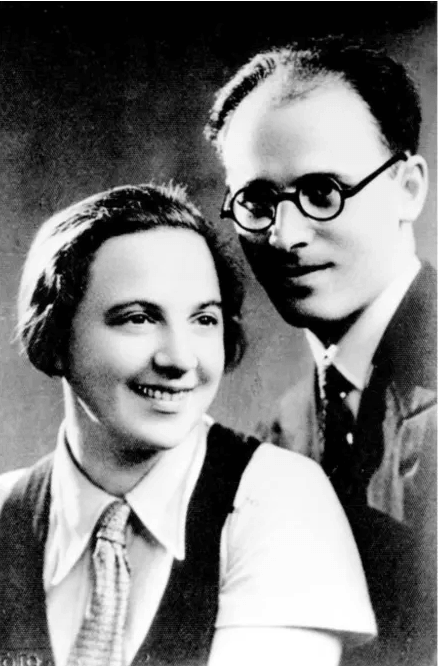
Academic stars in high school, Abrasha Blum and Luba Bielecka shared a slow burn romance and fervor for radical change. That hardly set them apart amid the ferment after the tsarist empire crumbled in 1919. No one would have predicted that Bielecka would go on to be awarded global nursing’s highest honor and Blum Poland’s equivalent of the Congressional Medal of Honor.
But their story poses a provocation in today’s hyper-polarized politics: Blum and Bielecka were devoted Bundists, and as such, they were not only socialists but anti-Zionists.
That combination can get you labeled today as anti-Israel and antisemitic, and even anti-American. Yet at the time they were Jewish heroes.
Bielecka repeatedly risked her life smuggling children out the Warsaw ghetto under Nazi occupation while directing the sole Jewish nursing school, sustaining its rigorous professional standards even as it was squashed into oblivion. Blum, a physically frail man, was dubbed the “ideological father of armed resistance” in the Bund; he led his band of militants into joining forces with the detested Zionists in the historic Warsaw Ghetto Uprising. When the insurgency was crushed — as all the combatants knew it would be — Blum, an engineer by training, led the surviving remnant through the cavernous sewer system to safety. But soon thereafter, in fleeing the police, he plummeted three stories from an apartment building. Badly injured, he was taken to Gestapo headquarters and never seen again.
Blum and Bielecka engaged the world as they found it and fought for justice for Jews and humanity. Blum’s photo is on display at Yad Vashem, Jerusalem’s Holocaust museum.
A lot has changed in 85 years. In 1939, most Americans Jews opposed Zionism and feared it would be misused by antisemites to justify allegations of dual loyalty. At the time, twice as many Jews lived in Warsaw as in all of British Palestine. The Bund swept 17 of 20 Jewish-designated seats on city council (Blum held one of them), far outdistancing all the Zionists parties together. Socialism made sense to Jewish voters, who were overwhelmingly “blue collar.” And so did doikayt (“hereness”), the doctrine that Poland’s three million Jews belonged there, not in a far-off desert, as the Zionists maintained.
The Holocaust radically and irrevocably changed the landscape. Ninety percent of Polish Jewry was exterminated. Even after the Nazis were vanquished, Jews continued to endure pogroms and were largely purged from Poland’s ruling communist party. By then, Israel was the sole destination in the world that welcomed large numbers of Jews.
Blum and Bielecka’s daughter, 17-year-old Aviva (née Victoria), was among the pioneers who migrated to a kibbutz in the new State of Israel. Zionism offered her the promise of milk and honey in a sanctuary free of antisemitism.

For years, her younger brother, Olek, held fast to his parents’ politics. But he too ultimately exited Poland, not for Israel but for the US, saddened that his father’s dream of “a prosperous Jewish minority inside Poland was impossible to realize.”
Like their parents, Aviva and Olek too engaged the post-WWII world as they found it and sought a better world.
Today, socialism and anti-Zionism are each experiencing something of a revival in the U.S. Self-described socialists have won mayoral elections in New York, Seattle and Washington, D.C. DSA-supported candidates won the Senate Democratic primary in Florida and narrowly lost Wisconsin’s gubernatorial primary. A recent CBS News poll found that 58% of Democrats now hold a favorable view of socialism, whereas only 32% view capitalism positively. The gap is even wider among young people. Jews, despite their relative affluence, remain among the most liberal voters in the U.S., although their current views on socialism have not been scientifically surveyed.
Anti-Zionism looks quite different in 2026 than in 1939, at least to Jews. Israel, approaching its 80th anniversary, is far from the desert mirage ridiculed by pre-war Bundists. While only a minority of American Jews self-describe as Zionists, an overwhelming majority support Israel as a Jewish and democratic state. Yet they are deeply troubled by Israel’s direction: Polls show that Zohran Mamdani, a socialist and anti-Zionist, is more popular among American Jews than Israeli Prime Minister Benjamin Netanyahu.
We’re left with this thought experiment: What if Abrasha and Luba resided in America today? What would they view as justice and how would they engage to achieve it? What if they resided in Israel?
And finally, a question about the rest of us: Would we recognize them as heroes?
The post These Bundist pioneers were heroes in their time. Would they be in ours? appeared first on The Forward.
Uncategorized
AIPAC couldn’t stop Michigan’s El-Sayed in the primary. Now it’s trying again.
AIPAC’s super PAC has re-entered Michigan’s closely watched U.S. Senate race less than a month before the general election, spending nearly $100,000 on mailers attacking Abdul El-Sayed, despite earlier concerns by allies of his Republican opponent, Mike Rogers, that it would boost the Democratic nominee.
The spending of $94,620 by United Democracy Project (UDP) on direct mailers was disclosed in a Friday campaign finance filing. It comes after Rogers publicly welcomed AIPAC’s support during a televised debate last week, reversing the position initially taken by people close to his campaign who worried the pro-Israel group’s involvement could hurt his chances.
A spokesperson for the group told Jewish Insider that the mailers target 130,000 identified Jewish voters in the swing state. It focuses on El-Sayed’s response to an attack on Temple Israel in West Bloomfield earlier this year. El-Sayed drew criticism for saying “hurt people hurt people” when discussing the attacker, whose brother was reportedly a Hezbollah commander killed in an airstrike on Lebanon. El-Sayed later apologized, saying he had been trying to provide broader context for the attack.
UDP spent more than $30 million trying to defeat El-Sayed in the Democratic primary this summer and in support of Rep. Haley Stevens, who lost by about one percentage point.
Following the primary, allies of the Republican nominee reportedly asked AIPAC not to run ads to boost him, fearing that the group’s involvement would give El-Sayed the same political foil that helped him overcome its massive spending in the primary. Axios reported that AIPAC officials didn’t take that rejection easily.
But Rogers appeared to change course last Thursday when asked whether he’d welcome AIPAC’s support.
“Anybody that wants to help my campaign stop a guy who can’t condemn terrorism in our own country because he’s so close to the people who are supporting the Muslim Brotherhood, again, I’ll take all of that help,” Rogers said at Thursday’s televised debate. El-Sayed interrupted to say he had condemned terrorism.
A new super PAC, Together for Michigan, aired an ad during the debate featuring Taylor Weintraub, whose child attends the Temple Israel preschool that was attacked in March.
Rogers went further on Friday at a campaign event with Sen. John Kennedy of Louisiana, accusing El-Sayed of being “so anti-Jewish” that a single mailer had upset him. Rogers said he welcomed help from Jewish supporters seeking to defeat his opponent. Kennedy also attacked El-Sayed, saying AIPAC would not be involved in the race if the Democrat did not “sleep in a Bin Laden jersey.”
El-Sayed, an Israel critic who has made opposition to AIPAC a central part of his campaign, responded by accusing Rogers of desperation. “You know Mike Rogers is in trouble when he begs AIPAC to start spending against me,” he wrote on X.
Some Jewish Democrats are publicly supporting Rogers, saying El-Sayed has failed to assuage concerns in his outreach to Jewish voters and in campaign appearances in recent months. If elected, El-Sayed would become the first Muslim member of the U.S. Senate.
Recent polls show El-Sayed with a narrow lead in the race to replace retiring Democratic Sen. Gary Peters. Recent elections in Michigan have been decided by narrow margins. Trump won the swing state in 2024 by about 80,000 votes, while Democratic incumbent Elissa Slotkin defeated Rogers in the Senate race that year by fewer than 20,000 votes. Four years earlier, Joe Biden won Michigan by about 2.8 percentage points.
The post AIPAC couldn’t stop Michigan’s El-Sayed in the primary. Now it’s trying again. appeared first on The Forward.
Uncategorized
In Israel’s election, Netanyahu faces a reckoning over Oct. 7 failure
With barely two weeks remaining before Israel’s Oct. 27 election, the country has been consumed by an extraordinary confrontation between Prime Minister Benjamin Netanyahu and senior former aides over what he knew before the Hamas massacre of Oct. 7, 2023, what he did with that knowledge and whether his office subsequently sought to rewrite the historical record.
The immediate catalyst was a bombshell television interview in recent days with Maj. Gen. (res.) Avi Gil, Netanyahu’s former military secretary, who served alongside him before and during the attack that killed approximately 1,200 people and saw 251 taken hostage. Gil had remained largely silent for three years, expecting to present his evidence to a state commission of inquiry. But with Netanyahu blocking such an inquiry, amid transparent scheming to deflect blame, Gil decided to speak publicly.
What he described went considerably beyond the failures of intelligence and military preparedness that have already been extensively documented. Gil accused Netanyahu’s office of attempting to falsify an official record from the morning of the attack. He challenged the prime minister’s account of early warnings he received. He confirmed that Netanyahu rejected recommendations for preventive military operations against Hamas. And he described how political considerations influenced decisions over hostage negotiations, potentially prolonging the captivity of people who could have been brought home earlier – and alive.
His testimony is particularly consequential because it directly challenges a 55-page document Netanyahu released in February, presenting his version of the events preceding Oct. 7. Submitted to Israel’s state comptroller, the document portrayed Netanyahu as having repeatedly advocated tougher action against Hamas while security officials underestimated the threat. It has become central to his defense against accusations that his longstanding policy of containing Hamas helped create the conditions for the catastrophe.
Gil, who attended the relevant meetings and recorded his experiences in 16 notebooks, described the published document as a profoundly incomplete and misleading account, containing lies and half-truths. It failed to reflect even half of what he witnessed.
A separate investigation published Friday by Yedioth Ahronoth, comparing Netanyahu’s account with original records of security deliberations, reported significant omissions and distortions, including instances in which Netanyahu allegedly rejected proposals to target Hamas leaders that his February document presented as initiatives of his own.
Most explosive was Gil’s account of an alleged attempt by Netanyahu’s then-chief of staff, Tzachi Braverman, to change the official time of a telephone conversation on Oct. 7 from 6:40 a.m. to 6:29 a.m. Moving the time backward could create the impression that Netanyahu had been issuing instructions from the first moments of the assault. Gil said a stenographer told him she had been instructed to alter the record, prompting him to notify the attorney general.
Nitzan Alon, another retired general who headed the government’s hostage release operation, and took part in negotiations throughout much of the war, also told reporters that “it was possible to end the war a year earlier” and save the lives of numerous hostages who eventually died in captivity.
Another remarkable confrontation involves Ronen Bar, the former head of the Shin Bet domestic security agency, whom Netanyahu has repeatedly blamed for the failures of Oct. 7. In late September, Bar announced plans to sue Netanyahu for defamation, accusing him of conducting a campaign of false allegations about his conduct before the massacre. Bar said he had warned Netanyahu about a looming security disaster and demanded disclosure of the original records of security meetings, communications and warnings, including the prime minister’s contacts with foreign officials.
Those demands have acquired additional significance amid reports that senior officials from Egypt and the United Arab Emirates warned Netanyahu about Hamas preparations shortly before the attack. Netanyahu categorically denies receiving such warnings and has threatened legal action over the reporting.
Gil’s revelations arrived alongside another striking intervention from a former Netanyahu confidant. Yoav Horowitz, , once Netanyahu’s chief of staff and director-general of the Prime Minister’s Office, told Kan’s Reshet Bet radio last week that he had gradually come to understand that Netanyahu’s decisions were driven primarily by considerations of personal political survival rather than the national interest.
Now a senior aide to leading opposition figure Gadi Eisenkot, Horowitz attributed that transformation to the corrosive effects of prolonged power, observing that “too much time in power corrupts,” and framed the approaching election as being about saving the country.
Horowitz now heads the team preparing its first 100 days in government. His criticism therefore comes from a former trusted aide who has become an active political opponent, adding another dimension to the dispute over Netanyahu’s leadership.
The question of political survival also figured prominently in Gil’s account of the hostage negotiations. Asked whether coalition pressures had influenced decisions that delayed agreements to free hostages, Gil said some hostages could have returned earlier and that political calculations had played a role in the decisions that kept them in captivity.
Netanyahu has rejected Gil’s allegations, and his Likud party has characterized the latest revelations as politically motivated propaganda. Netanyahu and his supporters maintain that senior security officials failed to recognize the imminent danger.
The country is still struggling to establish a common factual account of its most traumatic day in decades, while the officials who participated in the crucial decisions offer sharply conflicting versions of what happened. Meanwhile, the families of those killed on Oct. 7, survivors of the massacre and former hostages continue demanding answers about the decisions that shaped their lives.
The public appetite for an inquiry into the disaster is overwhelming. A September 2025 survey by the Israel Democracy Institute found that 74 percent of Israelis supported establishing a state commission of inquiry, including 68 percent of Jewish respondents identifying with the political right. A subsequent survey conducted in February 2026 found that 92 percent of Israelis considered it important to investigate the events.
The absence of such an inquiry has left journalists, former officials, politicians and bereaved families conducting an increasingly contentious public investigation of their own. Documents appear selectively, witnesses offer competing recollections, and allegations that might otherwise be tested through sworn testimony and access to classified evidence become weapons in an election campaign. With spiraling suspicions being leveled at Netanyahu, the election will take place amid unresolved questions – and a rage that grows more toxic by the day.
The post In Israel’s election, Netanyahu faces a reckoning over Oct. 7 failure appeared first on The Forward.
