Why Sydney’s Hanukkah attack was not a surprise to hate researchers
At least 15 people – including a ten-year-old child – are dead after two men opened fire on a crowd of people celebrating the Jewish holiday of Hanukkah on Sunday in a public park at Sydney’s Bondi Beach. Many more are injured.
I am horrified. But as a researcher who studies hate and extremist violence, I am sadly not surprised.
The Jewish community has been a top target for terrorist ideologies and groups for a long time. Many people working in this field have been expecting a serious attack on Australian soil.
Much remains unclear about the Bondi terrorist attacks and it’s too early to speculate about these gunmen specifically. The investigation is ongoing.
But what about antisemitic sentiment more broadly?
Our research – which is in the early stages and yet to be peer reviewed – has recorded a significant and worrying increase in antisemitic sentiment after October 7.
Our research
We have been training AI models to track online sentiment in social media targeting Australian communities, including Jewish people.
That means working with humans – including extremism experts and people in the Jewish community – to label content. This is to teach our model if the content it is encountering is hateful or not.
Based on definitions adopted by the Jewish community, we distinguished between two main types of antisemitism: “old” antisemitism and “new” antisemitism.
“Old” antisemitism targets Jews as Jews. It draws on entrenched myths and stereotypes that portray them as alien, dangerous, or morally corrupt.
“New” antisemitism shifts the focus from individual Jews to the state of Israel. It blames Jews collectively for Israel’s actions.
Many in the Jewish community see this as a modern continuation of historical antisemitism. Critics (both within and outside the Jewish community) contend it risks conflating legitimate opposition to Israeli policies with antisemitism.
Central to this debate is whether anti-Israel sentiment represents a continuation of age-old prejudices or a political response to the Israeli-Palestinian conflict.
In our research, we tracked both “old” and “new” antisemitism.
A sharp increase
We found that both increased sharply after October 7.
For example, we studied posts on X (formerly Twitter) geolocated in Australia before and after October 7. We wanted to understand the size of the rise in antisemitism.
We found that “old” antisemitism rose from an average of 34 tweets a month in the year before October 7 to 2,021 in the following year.
“New” antisemitism increased even more, rising from an average of 505 a month in the year before October 7 to 21,724 in the year after.
Some examples of “old” antisemitism are explicit, such as calls to “get rid of all Jews” or “kill all Jews”.
Others are more indirect, including minimising or denying the Holocaust. Examples include posts claiming that “if the Holocaust of 6 million Jews were true, Israel could not exist today” or that the Nazis had only a minimal impact on the Jewish population.
Other forms of hate rely on conspiracy theories, such as claims that “Jews are paying to destroy Australia”.
However, the vast majority of the content our models identified as antisemitic fell into the category of “new” antisemitism. This included content that blamed the Jewish community for events in Israel, such as calling all Australian Jews “baby killers” or “Zionazi fu–wits”, regardless of their personal political views and opinions about the Israeli government and its actions.
(All examples here are drawn from real content, but the wording has been slightly modified to anonymise them and prevent identification of the original authors).
In other words, we have seen an overall escalation of hostilities against Jews online.
More extreme and explicit calls for violence rarely appear on mainstream platforms. They tend to circulate on fringe social media, such as Telegram.
On X, we have seen a collision of mainstream discourse and fringe discourse, due to the lack of moderation.
But antisemitism doesn’t always involve slurs, meaning it can also happen in mainstream platforms. Especially after the election of Trump and the relaxation in moderation practices of Meta, we have also seen it on Instagram. This includes Instagram posts published after the Bondi attack.
Could more have been done?
Certainly the Jewish community, I am sure, will feel not enough was done.
Jillian Segal, Australia’s first government-appointed special envoy for combating antisemitism, released her plan for addressing the issue back in July.
As I wrote at the time, the recommendations fell into three main categories:
preventing violence and crime, including improved coordination between agencies, and new policies aimed at stopping dangerous individuals from entering Australia
strengthening protections against hate speech, by regulating all forms of hate, including antisemitism, and increasing oversight of platform policies and algorithms
promoting antisemitism-free media, education and cultural spaces, through journalist training, education programs, and conditions on public funding for organisations that promote or fail to address antisemitism.
The government had said it will consider the recommendations. Segal has now said government messaging combating antisemitism has “not been sufficient”.
Some might argue addressing points two and three could have helped prevent the Bondi attack. A common assumption is that a climate of widespread antisemitism can embolden violence.
The reality, however, is that this is hard to establish. People who commit terrorist acts – whether they self radicalize or are recruited by terrorist organizations – do not necessarily respond to changes in broader public sentiment.
That said, there is obvious value in prevention work aimed at reducing hostility and antisemitic attitudes, even while small networks or individuals committed to violent terrorism may still exist.
Preventing terrorist violence of this scale relies primarily on effective law enforcement. This requires adequate resourcing and a clear legislative framework.
Education and broader cultural change matter. In short term, however, they are less likely to be as effective at preventing acts of terrorism as measures such as firearm regulation, monitoring extremist networks, and disrupting plots before they turn into action.
A great Jewish intellectual understood the Kafkaesque horror of Tennessee’s botched execution
Two days ago, the state of Tennessee tried to kill Christa Pike, the Death Row prisoner who, in 1995, was found guilty of the torture and murder of her classmate Colleen Slemmer. After spending more than 30 years on death row, Pike was strapped to a prison gurney and, as journalists watched through a window, an execution team cycled through at least a half-dozen syringes before finding a vein suitable for the injection of pentobarbital.
Or so they thought.
After Pike herself tried to help the team find a vein, they injected her with a supposedly lethal dose of the barbiturate. Though it caused an intense burning sensation in Pike’s arm, the dose failed to do its job, leading the executioners to empty a second dose into what they thought was a vein but turned out to be the surrounding tissue. Shortly thereafter, a curtain was drawn across the window and, for an hour, the journalists heard Pike continue to breathe and snore. Pike’s legal team eventually learned that their client, barely but still stubbornly alive, had been rushed to the emergency room of a nearby hospital.
While Pike’s physical prognosis is uncertain, there is nothing uncertain about the ethical diagnosis of this event. At least this would be the case for two earlier journalists who wrote at length on the death penalty: Arthur Koestler and Albert Camus. Long after they both became celebrated novelists and intellectuals, the two men each wrote essays on state-sanctioned killing, which were combined and published in France with the title Réflexions sur la peine capitale, or Reflections on the Death Penalty.
These reflections are as relevant in our own age of drug-induced executions as in Koestler and Camus’ era of where the delivery system of death was a noose or the guillotine.
Born into a secular Jewish family in Budapest, Koestler was, as the phrase goes, a child of his century, one convulsed by catastrophic wars, murderous ideologies, and multiple genocides. Described by his friend George Orwell as an “outstanding figure” of his time, Koestler, like Orwell, fought in and reported on the Spanish Civil War. As a member of the Spanish republican forces, he was captured by Franco’s intelligence service and sentenced to death — a fate Koestler escaped when, after several months of imprisonment, he was released in a prisoner exchange.
Yet this experience deeply marked him. In the mid-1950s, he rallied to the campaign to end capital punishment in Great Britain, penning the essay “Reflections on Hanging.” Serialized in two newspapers, the essay galvanized public opinion and played a pivotal role in the parliamentary vote that, while not entirely abolishing the death penalty, severely limited it. Given the clarity and ferocity of Koestler’s writing — which, Rebecca West observed, was as historically misleading as it was rhetorically moving — this sea change in the public’s attitude and parliament’s position is not surprising.
One passage seems especially relevant for the recent events in Tennessee. “There is indeed a Kafkaesque horror attached to an execution,” Koestler writes, “which goes beyond the mere fear of death or pain or indignity. It is connected not with the brutality but with the macabre, cold-blooded politeness of the ceremony, in which the person whose neck is going to be broken is supposed to collaborate in a nice, sensible manner, as if it were a matter of a minor surgical operation…it is present in the delinquent’s knowledge that in the embarrassed stares of the officials he is already mirrored as a dead man with a blue face and ruptured vertebrae; and that what for him is the final, violent termination of life is for them merely an unpleasant duty, followed by a sigh of relief and a plate of bacon and eggs.”
Did the unnamed doctor, I wonder, stare with embarrassment as he repeatedly tried but failed at killing the — perhaps this is not the best word — patient? How, I also wonder, should readers respond to the description of Pike’s attempted execution? (With embarrassment, I admit while I was revulsed, I also continued sipping from a mug of coffee as I read the New York Times’ account.)
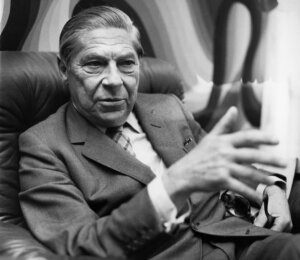
Arthur Koestler, circa 1980. Photo by Louis MONIER/Gamma-Rapho via Getty Images
We can guess how Lucien Camus might have responded. His son, Albert Camus, told and retold the story in his writings of his father who, having witnessed a public execution by guillotine, returned to the house, vomited in the sink, and never spoke about the experience. In the essay “Reflections on the Guillotine,” which accompanied Koestler’s, Camus suggested that rather than telling the condemned man or woman that they will pay the ultimate price or their debt to society for their crime, they instead be told the truth. “If you kill you will be imprisoned for months and years, torn between impossible death and constantly renewed terror, we shall slip into your cell…tie your hands behind your back [and] bind your arms with a strap to that you are forced to stoop [and] then carry you through the corridors [and] seize you by the seat of your pants and throw you on a board [then] let fall from a height of seven feet a 120 pound blade that will slice off your head like a razor.”
What, then, did the judge overseeing the 1995 trial tell Christa Pike when the sentence was rendered? The delivery system for death then was the electric chair and, to the judge’s credit, she did inform Pike that she would be subjected to a degree of electroshock sufficient to kill her. I do not know when the agent of death shifted from electroshock to pentobarbital nor do I know if a judge explained to Pike how the drug would act on her brain and organs to bring about her death. But I am pretty certain that none of the judges informed Pike of one legal scholar’s assessment of this form of death: “It is not the most humane, it is the most humane-looking.” I am even more certain they did not inform her, in case she survived another botched execution by the state of Tennessee, which boasts a history of such botches, that her brain would be irreversibly damaged.
Finally, I am most certain that, whether strangled by a tightened noose, decapitated by a sharpened blade, or injected by what was possibly an expired dose of pentobarbital, the sheer barbarism exercised by officials wearing white coats remains constant.
‘East of Eden’ was my family Bible — until I read the real one.
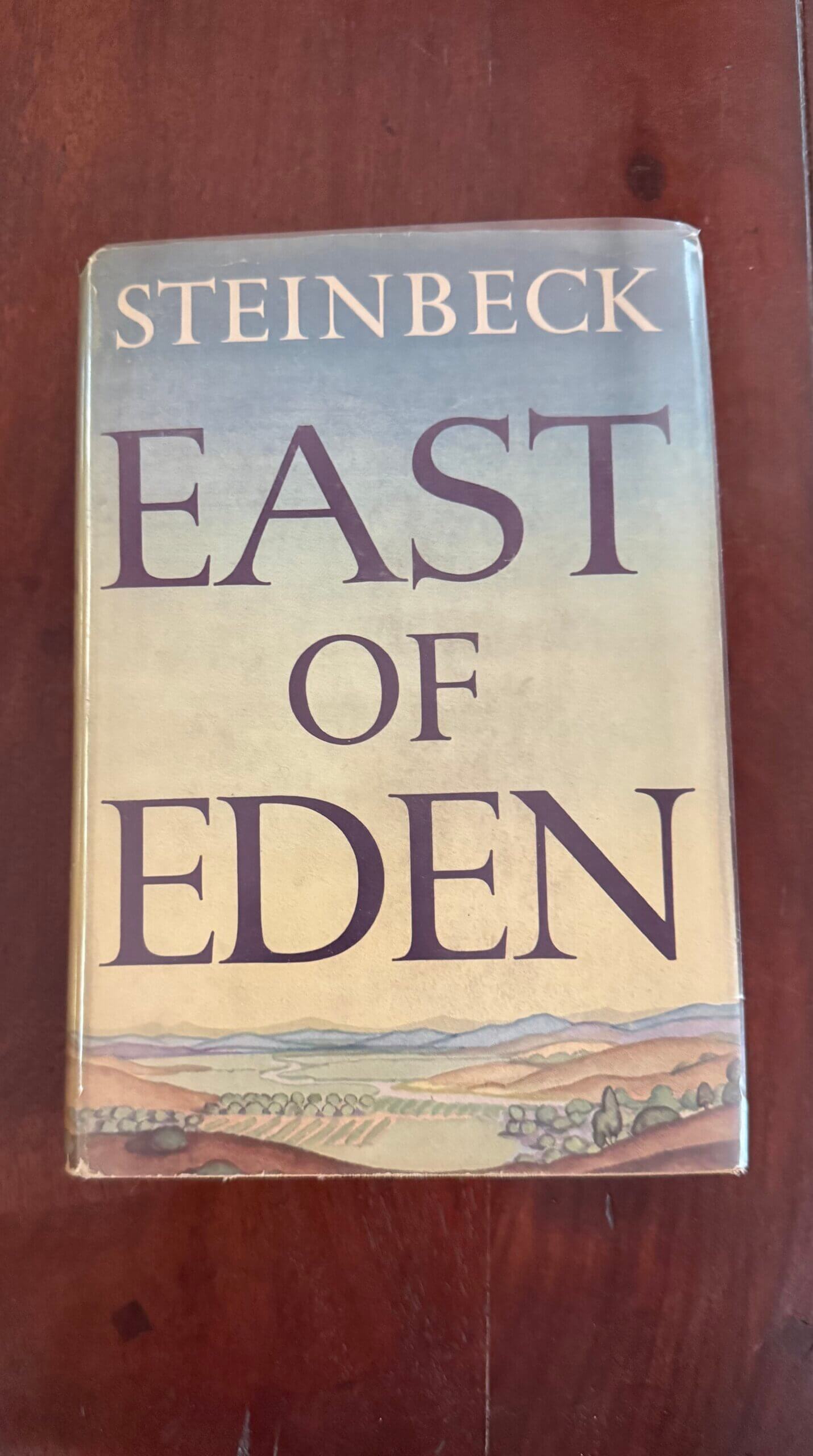
I didn’t know until recently whether the house I grew up in had a Bible, but I always knew we had a first edition of John Steinbeck’s East of Eden.
It’s my mother’s, gifted to her by her boss at Brattle Book Shop, an antiquarian book store in Boston, where she worked in college. Its dustjacket shows a pastoral scene, a simple rendering of a valley in greens and ochres. Were I to inherit it, and were it in better shape, it would be the most valuable thing I own. (In 1975 it went for $25.)
I never picked it up to actually read it: too precious. My own copy was a paperback with deckle edges. I left it behind on a communal shelf at a hostel in London for some other traveler 12 years ago during my first trip to Europe.
The novel, about three generations of the Trasks and how they struggle to earn their father’s approval, urges us to consider what we carry with us and what we discard. The question of legacy was certainly in the mind of Steinbeck, who considered it his masterpiece. While the author includes his mother’s side of the family, the Hamiltons, as characters, I’m not quite sure if he consciously linked his biblically-inspired epic to his paternal side’s short residence in the Holy Land.
Steinbeck’s grandfather Johann Adolf Großsteinbeck helped to establish an agricultural community, Har Hatikvah, outside of Jaffa in the 19th century. The community, made up of Christians who believed the end times were at hand, disbanded in 1858, after Johann’s brother Friedrich was killed in a raid by the locals.
Zoe Kazan’s Netflix adaptation of the book is hyper-aware of her own paternal grandfather, Elia Kazan, who adapted the film in 1955 with a smoldering star named James Dean. At the heart of her response is the word “timshel,” absent from her grandfather’s adaptation but central to Steinbeck’s book.
It’s not a real Hebrew word, but a poor transliteration that Steinbeck incompletely translated as “thou mayest.” To the characters, reading it from a verse in Genesis, it signifies an open path. In reintroducing the word to the story — a more holistic, and by my lights better, telling — Kazan has said she is showing that we have choices.
We can choose, for example, not to name names before the House Un-American Activities Committee as Elia Kazan did and, more to the point, we can opt to be different from our families and learn from their mistakes.
One line, spoken by the character Lee and tweaked slightly for the series, earns a new dimension with Zoe Kazan penning the script: “It’s easy to excuse yourself because of your ancestry, but whatever you do, it will be you who does it.”
The family Bible I was most familiar with. Courtesy of the author
Steinbeck, for his part, did not follow his forebears in settling Ottoman Palestine as a messianic Christian. He visited in 1966, when it was Israel, on assignment from Newsday to document the development of the new country. (His impressions, coming a year before the Six-Day War, were highly favorable; his pitstops included Masada and the remnants of his family’s settlement.)
My own differences from the older generation —I was the one who told my disappointed mother that Steinbeck botched his Hebrew — has been a process.
I hadn’t yet read Genesis when I first read East of Eden. Now that I have, I see many biblically mixed metaphors. The first patriarch Cyrus Trask — who perhaps ironically, given his inflated record as a Union soldier, shares the name of the king who liberated Jews from Babylon — lost a leg in the war, which could recall the injury Jacob sustained fighting the angel. In accepting the gift of one son and not the other, Cyrus also stands in for God the Father.
His sons are Adam and Charles (the first letters of their names tell us who’s Abel and who’s Cain), who are in fact half brothers like Isaac and Ishmael. Adam’s wife, Cathy, is the serpent — and Eve, Lilith, Satan, Jezebel and perhaps simply the concept of evil.
Adam and Cathy’s sons, Caleb and Aron, are twins, like Jacob and Esau, but their story replays that of Cain and Abel. The book’s title, taken from Genesis, refers to where Cain was cast out, is misleading. The book begins in Connecticut, Adam moves West to Salinas, California. Charles stays put and dies at home, never experiencing exile.
I didn’t grow up knowing all these beats from the Tanakh, and it’s beside the point, really, and yes, pedantic. Steinbeck’s genius is not in how closely he hews to the biblical narrative, but in how he finds the echoes that are there in the origin story of mankind and the Jewish people.
The dynamics we see in Cain and Abel travel down to Ishmael and Isaac, Jacob and Esau, Joseph and his brothers. In each of their stories is betrayal, favoritism and the common theme, as expressed by Sam Hamilton, the character modelled on Steinbeck’s grandfather, that when it comes to love “no one ever had enough,” a feeling that can induce even fratricide.
I never felt I lacked love, but there are less dramatic ways to disappoint one’s parents. I might have left my mother’s first edition in London instead of my ratty paperback. I’m sure I’d have been forgiven, but it’s better as an inheritance.
Is this Vermont farm the American kibbutz? I camped out there during Sukkot — and got a taste of Judaism’s ancient agrarian roots
Sukkot, the Jewish harvest festival, can feel a little abstract for Jews like me who live in big cities, far removed from the agricultural cycle that gave rise to the holiday. Typically, the extent of my fall harvest consists of buying a pumpkin from Trader Joe’s.
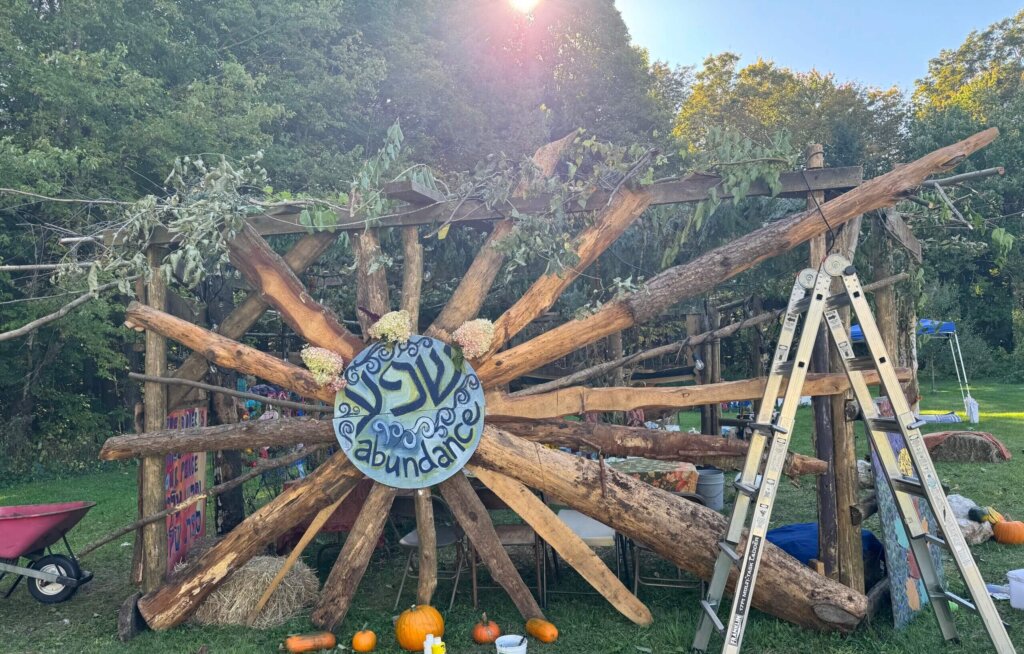
But last weekend, sleeping in a tent at Living Tree Alliance, a Jewish farm and co-housing community in rural Vermont, I found myself much closer to Sukkot’s agrarian roots. Rows of colorful produce stretched across the 93-acre property, much of it destined for the “stone soup” that would become our dinner the following night. Plants grown on the farm formed the sukkah’s schach, or roof covering.
“I forgot scissors,” Melanie Grubman, one of Living Tree’s founding members, told me as she cut yellow flowers off their stems with her teeth for material to decorate the sukkah.
About 16 people, including a few families with children, live on this bucolic property year-round, in what may be the closest American equivalent to an Israeli kibbutz. Residents are expected to volunteer between 8 and 16 hours per month, doing farm chores, serving on committees, managing the on-site AirBnB and keeping common spaces clean. All disagreements are resolved through a system of “sociocracy,” a governance model based on consent; decisions are made only when no one objects. On Shabbat, that work ceases, and chickens raised by residents are butchered kosher-style for dinner.
By living closer to the land, their food supply, and each other, residents say they feel closer to Judaism, too.
“It’s hard for me to pray not in the garden,” Grubman said. “I have no desire to sit inside when holiness is blowing on me.”
The Founders
Sephirah Oshkello. Photo by Hannah Feuer
Sephirah Oshkello, 54, barefoot and wearing a long purple tie-dye dress, swayed back and forth with the rhythm of prayers. As we went around the circle naming those in need before reciting the Mi Shebeirach, the prayer for healing, she offered, “Mama Earth.”
Oshkello, a Hebrew priestess, or kohenet, also works as a holistic nutritionist when she isn’t gardening or leading prayers.
This free-spirited lifestyle is a far cry from the environment in which she grew up. Oshkello was raised in Great Neck, New York, where she attended Temple Israel, a Conservative synagogue.
But after college at University of Maryland, she joined a community service program in Tzfat, Israel, where she got a taste of Jewish communal living, studied Jewish tradition, and spent her days hiking. From there, she spent a year living on an Israeli kibbutz.
“From then on, I felt like, I want to create something like this in the States,” Oshkello said. “Because when I went to Israel, my mom said, ‘OK, go, but you better come back.”
She returned to Great Neck and attended an Orthodox synagogue, but quickly realized it wasn’t the right fit.
“Judaism is connected to the land, and when the Jews got kicked out of their land, it became a culture of the book,” Oshkello said. “I do love to study words, but it only serves one part of our being, right? In Kabbalah, we talk about body, mind, spirit.”
The idea for Living Tree took shape on Oshkello’s second date with her now-husband, Craig, at a vegetarian restaurant in Seattle in 1997, when she told him about her dream to create an intentional Jewish community. The couple moved to secular co-housing in New Hampshire, where they began scouting property in Vermont and making plans for their own Jewish community.
In 2015, she and Craig bought the 93-acre Living Tree property in Moretown, Vt., then just a field with trees and a sugar shack, and moved there about a year later.
Grubman, a 47-year-old Waldorf teacher and owner of an all-women stonemasonry business in Vermont, was among the first residents. Like Oshkello, Grubman grew up in a suburban Jewish community — in her case, a “ritzy” Conservative synagogue outside Philadelphia. But she never connected with the idea of praying while sitting still inside.
“I was one of these angsty teenagers who was like, ‘Nature is busting through the concrete!’” Grubman said. “‘My heart is crying!’”
At Wesleyan University, Grubman became president of the environmental club and wrote her own eco-Haggadah for Passover. She later helped jumpstart Wilderness Torah, a program reconnecting Jews with the agricultural context of the Hebrew calendar, in Berkeley and Oakland, California.
Along the way, she encountered spiritual leaders who helped her understand that Jewish practice could look different from the Judaism of her childhood.
She remembered one rabbi who arrived for Yom Kippur “in white pajamas, covered in dirt.”
“And we were like, ‘Oh, what’s he doing?’ And he was like, ‘Oh, I was davening in the woods,’” Grubman said. “That’s the opposite of suburban Philadelphia Yom Kippur — when you show up in some fancy dress [that] you went to the mall to buy and gossip.”
Living Tree, Grubman said, offered a way to make Judaism a part of daily life beyond prayer and study.
“I felt like Judaism and like the world in general can be very intellectual. And I am a very intellectual person,” Grubman said. “But the more I link it to what I’m doing with my body and my hands, it just feels like it makes more sense to me.”
‘Shtetl Vibes’
There’s a long history of Jews who have sought to build communal, self-sufficient communities. But turning that ideal into a sustainable way of life has always been complicated.
The first kibbutz was established in Ottoman Palestine in 1910; the movement expanded after Israel’s founding in 1948. But the kibbutz system largely collapsed during the country’s financial crisis in the 1980s, when the utopian socialist model slowly gave way to a privatized version. Kibbutzim retained many of their collectivist values, but residents no longer pooled their incomes, raised their children together, or lived completely off the land.
American Jews experimented with communal living, too. During the back-to-the-land movement of the 1960s and ’70s, tens of thousands of young, college-educated city dwellers moved to rural Vermont as part of a countercultural movement. While few communes were explicitly Jewish, residents included many Jewish hippies. (Sen. Bernie Sanders, who briefly lived on an Israeli kibbutz in his twenties, was kicked off a Vermont commune for allegedly loafing around and talking about politics rather than working the land.)
But few of those experiments lasted as fully communal settlements.
Today, efforts to revive Jewish communal living are taking new forms. Young Jews live together through organizations like Moishe House, where residents get subsidized rent in exchange for planning Jewish community events. In Berkeley, an urban Jewish cohousing community called Berkeley Moshav is under construction; residents will own condos and make collective decisions about shared spaces.
Living Tree Alliance, which operates as both a nonprofit and a homeowners association, has seemed to stand the test of time — it has been hosting residents for over a decade. But like the modern kibbutzim, it’s not a full escape from the trappings of capitalism: Residents, most of whom have day jobs outside their farming responsibilities, don’t share income, and they own their own homes while co-owning the surrounding land.
Grubman, who works three jobs, cringed when I asked if Living Tree sometimes felt like utopia.
“It actually is a lot of work. It’s really really challenging,” Grubman said. “But what else are you going to do? Look at your screen?”
Many of the residents I spoke to were attracted to Living Tree as an escape from modern malaise.
Gil Ben Moshe and Ella Sutherland moved to Living Tree a few months ago with their three children, ages 2, 5 and 14. The couple met at an anarchist community in northern California and co-founded an intentional community in Virginia. After deciding they wanted a Jewish co-housing community instead, they found Living Tree online and moved.
Ben Moshe, wearing a kippah over his long hair, a plaid flannel, and no shoes or socks, has fond memories of living on an Israeli kibbutz until he was 4, when his family moved to the city of Eilat. The transition to urban life was jarring, he said, and he vowed to eventually return to the pastoral life of his early childhood.
“I’ve been so shocked at the discrepancy between people really believing that community is the right way to live, but not actually meaning it when they say it,” Ben Moshe said. “People’s relationship with spirituality is one that resembles more of their shelf with porcelain knickknacks … it’s not their daily bread.”
Arielle Sabot, a 28-year-old who uses they/them pronouns, worked as an apprentice at Living Tree for a year beginning in 2023. They now live in the Boston area, where they attend a traditional egalitarian synagogue and work as an outdoor Jewish educator.
While at Living Tree, they lived in a tiny cabin that lacked running water. During the winter, they chopped their own wood to heat the cabin with a wood-burning stove.
The arrangement wasn’t always idyllic. There were no flush toilets. Dishes, which Sabot had to boil water to wash, could pile up. And living alongside neighbors who were also co-workers could get tense sometimes.
But that proximity, Sabot said, also made some aspects of Jewish life feel more manageable.
“I think it’s easier when your community is right outside your door,” Sabot said. “You don’t have to go somewhere. It was shtetl vibes.”
Getting Outside
Since Living Tree was founded more than a decade ago, organizations explicitly linking Jewish spirituality and the natural world have been “growing exponentially,” Oshkello said.
A 2014 national study helped document the growth of what it dubbed Jewish Outdoor, Food and Environmental Education, or JOFEE, and found more than 2,400 people had participated in immersive Jewish outdoors programs the previous year. In 2025, Adamah, one of the movement’s largest organizations, reported more than 45,000 participants in its programs, including almost 10,000 Jewish teens and college students.
Vermont is especially fertile ground for this kind of experiential Judaism. On Shavuot, Living Tree and the Jewish Community of Greater Stowe hike Mount Mansfield, the state’s tallest peak, carrying a Torah for a small taste of what Moses may have felt ascending Mount Sinai to receive the Ten Commandments. On Tu B’Shvat, Jewish Vermonters snowshoe beneath the full moon, stopping at different trees for reflection, poetry and song. And then there’s “Ski Ride Purim,” when skiers and snowboarders hit the slopes in costume, eating hamantaschen along the way.
“Vermonters are going to be outside as much as we can,” said Beth Liberman, executive director of Jewish Communities of Vermont, the state’s Jewish umbrella organization. “We’re bringing Judaism where it connects for so many people.”
There may be an even larger Jewish constituency to capture: In a 2020 Pew Research Center survey, 51% of American Jews said they derived a great deal of meaning and fulfillment from being outdoors — more than twice the share who said the same about their religious faith.
The Jewish connection with the outdoors was a major draw for Talia Wilk, a 20-year-old spending two weeks at Living Tree through a fellowship program. Wilk said she grew up going to Jewish summer camp, where Judaism felt intertwined with being in nature. Now living in Toronto, she works as a Hebrew school teacher and an educator at an outdoors school. When she heard about the Living Tree fellowship, she jumped at the chance.
“I’ve always had that kind of longing for a space where Jewish holidays and rituals are really connected to the seasons and to the land,” Wilk said.
For Sabot, residing at Living Tree changed their relationship to the Jewish lunar calendar. In Vermont, where the seasonal changes are particularly dramatic — lush greenery in summer, brilliant foliage in fall, mud in spring, and snow in winter — Jewish holidays timed around an agrarian cycle feel more tangible, Sabot said.
Younger Jews in particular, Oshkello said, connect with the idea of getting outside over sitting in pews.
“This next generation, they don’t want to be bored and sit and listen to other people preach,” Oshkello said.
A Forward reporter settles in for the night. Image by
At Living Tree, I began to understand what that connection could feel like. I awoke in my tent around 6 a.m. to the sunrise and roosters cock-a-doodle-dooing as my alarm. Meditating in the sukkah, we took deep breaths and placed our hands on the earth. Eating potluck dinner, we were invited to reflect on the journey of our food, from seed to mouth. On my last day, we learned how to press apples to make hot cider and pickle cabbage.
After three days immersing myself in nature, I headed back toward New York City, eager to take a hot shower and sleep in my own bed.
But the next morning, I found myself missing the fresh air and the feeling of being outside. All weekend, residents had talked about getting Judaism out of their heads and into their bodies. Crammed into the subway on my morning commute, I understood what they meant.