


Uncategorized
Jews mobilized for Darfur 20 years ago. As violence surges again, where are they now?
They spoke of genocide and “Never Again.” They pushed to divest from entities that supported the offending government.
They protested the government’s blockade of humanitarian aid to the disputed region. They were arrested while protesting outside of an embassy.
The thousands of Jews who bused and flew to the National Mall from across the country on April 30, 2006 to call for these things fought on a platform that would be instantly recognizable to today’s pro-Palestinian protesters. But they were not there for Gaza. They were there for Darfur.
“Our halacha dictates that we help save lives,” Rebecca Stone, a Yeshiva University student who organized a fleet of buses from the Modern Orthodox school, told the Jewish Telegraphic Agency at the time, referring to Jewish law. “Apathy is really antithetical to Torah values.”
The Save Darfur Coalition sprung into being in the mid-2000s in response to the haunting spike in murders orchestrated by Sudanese dictator Omar al-Bashir, whose Arab Islamist government waged a civil war against ethnic African tribes in the country’s Darfur region. They would eventually kill an estimated 300,000 civilians and displace another 2.7 million.
Many of the coalition’s loudest voices were Jewish, and cited what they saw as a uniquely Jewish imperative to prevent genocide. Together, they worked to elevate Darfur as a significant foreign policy issue.
“The American Jewish community has been absolutely vital in uplifting the issue of Darfur, the crisis in Darfur, and the situation in Sudan in general in the American consciousness,” Noah Gottschalk, chief external relations officer for the Jewish immigrant aid group HIAS, said in a recent interview. “When you look at the organizations that were founded in the aftermath of the genocide in 2003, so many Jewish organizations were part of that.”
Today, six years after the end of al-Bashir’s reign and 14 years after the founding of South Sudan as an independent country, Darfur is again descending into chaos as the RSF, Sudan’s government-backed paramilitary forces, have laid siege to the town of el-Fasher. More than 150,000 people have been killed, and another 12 million have been forcibly displaced. Rape, kidnapping and famine are rampant. The bloodshed is so extreme that it is visible from space.
Yet nothing like the Save Darfur Coalition has been reconstituted on the activist front — neither by the mainstream Jewish groups who mobilized for the cause two decades ago, nor the progressive left that activated so strongly over what they deemed a genocide in Gaza, during the war that followed Hamas’ Oct. 7, 2023, attack on Israel.
“At this time, and simply for capacity reasons, we are not actively engaged in efforts around the ongoing tragedy in Darfur,” Barbara Weinstein, associate director of the Religious Action Center at the Union for Reform Judaism, told JTA.

Ruth Messinger attends the New York Action 2015 global mobilization event on Sept. 24, 2015 in New York City. (Brad Barket/Getty Images for Action/2015)
“The Jewish community has legitimately had several dramatic issues that have raised attention and concern, and often caused crisis, in the last three years, particularly Oct. 7 and rising antisemitism,” Ruth Messinger, the longtime head of American Jewish World Service and former New York City mayoral candidate who co-founded the Save Darfur Coalition, told JTA.
Messinger continued, “Those issues have appropriately concerned the Jewish communities around the world, and so concerned the Jewish communities that it’s been hard to create space for other concerns.”
It’s a conclusion that would have been foreign to Messinger two decades ago. Back then, she was at the forefront of a movement to take the lessons of the Holocaust, still relatively fresh, and apply them to a contemporary crisis.
She and others were haunted by the 1994 genocide in Rwanda, which occurred over just 100 days when the country’s Hutu government led an attempted purge of its Tutsi ethnic minority. An estimated 1 million Tutsis were massacred, and the speed and scale of the killings — many of which took place in churches, or in open fields in broad daylight — shocked the global consciousness.
Later, President Bill Clinton said he would have taken stronger action against genocide in Rwanda if he had known more at the time. Messinger and other Jewish leaders — those who had embraced the Never Again ethos 50 years after the term genocide was coined in the wake of the Holocaust — took that as a charge.
“There were a lot of people in the Jewish community who felt like we had missed the boat on Rwanda,” Messinger recalled. “We considered ourselves watchdogs for the potential next genocide.”
When, a few short years later, New York Times columnist Nicholas Kristof started writing regularly about the crisis in Darfur, Messinger and others — a group including Rabbi Steve Gutow, diplomat Samantha Power and the Holocaust survivor and Nobelist Elie Wiesel— paid attention. In a meeting organized by American Jewish World Service and the U.S. Holocaust Memorial Museum, Wiesel directly implored Jewish leaders to do something.
“I will never forget that meeting as Wiesel addressed us in his soft-spoken, yet powerful, voice,” recalled Rabbi Marla Feldman, director emeritus of Women of Reform Judaism, who worked on social justice issues with the Reform Action Center at the time. “He looked directly at each of us gathered around, impressing upon us our personal responsibility to take action. No one could say no to his charge to organize that day.”
They decided to throw everything they had into mobilizing on Darfur. The coalition was born.
“Everyone who came to the meeting said, ‘Well, let’s continue working together, and we’ll call ourselves the Save Darfur Coalition,’” recalled Jerry Fowler, now a law professor at the University of Wyoming. At the time Fowler was the (non-Jewish) director for the Committee on Conscience — a division at the U.S. Holocaust Memorial Museum committed to applying the lessons of the Holocaust toward preventing future genocides.
The museum, and more specifically the Committee on Conscience, played a significant role in elevating the crisis in Darfur within the Jewish community by issuing a rare warning that the region was at risk of tipping into genocide. When, in 2004, the U.S. government declared that the Sudanese government and its related militia groups, including the Janjaweed, were indeed committing genocide in Darfur, citing the United Nations Genocide Convention, the combined effect was to put Darfur on the map as a Jewish issue.

Rabbi David Saperstein (center foreground) and Jerry Greenfield (background) of Ben & Jerry’s ice cream fame, are arrested outside the Sudanese embassy during a protest against the genocide in Darfur, July 29, 2004, Washington, D.C. (Marvin Joseph/The Washington Post via Getty Images)
“Social justice is a huge component of the way American Jewry expresses their Jewish identity,” said Rabbi David Saperstein, director emeritus of the Union for Reform Judaism’s Religious Action Center. He was an active figure in both the Save Darfur Coalition and an earlier movement to push for a peace accord to end the Second Sudanese Civil War.
Quickly, Saperstein recalled, “Save Darfur” signs made their way into synagogues across the country.
“Many people put Darfur into their Passover Seders,” he said. “That helped deepen the connection [to] people forced to flee out of oppression and persecution, and what it was like to live in the desert, in a place not your home, with the hope of finding safety and security.” American Jewish World Service encouraged such identification by distributing Darfur-specific seder material.
Back then, Darfur crossed Jewish denominational boundaries. Everyone from the Union for Reform Judaism’s advocacy arm to the Conservative summer camp Camp Ramah to Yeshiva University engaged on the issue. Synagogues jumped onboard “Nothing But Net,” a UN-led initiative to raise funds to send malaria nets to refugee camps — and raised enough on their own to fully stock several camps. Young observant Jews would go on to intern with Darfur policy groups and bring their activism to the upper levers of power.

Union for Reform Judaism leaders distribute bed nets to Sudanese refugees in Dabaab, Kenya, as part of their organizational efforts with the Save Darfur Coalition, Feb. 10, 2009. Rabbi Marla Feldman, at the time a leader of social justice issues with the Religious Action Center, is second from left. (Claudio Gallone)
“I have this vivid memory of sitting in the Beit Knesset at camp listening to a Jewish World Watch staffer talk about the Janjaweed and show photos of devastated villages,” Ami Fields-Meyer, a fellow at the Harvard Kennedy School and former White House policy advisor under former President Joe Biden, recalled about his time at Camp Ramah. “It was shocking. It was almost certainly my first exposure to human rights work.”
Adam Zuckerman was a 17-year-old high school student in Maine when Messinger came to his Portland synagogue to speak about Darfur. He was immediately engaged on the issue, making close friends with members of the state’s large Sudanese refugee community and riding buses to D.C. with them.
“I think a lot of it was that, with the legacy of the Holocaust, we had a responsibility to make sure that it never happened again to anyone,” Zuckerman recalled, about the pitch to Jews for getting involved in Darfur. “That was a sort of driving force in why I took on anti-genocide work.”
His friends in the refugee community included El-Fadel Arbab, a genocide survivor who spent nine years trying to enter the United States before finally being granted passage in 2004. Upon his arrival in Maine, Arbab was embraced by local Jewish groups. He would go on to tell his harrowing story, involving fleeing his village and living on the street as a child, at synagogues and Holocaust museums in the state and beyond.
Arbab quickly felt a kinship with his Jewish allies and supporters, rooted in shared trauma: what Darfur villagers suffered at the hands of the Sudanese groups had morbid similarities with the Jewish victims of the Holocaust.
“What they went through is also remarkable,” he told JTA. “So many Jewish people have been killed. Millions and millions have been killed. They’ve been tortured, they’ve been burned alive. And this is not right.”
Besides the brutality, the Jewish comparison also inspired Arbab — particularly the refrain “Never again,” which he often repeats himself. “They’re still fighting for justice. They’re saying, ‘These victims will learn from the history.’”
A list of the biggest voices within Save Darfur included some of the most prominent Jews in America at the time.
Speakers at the National Mall rally included Messinger; Saperstein; National Jewish Democratic Council director Steve Gutow; Rabbi Rick Jacobs of the Union for Reform Judaism, before he became its president; and Rabbi Marc Schneier.
They shared the stage with then-Sen. Barack Obama, months before he announced his presidential bid; the top Democrat in Congress, Nancy Pelosi; actor George Clooney; and a range of Sudanese and interfaith activists. “I don’t think there have been many rallies like it in recent years,” Feldman said.

Elie Wiesel speaks at a Save Darfur rally at the National Mall, Washington, D.C., April 30, 2006. (Screenshot via C-SPAN)
But perhaps the most noteworthy person to grace the stage was Wiesel, who had vocally lobbied not only on behalf of Rwanda but also over the plight of Soviet Jews. It was Wiesel who had inaugurated the U.S. Holocaust Memorial Museum’s Committee on Conscience in the first place, to, in the words of the committee’s mandate, “alert the national conscience, influence policy makers, and stimulate worldwide action to confront and work to halt acts of genocide or related crimes against humanity.”
Only a few months earlier, in January 2006, “Night,” Wiesel’s memoir of the concentration camps, was chosen as an Oprah’s Book Club selection 50 years after its original publication. Though already a bestseller, the Oprah exposure introduced “Night” to a new generation of readers and reinforced Wiesel as a global authority on humanitarian crises.
He threw all of that leverage behind Darfur.
“I, as a Jew, am here because when we needed people to come to help us, nobody came. Therefore, we are here,” Wiesel told the National Mall crowd. “I am here as a member of the human family, and we believe that we sinned with Rwanda. We could have saved 6-800,000 men, women and children in Rwanda, and we did not, and the world should be ashamed for that.”
Over applause, he continued, “We are here because in Darfur, families are being uprooted, starved; children tormented and slaughtered in the thousands; and in the eyes of the victims, the world remains indifferent to their plight. We are here because we refuse to be silent. Remember, silence helps the killer, never his victims.”
It was a galvanizing moment, an explicit bridging from the Jewish communal trauma of the Holocaust to the modern-day tragedy in a far-off corner of the world with no obvious Jewish connection. To Wiesel, it just made sense.
“For my father, there was no split between doing what was right on the global stage and standing up for the Jewish community,” Elisha Wiesel, Elie Wiesel’s son, told JTA. “It wasn’t like those were two completely separate projects. My father felt that to be a good Jew meant to stand up and do the right thing on a global scale.”
And there was a divestment push within the Jewish community. The Reconstructionist Rabbinical College, under pressure from its members, divested its holdings from companies that did business with the Sudanese government, as a means of economically hurting al-Bashir’s regime. In so doing, it joined dozens of similar actions from the country’s leading universities, including Harvard, Columbia, and MIT, all celebrated by the activist group Investors Against Genocide. (A spokesperson for the Reconstructionist movement declined to comment for this story.)
Sustained Jewish activism around Darfur continued for years. In 2009, Jewish leaders were arrested for staging a demonstration outside the Sudanese Embassy in protest of al-Bashir’s expulsion of more than a dozen aid groups from Darfur. The rabbis were joined at the protest by Democrats including civil rights leader John Lewis. Several Jewish leaders also signed a Save Darfur Coalition letter urging Obama — then president — to resume humanitarian aid in Sudan.
The following year, a delegation of Jewish leaders — including Messinger, Saperstein and Jacobs — traveled to visit a camp for Darfur refugees just over the border in Chad. The trip happened to coincide with the holiday of Sukkot, which, like the Passover Seders before it, drove home the Jewish resonance of the cause.
“To see people living out in the open and eating out in the open,” Saperstein said, “had a particular resonance for us.”
As the years passed, the focus and methods of the Save Darfur Coalition attracted scrutiny and criticism from some corners. “Darfur Wasn’t Saved,” Slate declared in 2017 in a postmortem; groups like Genocide Watch have reached similar conclusions.
Critics dinged the movement for proposing the wrong policy solutions; for infighting among leadership; and for failing to steer more of its own financial resources toward direct aid, among other issues. Some, as early as 2006, were already accusing the movement and its Jewish leaders of using Darfur to ignore Israeli conduct in Gaza — which had just elected Hamas to power earlier that year.

Columbia University professor Mahmood Mamdani (right) with son Zohran and wife Mira Nair at a mayoral campaign event for Zohran, June 24, 2025, New York, New York. (Michael M. Santiago/Getty Images)
One of the foremost critics of the Save Darfur movement was Mahmood Mamdani, the Ugandan-born Columbia University professor, prominent critic of Israel and father of New York City’s mayor-elect.
In his 2009 book Saviors and Survivors: Darfur, Politics and the War on Terror, Mamdani argued that Darfur did not constitute a genocide; that those who applied the label may have been operating from a prejudiced perspective against Islam; that activists like those in the coalition didn’t have the proper context for the situation; and that Western intervention may have made the conflict worse. In promoting the book, Mamdani also didn’t mince words in criticizing the Save Darfur Coalition.
“Save Darfur is telling its supporters that the lesson of Rwanda is that there’s no point in talking about causes of conflicts,” Mamdani said on WNYC’s “The Takeaway” in April 2009.
Strains of dissent could also be heard from within the Jewish world, where some argued against what they saw as a conflation of Jewish and progressive values. “Health care, labor unions, public-school education, feminism, abortion rights, gay marriage, globalization, U.S. foreign policy, Darfur: on everything Judaism has a position — and, wondrously, this position just happens to coincide with that of the American liberal Left,” the Israeli writer Hillel Halkin complained in the conservative Jewish magazine Commentary in 2008.
But the Darfur coalition transcended typical ideological divides, including a wide array of Jewish groups as well as fundamentalist Christians and figures motivated by anti-Islam animus. The combination could be awkward. A series of rapid leadership changes, accusations of financial mismanagement and other infighting through the late 2000s led to the group’s ultimate collapse as a viable political force. Jewish communal leaders who spoke to JTA acknowledged that the coalition’s momentum couldn’t be sustained, but they believed that it had a lasting effect, particularly on Jewish communal organizing.
Zuckerman went on to become a close disciple of Messinger at the American Jewish World Service. Today he works for Public Citizen, a progressive group, on environmental issues.
He credits his Darfur activism with his trajectory, as well as for something else: his pro-Palestinian activism, which he has expressed through work in IfNotNow as well as with Jewish Action Maine, a group affiliated with the local Jewish Voice for Peace chapter.
“It’s been tricky, because I don’t feel like I necessarily fit into a box on it, and I am uncomfortable with some of the rhetoric and some of the slogans in these spaces,” Zuckerman said.
At the same time, he said, “I think it would be hypocritical for me to speak out about Darfur and not say anything when people who share my religion are also committing atrocities.”

A man amongst a group of African refugees, mostly from Sudan’s troubled Darfur region, visits the Yad Vashem Holocaust Memorial Museum on Aug., 2009 in Jerusalem, commemorating the six million Jews killed by the Nazis during World War II. (Uriel Sinai/Getty Images)
Israel itself got involved in the initial round of Darfur activism, allowing hundreds of refugees from the region to apply for asylum there. (Upon arrival some of the refugees visited Yad Vashem, the national Holocaust museum.) Most of those asylum cases, which were handled by HIAS and did not involve Jews, took years to work their way through Israeli courts before a judge granted the Sudanese asylum seekers temporary status last year.
Today much of the same Jewish institutional muscle that once advocated for Darfur has turned inward, toward fighting antisemitism and shoring up Jewish support for Israel since Oct. 7. That has included fending off accusations that Israel has committed genocide in Gaza.
Over the last two years, Jews have at times disputed statistics and declarations about the state of Gaza’s humanitarian crisis — including allegations that Israel, like Sudan before it, has deliberately withheld humanitarian aid from a conflict zone — that come from the United Nations and various NGOs they had previously worked together with on Darfur causes. Jewish leaders, including at the RAC, have objected to resolutions to boycott or divest from Israel, usually on the grounds that such measures are divisive and unhelpful or can lead to antisemitism.
This has saddened some of the more progressive Jews who saw, in the Darfur fight, a commitment to a kind of universalism of Jewish values they now believe has atrophied.
“I don’t think our voice would have the same weight or the same legitimacy that it has now to speak out on Darfur, because we’ve been so silent, and in many cases so oppositional, to what’s been happening in Gaza,” Zuckerman said. “I think that when we are silent about something that people who share our religion are perpetrating, the world would look at us sort of sideways to be speaking out about [Darfur]. I think it would be seen as trying to distract from other crimes against humanity that are happening in another part of the world.”
Others worry that the fight over whether or when to declare a genocide is blinding people, including Jews, from focusing on what’s really important.
“The term ‘genocide’ is being used in different ways today than in the past, and that’s itself a challenge,” Feldman said. “You could get caught up in the wordsmithing of it — call it genocide, don’t call it genocide. There are atrocities and tragedies taking place around the world, and that speaks to us, and that has a claim on us.”
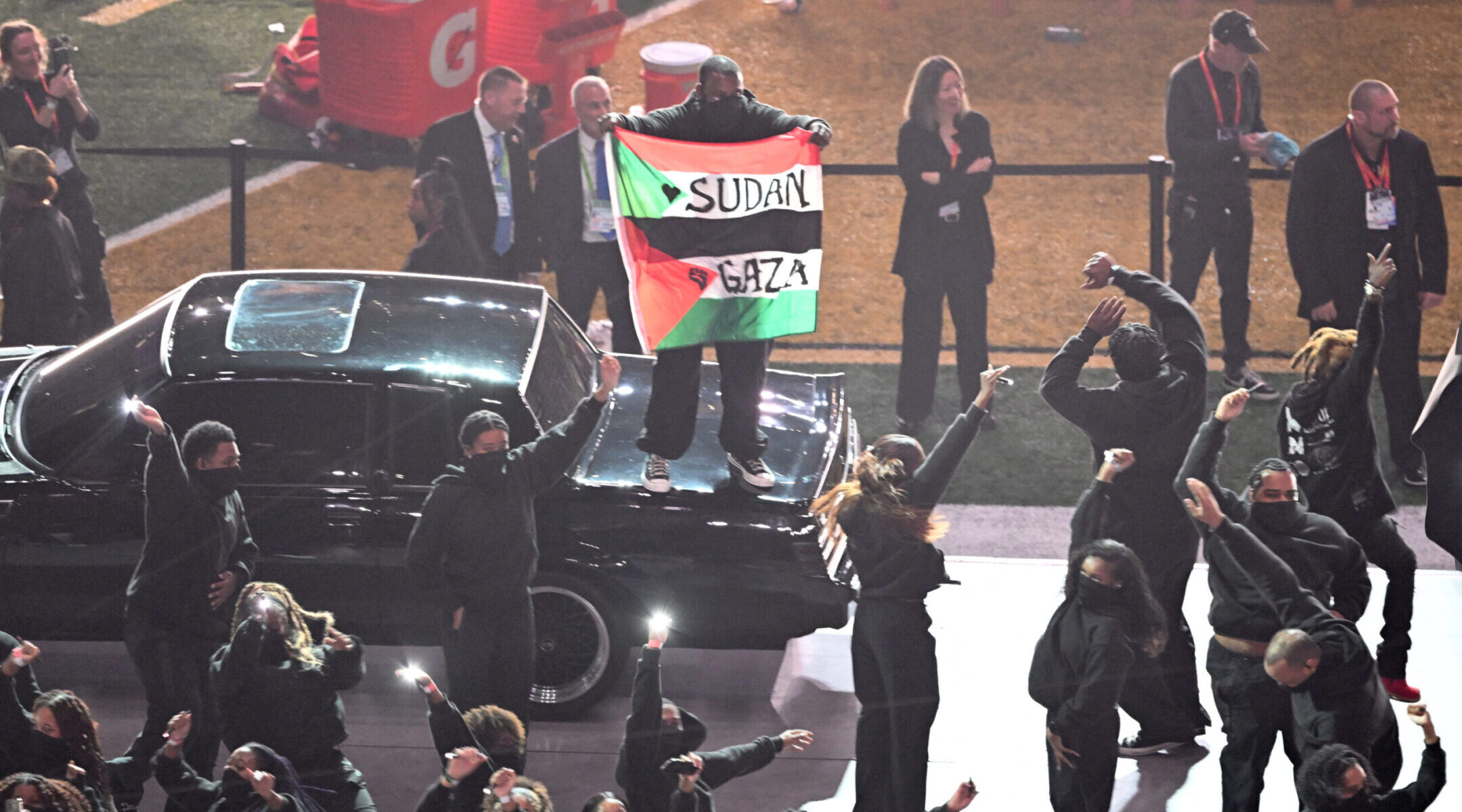
A protester holds a Sudan/Palestinian flag with the words “Gaza” and “Sudan” as US rapper Kendrick Lamar performs during the Super Bowl LIX halftime show, Feb. 9, 2025. (Chandan Khanna/AFP via Getty Images)
Meanwhile, with some exceptions, the global pro-Palestinian movement has also been relatively quiet on Darfur — further lending itself to criticisms that a purported principled stance against genocide didn’t extend further than Israel. Many Jews in a post-Oct. 7 climate have noted a fraying of the kinds of interfaith, intercultural alliances that once helped bolster the Save Darfur Coalition.
Jews who spoke to JTA for this article had mixed feelings on this shift. But some were quick to point out that they don’t see Darfur and Gaza as comparable.
“It’s not a parallel thing because you didn’t have an Oct. 7 in Darfur,” Saperstein said. “You didn’t have the people of Darfur attack the population centers where the Janjaweed were. This is just civilians caught in the middle of a horrible, horrible attack from the north and from the Janjaweed militias.”
Elisha Wiesel, like his father a staunch supporter of Israel, also believes Jews’ relative silence on Darfur in the wake of Gaza is a problem. In part, he said, he feared that Jews were allowing terms like “genocide” to become diluted by pro-Palestinian activists.
“I think we have to restore language to its proper use, and we have to call it as we see it,” he said, noting that the Wiesel family foundation has taken on the cause of the persecuted Uyghur minority in China. Similarly, the best way to assert Jewish credibility on the world stage, he argued, would be for Jews to advocate both for Israel and for global humanitarian concerns like Darfur.
“Since Oct. 7 we’ve been reeling, as an American Jewish community, with our own tragedy. And worse, we’ve been having to be on the back foot as accusations of genocide have been flung at Israel,” Wiesel said. “I feel now is the right time to reengage. I think the best way forward is to tackle real genocides.”
Arbab, the Darfur genocide survivor, also disagrees with the genocide label being applied to Gaza. He described feeling an immense empathy for Jews and Israelis after Oct. 7, noting that the brutal nature of the Hamas killings at the Nova music festival mirrored the nature of how the RSF and other Sudanese militias have targeted innocents.
“These monsters, they jumped on people partying, and they’re butchering everybody,” he said. “Israelis want to protect their people and their land, and they come and attack them.”

El-Fadel Arbab, a Sudanese refugee from the Darfur region, reunites with his family in the United States after they fled the region amid reignited hostilities, March 2024, Boston, Massachusetts. Arbab has allied with the Jewish community to advocate for Darfur’s victims. (Courtesy of El-Fadel Arbab)
Arbab continued, “If you’ve been through this struggle, you definitely will say, ‘I stand with Israel.’ If you did not go through these horrible things, you might go to the other side, you might say, ‘Oh, I will support the Palestinians.’ But that is not the case to me. If I have the power, I will protect my people. And anybody who comes to my people, I’m not going to leave them alone.”
Times have changed, some of Save Darfur’s Jewish leaders said. Even setting aside Gaza, the sheer scope and scale of the world’s challenges today means that pushing Jews to mobilize around something like Darfur has become much harder.
“We can’t fight every crisis everywhere,” Feldman, now retired, told JTA. “The current leaders have to be strategic, and the population, to a certain extent, is also going to speak with their feet in terms of what’s compelling them today.”
For more progressive Jews who cut their activist teeth on Darfur, the relative inaction — not just from Jewish communities, but more globally as well — especially stings.
“Darfur was in every Jewish space. And it felt like everyone had a green ‘do not stand idly by’ wristband,” Fields-Meyer recalled. “The unmistakable message was that our moral obligations as Jews bound us to people for no other reason other than that they are human. And a lot of us took that to heart. I certainly did.”
He continued, “Being consistent about those Jewish commitments means doing what’s necessary for families being torn apart by masked agents in Los Angeles, and for children under bombardment in Gaza, and for people under threat in Darfur, and for fellow Jews who are attacked for their identity. It means that there is no hierarchy of human dignity. We’re all worthy.”

A map of two years of hostilities in Darfur as of April 11, 2025. (AFP via Getty Images)
Today, the forces that are engaged on Darfur are trying to put pressure on the United Arab Emirates, currently Sudan’s largest arms dealer. President Donald Trump also signaled an interest in ending the conflict and dispatched Massad Boulos — a Lebanese-American businessman and Tiffany Trump’s father-in-law, who has also proposed a roadmap to Israeli-Palestinian peace — to try to negotiate a ceasefire.
But recent failed ceasefire efforts have led the United States to consider wider sanctions on Sudan. On Dec. 9, the Treasury Department seemed to follow through, sanctioning entities associated with a Colombian group that, the United States said, was funneling mercenaries to Darfur.
Some remain optimistic that American Jewish leadership could reactivate on Darfur today — and believe that it would be the right thing to do.
“I’m hopeful that there will be really positive energy for Darfur,” said Gottschalk, the HIAS staffer. He noted that HIAS, which operates a refugee camp in neighboring Chad, has remained active since the last conflict and is engaged again on Darfur today — in part thanks to the legacy of the coalition. “We haven’t left. It’s been more than 20 years. It’s an expression of the Jewish community’s solidarity.”

People displaced from El Fasher and other conflict-affected areas are settled in the newly established El-Afadh camp in Al Dabbah, in Sudan’s Northern State, on Nov. 9, 2025. Tens of thousands were forced to flee after the Rapid Support Forces (RSF) took control of the city of El Fasher on Oct. 26, triggering intensified clashes across North Darfur. (Stringer/Anadolu via Getty Images)
He continued, “When we’re working with people in Chad, we are absolutely the first and probably the only Jewish organization they’ve ever met or ever encountered with. We are representing our values and reflecting something really positive with the community.”
Today, Arbab still has family in Darfur under grave danger, though he was able to evacuate his wife and sons out of the region last year. He knows it’s harder now to get the international community to pay attention. He’s still speaking to some Jewish groups, though not as many as before.
The Sudanese government, he believes, fears the accountability that would come with the genocide label being applied once more to Darfur. He hopes the global community will activate again — and this time try to break the cycle of killing for good.
“The Jewish people, they went through their genocide a long time ago,” he said. “But the genocide now is the same, and even worse. These criminals, always, they’re thinking of new tactics and new ways to do more genocide, how to harm people. We have to stop that. Especially those who have felt the pain of the victims, they have to stand up.”
This article originally appeared on JTA.org.
The post Jews mobilized for Darfur 20 years ago. As violence surges again, where are they now? appeared first on The Forward.
Uncategorized
Herzog calls for crackdown on violent West Bank settlers as olive harvest tensions mount
(JTA) — BUDAPEST, Hungary — Israeli President Isaac Herzog is backing senior Israel Defense Forces commanders in taking decisive action against violent settler attacks in the West Bank, he told the Jewish Telegraphic Agency.
His comments came a day before Israeli forces detained New York Democratic congressional candidate Brad Lander along with 90 rabbis and activists accompanying Palestinian farmers during the olive harvest.
At a press briefing in Budapest, JTA asked Herzog what action had been taken to curb settler violence following his previous calls for a stronger government response. Herzog pointed to a meeting he held earlier this month with the IDF’s West Bank division commander and other senior officers.
“I looked them in the eye and I gave them full backing to do whatever it takes to stop this terrible phenomenon,” he said.
The goal was to end the settler violence “at its roots,” Herzog said, adding that “major efforts” were underway.
Israeli police arrested 10 suspects following a series of settler attacks over the weekend, including a violent assault on Washington Post photojournalist Heidi Levine. Nine of those suspects were released from custody, Haaretz reported on Wednesday.
IDF Chief of Staff Lt. Gen. Eyal Zamir ordered the deployment of an additional Border Police company to the West Bank to combat extremist violence. The unit is expected to begin operations in late November.
Herzog had personally called Levine on Saturday to apologize for the attack, which left her with four broken vertebrae and other injuries. “I was morally tormented during Shabbat when I thought about it, and I express deep sorrow and apologize for what you went through,” he told her.
The attacks have drawn condemnation from the U.S. and European governments. On Sunday, the European Union called for Israel to take “full accountability” in preventing further violence against Palestinians, journalists and diplomats.
During his visit Tuesday, Herzog met with Hungarian President András Baka and Prime Minister Péter Magyar, whose government ended its predecessor’s opposition to EU sanctions against extremist Israeli settlers.
Herzog’s visit was the first by a senior Israeli leader since Magyar defeated longtime Prime Minister Viktor Orbán, a close ally of Israel and Prime Minister Benjamin Netanyahu, in April. At a joint appearance, Baka described relations with Israel as “cordial and stable,” while Herzog called Hungary a “friend and an ally.”
Asked later at the press briefing whether he had received a cooler reception than under Orbán, Herzog dismissed the suggestion, describing his meetings with both leaders as “fantastic.”
Pressed on Baka’s reference to the Palestinians, Herzog said the issue had been discussed “very politely” but had not dominated the talks, adding that it was “a perfectly legitimate subject to discuss.”
Herzog called the new prime minister “a brilliant person, a very impressive leader.”
The Hungarian leaders had “opened their hearts” to him, Herzog said, citing the attendance of several senior ministers at a lunch hosted by Magyar among other gestures that he said went beyond diplomatic protocol.
The visit also had personal significance for Herzog, whose father, former Israeli President Chaim Herzog, made the first state visit to Hungary by a sitting Israeli president in 1991, shortly after the restoration of diplomatic relations between the countries.
Herzog also addressed the closing gathering of Voice of the People, his initiative bringing together 150 Jews from Israel and the diaspora. He warned that combating antisemitism would be a “long-range battle” and stressed the need to engage millions of unaffiliated Jews.
“Ask the average Israeli – he has no clue about the diversity of Jewish life,” Herzog said, adding that many Jews in the Diaspora were similarly unfamiliar with Jewish life in Israel.
The post Herzog calls for crackdown on violent West Bank settlers as olive harvest tensions mount appeared first on The Forward.
Uncategorized
El-Sayed campaign hires Jewish liaison
(JTA) —
DETROIT – Abdul El-Sayed’s campaign for Michigan’s U.S. Senate seat has hired a Jewish liaison in the final weeks of the election season, part of a new push to swing undecided Jewish voters as the contentious race enters its homestretch.
Lenore Goldman is a veteran political consultant with Michigan ties whose work has included One Fair Wage, a national movement to raise the minimum wage that has prompted years of back-and-forth in the Michigan state legislature and courts.
She also consulted on Voters Not Politicians, a 2018 Michigan campaign that successfully passed a ballot measure to create a nonpartisan redistricting commission in the state. She has also consulted for Jewish groups, including the Jewish Community Federation of San Francisco.
Multiple figures close to the campaign confirmed her hire to the Jewish Telegraphic Agency on Wednesday. The El-Sayed campaign did not immediately make Goldman available for comment, but she has already been a presence at some local events staged by Jewish supporters.
News of her hire comes nearly two months after the Democratic candidate’s campaign first told JTA they were interviewing for a Jewish liaison position.
Goldman enters the campaign at a precarious moment for El-Sayed, who has struggled to win over skeptical Jewish voters in his tight race with his Republican opponent, former U.S. Rep. Mike Rogers.
Recent polls show a tight race, with El-Sayed holding a narrow advantage. A Marist poll released Wednesday put him ahead of Rogers, 50% to 48% among likely voters, within the survey’s margin of error.
Jews have bristled at the former county health director’s strong criticism of Israel, including when he stated earlier this week that the country is “not an ally.” They have also objected to his campaign’s prior association with left-wing streamer Hasan Piker, whose remarks about Jews have drawn accusations of antisemitism. El-Sayed has since distanced himself from Piker.
Some Jews have criticized El-Sayed’s initial remarks to this spring’s Temple Israel attack, which he has since apologized for. Rogers called his opponent “anti-Jew” in a JTA interview this week.
A new letter from El-Sayed to Jewish Michiganders is also being circulated as part of an effort to warm relations.
“I care deeply about the threat of antisemitism to our communities, and I am committed to protecting all Michigan Jews against hatred and injustice,” El-Sayed writes in the letter, which was shared on social media.
A spokesperson for the Michigan Democratic Party, which is named as a sponsor in the letter, did not respond to JTA requests for comment by press time. The El-Sayed campaign also did not respond to a request for comment about the letter.
Michigan Democratic U.S. Senate candidate Abdul El-Sayed meets with concerned Jewish voters during the state Jewish Democratic caucus’s “Summer Simcha” event, Birmingham, Mich., Aug. 30, 2026. (Andrew Lapin/JTA)
In the campaign’s final days, Jewish surrogates for El-Sayed are hitting the pavement hard. A new Jewish canvassing initiative led by the progressive voter-mobilization group Seed the Vote hopes to engage voters in an effort to boost support for El-Sayed. Seed The Vote is working with the Jewish advocacy groups Bend the Arc Action and IfNotNow.
Most of the Jewish canvassers have come from out of state. One Jewish Michigander who is canvassing, Ronit Wagman, said the activists have sometimes experienced hostility from Jewish households.
“People just don’t want to put themselves on a limb and open themselves up to name-calling,” Wagman, who lives in the Detroit suburb of Oak Park and has canvassed in the nearby, largely liberal town of Huntington Woods, told JTA. “So I’m not too surprised that local Jews don’t really want to door-knock.”
In her own family, Wagman said she has been an El-Sayed supporter for a while but that her parents “took some convincing” to vote for him.
The argument that worked on them, she said, was pulling back from the candidate’s remarks about Israel and the Temple Israel attack. Instead, she asked them to consider the prospect of how Jews would fare long-term under what she described as continued Republican attacks on “constitutional democracy and civil rights.”
“Ultimately, we talked about how Jews have been able to enjoy so much safety and security in America because of the protections offered to all people by our constitution,” she said. “And when you start to erode that, nobody is safe.”
Conversations like the Wagmans’ could prove the tipping point for a Jewish population that largely considers itself liberal but has often been troubled by El-Sayed. Jewish organizers for him have also staged a series of small-room meet-and-greets with progressive politicians who are either Jewish, or who have close ties to the Jewish community. These figures have made their own pitches for the senate candidate.
One of those surrogates, Jewish Illinois congressional candidate Daniel Biss, spoke at a Detroit private Jewish residence on Monday to about 50 people. Goldman was also present at the event.
Biss was targeted by far-left activists during his own primary this spring, some of whom accused the candidate of being AIPAC-aligned himself. In fact, he is backed by the liberal Zionist lobby J Street and he fended off millions in spending that the pro-Israel group dropped in favor of an opponent.
Yet Biss told JTA he had no qualms about supporting El-Sayed, some of whose followers have targeted Jewish Democrats in the state in similar fashion.
“I don’t think it is ever healthy to associate any leader with the ugliest thing that anyone who supports them does,” Biss told JTA. “I absolutely never saw anything like that from Abdul himself.”
He continued, “It is possible to fight for Jewish safety in America with a variety of different positions on foreign policy. I think if we don’t accept that, we make ourselves vulnerable unnecessarily.”
To the group, he also argued that some Jewish concerns regarding El-Sayed were misplaced, particularly concerns about his language around AIPAC, which spent heavily against El-Sayed in his primary.
The lobbyists also spent heavily against Biss in his own primary, and, according to Biss, are fair game for criticism because they employed pernicious tactics in hiding their ad spending and paying for ads that often obscure their pro-Israel motivations.
“To be a little bit cheeky, I would say you can’t perform an antisemitic trope and then accuse me of antisemitism when I describe the thing you just did,” Biss told the Jewish crowd.
AIPAC announced Wednesday that it would cease endorsing and soliciting donations for its preferred candidates, though its associated super PAC, United Democracy Project, would continue operations.
El-Sayed will campaign in Detroit this weekend with former President Barack Obama. He and Rogers face off in their final scheduled debate tonight.
The post El-Sayed campaign hires Jewish liaison appeared first on The Forward.
Uncategorized
Why many Israelis are silent on West Bank violence even as it escalates
In the last month, Jewish terrorists in the occupied West Bank boasted on Telegram and in Whatsapp groups that they burned 56 Palestinian vehicles, torched 13 buildings, injured 146 Palestinians, smashed numerous windshields, cut down thousands of olive trees and burned hundreds of dunams of fields and orchards. The tally was accompanied by a video with upbeat music showcasing the violence and injured Palestinians.
This escalation of Jewish terrorism in the West Bank is hardly invisible in Israel. Israeli security data show a sharp rise: Serious incidents of “nationalistic crime” increased 63% in the first half of 2026 compared with the same period a year earlier. Israeli newspapers report attacks, arson and assaults with depressing regularity. Prime Minister Benjamin Netanyahu himself reportedly described the phenomenon in a closed cabinet discussion as a “metastasizing cancer.”
And yet, as Israel heads toward elections, the scale and severity of this violence have not been matched by serious political attention. Why?
The easiest explanation would be that Israelis approve of it. Some do. There is an ideological minority for whom the answer is straightforward: the land belongs exclusively to the Jewish people, Palestinian claims to it have no legitimacy, and violence that drives Palestinians from contested areas can be understood as serving a national and religious purpose.
But that does not explain the broader silence or caution among the majority of Israelis who don’t share this ideology, including most mainstream political leaders and a growing number of rabbis and settlement figures who have explicitly condemned violence against and theft from Palestinians.
There are three primary reasons why mainstream Israelis who oppose the violence have nevertheless been cautious about making it a central political issue.
The first and perhaps most important reason is distrust. In mainstream Israeli discourse, there is widespread skepticism about the way settler violence is described by international organizations and parts of the media. That skepticism does not amount to denial of the phenomenon itself: a 2026 INSS poll found that 65% of Israelis viewed nationalist violence by Jews as either Jewish terrorism that must be stopped or serious violence requiring prevention. Still, many Israelis believe its scale is vastly inflated, stripped of context and folded into a larger campaign to portray Israel as uniquely monstrous. Palestinians, in this view, are perceived not as isolated civilians but as part of a hostile population, and the international institutions, NGOs and media documenting their victimization are themselves viewed with profound suspicion.
That reaction is not without cause. Israelis have spent three years hearing accusations they experience as grotesquely false, from sweeping charges of genocide to rhetoric questioning whether a Jewish state should exist at all, alongside repeated minimization or erasure of what Israelis endured on October 7. When many accusations really are distorted, it becomes instinctive for Israelis to dismiss all accusations. Suspicion of the accusers thus replaces the need to examine their claims, tragically removing any responsibility for self-reflection or the need to acknowledge wrong-doing.
The second reason is trauma and security. Palestinian terrorism in the West Bank has declined dramatically in recent years. According to IDF figures reported in the Israeli press, attacks fell from roughly 850 in 2023 to 260 in 2024 and about 60 in 2025. The security establishment attributes much of that decline to aggressive Israeli counterterrorism operations and unprecedented freedom of military action in Palestinian cities. But many Israelis draw a broader, less provable conclusion: Palestinian terror has declined because Jewish settlers became more aggressive and Palestinian communities more intimidated.
The implied logic is uncomfortable but powerful — lawlessness is ugly, but perhaps it is also keeping us alive. There is no good evidence that settler violence caused the decline. In fact, senior Israeli officials have argued the opposite: that Jewish rioters divert troops and damage counterterrorism efforts. But elections are shaped by perceptions, not causal studies. For a society still traumatized by Oct. 7, the possibility that confronting Jewish extremists might somehow weaken Jewish security is enough to make many voters reluctant to look too closely.
The third explanation is electoral politics. The Israeli left talks about Jewish terrorism frequently. The Democrats have sent lawmakers and activists to provide “protective presence” for Palestinians under threat. Different Israeli groups, including Rabbis for Human Rights, Bnei Avraham, Reservists Against Terrorism, and others, regularly accompany Palestinian farmers and shepherds; some of their activists have themselves been beaten by settlers. There are also, increasingly, leaders inside the settlement movement who have condemned the violence, issued halachic rulings against it, and demanded enforcement by the state.
But for much of the opposition bloc, making Palestinian victimization a central campaign issue carries a political risk. The opposition is trying to reach beyond its existing base, especially toward softer right-wing voters, while avoiding being cast as “the left.” In that political environment, condemning Jewish terrorism is one thing; centering Palestinian suffering is another. That does not mean opposition leaders are unaware of the problem of settler violence or unwilling to confront it. It means they are reluctant to make wrongdoing against Palestinians a defining campaign issue.
None of this should excuse the silence. Explaining why Israelis look away is not the same as justifying it. Violence against innocent Palestinians is a moral corruption before it is a diplomatic problem.
The attacks – and the lack of consequences that follow – corrode Israeli democracy and the rule of law, and undermine the conviction that Jewish power must remain bound by morality and the sanctity of human life. But the growing number of settlers, rabbis, reservists and activists who refuse to look away is also part of the Israeli story. After the election, those voices need to move from the margins toward the center.
The post Why many Israelis are silent on West Bank violence even as it escalates appeared first on The Forward.
