


Uncategorized
Remains of Jewish American WWII Pilot Return to US for Burial 82 Years After Death in Combat Mission Over China

US Army honor guard members begin to settle a casket into a grave at a cemetery in Greenville, South Carolina, Dec. 14, 2025, of 1st Lt. Morton Sher served with the 76th Fighter Squadron. Photo: Air Force Senior Airman Savannah Carpenter
The remains of a Jewish American fighter pilot in the US Army Air Force, who was shot down over China and killed in World War II, have been identified more than 80 years after his death and now buried in South Carolina, the US Department of War announced this week.
Army Air Forces 1st Lt. Morton Sher was killed in action on Aug. 20, 1943, when his P-40 Warhawk fighter-bomber aircraft crashed and burned in a rice paddy in the Xin Bai Village during a combat mission over Hunan, China, during World War II. He was 22 years old. Sher’s remains were accounted for this summer and have since been buried at a cemetery in his native town of Greenville, South Carolina. A memorial was held for him that included remarks by his nephew and a flyover conducted by the Air Force’s 476th Fighter Group, according to the Department of War.
Sher escorted bombers and flew dangerous combat missions in the 76th Fighter Squadron, 23rd Fighter Group, 14th Air Force. His unit was part of the famed Flying Tigers, a name given to a small group of American pilots who flew combat missions in China during World War II to help Allied forces.
“We never knew Morton, but he was larger than life in the stories our family told us, his photos, and his writings,” said Bruce Fine, Sher’s nephew. “He was certainly a man who filled his pages of life with meaning, and he lived every day to its fullest. In fact, the day before he died, on Aug. 19, 1943, he wrote a letter home telling his parents, ‘I let another pilot take that instructing job, for I find things too exciting here to leave right now,’ and the very next day, he was gone.”
Sher as a “real hero,” Fine added, “the kind you read about and see on the big screen, except he was real. We hope his bravery and his courage will inspire the family members who follow us to believe anything you can dream can be truly possible if you’re willing to commit to it and work hard to achieve it.”
During a mission in October 1942, Sher’s aircraft was forced to go down in a Chinese village because of engine damage. Grateful for American protection from Japanese forces, villagers embraced Sher as a hero and welcomed him with food and a celebration. He “entertained 15,000 with songs and a story, received a silk banner for his missions and was warmly escorted through nearby mountain villages back to his base,” according to the Department of War.
“Lt. Sher was shot down on Oct. 25, 1942, and returned to the 76th Fighter Squadron to fly, fight and win another day,” said Mark Godwin, a historian of the Air Force’s 23rd Wing. “He had an opportunity to return home and become an instructor pilot but chose to stay and continue the fight. He personified the last two core values: service before self and excellence in all we do.”
“[He] spent just over a year in China during World War II,” Godwin said. “He racked up three aerial victories before his untimely death. … He gave his life to protect his fellow Flying Tigers. He should forever be remembered for his courage and sacrifice.”
Following Sher’s death, local Chinese villagers placed a memorial stone at his crash site. He was posthumously awarded the Purple Heart in September 1943, which was presented to his mother in Greenville. The US conducted post-war search and recovery efforts, but a board of review concluded on Sept. 8, 1947, that Sher’s remains had been destroyed in the crash. They officially declared that he was killed in action and his body was unrecoverable, the Department of War explained.
After a private citizen contacted the US government’s Defense POW/MIA Accounting Agency (DPAA) in 2012 with a photo of Sher’s memorial site in China, the government agency visited the site in 2019. They initially found nothing but, following a more extensive search in 2024, recovered the plane wreckage and Sher’s remains, which were transferred to a lab in Hawaii. The remains were positively identified using DNA samples from Sher’s nephew and more than eight decades after his death, Sher’s remains were returned to his family.
“This was through team effort,” said Air Force Col. Brett Waring, 476th Fighter Group commander. “The teams that continue to scour the earth for our missing and KIA are beyond impressive. They’re part of that American commitment to individuals that endures across generations … when he was shot down, the local populace protected him when he survived the first [crash], and then prevented the enemy from taking his aircraft and body when he was killed in action. That speaks to the humanity that connects us all, even when other circumstances point towards adversarial actions.”
The Department of War also honored Sher’s bravery and sacrifice.
“Sher loved what he did and created a legacy that endures,” said the department. “His story, once unfinished, now stands a complete testament to service, sacrifice, and a nation’s promise to remember those who gave everything. That enduring legacy, woven from history, heroism and personal courage, continues to inspire both the families who remember him and the generations who follow.”
Uncategorized
‘I made a mistake’: Abdul El-Sayed apologizes to Michigan Jews for past comments about synagogue attack
(JTA) — LANSING — Michigan U.S. Senate candidate Abdul El-Sayed apologized for his past comments regarding the March attack on Temple Israel in suburban Detroit during a meeting with the state Democratic party’s Jewish caucus at the party convention on Saturday.
The Democratic nominee told the room that his remarks following the attempted targeting of the West Bloomfield synagogue preschool, in which he had said, in part, “Hurt people hurt people,” were intended to provide “context.”
Reflecting on them, he said on Saturday, “I made a mistake.”
“If my statement caused pain, I’m sorry. It was not what I intended to do,” El-Sayed continued. Referencing the first of two statements he had made about the attack, he added, “We issued a statement, of course, condemning it, and that just should have been it, full stop.”
El-Sayed’s initial Temple Israel comments, which many Jews interpreted as justifying the attack, have alienated Jewish voters in the state. After an initial statement condemning the attack, El-Sayed then followed up with one referencing Israel’s war in Lebanon, where the attacker had lost family in an Israel airstrike.
On Saturday, El-Sayed, a former county health director, insisted that his push for “context” to the attack was broadly appropriate, but not at that moment, explaining that such “conversations” could happen “in the fullness of time.”
“Sometimes you can’t really see context in the moment of acuity or pain,” he said. “The intention for me was not to trample that pain. It was not to discount it. It was not at all to justify any sort of domestic terrorism. That’s wrong, full stop.”
El-Sayed’s apology, which was in response to a question posed to him by a Jewish Democrat in attendance, came amid a new round of outreach efforts he has been making with Jewish voters since he won Michigan’s Democratic senate primary earlier this month. He also plans to attend a Sunday Jewish caucus gathering honoring state Attorney General Dana Nessel with congressional nominee Jeremy Moss in attendance, both of whom the candidate has publicly been at ideological odds with over Jewish issues.
In recent days El-Sayed has also minimized some of his harsh critiques of Israel in his stump speeches and issued a statement distancing himself from onetime campaign ally Hasan Piker, the left-wing anti-Israel streamer.
His nomination acceptance speech later that day made only one, oblique, reference to American support for Israel: “It shouldn’t be this hard to pay your taxes and know that that money’s going to be spent on you, and your kids, and your schools, instead of being dropped in the form of a bomb on somebody else, and their kids, and their school.”
But skepticism was still palpable among the 30 or so Jewish Democrats in the room, a crowd that included one delegate who said his daughter and grandson had been inside Temple Israel when it was attacked.
“Our safety as Jews in America relies on, I think, what’s said by public figures, and how they present themselves in public, and how they advocate for Jews in public,” he said just prior to El-Sayed’s apology.
Not all of El-Sayed’s answers pleased the room. Fielding another question about whether he would support the longstanding Democratic platform of a two-state solution in the Middle East if elected senator, the candidate pivoted.
“It’s incoherent to start with a solution and say, ‘Figure out how to work here,’” El-Sayed said. “To me, it’s about starting with a process and saying, ‘How do we dignify equal rights to peace, dignity, and self-determination for Palestinian people and Jewish Israelis alike?’”
He added, as he has in other interviews, that he was open to the possibility of a two-state solution “if that’s what a free Palestinian and free Jewish Israeli people decide.” But, he qualified, “Our country, under the guise of a two-state solution, has been aiding, arming, and abetting a government that wants to foreclose on the possibility of a second state.”
That didn’t sit well with some in attendance, even as El-Sayed’s apology for his other comments was broadly appreciated.
“I really liked him apologizing for misspeaking. We’ve all made comments that we regret later on,” Rebecca Kasen, a Lansing-area Michigan Jewish Democrat in attendance, told the Jewish Telegraphic Agency. “I was less comfortable with what he said about not supporting a two-state solution.”
Overall, Kasen said, her opinion of El-Sayed had improved after the Jewish caucus meeting as a result of his apology.
“I was probably a more reluctant voter for him” beforehand, she said. That had changed: “Instead of just going to vote now, I am going to be enthusiastically voting for him.”

As the senate race is shaping up to be the potential tipping point to decide control of the chamber in a crucial midterm year seen as a referendum on President Donald Trump, the views of the state’s Jewish Democrats regarding their party have been placed under a microscope for more reasons than just El-Sayed. That has led some longtime Jewish Democratic voters to defect to the Republican opponent, former U.S. Rep. Mike Rogers, and also led to some awkward moments at the convention.
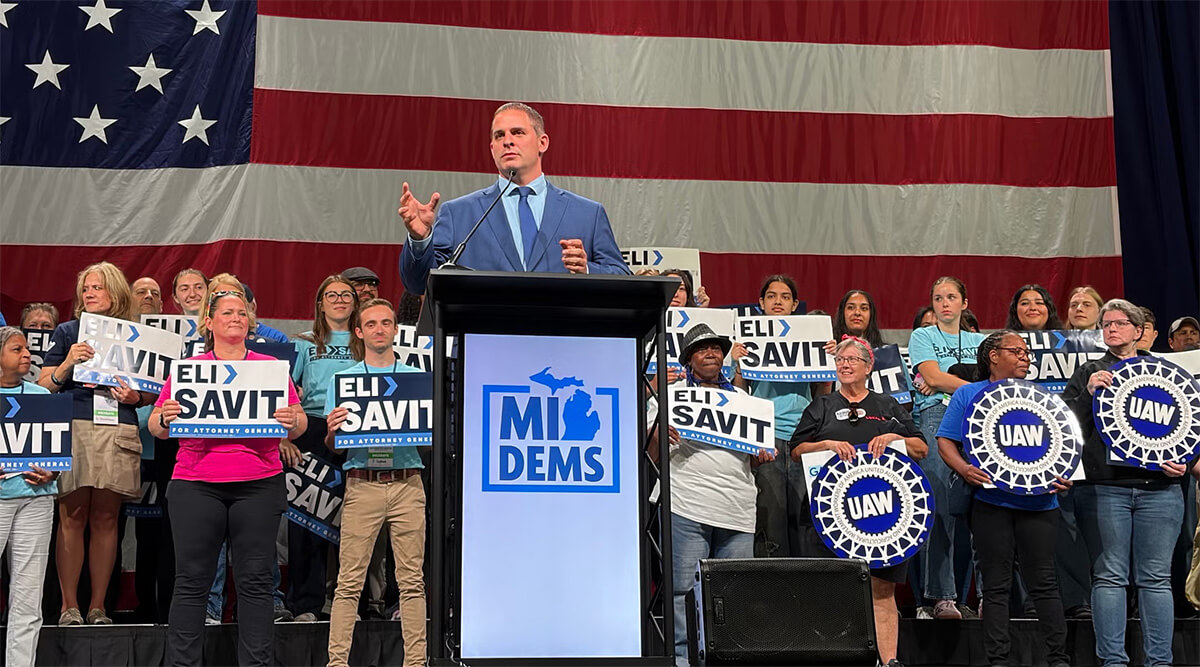
In one example, Washtenaw County Prosecutor Eli Savit, the party’s progressive Jewish nominee for state attorney general, addressed the Jewish caucus by declaring, “We’re going to win and keep the attorney general’s office in the hands of a Michigan Jewish Democrat.” Conspicuously absent from the day’s events was Nessel, the Jewish Democrat currently holding the seat.
Prior to the Saturday convention, Nessel, the state’s highest ranking Jewish official, had announced she would not be attending for fear she would be targeted by antisemitic harassment. Earlier this week, in a podcast interview with The Atlantic, Nessel had reiterated her issues with El-Sayed’s comments about Temple Israel and expressed hope he would walk them back soon.
Nessel’s son Zach Nessel, secretary of the state Jewish Democratic caucus, told the caucus that his mother’s absence stemmed from “agitators” who had targeted her at the party endorsement convention in the spring. Attendance at Saturday’s event was less than one-third of what the Jewish caucus had drawn at the spring convention, organizers said.
Zach Nessel criticized the state Democratic Party for failing to take prompt action to remove the agitators from the earlier convention. He told JTA that Jews in the party “have a right to be concerned.”
“I think the Democratic Party needs to put more work into addressing their concerns,” Zach Nessel said. “But I think that can’t happen without showing up.”
Moss, the Michigan state senator who has recently been at the center of another El-Sayed-related controversy, was spotted at the convention on Saturday but did not attend the Jewish caucus events.
One ally of El-Sayed’s who also addressed the caucus is University of Michigan Board of Regents nominee Amir Makled. He is an attorney for members of the school’s pro-Palestinian encampment movement who had pushed out a Jewish pro-Israel incumbent at the previous convention. During his own address to Jewish delegates, Makled did not mention his history of social media posts including retweeting far-right antisemitic conspiracy theorist Candace Owens and sharing praise for Hezbollah leaders.
Makled’s speech later that day at the nominating convention alluded to his work with the encampments as he declared that Michigan “will never have a university where students are punished simply because their speech makes the powerful uncomfortable.”
In-between candidate meet-and-greets, Jewish caucus members shared their anxieties about their closely scrutinized role in the midterm elections. They were gravely concerned about protecting democracy and election security from Republican threats, and felt that flipping the Senate was crucial.
Yet it was hard, they said, to get much of the Jewish community onboard this time, given the positions of El-Sayed and some other members of the Democratic slate. Michigan is home to an estimated 100,000 Jews, and the senate race is currently polling in a dead heat, making their votes potentially pivotal.
“How do we unify our community to put the country first?” one attendee asked the group. “I have a hard time doing that.”
This article originally appeared on JTA.org.
The post ‘I made a mistake’: Abdul El-Sayed apologizes to Michigan Jews for past comments about synagogue attack appeared first on The Forward.
Uncategorized
The woodcutter and the water carrier in the Torah portion, Nitzavim
לעילוי נשמת מײַן באָבע מנוחה וויטקא ע״ה לזרוב, לכבֿוד איר יאָרצײַט, ט״ו אלול
איינער פֿון די שטאַרקסטע קעגנער מיט וועמען אַ מענטש דאַרף זיך אויסקעמפֿן איז…זיך אַליין.
די סיבה איז פּשוט: די געדאַנקען און געפֿילן וואָס אַ מענטש קען צום בעסטן, זענען זײַנע אייגענע. און ווײַל דאָס זענען זײַנע פּערזענלעכע געדאַנקען און נײגונגען, איז מען נאַטירלעך גענייגט זיי צו געבן אַ גרויסע חשיבות. אויב איך פֿאַרשטיי אַזוי, אָדער איך פֿיל אַזוי, איז דאָס שוין לכאורה אַ גענוג גוטע סיבה צו טאָן אַלץ וואָס איך קען כּדי אויסצופֿירן מײַנע געדאַנקען און באַפֿרידיקן מײַן ווילן.
אָבער זייער אָפֿט טרעפֿט דווקא דאָס פאַרקערטע. דער מענטש וואָס שטעלט אויס זײַן לעבן בלויז לויט דעם וואָס אים דאַכט זיך ריכטיק אָדער באַקוועם, קען צום סוף שאַפֿן געלעגנהייטן וואָס גייען ווײַט העכער פֿון זײַנע באַגרענעצטע און פֿאַרבײַגייענדיקע פּערזענלעכע געפֿילן.
מיט אַנדערע ווערטער, באַקוועמלעכקייט און צוגעוווינטקייט קענען זײַן די גרעסטע שׂונאים פֿונעם מענטשן, אַנשטאָט זײַנע מיטהעלפֿער.
אין דער סדרה פֿון דער וואָך, נצבים־וילך, ווענדט זיך משה רבינו צום ייִדישן פֿאָלק אַזוי:
„אַתֶּם נִצָּבִים הַיּוֹם כֻּלְּכֶם לִפְנֵי ה׳ אֱלֹקֵיכֶם… מֵחֹטֵב עֵצֶיךָ עַד שֹׁאֵב מֵימֶיךָ“ — איר שטייט הײַנט אַלע פֿאַר דעם אייבערשטן, אײַער ג־ט… פֿון דײַנע האָלצהעקערס ביז דײַנע וואַסער־שעפּערס (וואַסער־טרעגערס).
דער גרינדער פֿון חב״ד, רבי שניאור זלמן, באַקאַנט ווי דער אַלטער רבי, דערקלערט אַז דאָס האָלצהאַקן און וואַסער־שעפּן האָבן, אויסער זייער פּשוטן באַטײַט, אויך אַן אינערלעכן טײַטש אין דער פּערזענלעכער עבֿודה פֿונעם מענטש.
דער אויסדרוק „עֵצֶיךָ“, דײַן האָלץ, קען מען אויך פֿאַרשטיין ווי „עצותיך“, דײַנע אייגענע עצות, געדאַנקען און חשבונות.
דאָס „וואַסער“ איז מרמז אויף דעם יסוד המים פֿונעם נפֿש הבהמית — דער מקור און טרײַבקראַפֿט פֿון קערפּערלעכע תּענוגים.
די לערנונג, זאָגט רבי שניאור זלמן, איז אַז אַ מענטש דאַרף „אויסהאַקן“ די אייגענע חשבונות און „אויסשעפּן“ די תּאוות וואָס צילן בעיקר אויף פּערזענלעכע קערפּערלעכע הנאות.
ערשט ווען אַ מענטש קען נייטראַליזירן אָט די צוויי כּוחות און זיך נישט לאָזן פֿירן פֿון זיי, קען ער צום בעסטן מקיים זײַן זײַן שליחות אין לעבן — אָן דעם שוחד פֿון פּערזענלעכער באַקוועמלעכקייט. שוחד פֿאַרבלענדט דאָך די אויגן און לאָזט ניט זען קלאָר און אָביעקטיוו. דאָס זעלבע טרעפֿט מיט באַקוועמלעכקייט. עס לאָזט ניט טראַכן אָביעקטיוו.
מען וואָלט אָבער געקענט מיינען אַז אַזאַ דיסציפּלין איז שייך בלויז צום תּורה־לערנען, צו מענטשן וואָס פֿירן אַ רוחניותדיק לעבן, אָדער בלויז ווען אַ מענטש וויל מצליח זײַן אין זײַן אייגענער גײַסטיקער זוכעניש.
וואָס איז אָבער מיט מסחר, פּרנסה אָדער אַ פּראָפֿעסיע — מיט די לכאורה „נישט־רעליגיעזע“ געביטן פֿון לעבן? דאָרט מעג מען דען נישט טאָן וואָס מען אַליין האַלט פֿאַר ריכטיק און וואָס גיט פּערזענלעכע צופֿרידנקייט?
דער ליובאַוויטשער רבי — זכותו יגן עלינו — ווײַזט אָן אַז דער ענטפֿער אויף דער פֿראַגע ליגט שוין אינעם פּירוש רש״י אויפֿן פסוק.
ווער זענען געווען די דאָזיקע האָלצהעקערס און וואַסער־שעפּערס?
רש״י דערקלערט אַז זיי זענען געווען כּנענים וואָס זענען געקומען צו משה רבינו ע״ה מיט דער כּוונה זיך מגייר צו זײַן, און משה האָט זיי באַשטימט צו דינען ווי האָלצהעקערס און וואַסער־שעפּערס.
דער רבי ווײַזט אן אַז דאָס וואָרט „כּנעני“ מיינט אויך אַ סוחר.
דער רמז איז, אַז נישט בלויז ווען עס רעדט זיך וועגן הימלישע און רוחניותדיקע ענינים — „רעליגיעזע“ באַשעפֿטיקונגען — דאַרף מען זיך באַפֿרײַען פֿון פּערזענלעכע אינטערעסן, צי שׂכלדיקע צי פֿילעוודיקע.
אויך אין מסחר, אין אַלע ענינים וואָס האָבן צו טאָן מיט גשמיות און מאַטעריע, דאַרפֿן די „האָלצהעקערס“ און „וואַסער־שעפּערס“ גיין צו דער אַרבעט.
מען דאַרף זיך העכערן איבער די אייגענע חשבונות און תּאוות, און זיך אָפּגעבן מיט די גשמיותדיקע טעטיקייטן מיט דער כּוונה, אַז דורך זיי זאָל מען אַרײַנברענגען הייליקייט און ג-טליכקייט אין דער וועלט — דורך דעם ליכט פֿון דער תּורה און דער נפֿש האלוקית.
עס זענען דא מענטשן וואָס קענען דאָס באַטראַכטן ווי אַ באַגרענעצונג: „מען לאָזט מיר נישט טאָן וואָס איך וויל.“
מען קען דאָס אָבער באַטראַכטן גאָר אַנדערש — ווי אַן אויסערגעוויינטלעכע געלעגנהייט:
„שטענדיק — אַפֿילו אין די מערסטע וועלטלעכע און לכאורה נישטיקע טעטיקייטן — האָב איך די מעגלעכקייט צו דערגרייכן עפּעס וואָס האָט אַן אומענדלעכע און אייביקע ווערט.“
דעריבער איז די געצײַג פֿון דער וואָך:
אויב דו פֿילסט זיך שלעכט ווײַל עס דאַכט זיך דיר אַז אַ גרויסער טייל פֿון דײַן לעבן האָט נישט קיין באַזונדערן זין אָדער ווערט, געדענק אַז עס ליגט אין דײַנע הענט צו באַשליסן אין וועלכער ריכטונג דו וועסט גיין.
דו קענסט צייכענען דײַן וועג לויט דײַנע פּערזענלעכע געדאַנקען און געפֿילן, וואָס קומען און גייען און לאָזן נישט קיין אייביקע שפּור.
אָדער דו קענסט זיך באַפֿרײַען פֿון זייער הערשאַפֿט און זיך אָפּגעבן מיט עפּעס וואָס איז אַ טייל פֿון אַ ציל וואָס איז אומענדלעך גרעסער — און אומענדלעך מער ווערטפֿול.
The post The woodcutter and the water carrier in the Torah portion, Nitzavim appeared first on The Forward.
Uncategorized
Vance, who’s drawn ire of Jewish conservatives, will speak at Republican Jewish confab
(JTA) — Vice President JD Vance, who has drawn the ire of a number of Jewish conservatives, will speak at the Republican Jewish Coalition’s annual summit in Las Vegas on Monday, the RJC confirmed.
“The Republican Jewish Coalition is proud to welcome Vice President JD Vance to our National Leadership Summit in Las Vegas,” said an RJC spokesperson. “JD Vance is a friend, who is coming back after first joining us in 2022 as a candidate for the US Senate.”
Vance’s appearance comes as a number of Jewish Republicans and major GOP donors have indicated that they would rather support Marco Rubio for the presidential nomination in 2028 than Vance, who is seen as Donald Trump’s likeliest successor. Some of those donors will be in the room on Monday at the Venetian Resort, which is owned by the billionaire Adelson family — a major backer of Trump and various Jewish and Israeli causes.
The vice president has lost the confidence of the pro-Israel crowd with his reprimanding of Israeli officials, indulgence of anti-Israel conspiracy theories and silence on Tucker Carlson, the prominent pundit who has spread antisemitic conspiracy theories. Multiple donors told the Jewish Telegraphic Agency during last year’s confab that they would not support Vance in 2028.
Carlson, meanwhile, was a major focus of the discussion at the RJC’s 2025 summit, where signs reading “Tucker is not MAGA” were handed out to attendees. His son, Buckley Carlson, is a former Vance staffer.
An agenda sent by the RJC lists Vance as a speaker during a Monday evening session that will be closed to press. A spokesperson confirmed that Vance will be speaking in a “fireside chat.”
A number of high-profile Republican candidates are also expected to speak at the RJC confab, which is being held on Sunday and Monday, a few months ahead of the midterm elections. Speakers include U.S. Senate candidates Mike Collins, the Georgia congressman who is challenging Jewish Democrat Jon Ossoff, and former Rep. Mike Rogers, who is running against Abdul El-Sayed in Michigan.
Collins has faced accusations of antisemitism and having ties to the far right. He has said that some of his statements were misunderstood, and has defended himself by citing his support for Israel.
This article originally appeared on JTA.org.
The post Vance, who’s drawn ire of Jewish conservatives, will speak at Republican Jewish confab appeared first on The Forward.
