


Uncategorized
Selective Reporting: How Gaza Aid Vetting Became a Media Narrative

Trucks carrying humanitarian aid and fuel line up at the crossing into the Gaza Strip at the Rafah border on the Egypt side, amid a ceasefire between Israel and Hamas in Gaza, in Rafah, Egypt, October 17, 2025. Photo: REUTERS/Stringer
Embedding operatives in civilian and humanitarian organizations in Gaza to evade detection by Israeli authorities has been a key strategy of Hamas and other terrorist organizations. Israel has consistently worked to prevent well-intentioned humanitarian organizations from being exploited for these purposes.
This past week, Israel demonstrated yet again its persistence in combating terrorism wherever it may exist by suspending the Gaza operations of 37 humanitarian organizations that refused to cooperate with the rules laid out by Israel.
In March 2025, Israel notified every aid organization in the Gaza Strip that they had to complete a re-registration process to be able to continue their operations in January 2026.
The main requirement asked of the organizations was to submit a list of all employees as part of a security screening process. Those who did not complete the process would be unable to continue their operations.
Protecting Aid – Preventing Exploitation
As of January 1, 2026, international NGOs that did not renew their registration will no longer be allowed to operate.
Organizations were notified in March 2025, given nearly ten months to comply, and granted a good-faith extension… pic.twitter.com/U0JqfR8OKF
— Oren Marmorstein (@OrenMarmorstein) December 30, 2025
Many outlets, such as CNN, have framed this as potentially leading to a “humanitarian crisis.” This is despite the total amount of aid from these 37 organizations accounting for only 1% of the total aid entering the Gaza Strip.
Alex Crawford of Sky News claimed that Israel was blocking these organizations “without evidence” that there have been connections to terrorist organizations, calling the groups “respected.”
Israel is blocking some of the world’s most respected aid groups from Gaza, The groups say Israel’s rules to operate are arbitrary and cd endanger lives. Israel insists – without evidence – that they’ve been infiltrated by militants. https://t.co/gMb3i7XUz4
— Alex Crawford (@AlexCrawfordSky) December 30, 2025
But there’s nothing respectable about terrorists infiltrating organizations meant to help civilians in need. More than that, this effort is meant to ensure terrorist organizations do not take control of or subvert humanitarian operations.
Throughout the war, humanitarian organizations have been abused by terrorist organizations.
Doctors Without Borders (MSF), for instance, is one of the organizations whose operations are being suspended in the coming months, after it failed to provide a list of its Gaza employees. But MSF has previous form. In 2024, it was revealed that an employee of MSF was active in Islamic Jihad and another was a sniper in a Hamas unit.
This is your employee, @MSF. A physical therapist by day and terrorist by night.
Fadi Al-Wadiya, who was eliminated by the @IDF 2 days ago, worked both as a physical therapist for Doctors Without Borders and as a prominent terrorist in the PIJ terrorist organization.
Fadi… pic.twitter.com/N1FiO6QgLz
— COGAT (@cogatonline) June 27, 2024
Mosab Abu Toha, a Pulitzer Prize winner exposed by HonestReporting for excusing the abduction of Israeli hostages on October 7, likewise joined the choir online to complain about MSF being suspended in Gaza.
He faces a knowledge gap in understanding that Hamas and other terrorist organizations have embedded themselves in civilian infrastructure, including hospitals. And MSF only operates five out of 220 primary care clinics and medical points in Gaza, as per COGAT.
What country is barring more than 30 humanitarian organizations, including Doctors Without Borders, from operating in Gaza?
As if these aid groups were ever allowed to function freely in the first place. For months, humanitarian organizations have faced blocked access, extreme…— Mosab Abu Toha (@MosabAbuToha) December 31, 2025
Naturally, this context is omitted from international reports on the NGO suspensions, as it does not fit the narrative. It is thus also telling that the media’s focus has been on the 15 percent of organizations not complying with Israel, rather than the 85 percent who are. This would, however, require the media to question why 37 so-called aid organizations are refusing the simple task of providing a list of their employees.
This is not the first time Gaza’s aid system has been highlighted as being vulnerable to — if not outright compromised by — terrorist infiltration. Hamas has systematically embedded members in civilian infrastructure as a way to control resources. As a result, international aid organizations have repeated claims published by Hamas without any scrutiny. These claims have then been uncritically amplified by the media, creating a self-reinforcing cycle in which Hamas’ aid narratives turned into accepted facts.
While terrorist organizations seek to spread false information about the lack of humanitarian aid in the Gaza Strip, the truth remains that 4,200 trucks filled with aid enter Gaza every week, coordinated between Israel and aid organizations that have complied with the rules. Organizations unwilling to comply and provide a list of employees must explain their persistent refusal to meet this basic requirement of transparency.
The author is a contributor to HonestReporting, a Jerusalem-based media watchdog with a focus on antisemitism and anti-Israel bias — where a version of this article first appeared.
Uncategorized
Peter Lorre, decades after ‘Casablanca,’ is the breakout star of ‘Coyote Vs. Acme’
The character actor Peter Lorre died in 1964. The doctor Peter Lorre is alive, quite possibly immortal and has never looked better.
In Coyote Vs. Acme, the long-awaited legal comedy in which Wile E. Coyote sues the mega-corporation behind all his contraption needs for decades of grievous injury, the Good Doctor is seen smuggling evidence outside of Acme labs. Soon thereafter, the company’s security forces him to step into a black hole in the ground that is then rolled up like an old carpet.
As a man who knows too much, he’s a threat to the business.
If it seems strange that the Hungarian-born Jewish performer known for his turn as a child murderer in M and black market peddler Ugarte in Casablanca should be revived as a whistleblower, you may be forgetting his earlier appearances in the Looney canon.
The first was as himself, voiced by Mel Blanc, sitting with a crowd of celebs in Ciro’s nightclub and admiring an oversized bubble covering up a burlesque performer. That short from 1941 scans as uncomfortably close to the house style of the Der Stürmer cartoonists. In subsequent episodes, Lorre was caricatured as a mad scientist, though shrunk down considerably even as his role grew.
In Hair-Raising Hare, Dr. Lorre lures Bugs Bunny into his castle in the hopes of feeding him to the gargantuan red monster Gossamer. (A flashing neon sign on his lair indicates that he is an “Evil Scientist.”) Bugs gets the upper hand by providing a manicure to the tennis-shoed behemoth, jousting him into a tin can and ultimately spooking him by drawing his attention to the fourth wall.
When Daffy Duck tricks his way into Lorre’s suburban home in Birth of a Notion, the diminutive doc tries through a series of booby traps to recover his wishbone for a science experiment. (Stan Freberg voices Lorre in this one.) When Daffy manages his escape, Lorre’s eyes turn toward his dog, Leopold, prompting the pooch to make his exit.
In these treatments Lorre is a lonely, depressive psychopath of the sort Lorre excelled at playing. His revival for 2003’s Looney Tunes: Back in Action reimagined him as a different sort of villain: an underling for the Acme Corporation.
What Coyote Vs. Acme does is revolutionary not just for exploring the liability implications of cartoon case law, but for the redemption it offers Lorre, a kind of fitting tribute to a Hollywood legend whose life and career was cut tragically short by chronic pain and addiction.
This Lorre, who’s had a bit of a glow-up, sacrifices himself to sound the alarm for Acme’s evil R&D methods. It’s an apt arc for a refugee from Nazi Germany, among whose most recognizable work is his role in perhaps the greatest anti-fascist film of all time. While Ugarte takes advantage of refugees desperate for exit visas in Casablanca, the real Lorre helped many flee Europe ahead of World War II, just as cartoon Lorre works on behalf of his fellow toons. (His role as a complicit scientist also recalls his lone directorial effort, The Lost One, in which he plays a Nazi chemist haunted by the war.)
Coyote Vs. Acme’s Lorre also plays piano — not with a disembodied hand — and is revealed to be in a long-lasting — 80-plus years! — marriage with Tweety’s doting owner Granny.
With the film marking the largest-ever opening for Ketchup Entertainment, which snagged the distribution rights after Warner Bros opted to ditch the flick for a tax write-off, it’s too soon to tell if it will herald a Looney Tunes renaissance. However it shakes out, it has singlehandedly upped Peter Lorre representation in the films of 2026.
For those who don’t despise him — or who give him any thought — that’s victory enough.
The post Peter Lorre, decades after ‘Casablanca,’ is the breakout star of ‘Coyote Vs. Acme’ appeared first on The Forward.
Uncategorized
Bedouin shepherds found it. A bishop sold it. An Israeli agent bought it. Now you can see it up close.
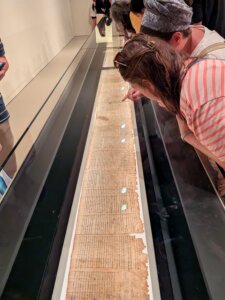
The magnificent 717-centimeter ancient Isaiah scroll on view right now at The Israel Museum, for the first time in 60 years, is drawing so many people that the museum has set strict guidelines for visitors.
To see the scroll — meaning the original, handwritten, non-facsimile, version that survived for two thousand years in jars hidden in a cave — with your own eyes, all 23 1/2 feet of it, you need to register by 8 a.m.
Once you are at the exhibit entrance, you need to wait your turn; you have to watch a film first about the incredible story of how the Isaiah scroll was found by Bedouin shepherds in a remote cave near the Dead Sea, sold to Archbishop Samuel, head of the Syrian Orthodox Monastery of St. Mark in Jerusalem, then read and evaluated by a professor whose son became Israeli military royalty, photographed by an American scholar, sent by the bishop to the U.S. for a tour of several leading universities in the hope of snaring a very high price, and then at long last, clandestinely purchased by an agent hiding that he was representing Israel from a small and seemingly innocuous ad in The Wall Street Journal. Then you have exactly 10 minutes in a temperature-controlled room with the scroll.

There is something spiritual and moving about seeing this gigantic, complete, handwritten scroll that was literally hidden in a cave for millennia. What is remarkable about it, Professor Noam Mizrahi of the Hebrew University in Jerusalem explains in a video you can watch after you check the scroll out for yourself, is first of all its age.
“It is over two thousand years old,” he explains. To be precise, the scroll was written in 125 BCE. The other amazing aspect of it is its fullness — not only are all 66 chapters there, but the Hebrew is written in a full way.
What does that mean, exactly? Consider the first line, “This is the vision of Isaiah the son of Amotz,” written in the scroll as “Yishayahu ben Amotz.” You can see with your own eyes that the original scribe wrote “Yeshaya,” and that another, later, scribe, added a letter, the ayin, so that it now reads “Yishayahu” as Isaiah is pronounced in today’s Hebrew.
It offers a glimpse into ancient pronunciation, Mizrahi explained. I would add that it also offers a glimpse into editing — writers are never done.
And maybe the Jewish people are never done discussing what the vision of Isaiah is, and what it means. This particular scroll wasn’t a museum artifact in the early days.
“It was in use for at least 100 years,” Mizrahi said — you can tell from the corrections.
But back to that fullness. This is a neatly written scroll of a text so many of us recognize — timeless, the curator Hagit Maoz commented in the video, and about peace, and justice. Maybe my vision is failing, but it was hard to make out psukim, or verses, I knew by heart.
This is not because the handwriting wasn’t neat — each aleph was distinct and perfect — but because the letters are small. I found myself cheating by taking a picture with my phone and enlarging it. Then I felt guilty for wasting a bit of my precious ten minutes on technology.
My group included a woman with a seeing-eye dog. If I could barely make out the letters, what could she see?
But the scroll is not just about seeing. It is about feeling. You can feel that this text is connected to this place. It’s the feeling of being here, of being near something written thousands of years ago by hand, something ours, something whole. There is the feeling that this is where Isaiah roamed, and this is where this incredible book — this timeless piece of Jewish literature — began.
Once the ten minutes are up, visitors are ushered into another room with a copy of the Isaiah scroll enlarged, and with key verses highlighted. There was the dream of peace, I thought as I looked at individual verses — the wolf dwelling with the lamb — and then there is the reality. The other day, I heard a young guy tell a date he had done 600 days of miluim, or reserve service.
I found myself refocusing on the true story of how the Isaiah scroll made it to the public. I couldn’t get enough of the details.
From shepherds to The Wall Street Journal
When Bedouin shepherds chased a sheep sometime in early 1947, they reached challenging terrain across from the northwest rim of the Dead Sea that no one else was willing to enter.
They heard a piece of pottery in a cave crack.

Curious, they went inside and found seven scrolls inside jars in the cave. They took them out, not knowing what they were. The museum explains that the bishop, who purchased the scrolls, consulted Eleazar Sukenik of the Hebrew University of Jerusalem, who immediately realized he was looking at an ancient Isaiah scroll and copied some sections; he told the bishop he was interested in purchasing the scrolls, both the ones in his possession and those still with the shepherds.
According to the Israel Antiquities Authority website when Sukenik learned of the scrolls’ discovery, he set out to investigate their significance. “Braving Arab-Jewish tensions, he travelled to meet the Armenian dealer at the British divided military zone of the Jerusalem border. In this clandestine meeting, the dealer held up a fragment of leather for the professor to examine. As Sukenik peered through the wire, he recognized the ancient writing.”
Incredibly, on Nov. 29, 1947, on the very same day as the United Nations vote on the Partition Plan, the historic vote which led to the establishment of Israel, Prof. Sukenik bought three of the seven scrolls.
Meanwhile, the bishop decided to get another opinion on his four scrolls, from an American scholar in Jerusalem who was the first to photograph them. By March 1948, convinced of the scrolls’ value and concerned for their safety as the War of Independence raged, the bishop had his assistant take the scrolls to a bank in Beirut, where they were held in a safe.
In Dec. 1948, the bishop headed to Beirut, picked up the scrolls, when gone to New Jersey, where he hoped to sell them.
Echoes of history
Learning of the scrolls, I couldn’t help but think of the great Yiddish poet Avrom Sutzkever and the Paper Brigade in Vilna. As the Nazis tried to annihilate the Jewish people, great writers risked their lives to save Jewish literature and culture, to hide it for the future. It’s a repeating theme in Jewish history — the military battle and the cultural battle, continuing at the same time.
Sadly, Professor Sukenik lost a son to battle in the war.
Then the professor himself died.
But the family’s passionate connection to the Isaiah scroll was not over. The professor’s other son, Yigael Yadin, who would become both a major scholar and a military leader, was in New York in the early 1950s and happened to read a small advertisement in The Wall Street Journal offering four scrolls. He guessed that the Isaiah scrolls his father wanted had been spirited off to the United States; he wired Israel to tell the new government to find $150,000. (Here, some Jewish philanthropy helped.)
It turns out that the bishop’s representative had tried to sell — to the Library of Congress, the Walters Gallery in Baltimore, Duke University, and The University of Chicago — but all refused. He failed because Jordan claimed the scrolls belonged to it because of where they had been found, while Israel claimed they were theirs because of cultural heritage.
Yadin hired an agent to conceal that Israel was the actual buyer, and the four were purchased on July 1, 1954. On July 9, the Isaiah scroll was separated and spirited to Israel by plane, with other planes escorting it for safety.
The Israel Museum built the Shrine of the Book to house the scroll, and it was opened to the public in 1955. But in 1968, the real scroll was replaced with a very good facsimile for the scroll’s continued safety.
Now, in honor of the museum’s 60th anniversary, the real thing is on view. My advice — don’t miss it.
“A Voice from the Desert: The Great Isaiah Scroll” is on view at the Israel Museum through Oct. 3.
The post Bedouin shepherds found it. A bishop sold it. An Israeli agent bought it. Now you can see it up close. appeared first on The Forward.
Uncategorized
When Gloria Steinem identified as a Jew most
Gloria Steinem, the journalist and organizer who became the most recognizable face of America’s modern women’s movement, died Wednesday at her New York City home. She was 92.
For more than half a century, Steinem pushed American women to imagine lives beyond the limits society had set for them. She co-founded Ms. magazine, helped establish the National Women’s Political Caucus and turned phrases like “sexual harassment” from unnamed experiences into subjects of national debate.
Steinem was the daughter of a Jewish father, Leo Steinem, and a Protestant mother, Ruth Nuneviller. She was raised without much religion and generally described herself as secular, but she was unequivocal about where she stood when Jews were targeted: “Never in my life have I identified as a Christian,” she said, “but wherever there is antisemitism, I identify as a Jew.”
Her mother taught her to value her Jewish roots. Steinem told the Forward in 2015 that her father rarely discussed his heritage; it was her non-Jewish mother who presented Judaism to her as something positive — “She also told me Jewish men made better husbands” — and taught her about her paternal grandmother.
That grandmother was a feminist pioneer in her own right. Pauline Steinem, who kept kosher, was an educator, suffragist, delegate to the 1908 International Council of Women and the first woman elected to Toledo’s school board — and during the Nazi’s rise in the mid-1930s, she worked to rescue members of her family from Europe.
A feminist Seder became her strongest connection to Jewish ritual. Steinem participated for decades in an annual women’s Seder, calling it the first spiritually centered experience of her feminist life. What drew her to Judaism, she said, wasn’t the law — it was “the mystical part, the Kabbalah, the Shechinah.
She recognized how antisemitism and misogyny fed each other. In her memoir, Steinem recalled a cabdriver telling her that feminism was a Jewish plot to destroy the Christian family. Her response to such hatred was not to distance herself from Jews, but to identify with them more strongly.
That identification outlasted her. Gloria and her sister, Susanne, donated a catalog of jewelry seized from Nazi victims to the U.S. Holocaust Memorial Museum — in honor of their grandmother.
Steinem continued writing and advocating for equality into her 90s. Her final book, An Unexpected Life, is scheduled to publish later this month.
The post When Gloria Steinem identified as a Jew most appeared first on The Forward.
