


Uncategorized
When Hate Hides Behind Nuance, Babka and Protest Cannot Rise Half‑Baked

A Breads Bakery location in New York City. Photo: ZUMA Press Wire via Reuters Connect
This weekend, a crowd wrapped around the corner of 63rd and Broadway in New York City, lining up for babka and bread at Breads Bakery. But this wasn’t the usual pre-Shabbat rush. It was a quiet show of solidarity with the Israeli-owned bakery, after union activists urged it to sever ties with Israel.
A line for pastries became a reminder that antisemitism doesn’t always announce itself with slurs or slogans. Sometimes it appears in smaller, more familiar spaces — through pressures and demands that seem benign on the surface.
When New York City’s new mayor, Zohran Mamdani, revoked a series of executive orders aimed at combating antisemitism, the justification was familiar: overly broad, insufficiently nuanced, potentially chilling to free speech. For many Jews in this city — especially those who are visibly Jewish or openly supportive of Israel — this reversal did not feel like balance restored. It felt like protection withdrawn.
New York is home to the largest Jewish population outside of Israel, and Mamdani’s decision came at a moment when antisemitic threats are rising nationally and globally, when synagogues and schools require armed guards, and when fear is not theoretical but lived.
One word — nuance — has stayed with me.
Not long before the mayor’s announcement, a friend objected to the International Holocaust Remembrance Alliance’s working definition of antisemitism: Too broad, too political, not nuanced enough. I had heard the argument before — but hearing it again, now, felt revealing.
Can we fight hate in the language of nuance?
For decades, we have treated language as a tool of moral repair. We revised terminology to be more inclusive, more precise, and more humane. We expanded our understanding of gender and identity. Language evolved to widen the circle of belonging.
Names matter. If language shapes how people are seen — and how they see themselves — then these changes matter.
But somewhere along the way, the project of inclusion began to drift.
Refining language stopped functioning as a starting point for justice and became a substitute for it. Linguistic correction began to stand in for moral and institutional accountability. We treated vocabulary changes as progress, even when the underlying structures remained unchanged.
We changed the words without changing the world.
As we focused on more delicate modifiers and culturally sensitive phrasing, we also became cautious in how we described injustice — so cautious that we often avoided confronting it at all. Language became a tool to minimize, camouflage, or justify inaction.
Nowhere is this clearer than in how we talk about antisemitism.
At a time when antisemitic incidents are rising, the insistence on narrower definitions and softer language feels less like rigor and more like retreat. Definitions tighten just as hostility becomes more explicit, more public, and more emboldened.
And the question lingers: Are we blurring the reality of antisemitism out of fear that naming it clearly will constrain legitimate criticism of Israel? Are we reinforcing old tropes equating Zionism with racism, legitimizing a wave of boycotts and, increasingly, outright acts of violence against Jews?
Would we ask other marginalized communities to soften the words used to describe the hatred aimed at them?
If we would not ask it of others, why do we ask it of Jews?
Outside of Breads Bakery, the protest didn’t sound like a protest. No bullhorns, no chants — just a line of New Yorkers waiting for pastries to push back against a union’s demand that the bakery cut ties with Israel. It turns out that you can fight antisemitism with babka.
But the gesture can be quiet only if the definition is not. We cannot fight what we don’t hear, and we cannot hear what we refuse to name. When antisemitism hides behind nuance, policy, or the polite language of activism, clarity stops being optional. Even a line for babka can become a battleground against hate — but only if the hate is named plainly. Buying bread may seem like a Beijing form of activism, but when the message it sends is clear, hate can no longer hide in the shadow of nuance.
Gillian Granoff is a New York–based writer focused on Jewish identity, the Israel–diaspora relationship, and the challenges of navigating antisemitism after October 7. Her work draws on personal experience and time spent in Israel, bringing cultural insight and emotional clarity to her essays. She holds a degree in Comparative Literature from Brown University and spent more than a decade as a senior reporter for Education Update, an award-winning New York education newspaper.
Uncategorized
Robert Kraft pledged $2M to aid Palestinians amid Macklemore row. How will he do it?
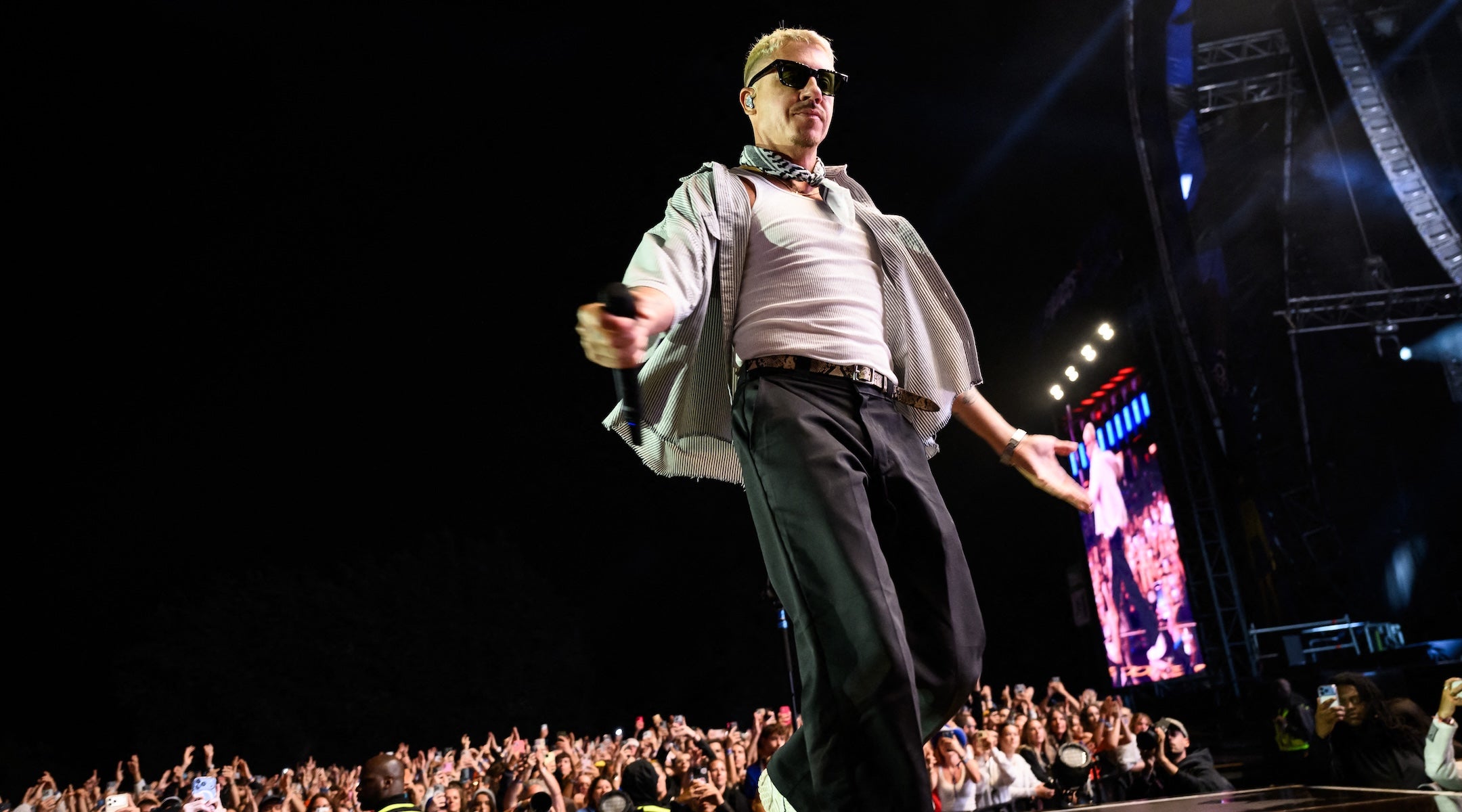
(JTA) — Robert Kraft has found himself in an unusual position: nixing the rapper Macklemore’s appearance at a stadium he owns for what he said was hateful behavior — and then taking up the performer’s charity challenge.
Macklemore challenged the Jewish pro-Israel billionaire to make a donation in support of the Palestinians days after pressuring singer Ed Sheeran to drop Macklemore from his tour over the latter’s pro-Palestinian comments. Kraft responded by announcing that he would donate $2 million to “fight this humanitarian crisis” in the Middle East.
“I have dedicated much of my life to building bridges between all people,” Kraft wrote in a statement posted by Gillette Stadium, which he owns and where Sheeran and Macklemore had been scheduled to play. “I believe deeply that all lives are worth protecting.”
Kraft’s statement Wednesday came in response to challenges from both artists: a public call from Macklemore to match his own $1 million donation to a group of six pro-Palestinian organizations; and what Kraft described as private conversations with Sheeran to commit twice that amount to unspecified groups. Kraft said his own donation was meant to match Sheeran’s.
Kraft’s gift comes as the controversy has prompted questions about how pro-Israel Jews in positions of power choose to wield their influence to combat what they see as antisemitism. His pledge carries additional, politically fraught implications, as Jewish groups have been divided on whether, or how, to donate directly to Gaza relief efforts.
In his public comments, Kraft has insisted that he does not object to pro-Palestinian advocacy or aid as long as it does not cross the line into advocating for Hamas.
But where will Kraft donate? The New England Patriots owner didn’t specify in his public statement, and a representative didn’t immediately respond to questions from the Jewish Telegraphic Agency.
In Macklemore’s own post issuing the donation challenge, he said the $1 million he was giving constituted his entire net earnings from Sheeran’s tour. He named six beneficiaries: the Palestine Children’s Relief Fund, HEAL Palestine, Medical Aid for Palestinians, American Near East Refugee Aid, Gaza Soup Kitchen and UNRWA USA, a nonprofit supporting the United Nations Agency for Palestinian Refugees.

UNRWA itself has proven particularly contentious among the Jewish community. After an investigation revealed that agency members had participated in Hamas’ Oct. 7, 2023, attacks on Israel, the Trump administration led a successful effort to slash the agency’s funding.
In his posts, Kraft offered clues to where he has given in the past.
“I’d like the people who are speaking in support of the Palestinian people to know that for decades, I have supported efforts that create opportunity for Palestinians and have brought young Palestinians and Israelis together to build businesses, create jobs, and forge relationships,” he wrote on Wednesday. In an earlier statement, Kraft said he has “created athletic and entrepreneurial opportunities for Palestinians who I admire and respect.”
One well-known organization that fits Kraft’s description of bringing Palestinians and Israelis together, Seeds of Peace, has a documented relationship with the businessman. In 1994, the year after the peacebuilding initiative launched, Kraft hosted more than 100 teenagers from Israel, Gaza, the West Bank, Jordan, Egypt and Morocco at a Patriots game.
Seeds of Peace did not immediately respond to a JTA request for comment about whether Kraft would be giving to the group as part of his new pledge.
Kraft has also invested heavily in a push to bring American football to Israel via the Kraft Family Israel Football League. In that context, Palestinians have played for league teams — including for the Judean Rebels, a team based in an Israeli settlement in the occupied West Bank.
Steven Koltai, a Jewish onetime entrepreneurship liaison for former U.S. Secretary of State Hillary Clinton and author of “Peace Through Entrepreneurship,” said he welcomed Kraft’s commitment.
“I would love to see, as a Jew who believes in the two-state solution and particularly in humanitarian relief to the millions of Gazans who are completely blameless, if we could show that side of who we are,” Koltai told JTA. “I think that he would be doing an incredible mitzvah for the whole Jewish world, especially the American Jewish community, if he could leverage his money towards something like this.”

Jeremy Burton, CEO of the Jewish Community Relations Council of Greater Boston, told JTA that Kraft “deserves kudos for leaning in with his philanthropy.” Prior to the pledge, Burton had praised Kraft’s actions against Macklemore, saying in a statement that Kraft “drew a clear moral line in the sand about the demonization and offensive conduct that he will not allow in ‘his home’.”
“One can work to end Palestinian suffering without being antisemitic,” Burton wrote to JTA in a text Thursday.
Kraft has said he pressured Sheeran to drop Macklemore because he thought the latter’s conduct at a recent show, in which the rapper had accused Israel of genocide and broadcast footage from Columbia University’s encampments, crossed the line into “hate speech.” According to The Wall Street Journal, other NFL team owners had also voiced objections to Macklemore performing in their stadiums after witnessing one of his sets.
The Journal also reported that Kraft, in his conversation with Sheeran, recalled that Macklemore had performed in a costume with antisemitic signifiers in 2014. Sheeran, whose tours have grossed nearly $2 billion since 2008, and Kraft are friendly: The singer performed at Kraft’s 2022 wedding.
Backlash has been swift, with Sheeran distancing himself from the decision to drop Macklemore, and the singer’s other opening acts and supporting band leaving the tour in protest. Some of them named Kraft specifically in public comments. Figures including children’s entertainer Ms. Rachel and U.S. Rep. Alexandria Ocasio-Cortez, a New York Democrat, have also defended Macklemore, with Ocasio-Cortez additionally criticizing Kraft.
“When you see what Robert Kraft did to line up all of the stadiums to censor speech in that one specific way, it’s become clear that this is not just about one music artist or two music artists, but this is about how just a handful of stadium owners and the elite can prevent an entire massive issue, in this case, the genocide in Gaza,” the congresswoman told TMZ.
Others, including singer Pink and Barstool Sports mogul Dave Portnoy, have criticized Macklemore or defended Kraft’s decision.
Much of Kraft’s philanthropy has gone to fighting antisemitism and to Jewish organizations. He recently gave $10 million to Brandeis University to endow a new center for Jewish life at the school.
Koltai, who himself has not worked with Kraft, said it’s possible for Jewish donors to distribute money to Gaza through “vetted, kosher organizations” that are “clearly not Hamas.” He suggested that Kraft look beyond his past donations to peacebuilding and sports efforts in order to address the current need.
“Sewage, water, housing, medical care and child care are all much more important than a summer camp or a football team,” he said.
This article originally appeared on JTA.org.
The post Robert Kraft pledged $2M to aid Palestinians amid Macklemore row. How will he do it? appeared first on The Forward.
Uncategorized
Hundreds of Michigan Jews pledge to vote for Abdul El-Sayed
(JTA) — ANN ARBOR – More than 600 Michigan Jews have signed a new open letter pledging to vote for Abdul El-Sayed for U.S. Senate, seeking to grow the Democratic candidate’s rocky Jewish support in what is expected to be a close and pivotal election.
The coalition, “Michigan Jews for Democracy,” includes several liberal and progressive Jewish figures in the state, though they signed in personal capacities. Signatories include father and son former U.S. Reps. Sander and Andy Levin, progressive attorney general nominee Eli Savit, Michigan Democratic Jewish Caucus chair Decky Alexander, Detroit Jews for Justice executive director Lisa Tencer and former “Uncommitted” organizer Eleanor Gamalski.
“Some of us are enthusiastic supporters of El-Sayed,” the open letter reads. “Some of us have reservations: there are disagreements with El-Sayed on important issues, including aspects of his approach to Israel and the language used by some of his allies.”
The letter continues, “We understand that a vote is not a valentine; it’s a strategic chess move.”
El-Sayed’s campaign promoted the letter Thursday morning.
Jewish clergy who signed include Rabbi Alana Alpert of the Reconstructionist Congregation T’chiyah in Ferndale; Rabbi Nate DeGroot, who serves congregations in Jackson and Flint and directs the Shalom Center; and retired Cantor Annie Rose of Reform Temple Beth Emeth in Ann Arbor. Other notable signers include University of Michigan Jewish Studies professor Deborah Moore and Danny Fenster, the Jewish journalist who was imprisoned in Myanmar for five months in 2021.
El-Sayed has sought to mend relations with Jewish voters in the state in recent months, though his opposition to a two-state solution in Israel, along with past controversies involving anti-Israel streamer Hasan Piker and his response to the attack on the Detroit-area Temple Israel, have rendered his candidacy polarizing to the community. Recently El-Sayed held an unpublicized meeting with rabbis at Temple Israel, weeks after apologizing for his earlier remarks in which he appeared to equivocate about condemning the March attack, according to a report in Jewish Insider.
The new letter in favor of El-Sayed also comes in contrast to other Jewish open letters in the state. One pledging to vote for his GOP opponent, former U.S. Rep. Mike Rogers, has collected 478 names since launching in August. Another, urging El-Sayed to respond to Jewish “non-negotiables” including “Jewish sovereignty in Israel,” has been promoted by several rabbis in the state.
National Democrats see retaining Michigan’s Senate seat as essential to their hopes of retaking the chamber this fall and instituting checks on President Donald Trump. The Michigan Democratic Jewish Caucus has not endorsed El-Sayed, despite its chair’s presence on the new letter. The Jewish Democratic Council of America, whose CEO Halie Soifer is a Michigan native, has also not endorsed him, telling Jewish Insider this week that the organization does “not endorse all Democrats.”
This article originally appeared on JTA.org.
The post Hundreds of Michigan Jews pledge to vote for Abdul El-Sayed appeared first on The Forward.
Uncategorized
Jewish radio host Sid Rosenberg says he ‘charmed’ JD Vance, after slamming his stances on Israel
(JTA) — Conservative radio personality Sid Rosenberg, a vocal critic of JD Vance’s positions toward Israel, left a meeting with the vice president on Thursday giddy with optimism.
“I went in there with very low expectations,” Rosenberg told the hosts of WABC Radio’s Cats & Cosby.
Noting that multiple people had assured him Vance would win him over, Rosenberg confirmed that “he did.”
“I think I charmed him more,” he said.
The highly publicized meeting occurred amid Vance’s attempt to make overtures to the Jewish community following a series of controversial remarks about Israel, in order to shore up its support for a possible 2028 presidential run.
Rosenberg, a Jewish New Yorker and friend of President Donald Trump, has faulted Vance for not being “strong enough on Israel.” He has also called for Vance to distance himself from Tucker Carlson, a right-wing commentator who regularly condemns U.S. military support for Israel and has been accused of amplifying antisemitic tropes.
“Honestly, I’ve been very critical of JD, very critical,” said Rosenberg, who hosts his own WABC show, Sid & Friends In The Morning.
He told Rita Cosby and her co-host John Catsimatidis that he was “really surprised” to receive an invitation to meet with the vice president, after they both spoke last month at a Republican Jewish Coalition meeting in Las Vegas.
“The talk was that I was going to grill JD Vance on Tucker Carlson and the Israel comments he’s been making as of late,” Rosenberg said. “This was more of a get-to-know-each-other session.”
While Rosenberg explained that most of their conversation would remain off the record, he emphasized that “it went well” and they “hit it off,” adding that the two men would likely have “many more meetings about very substantial things” in the future.
Though he remained outspoken about his preference for Secretary of State Marco Rubio as a 2028 presidential nominee, Rosenberg said that if Vance is “going to be our guy,” he left Thursday’s meeting feeling like he could work with him.
“He is willing to listen,” Rosenberg said. “I don’t think by any stretch that JD Vance hates Israel, hates the Jewish people.”
Just a few hours before Rosenberg’s meeting with the vice president, i24 News reported that Vance was also planning to host a Shabbat dinner this week as a method of outreach to Jewish Republicans.
“Vice President Vance is making considerable outreach efforts to the American Jewish community, particularly with this Shabbat dinner,” Shabbos Kestenbaum, a pro-Israel campus activist who spoke at the Republican National Convention in 2024, told The Jewish Telegraphic Agency.
Kestenbaum, who filed a Title VI lawsuit against Harvard University for ignoring antisemitism in 2024, added that he looks “forward to working together on our common interests while also expressing our concerns.”
Despite the rosier outlook shared by Jewish Republicans on Thursday, the meeting between Rosenberg and Vance came just two days after the vice president told participants at a technology conference that Trump does not shy away from opposing Israeli Prime Minister Benjamin Netanyahu in order to advance the interests of the American people.
The president “has shown a willingness to actually part ways with ‘Bibi’ Netanyahu when he feels like the interests of the American people are different from the interests of the government of Israel,” Vance said in a virtual address at the All-In Summit.
In response to those remarks, Sam Markstein, national political director for the RJC, told JTA in a statement that “the vice president has said, time and again, that Israel is a close and important ally of the United States.”
Markstein recalled how at last month’s RJC meeting — where both Vance and Rosenberg also spoke — Israel’s former minister for strategic affairs, Ron Dermer, said he’d be “forever grateful” for Vance’s role in the June 2025 conflict with Iran.
“All true partnerships between proud, independent, sovereign nations have room for disagreement — that is the mark of the alliance’s strength,” Markstein added.
Vance’s address at the RJC meeting was seen across the media as a chance to mend ties with Jewish conservatives, particularly regarding his views toward Israel and his connection to Carlson. The vice president spoke at a closed-door session, during which he reportedly described Israel as “extremely important to America’s national security,” according to Axios.
Regarding another right-wing podcaster, Joe Rogan, Vance argued that “the best approach is to actually go in there, and talk to him, and make the best argument you can,” The Wall Street Journal reported. Although the vice president denounced a third podcaster, Nick Fuentes, as someone who “really does hate Jews,” he did not offer an opinion on Carlson, per the Journal.
After the address, Rosenberg slammed Vance for foregoing “a chance to hammer” Carlson and for blaming antisemitism on immigration, which the radio host called “silly.”
But following what he described as “a great meeting” with the vice president on Thursday, Rosenberg appeared to have changed his tune.
Asked by Cosby if he walked away optimistic about Vance’s stance on Israel, Rosenberg responded, “The answer is yes.”
This article originally appeared on JTA.org.
The post Jewish radio host Sid Rosenberg says he ‘charmed’ JD Vance, after slamming his stances on Israel appeared first on The Forward.
