


Uncategorized
What Iran’s Internet Blackout and the Patagonia Fires Revealed About Global Disinformation

Cars burn in a street during a protest over the collapse of the currency’s value, in Tehran, Iran, Jan. 8, 2026. Photo: Stringer/WANA (West Asia News Agency) via REUTERS
The lie that raced across social media during Argentina’s recent Patagonia wildfires was not just grotesque. It was revealing.
Within hours, recycled images and viral posts blamed Israelis for igniting the fires. The language was familiar: vague references to “foreign states,” insinuations of coordination, and the ritual refrain that “the media” was covering it up. Argentine journalists documented how quickly the fires became a vehicle for antisemitic conspiracy theories, including false claims involving an “IDF grenade” in Patagonia.
Days later, a seemingly unrelated anomaly appeared in Europe. A cluster of pro-Scottish independence accounts on X, previously prolific, fell abruptly silent. Their disappearance coincided precisely with Iran’s imposition of a nationwide Internet shutdown amid domestic anti-regime protests. British reporting and independent researchers had already identified many of these accounts as part of an Iranian-linked influence operation masquerading as Scottish voices. When Tehran pulled the plug at home, the “Scots” abroad went quiet too.
Two continents. Two narratives. One underlying mechanism.
Authoritarian regimes — and the ecosystem of state media, proxy outlets, and cutout accounts they cultivate — are pushing democratic societies along their fault lines. Increasingly, Israel is authoritarian regimes’ accelerant of choice.
Influence operations are often exposed by sloppy tradecraft: recycled phrasing, unnatural engagement patterns, or accounts created in batches. But recent platform transparency has added a more revealing diagnostic: origin.
As researchers gained better tools to determine where accounts actually operate, a striking pattern emerged. Accounts branding themselves as “MAGA,” hyper-focused on American culture-war issues, were frequently traced to Bangladesh. Accounts claiming to post from Gaza — offering supposedly raw, on-the-ground testimony during the war — were often operating from Pakistan or Indonesia.
This matters because it punctures a central illusion of the online age: that what feels like organic, local outrage usually isn’t. Much of it is, in fact, geographically divorced from the societies it claims to represent.
Iran’s January 2026 Internet shutdown and its cyber iron curtain made this impossible to ignore. When Tehran cut connectivity nationwide, clusters of supposedly local voices in Western democracies stopped posting. The blackout did not merely suppress dissent inside Iran; it exposed the scaffolding of external influence operations. When the lights go out at headquarters, the field offices go dark too.
Once you see the pattern, the choice of disguises stops looking random.
Democracies argue in public. That is not a flaw. It is the point, and it is precisely what authoritarian systems exploit.
Separatist politics, immigration debates, populist movements, and foreign conflicts provide ready-made content pipelines. Operators do not need to invent controversies; they need only to impersonate participants and intensify the most divisive frames through distortion, omission, and outright falsehood.
The Scottish case is illustrative, not exceptional. The same architecture animates accounts posing as Midwestern Americans furious about election integrity, or as desperate Gazans posting emotionally fluent English from thousands of miles away. The objective is not persuasion in any classical sense. It is erosion — of trust, cohesion, and confidence that democratic disagreement reflects real people rather than staged performance.
So why did an environmental disaster in Argentina metastasize so quickly into an “Israeli plot”?
Because Israel is uniquely useful to anti-Western authoritarians.
Israel sits at the convergence of several propaganda imperatives. It is framed as a Western-aligned democracy in a region hostile to that model — making it a proxy target for liberal democracy itself. It allows classic antisemitic conspiracies — hidden power, omnipresent influence, coordinated deception — to be laundered through the more respectable language of “anti-Zionism.” And it offers moral intoxication: if Israel is cast as a singular source of global evil, then every crisis, anywhere, can be folded into a pre-existing narrative of resistance to that evil.
Coverage of the Patagonia fires demonstrated this dynamic precisely. Israel was inserted reflexively into an unrelated catastrophe because audiences had already been conditioned to accept Israel-blame as plausible background noise. The speed was the point.
These narratives are not born on social media alone. They move through a supply chain.
At one end are state broadcasters and aligned outlets — Tehran, Moscow, Doha, Beijing — each with its own tone but a shared objective: undermine trust in Western institutions and normalize cynicism or outright hostility toward democratic governance. At the other end are social platforms, where content is stripped of provenance and redistributed as “what ordinary people are saying.”
These regimes often fit a familiar pattern: control information distribution at home, and export confusion abroad. When regimes clamp down domestically, they often compensate by escalating external information warfare. Destabilizing other societies becomes a way to offset internal fragility.
If the volume of Israel-related falsehoods feels overwhelming, that sensation is intentional.
The Scottish accounts that vanished, the Bangladesh-based “MAGA” profiles, the Pakistan- and Indonesia-based “Gaza voices,” and the Patagonia wildfire conspiracy are not separate scandals. They are iterations of the same method: impersonation, amplification, moral outrage, repeat.
The temptation is to treat each viral lie as a discrete incident: debunk it, move on.
But the pattern is systemic.
Israel is not merely a target in this ecosystem. It is a tool — the tip of the spear in a broader campaign designed to erode confidence not only in Israel, but in the legitimacy of democratic societies themselves.
Israel is the test case — but free societies are the ultimate target.
Micha Danzig is an attorney, former IDF soldier, and former NYPD officer. He writes widely on Israel, Zionism, antisemitism, and Jewish history. He serves on the board of Herut North America.
Uncategorized
He was a hidden child during WWII. The French town that saved him lost his painting and rediscovered a chapter of its history.
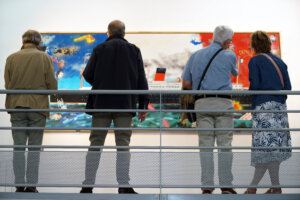
The day Isabelle Siméon cleared out a basement storage area in the town hall in Houdan, France, and found a rolled-up painting on top of a bookcase, she discovered a forgotten piece of history. My father, Philip Orenstein, a professor of art at Rutgers University, had started work on that painting in 1989 and donated it to the town in 1994 at an event marking the 50th anniversary of its liberation by American forces.
My father donated the painting because he felt a deep debt to the town that saved his life during the Second World War. A hidden child in Houdan from 1942-45, my father was saved by a parish priest who threatened to excommunicate anyone in this small market town who informed the occupying Germans about the Jewish children, resistance fighters, or downed allied pilots concealed there, or other acts of resistance. And by a farming family — the Trouvers — that took in children of French POWs, including Jews.
Yet by 2024, when Siméon, a municipal official, made her discovery, the town had forgotten not only the painting that had gone straight into storage, but its proud history of sheltering Jewish children and its heroic French resistance priest Abbé Pierre Condé. A dramatic page in the town’s 1,200 years of recorded history was lost. Even among the Jewish community in Yvelines, the bucolic region immediately to the west of Paris, the story was unknown. In France, the story of the hidden children, Jewish children sent to the countryside or small towns under various pretexts to avoid detection by Nazi occupants is well known. Several towns have established national reputations as places of refuge. But not Houdan and not elsewhere in Yvelines according to Valérie Boussard, president of the Council of Jewish Communities of Yvelines.

After spending more than a year to find my father based only on his signature and then restoring the painting, the Tannery (La Tannerie) gallery in Houdan is now hosting an exhibition through Nov. 1 to celebrate the restoration of this painting and this forgotten page of the town’s history.
Houdan today has changed. For many Parisians, this part of France serves as a country retreat and Houdan has fought hard to preserve its ancient town center. The result is a small town that continues to serve as a delightful regional hub with open air markets, restaurants situated in old farm buildings, an enormous fair each September, and increasingly fancy small shops, perhaps akin to the Cotswolds in England.
I accompanied my father to Houdan for the opening of his exhibition on Sept. 10 and stood with my extended family and Mayor Jean-Marie Tétart who proudly announced the future installation of the painting to a pride of place in the town hall. A former parliamentarian, Tétart seeks for Houdan the recognition it deserves as a place that, when times were at their hardest, resisted antisemitism and sought to repair the world. Even today.
Yet the town’s proud embrace of my father, his work, and this vital chapter of its history raises an important question: How was this history lost in the first place? And why was it rediscovered only now?

According to my father, the hidden child whose family survived the war and then emigrated to Brooklyn, France was simply not ready to receive this history before. It was not until 1995 that France officially took responsibility for the Vel d’Hiv roundup in Paris that claimed the lives of my father’s cousin Henri Herzhorn and thousands of other children who died in the French concentration camp in Drancy in inhumane conditions or in Auschwitz, their final destination. My father intended the seven murals that he painted starting in the 1990s to force France to recognize this history.
Paradoxically, with the dramatic rise of antisemitism that has deeply worried the French Jewish community, this history and the history of those who resisted resonates even more loudly. With every online or physical or verbal attack, the Jewish community and its allies in France respond with acts of memory.
My father’s work is at once personal and political, mixing family imagery with images of the grand politics of the day and oddly juxtaposed popular culture references. His murals stun the viewer with outsized images of a DeGaulle and Pétain or the D-Day landings, overlaid with family photos, Parisian graffiti, posters, and film advertisements. The colorful, powerful, and emotional images rush together and appear to jump off a graffitied wall in Paris as you are passing by.
“The Big Cheese,” his painting in Houdan, features an outsized image of the Ile de France steamship sailing across a brightly tricolored French flag background. The ship that bore him and his family to New York appears to be racing away from images of the iron cross, yellow stars, Drancy, and Karl Marx towards Mt. Rushmore, Max Beckman, and Statue of Liberty sunglasses. The work is colorful and epic in composition, on the one hand, while also inlaid with engaging and perplexing historical symbols designed to draw one in from afar and up close. My father has always dwelt on this history.
“As I worked on the seven canvases I describe as murals — my major body of work — I constantly thought of my cousin Henri Herzhorn, whom I had never met, as well as the more than 4,000 Parisian children who were victims of the Vel’ d’Hiv Roundup — my contemporaries, who, like me, left France,” my father said when he was in Houdan.
Today, though France seems open to revisiting this history, mysteries still remain. Particularly the postwar life and fate of Abbé Pierre Condé. I spoke with Monsignor Luc Crepy, the Bishop of Versailles for Yvelines, who has begun to research Houdan’s wartime hero together with the current Curé of Houdan, Father Pierre Bothuan. Condé left behind a published journal recording the major events of the war, occupation, and liberation of Houdan. After that, he too disappeared from collective memory.
Growing up in my father’s house, surrounded by this history, I came away from Houdan shocked at the distances we have traveled and the voids that remain. My father and his older brother Stephen, a former professor of nuclear physics at CUNY — hidden with him in Houdan — never expected to survive 1944, let alone to return there in 2026. The house where they lived lay just beside a small bridge that the Germans planned to dynamite after D-Day to slow the advance of Patton’s army. Yet the town’s postman cut the wires and my father and uncle survived to consider the contemporary relevance of a lost painting and a lost history to a lost world in need of repair.
The post He was a hidden child during WWII. The French town that saved him lost his painting and rediscovered a chapter of its history. appeared first on The Forward.
Uncategorized
Netanyahu to confront Mamdani’s call to arrest him in U.N. address this week
(JTA) — Prime Minister Benjamin Netanyahu on Tuesday accused New York Mayor Zohran Mamdani of supporting Hamas and inciting violence against Jews, setting up a showdown between the Israeli leader and one of the most prominent American pro-Palestinian politicians ahead of Netanyahu’s visit to the city.
Netanyahu said he would respond to Mamdani’s criticism of him and Israel during his speech at the United Nations General Assembly on Thursday, when he will visit New York for the first time since Mamdani took office.
Mamdani on Monday renewed his demand for the arrest of Netanyahu, who he called “a war criminal and an architect of a horrific genocide of the Palestinian people” in an interview with CNN’s Christiane Amanpour. He acknowledged that he did not have the authority to carry out a warrant for Netanyahu issued by the International Criminal Court, but said the warrant should still be “honored” to protect “accountability” to international laws.
“If the International Criminal Court deems someone worthy of an arrest because of a violation of those laws, then who are we to say that anyone should be above that?” said Mamdani.
Netanyahu responded in a video statement, “Shame on you for supporting the Hamas terrorist monsters who butchered our people. Shame on you for inciting riots against New York Jews.” A number of prominent New York Jewish figures have asked Mamdani to tamp down his rhetoric about Israel, linking it to rising violent attacks on Jews. Mamdani has said that he is mayor for all New Yorkers, including Jews, and denounces antisemitism.
“I’m coming to the U.N., I’m going to tell the truth about our heroic soldiers, and I’m going to tell the truth about you,” added Netanyahu.
Mamdani pledged during his mayoral campaign last year that he would seek to arrest Netanyahu if he visited, but admitted in July that the city could not legally do so.
The ICC issued its warrant for Netanyahu in 2024, accusing him of war crimes and crimes against humanity in Gaza. The United States and Israel are not signatories of the treaty that created the ICC in 2002 and do not recognize its jurisdiction.
Netanyahu has prominently featured Mamdani in campaign ads as he currently seeks reelection in Israel, framing the mayor as both a pro-terror extremist and a leader reminiscent of Nazi Germany.
Netanyahu is set for one of his shortest trips to the United States, where he is not slated to meet with President Donald Trump, according to The Jerusalem Post. He is currently scheduled to leave New York on the same day he arrives. Protests are expected both outside the United Nations and inside during Netanyahu’s speech, which last year saw representatives from dozens of countries walk out.
Meanwhile, Mamdani had his third meeting with Trump on Monday, continuing a rapport between the two populist leaders on opposite ends of the political spectrum. Despite their stark differences on issues including immigration enforcement, Trump praised Mamdani during a press conference on the lawn of Gracie Mansion.
“I want him to be a great mayor, and he’s certainly got potential,” Trump told reporters before shaking Mamdani’s hand and patting his arm.
This article originally appeared on JTA.org.
The post Netanyahu to confront Mamdani’s call to arrest him in U.N. address this week appeared first on The Forward.
Uncategorized
Could going to synagogue help or hurt a Jewish candidate? This poll offers a clue
Voters may react differently to a Jewish politician who publicly practices their faith than to one who simply identifies as Jewish, a new poll found. The distinction could matter for Pennsylvania Gov. Josh Shapiro, a possible 2028 presidential candidate who has made his Jewish faith central to his public life and service.
The Politico poll of 2,002 U.S. adults showed that Democratic voters were less likely to vote for a candidate who regularly attends synagogue than for a candidate not practicing a religion or attending services once a year. Among Republicans, however, a candidate who regularly attends synagogue performed better than one who attends only once a year.
The survey, conducted online in partnership with the London-based polling firm Public First between August 8 and 14, asked respondents to choose between hypothetical candidates with different characteristics, including political ideology, age, race, profession, sexual orientation and religious practice. The sample has a reported margin of error of plus or minus 2.2%.
The poll offers a window into how religious observance may shape the way voters view a Jewish candidate. In an earlier poll conducted by the same firm in May, among 2,038 voters, candidates were identified simply by religion rather than how often or where they worshipped. Being identified as Jewish hurt a hypothetical candidate among voters in both parties compared with being identified as Christian.
The findings could be particularly relevant to Shapiro, the popular Pennsylvania governor running for reelection this fall. He maintains a traditional Conservative Jewish lifestyle, keeps kosher and is a longtime member of Beth Sholom Congregation in Elkins Park, outside Philadelphia. In his recent memoir, Where We Keep the Light, Shapiro detailed experiences shaped by and tied closely to his Jewish identity, including his vetting as a vice presidential candidate in 2024.
Shapiro has been viewed as a potential first Jewish president since his gubernatorial campaign in 2022 and is one of three prominent Jewish Democrats — along with Illinois Gov. J.B. Pritzker and former Chicago Mayor Rahm Emanuel — mentioned as possible 2028 presidential candidates.
Religious identity, particularly Christianity, has become more central in Republican politics since President Trump returned to the White House in 2025. Trump and his Cabinet have made religious faith a prominent part of his administration’s agenda. He created a White House Faith Office to work with religious organizations and established a Justice Department task force focused specifically on what the administration calls anti-Christian bias. At the same time, an increasingly vocal faction on the far right has made Christian nationalism and antisemitism central to its politics.
The Politico poll does not explain why Republican voters responded differently to Jewish candidates based on how often they attended synagogue. But the gap aligns with the broader split in positions among conservatives who have warmly embraced visibly religious and politically conservative Jews, while criticizing liberal or less observant Jews over their politics and commitment to Judaism.
Trump has repeatedly drawn that distinction himself. During the 2024 election, for example, he said that Jewish Americans who vote for Democrats “hate their religion.”
The post Could going to synagogue help or hurt a Jewish candidate? This poll offers a clue appeared first on The Forward.
