


Uncategorized
Palestinian Terrorists Admit Their Own Rockets Kill Gazans, and the Media Look the Other Way

People inspect the area of Al-Ahli hospital where Palestinians were killed in a blast from an errant Islamic Palestinian Jihad rocket meant for Israel, in Gaza City, Oct. 18, 2023. Photo: REUTERS/Ahmed Zakot
A document seized in Gaza and reported by Israel’s Kan public broadcaster exposes a reality that sharply contradicts much of the global coverage of the Israel-Hamas war: Palestinian civilians have long been killed by Palestinian rockets and terrorist leaders knew it, discussed it, and accepted it.
The document records a meeting between Hamas and Palestinian Islamic Jihad officials held before Hamas’s Oct. 7, 2023, massacre across southern Israel and the war that followed. In it, Hamas representatives confront Islamic Jihad leaders over a deadly and recurring problem: rockets misfiring and landing inside Gaza, killing civilians.
“Your rockets are falling on people’s homes, and this is a recurring issue,” a Hamas official is quoted as saying.
The response from Islamic Jihad is even more damning. “We are at war,” a senior representative of the terrorist group replies. “Even if a thousand people are killed by friendly fire, that is the price of war.”
This is not a battlefield mishap acknowledged after the fact. It is an explicit, pre-war admission that Palestinian terrorist groups were aware their weapons routinely killed civilians and that they viewed those deaths as acceptable.
The document also records Islamic Jihad officials admitting that they knew their rockets were defective. According to the report, the weapons were manufactured using blueprints supplied by Iran’s Islamic Revolutionary Guard Corps. In other words, unreliable rockets were knowingly produced, launched from densely populated areas, and expected to fall short.
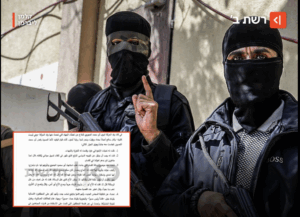
Image of the seized document, as presented by Kan Public Broadcaster
This matters because it directly undermines a central assumption that has dominated coverage of Gaza for years and intensified after Oct. 7: that civilian casualties are almost entirely the result of Israeli fire.
Kan’s report does not quantify how many Gazans have been killed by Palestinian rockets. But it does establish something journalists have consistently avoided confronting: terrorist groups themselves acknowledge that their own fire kills civilians and that this has been happening for years.
That reality burst briefly into view 10 days after the war began, when a PIJ rocket exploded in the courtyard of a Gaza hospital, killing hundreds of Palestinians. Israel was immediately blamed across much of the international media. Only later did evidence emerge that the blast was caused by a misfired Palestinian rocket.
This newly revealed document shows that the incident was not an anomaly. It was a known risk discussed internally long before Oct. 7.
So, why has this revelation barely registered outside Israel?
Journalists often justify their reliance on casualty figures and on the fog of war. But here, there is no ambiguity. This is a primary source document describing internal discussions between terrorist groups, criticizing each other for weapons failures and explicitly accepting civilian deaths as collateral.
If such a document emerged showing Israeli officials dismissing civilian deaths as “the price of war,” it would dominate headlines worldwide. When terrorist groups say it among themselves, it is met with silence.
This selective attention has consequences. Media outlets routinely report Gaza casualties without asking how many were caused by Palestinian fire. They rarely revisit earlier claims when new evidence emerges. And they almost never scrutinize the conduct of terrorist groups with the same intensity they apply to Israel.
The Kan report exposes not just the recklessness of Palestinian terrorist organizations but the media’s unwillingness to reckon with it. By ignoring evidence that complicates a simplified narrative, journalists deprive audiences of essential context and accountability.
This document does not absolve Israel of scrutiny. But it does demand that journalists stop treating Palestinian armed groups as passive actors whose actions are irrelevant to civilian harm.
Terrorists killing their own civilians is not a footnote. It is a central fact of this conflict. The question is no longer whether the evidence exists.
It is why so many in the media choose not to report it.
The author is a contributor to HonestReporting, a Jerusalem-based media watchdog with a focus on antisemitism and anti-Israel bias — where a version of this article first appeared.
Uncategorized
Teen slashed in Brooklyn synagogue by fellow congregant
(JTA) — A 14-year-old boy was slashed on Monday evening inside a Brooklyn synagogue by a suspect the police called an “emotionally disturbed person.”
The 22-year-old suspect, Krybus Shimon, is a fellow congregant of Yeshiva Gevoah Toldos, an Orthodox synagogue in Borough Park, the New York Police Department said. He was taken into custody and charged on Monday with assault, reckless endangerment and criminal possession of a weapon.
The boy’s hand was slashed with a “cutting instrument” and he was treated by emergency medical services on the scene, police said.
The incident is not currently being investigated as a hate crime, and it’s not yet clear what led to the slashing.
Borough Park is one of the largest Orthodox enclaves in the United States, home to about 96,000 Jews, according to UJA-Federation of New York.
In January, the neighborhood was hit with a spate of antisemitic vandalism. Over 70 swastikas and the words “Adolf Hitler” were sprayed over two days across Gravesend Park, a playground in Borough Park. Two 15-year-old boys were arrested for the vandalism and charged with aggravated harassment and criminal mischief as a hate crime.
New York Gov. Kathy Hochul last week announced a record $70 million in security funding for houses of worship, schools, community centers and other nonprofit organizations that are vulnerable to hate crimes and attacks because of their ideology, beliefs or mission.
This article originally appeared on JTA.org.
The post Teen slashed in Brooklyn synagogue by fellow congregant appeared first on The Forward.
Uncategorized
Staunch Israel supporter Coons expected to win Delaware Democratic Senate primary handily
(JTA) — Delaware incumbent Sen. Chris Coons, a longtime supporter of Israel, is expected to easily win Delaware’s U.S. Senate primary on Tuesday, despite criticism from party progressives.
Coons, a mainstay of the Senate Foreign Relations Committee, has repeatedly backed measures to bolster Israel’s capacity for self-defense. He also joined a bipartisan delegation to visit Israel immediately after the October 7, 2023, Hamas attacks.
But the senator has faced pushback in recent months for his refusal to back measures that would cut military aid to Israel.
This past spring, he was one of just seven Democrats to join Republicans in voting against a resolution authored by independent Vermont Sen. Bernie Sanders, which sought to stop the sale of military bulldozers to Israel. Coons was among just 11 Democrats who opposed a second Sanders resolution that proposed similar sales bans on massive bombs and other defense equipment.
Coons has served nearly three terms in the Senate. He won a special election in 2010, about a year after Joe Biden resigned to become U.S. vice president, and then went on to secure two full terms in 2014 and 2020.
In Tuesday’s primary, he will face off against artificial intelligence systems builder and historian Jeff Appelhans, naval architect and marine engineer Mary Louve and a former business executive who changed his legal name from Eric Hansen to E. No-Trump Hansen.
While Coons has earned endorsements from establishment Democrats, such as Delaware Sen. Lisa Blunt Rochester and Gov. Matt Meyer, he has drawn criticism from party progressives for both his support of Israel and the financial backing he gets from the American Israel Public Affairs Committee, the pro-Israel lobbying group.
Of Coons’s opponents, the most vocal critic on Israel-related policy has been Appelhans, whose campaign priorities included ending U.S. support for Israel’s war in Gaza. Appelhans slammed Coons for voting against the Sanders bills, writing on his campaign site that “the liberal consensus moved to block the sales.”
Appelhans condemned Coons’s voting record on “moving armaments to Israel,” noting in a recent interview that “there’s never been a vote that he’s stopped” on this issue. He was speaking with Delaware Public Media last week as part of a series of candidate interviews.
Regarding the conflict in Iran, Appelhans slammed “Congress’ unwillingness” to challenge the president, noting that “there was very much a sense that Israel would be a staunch ally and they could sort of get this done really easily.”
In the same radio series, another candidate, Louve, expressed uncertainty as to “why we’re still backing Israel,” while acknowledging the country’s history as a U.S. ally.
“Is it worth us continuing to step up for a bully?” she asked. “It’s aggression that is unnecessary that’s continuing to escalate because we’re helping it.”
Hansen did not participate in these conversations, Delaware Public Media stated.
This summer Coons pledged to stop taking donations from the data company Palantir, which has come under scrutiny for its work with the Israel’s Defense Ministry, the U.S. military and U.S. Immigration and Customs Enforcement, according to the nonprofit news site Spotlight Delaware.
Despite his more centrist reputation, Coons has had significant criticism for the Trump administration’s strategies in Iran. In his own Delaware Public Media interview, Coons accused the president of selling the conflict “as a cheap, quick war.”
While little polling data was available ahead of Tuesday’s race, the Polymarket predictions site gave Coons a 99.7% chance of winning as of Monday evening. In his last primary in 2020, Coons defeated a progressive opponent, Jessica Scarane, with nearly 73% of voter support.
Regardless of Tuesday’s outcome, the victor is expected to easily defeat the Republican challenger in the November general election, with the Cook Political Report deeming Delaware “solid” Democratic territory.
This article originally appeared on JTA.org.
The post Staunch Israel supporter Coons expected to win Delaware Democratic Senate primary handily appeared first on The Forward.
Uncategorized
Noah Wyle wins an Emmy for playing one of TV’s most Jewish doctors
(JTA) — Noah Wyle on Monday night won his second consecutive Emmy for playing Dr. Michael “Robby” Robinavitch on “The Pitt.” The win also marked a second victory for one of television’s more fully realized Jewish characters.
The actor won Outstanding Lead Actor in a Drama Series for the HBO Max medical drama, which also won Outstanding Drama Series for the second year in a row. In his acceptance speech, Wyle recalled growing up in Los Angeles and said, “This is all I’ve ever wanted to do, and this is the only club I’ve ever wanted to join.”
For Jewish viewers, the significance of Wyle’s victory goes beyond the actor’s own Jewish ancestry. In the first season, Robby was seen reciting the Shema at one of his lowest moments, turning what might have been a throwaway piece of character background into an intimate expression of fear and faith.
In the second season, Wyle, who is also a writer and executive producer on the show, pushed that dimension further. An episode he wrote dealt with the trauma of the 2018 Tree of Life synagogue shooting in Pittsburgh, while also exploring Robby’s complicated relationship with his Jewish faith.
Wyle has described Robby’s faith as something he is still “grappling” with — including the question of whether he has faith at all. The Shema scene, he said, functioned almost like a child’s primal plea for help.
Wyle was not the only Jewish winner of the night. Saul Metzstein, the Scottish Jewish director whose father was the prominent modernist architect Isi Metzstein, won Outstanding Directing for a Drama Series for “Slow Horses.” Metzstein had been competing against Wyle, who was nominated for directing an episode of “The Pitt.”
Those two wins were among the relatively few Jewish victories at this year’s ceremony. Jewish actors including Jason Segel, Lisa Kudrow, Harrison Ford and Hannah Einbinder were among the nominees but did not win in their categories.
“Nobody Wants This,” the Netflix show about a rabbi’s romance with a non-Jewish podcaster, was nominated for Outstanding Comedy Series but lost to “Widow’s Bay.”
An Emmy was also awarded to a Jewish actor and director whose death in 2025 stunned the industry and a legion of fans. Rob Reiner, who was killed in December with his wife, Michele, won a posthumous Emmy for his guest role as a kind dispenser of business advice on “The Bear.” Reiner’s award was presented at the Creative Arts Emmys earlier this month, rather than Monday’s televised ceremony.
Reiner, before going on to direct Hollywood classics like “This Is Spinal Tap,” “The Princess Bride” and “When Harry Met Sally” won his first two Emmy awards in 1974 and 1978 for playing Mike Stivic, the liberal son-in-law of Archie Bunker on “All in the Family.”
This article originally appeared on JTA.org.
The post Noah Wyle wins an Emmy for playing one of TV’s most Jewish doctors appeared first on The Forward.
