US and Iran Agree to Friday Talks in Oman but Still at Odds Over Agenda
Iran’s Supreme Leader Ayatollah Ali Khamenei speaks during a meeting in Tehran, Iran, Feb. 1, 2026. Photo: Office of the Iranian Supreme Leader/WANA (West Asia News Agency)/Handout via REUTERS
The US and Iran have agreed to hold talks in Oman on Friday, officials for both sides said, even as they remained at odds over Washington’s insistence that negotiations include Tehran’s missile arsenal and Iran’s vow to discuss only its nuclear program.
The delicate diplomatic effort comes amid heightened tensions as the US builds up forces in the Middle East and regional players seek to avoid a military confrontation that many fear could escalate into a wider war.
Differences in recent days over the scope and venue for the talks have raised doubts whether the meeting would take place, leaving open the possibility that US President Donald Trump could carry out his threat to strike Iran.
Asked on Wednesday whether Iran’s Supreme Leader Ayatollah Ali Khamenei should be worried, Trump told NBC News: “I would say he should be very worried. Yeah, he should be.” He added that “they’re negotiating with us” but did not elaborate.
After Trump spoke, US and Iranian officials said the two sides had agreed to shift the talks’ location to Muscat after initially accepting Istanbul.
But there was no indication they had found common ground on the agenda.
Iran has pushed to restrict the negotiations to discussing its long-running nuclear dispute with Western countries.
But US Secretary of State Marco Rubio presented a different view on Wednesday. “If the Iranians want to meet, we’re ready,” Rubio told reporters. But he added that talks would have to include the range of Iran’s ballistic missiles, its support for armed proxy groups around the Middle East, and its treatment of its own people, besides nuclear issues.
A senior Iranian official said, however, that Iran’s missile program was “off the table.” A second senior Iranian official said Tehran would welcome negotiations over the nuclear dispute but that US insistence on dealing with non-nuclear issues could jeopardize the talks.
Trump’s son-in-law, Jared Kushner, was due to take part in the talks, along with US special envoy Steve Witkoff and Iranian Foreign Minister Abbas Araqchi, officials said.
CHANGE OF VENUE
While the talks were originally slated for Turkey, Iran wanted the meeting to take place in Oman as a continuation of previous talks held in the Gulf Arab country that had focused strictly on Tehran’s nuclear program, a regional official said.
Iran says its nuclear activities are meant for peaceful, not military purposes, while the US and Israel have accused it of past efforts to develop nuclear weapons.
A Gulf official said the talks could be mediated by several countries, though Iran has indicated that it wants a two-way format limited to Washington and Tehran.
The diplomatic efforts follow Trump’s threats of military action against Iran during its bloody crackdown on protesters last month and the deployment of more naval power to the Gulf.
The US has sent thousands of troops to the Middle East since Trump threatened Iran last month – including an aircraft carrier, other warships, fighter jets, spy planes, and air refueling tankers.
After Israel and the United States bombed the Islamic Republic last summer, renewed friction has kindled fears among regional states of a major conflagration that could rebound on them or cause long-term chaos in Iran.
Trump has continued to weigh the option of strikes on Iran, sources say. Oil prices have risen on the tension.
NUCLEAR DISPUTE
Trump has warned that “bad things” would probably happen if a deal could not be reached, ratcheting up pressure on the Islamic Republic in a standoff that has led to mutual threats of airstrikes.
Iran’s leadership is increasingly worried a US strike could break its grip on power by driving an already enraged public back onto the streets, according to six current and former Iranian officials.
Trump, who stopped short of carrying out threats to intervene during last month’s crackdown, has since demanded nuclear concessions from Iran, sending a flotilla to its coast.
Iran also hopes for an agreement that could help lift Western sanctions over its nuclear program that have ravaged its economy – a major driver of last month’s unrest.
BALLISTIC MISSILE STOCKPILE
Iranian sources told Reuters last week that Trump had demanded three conditions for the resumption of talks: zero enrichment of uranium in Iran, limits on Tehran’s ballistic missile program, and an end to its support for regional proxies.
Iran has long said all three demands are unacceptable infringements of its sovereignty, but two Iranian officials told Reuters its clerical rulers saw the ballistic missile program, rather than uranium enrichment, as the bigger obstacle.
An Iranian official said there should not be preconditions for talks and that Iran was ready to show flexibility on uranium enrichment, which it says is for peaceful, not military purposes.
Since the US strikes in June, Tehran has said its uranium enrichment work has stopped.
In June, the United States struck Iranian nuclear targets, joining in at the close of a 12-day Israeli bombing campaign and Iran struck back at Israel with missiles and drones.
Iran said it replenished its missile stockpile after the war with Israel last year, warning it would unleash its missiles if its security is under threat.
Adding to tensions, on Tuesday the US military shot down an Iranian drone that “aggressively” approached the Abraham Lincoln aircraft carrier in the Arabian Sea, the US military said, in an incident first reported by Reuters.
In another incident in the Strait of Hormuz, the US Central Command said Iran’s Islamic Revolutionary Guard Corps had approached a US-flagged tanker at speed and threatened to board and seize it.
And each Yom Kippur, as worshippers attend the last prayers of the day, they might well ask: “Why is this closing service different from all other services?”
The Book of Life
Throughout the High Holidays, the 10-day period that begins with Rosh Hashanah and ends with Yom Kippur, Jews pray to be “inscribed” in the Book of Life – that God grant them life, livelihood, health and moral growth in the coming year.
The holidays culminate in Yom Kippur, the Day of Atonement: a day dedicated to reflection, fasting and repairing each person’s relationship with others – and through that, their relationship with God.
According to Jewish tradition, the Book of Life is sealed as Yom Kippur draws to a close, as is each person’s fate for the coming year. During the fifth and final service, one prays to be “sealed,” which on this Day of Judgment entails being forgiven. This last service is thus titled “Ne’ilah,” or “the closing,” reflecting the idea that the gates of heaven are closing. It also alludes to the gates of the ancient Temple in Jerusalem, where the holiday was once celebrated.
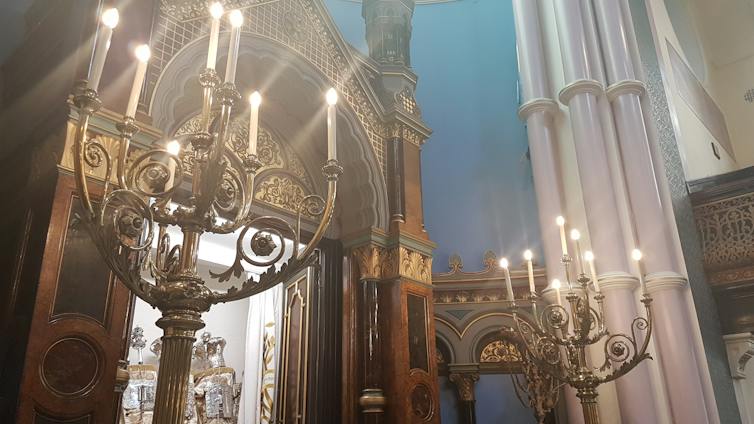
Ne’ilah prayers are accordingly recited at the closing of the day – just at sunset, adding nature’s drama to the closing of the day. The ambience is enhanced by keeping open the ark of the Torah, the usually closed chamber at the front of the synagogue that protects the scrolls of scripture. Many congregants remain standing, using this final chance to plead their case as the day slips by.
Yom Kippur is a day reserved for repentance, expressed through confession – and, in many ways, it is a day of repetition. The confessional prayer is recited up to 10 times over the course of five services.
It begins with the congregation asking God for forgiveness “for the sin that I have committed before You.” Yet what follows is an extended list of ethical sins, with a focus on the sins of abusive speech, such as slandering, slurring, slighting and smearing the reputations of others. A foundational concept of Judaism is that humanity is made in the image of God, meaning that in wronging others, we offend God as well.
After reciting the confessional, the Ne’ilah service adds one more prayer, not used in other services. This addendum focuses not on the specifics of confession but the dynamics of repentance: underscoring that belief that each person’s relationship with God is correlated with their relationship with other people.
Ne’ilah thus focuses on the sin of fraud, echoing a passage from the biblical Book of Jonah read in the preceding afternoon service: “Let everyone repent of their evil way by giving back the stolen goods in their hands.” To return to God, then, it is important to return what is owed to other people: emotionally, spiritually and materially.
Whereas the oft-repeated confessional focuses on offenses of the lips, such as slander, here the focus is on offenses of the hands: taking what does not belong to us, such as by exploiting the vulnerable or committing fraud.
“You give space” – literally, you give a hand – “to the sinner, but You extend Your right hand to penitents,” it begins. “You have taught us … to confess to You every one of our sins so that we cease handling unlawful goods.”
Judaism holds that God won’t forgive you for a sin if you haven’t made amends with the person you wronged. During the Days of Awe leading up to Yom Kippur, Jews are taught to ask each other for forgiveness, apologizing for the ways we wronged one another in the past year.
Repent and repair
Rather than browbeating people into repentance, the Ne’ilah service’s strategy is to boost them up into it, playing upon the biblical idea of the grandeur of humanity. “You have distinguished humanity from the beginning, privileging it to stand before You,” the liturgy says.
Judaism sees sin as a rupture that can be healed, not an inherent condition. The liturgy’s message is this: Live up to your greatness, your divinely endowed potential, as a being made in God’s image.
For Ne’ilah, the eminence of humanity consists in the ability to repent and set things right before man and God. This is what Yom Kippur is all about.
At Dartmouth, Jewish and Middle Eastern Studies refuse to stay apart
Immediately after the Oct. 7 attacks and the start of the Israel-Gaza War, Dartmouth College student Jackson Weinstein was “extremely outspoken” on campus about his support for Israel.
But by his sophomore year, he had largely withdrawn from discussing the conflict with other students.
“It felt like I was losing friends and just making things harder for myself,” said Weinstein, now a senior at the Ivy League university in New Hampshire.
This past school year, he enrolled in a new course, Difficult Conversations on the Middle East, developed by the college in response to debates over Israel and Gaza that have divided campuses across the country.
For the first several weeks, the class, jointly offered by Dartmouth’s Middle East and Jewish Studies departments, avoided delving into the conflict. Instead, students started by studying topics like groupthink, mindfulness, emotional regulation and academic freedom.
Only by the fifth week did they plunge into subjects like Palestinian armed resistance, women’s rights in the Middle East, the accusation of genocide in Gaza and the role of colonialism in the region.
“In the first class, students come in with this idea of, ‘How do I win the debate? How do I show that I’m right?’’” said Jonathan Smolin, a professor of Middle Eastern Studies. “That’s categorically not what we’re doing in the class.”
Smolin teaches the course alongside Ezzedine Fishere, a former Egyptian diplomat who spent five years posted in Israel.
The hope is that students learn to take an argument seriously enough to understand it before deciding whether they reject it.
The unusual course, offered again this school year, is the product of an experiment Dartmouth began long before Oct. 7. For roughly a decade, its Jewish and Middle Eastern Studies programs have deliberately intertwined themselves: professors co-teach and cross-list courses, serve on each other’s steering committees, co-sponsor visiting professors and even occupy neighboring offices in the same building. It’s just as much for the faculty as it is for the students.
“I want to understand why some people hold positions that I may find horrific,” said Susannah Heschel, chair of Jewish Studies at Dartmouth. “I’m not here to just condemn something; I want to understand the complexity of it.”
An unusual partnership
For Darcy Rochkind, a Middle Eastern Studies major modifying her degree to include Jewish Studies, the partnership is what drew her to Dartmouth.
Rochkind was applying to college in the fall of 2023, as campuses across the country were convulsed by protests and arguments over universities’ responses to Oct. 7. Her dream school was Columbia, but after watching congressional hearings on antisemitism in person and videos her mom sent her of Dartmouth’s Jewish Studies and Middle Eastern Studies professors discussing the conflict side by side, she changed her plans and enrolled at Dartmouth.
“You’d have a very hard time being a Middle Eastern Studies or Jewish Studies major without taking a class from the opposite department,” she said.
The experiment also extends beyond the classroom. In the immediate aftermath of the Oct. 7 attacks, Heschel and her colleagues in Middle Eastern Studies organized two public forums to discuss what had happened and opened it to students. The room was so packed that Dartmouth needed an overflow space, and Heschel said another 1,600 people watched via livestream.
After those initial forums, Dartmouth launched Middle East Dialogues, a series of events organized by faculty in Jewish and Middle Eastern Studies to explore challenging topics related to the region. Rather than foster safe spaces, Dartmouth leaders aspired to create what they call “brave spaces,” where students are encouraged to actively engage with disagreement.
To make it work, Smolin, who has organized many of the program’s events, deliberately avoids inviting speakers who are political activists on either side.
“We’re not interested in people declaring who’s right and who’s wrong,” he said. “That’s not what we do in higher education.”
Instead, they have hosted Israeli and Palestinian political commentators, think tank experts, and public-opinion researchers.
Professors have also facilitated meetings between students to expose them to different viewpoints. Weinstein and several other Jewish students went to dinner with a group of Muslim students, including two Palestinians and a student who had grown up in Gaza. His professor, Fishere, facilitated the gathering.
The students sat together at Pine, a Dartmouth restaurant, and talked for hours about the war, the accusation of genocide in Gaza and the experiences of Gazan civilians.
Weinstein had never before met someone who had spent his entire life in Gaza. He described the dinner as “one of the most human experiences I’ve had at Dartmouth.”
A national flashpoint
Dartmouth’s approach has become increasingly distinctive as Middle East studies programs have become flashpoints in campus battles over Israel, antisemitism and academic freedom.
Since Oct. 7, critics — including Jewish students, alumni, and watchdogs — have accused some Middle East studies programs across the country of teaching about Israel through a hostile ideological lens and creating an inhospitable environment for Jewish and pro-Israel students.
Some professors in the field, meanwhile, have argued that accusations of antisemitism in higher education are being used to police scholarship that could be critical of Israel.
Under similar pressure, Harvard’s Center for Middle Eastern Studies removed the center’s director and associate director from their leadership posts, though they kept their jobs. The Trump administration later demanded that the school’s Middle East Studies Department, among others, be audited by a third party to ensure a diversity of viewpoints.
The interventions prompted outrage from professors, students, and academic-freedom advocates arguing that the government was seeking to exert control over how universities teach about Israel and the Middle East.
According to Heschel, the climate has contributed to driving a wedge between Jewish Studies and Middle East Studies departments on some college campuses.
“I know that at some universities, faculty in Middle East and Jewish Studies don’t even talk to each other; they don’t respond to each other’s emails, for example,” she said. “That I find appalling. That’s unacceptable.”
Not everything is about conflict
For Heschel, the intellectual case for faculty in Jewish and Middle Eastern Studies to collaborate goes beyond teaching students how to talk about the current conflict.
“We want our students to know not just about the conflict that they read about in the newspapers today,” Heschel said. “We want them to know about a period where there was religious tolerance and respect for one another, to see that it’s possible we don’t have to live in a condition of anger and enmity.”
She co-teaches a course with a Middle East Studies professor examining how Jews in Europe and Arabs in the Middle East responded to modernity during the 19th century.
In one lesson, students learn about the Lebanese intellectual Butrus al-Bustani, who founded a school in Beirut in 1863 for Christian, Muslim and Jewish boys — and hired a cook to prepare kosher food for his Jewish students.
Engineering major Oguz Kurt, a rising junior who was born and raised in Turkey, took the course last semester.
“Building trust week over week” with classmates and professors, he said, brings people like him into the room who might otherwise be “intimidated” by the prospect of tense encounters in a class focused explicitly on the Israeli and Palestinian conflict.
Kurt wants to be there, which points to one obvious limitation to Dartmouth’s experiment: Students have to want to participate.
A 2025 survey of graduating seniors by the university’s campus newspaper, The Dartmouth, found that nearly 70% described themselves as liberal or very liberal, compared with roughly 12% who identified as conservative or very conservative. More than 70% said most of their closest friends shared their political beliefs.
Additionally, a 2025 Gallup poll conducted on the Dartmouth student body in 2025, found only 38% reported feeling comfortable sharing unorthodox ideas in class.
Weinstein wonders whether this degree of homogeneity is why courses like Difficult Conversations succeed – the people least willing to engage with opposing points of view don’t take the class.
“Everyone was there to learn. Everyone could be persuaded,” he said. “In some ways that’s a problem,” adding that the class might benefit from “a wider range of ideologues.”
“Not all of Dartmouth is like this,” Smolin acknowledged. “No doubt there are professors in other units that think it’s up to faculty to lead liberation and that this approach is stifling.”
On the other end of the spectrum, Heschel said some right-wing Jewish faculty members outside the Jewish Studies program have criticized the approach she and her colleagues take.
“I understand the anxiety that Jews feel today about university campuses, but I think they’re underestimating their own students,” she said. “Kids will encounter viewpoints that they will find disturbing and offensive, not just about Israel… they need to learn how to handle such a situation, how to respond.”
Heschel said faculty and administrators at other universities have approached Dartmouth to ask how to replicate what they did.
“I was surprised that we received so many requests from deans and presidents of colleges and universities to come and talk about what we had done,” she said.
From Dartmouth to Damascus
One of the people thinking about what could be replicated outside Hanover comes from much farther away.
Before flying to New Hampshire this May, Ibrahim Imre El-Khalid Bethlen asked ChatGPT a question he had never needed answered before: What is proper Shabbat etiquette?
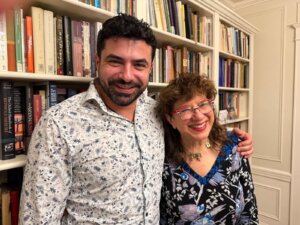
Heschel and Bethlen at Dartmouth Courtesy of Ibrahim Imre El-Khalid Bethlen
Bethlen, a Syrian political scientist who teaches at Damascus University, met Heschel when she traveled to Damascus with a delegation of Jewish Americans in December 2025. She invited him to come to Dartmouth for 10 days and packed his schedule with jointly taught courses like Difficult Conversations, and a seminar about Jews in Algeria. Bethlen also lectured about the current political situation in Syria and attended his first ever Shabbat at the campus’ Chabad.
Just as new to him was seeing Jewish Studies and Middle Eastern Studies professors teaching together.
“With every professor we had some brainstorming about how we could bring the people closer,” he said. “How could we demystify” Jews to Syrians. Most of them have never met a Jewish person since the millennia-old Syrian Jewish community left en masse in the mid-20th Century.
Now, Bethlen hopes to connect faculty at Damascus University to their counterparts at Dartmouth. He is realistic about political sensitivities. Bringing an Israeli or Jewish Studies professor into a Syrian classroom to discuss the contemporary conflict, he says, could be a nonstarter. But having an Arab professor in the classroom as well could help.
“We don’t want to jump too high,” he said.
He imagines beginning somewhere Dartmouth itself often begins: with classes focused on shared history and culture rather than contemporary politics. Perhaps a jointly taught course that introduces students to the literature and poetry of Jews and Arabs once shared across the Middle East. Classes like Difficult Conversations can come later.
As a part of that Dartmouth class’s final assignment, students are asked to have a conversation with someone on campus they disagree with about the region, applying what they have learned.
Weinstein chose a friend and fraternity brother whose views on Israel differed sharply from his own. They talked for several hours.
“I ended by congratulating Eli on being ‘the only close friend I’ve ever had that wasn’t pro-Israel,’” Weinstein wrote in his reflection afterward. “I sure hope he isn’t the last.”
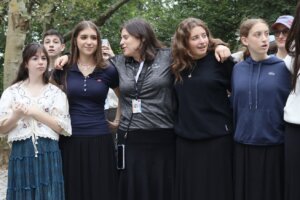
In a sea of kippot and black skirts, more than 200 Orthodox middle school and high school students gathered outside Gracie Mansion on Friday, conducting morning prayers and giving speeches.
“I like protesting against Mamdani,” Rami Fishman, a 16-year-old student, told the Forward. “He’s not a great guy. I’ll take an opportunity to speak out against him.”
Prominent Modern Orthodox preparatory schools Ramaz and SAR organized the gathering with Congregation Kehilath Jeshurun, the synagogue that sponsors the institutions. Organizers said that comments Mayor Zohran Mamdani made over the summer attacking AIPAC and Israel drove their efforts. Rabbi Bini Kraus, principal of SAR, said the experience was also intended to teach students about “their civic responsibilities.”
“It’s fun,” Fishman said. “We’re praying and we’re saying ‘no’ to Mamdani.”
Fishman, a junior at SAR, said he liked waking up late and he was enjoying meeting students from another school. Kraus told the Forward students were missing three periods by participating, but noted prayer is part of the school’s curriculum and the gathering wasn’t taking away from their studies.
Students and parents could opt out, with Kraus noting some declined to participate. Nearly 400 alumni and members of Congregation Kehilath Jeshurun signed a petition against the gathering.
Photo by Molly Myers
In their speeches, students touched on fears of antisemitism, being proud Jews and supporting Israel openly. One 8th grader called on Mamdani to prioritize the safety of the Jewish community.
Neturei Karta, a Haredi group that opposes Zionism, protested against the student group by waving Palestinian flags, chanting and holding signs in support of Mamdani. The NK group chanted “Antizionism is not antisemitism,” and called for Israeli Prime Minister Benjamin Netanyahu to be arrested during his visit to New York next week. Mamdani, who campaigned on arresting Netanyahu, recently acknowledged he does not have the authority to do so.
Michael Rapaport, an actor and staunch supporter of Israel, came to support the students saying it was “moving,” and “not a political statement.”
“These are kids,” Rapaport told the Forward, “they can’t even vote. This is a beautiful, beautiful, beautiful prideful thing.”
Organizers did not describe the gathering as a form of protest, instead referring to it as a vigil or communal prayer. However, the event involved classic hallmarks of a protest. A handful of participants waved or wore Israeli flags, and organizers acquired a permit for noise amplification.
“Our students have been going out for decades, really, when things matter,” Kraus said.
He noted he demonstrated for Soviet Jewry when he was a student at the school.
A reporter asked Mamdani about the demonstration at a press conference Wednesday.
“I welcome them,” he said. “They can have a vigil, or I’ve heard some describe it even as a ‘protest.’ Whatever it is intended to be, they have the room and space to do so outside of Gracie Mansion. I think that at the time that they are there, I will probably be somewhere else across the city.”
Rabbi Chaim Steinmetz, senior rabbi at Kehilath Jeshurun, said Thursday, “That’s the right response.”
Kraus, however, said he hoped the mayor would change his mind and attend. If he did, he would hear singing, praying and concerns “expressed respectfully.”
“Maybe that will move him,” Kraus said.
Some alumni and parents opposed the demonstration
The petition against the demonstration stated, “This gathering needlessly inflames tensions between the mayor and the Modern Orthodox Jewish community, as opposed to inviting him into conversation as a potential ally working for the shared safety of all New Yorkers.”
Much of the signatures are anonymous, with only school and class year listed.
The petition also said the schools risked portraying the Modern Orthodox community “as a political monolith opposed to the mayor.”
“They don’t want it to look like the Modern Orthodox community is a monolith, but the Modern Orthodox community really is a monolith on this,” Steinmetz said. “The Modern Orthodox community is, by and large, quite Zionist and really takes the security and safety of the state of Israel very seriously.”
A 2024 poll conducted by Nishma Research found 94% of the Modern Orthodox community identifies as Zionist, compared to 51% of Haredi Jews.
Halachic Left, an observant organization that says its members have “deep connections” to institutions in the Modern Orthodox community, helped circulate the petition. In a statement to the Forward, the organization insisted there is a “full range of views in the Modern Orthodox community on Israel, Zionism, and Mayor Mamdani.”
“The mayor has shown a willingness to respect and speak with our community,” read the statement. “We should be partnering with and engaging the mayor rather than castigating or insulting him.”