


Uncategorized
Can Manischewitz make matzo ball soup hot again?
Last weekend, I was walking through Lower Manhattan, when I strolled past something confusing. Several women in matching baby blue leggings and puffer coats were dancing to pop music in a small park outside the Soho Apple store, surrounded by ice blocks with something — it was hard to tell what — frozen inside them. As I got closer, I realized that they were handing out some kind of greens-boosted energy drink. The set-up was a made-for-Instagram PR stunt.
The whole point of the event seemed to be to cultivate a cool Manhattanite sheen for the brand. People were taking cans of the beverage, because why not — it was free! No one, however, was hanging out and dancing with the paid promoters, who were dancing conspicuously alone. The drink, which was gross, piled up in nearby municipal trashcans. The whole thing left a sour taste in my mouth, and not just from the fake sweetener in the beverage. Do these stunts sell energy drinks? Do they sell anything at all?
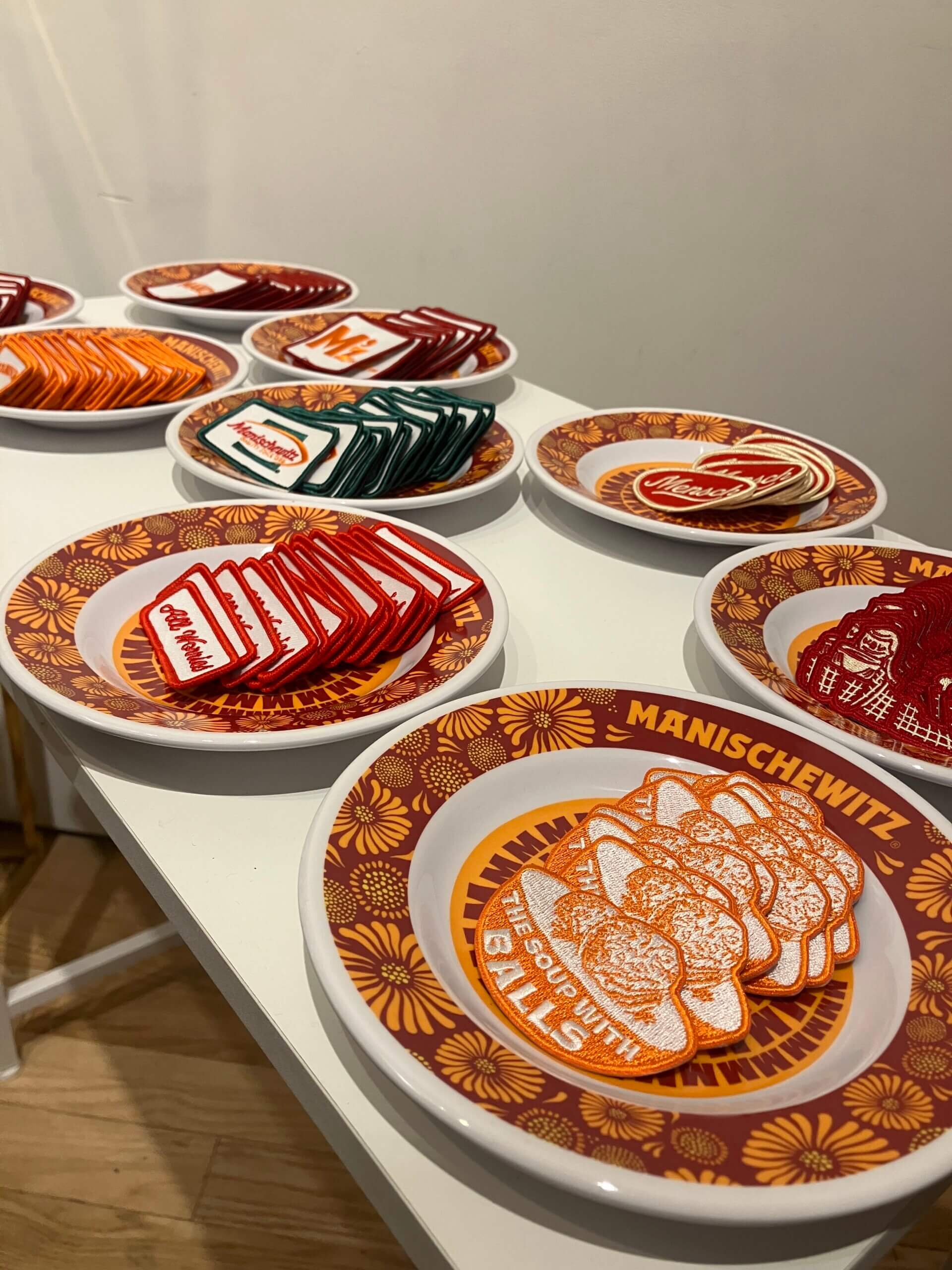
These questions were front of mind when I showed up at an art exhibit at a gallery on the Lower East Side. The art show was called SOUP, and it was hosted by Manischewitz to mark the launch of, yes, a line of jarred soups.
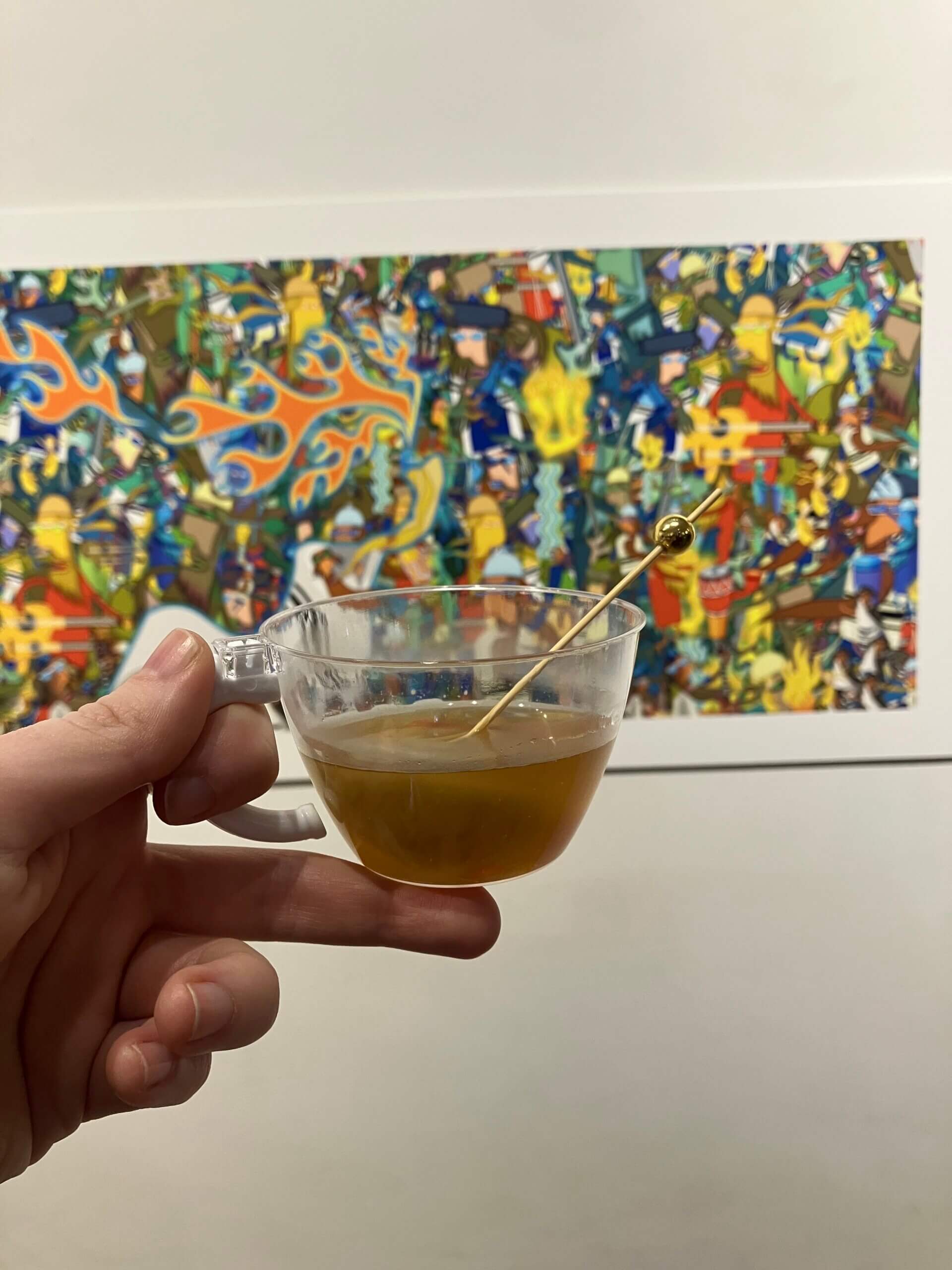
When I walked in, there was a solid crowd mingling in the gallery. Photos from Manischewitz’s newest ad campaign from Ohad Romano — a delightfully campy set of family photos featuring, of course, jars of soup — hung on one wall, opposite the soup-free work of two other Jewish artists, psychedelic scenes by Dan Weinstein and colorful objects from Rosemarie Gleiser.
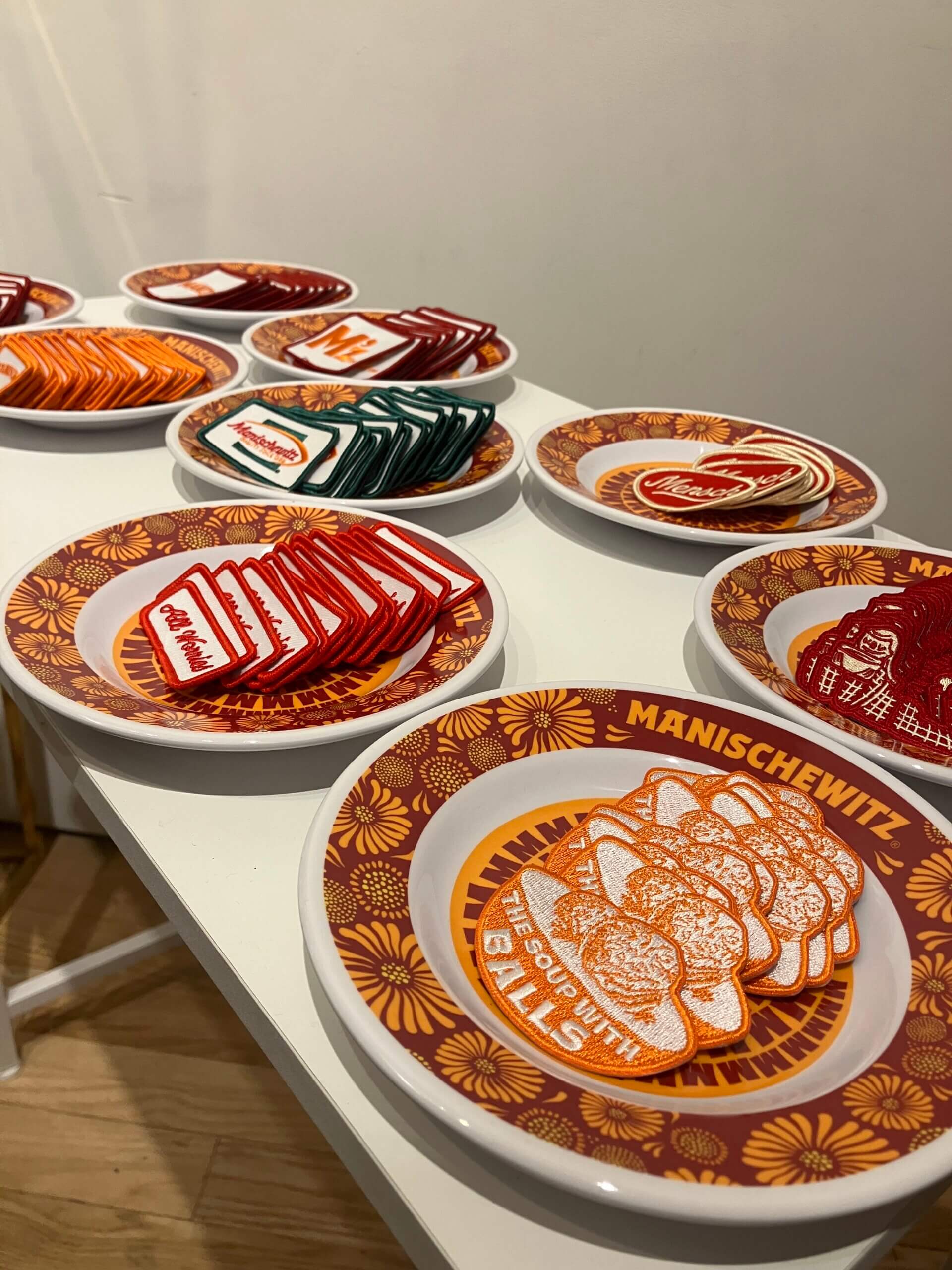
Orange-aproned waiters passed around teacups full of soup and a bartender made gin and tonics featuring Cel-Ray and spritzes with Manischewitz wine. (The wine is owned by a different company than the food products, so was unrelated to the event.) There was a line in the back room to get Manischewitz-themed patches sewn onto Manischewitz-branded hats. A baby on a woman’s hip giggled. A man in a sharp suit, cravat and kippah laughed with a group of friends as they all sipped chicken soup with matzo ball floaters.
But what did any of it have to do with actually selling soup?
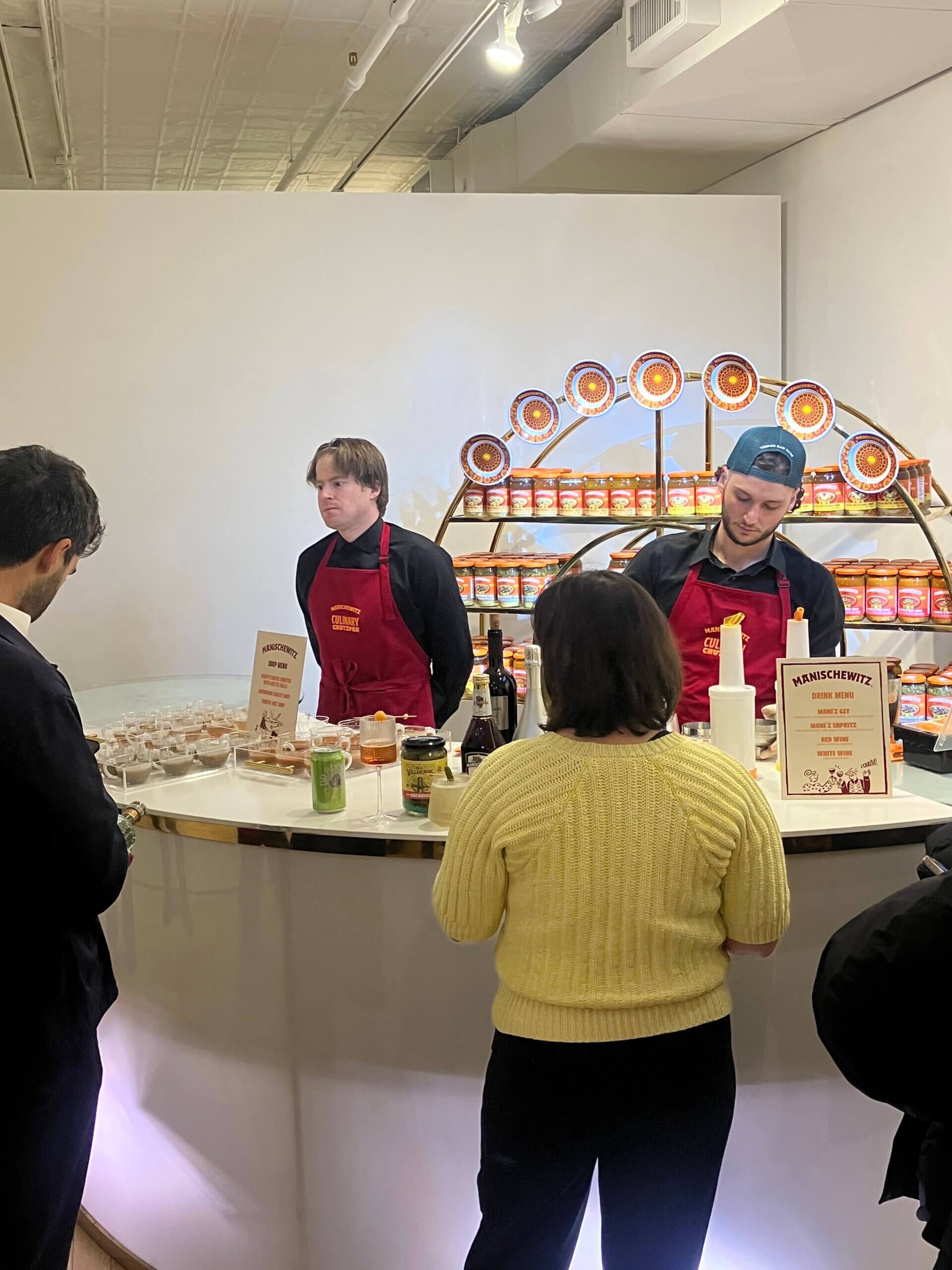
Talia Sabag, a marketing manager at Manischewitz, told me that the art show was part of the rebrand that the company has been rolling out over the past few years. Their boxes of matzo went from a bookish off-white to a bright orange, with scribbled illustrations of little figures carrying bowls of soup across the box that look like they should have walked out of the Jewish Almanac. The company told The New York Times, in 2024, that the rebranding effort was to refresh the brand, but also to target a new base of “culturally curious” consumers. In short, they wanted to sell kosher products to everyone, not just Jews.
Nearly everyone at the art show’s opening, however, seemed to be Jewish. More relevantly, the show was only planned to be up for six days.
While I sipped my teacup of soup, I asked Sabag what the show was meant to achieve for the brand. At first, she stuck to the message, arguing that the show was exactly what it said it was: an art show about soup.
“We want to celebrate the interwoven ways cuisine plays a role in communicating Jewish culture to ourselves and to the world,” she said with a bright smile, all symbolized by “the warmth of soup!”
Eventually, though, we got down to it: “A lot of studies do show that Gen Z does buy products based on that coolness factor,” Sabag told me. (She mentioned Nutter Butter as an example; the cookie started posting surreal, apocalyptic memes and saw their sales spike as a result.) In the words of the Gen Z buyers the brand is trying to attract, the art show is aura farming.
But is it possible to make Manischewitz cool? The brand is so iconic, so central to American Judaism, that it almost feels like asking whether it’s possible to make Judaism itself cool. Whether or not Judaism needs help in that arena is an open question, but plenty of people and brands have been trying to boost its coolness factor, whether it’s handbag designer Susan Alexandra’s glitzy launch party for her line of Judaica or the transgressive Bushwick burlesque show, Sinner’s Shabbat.
“We want to open up the conversation to the younger generations of course,” Sabag said. “But we’re not neglecting our core audience: our bubbes.” That means balancing nostalgia and hipness.
It’s almost impossible to purposefully construct coolness; by its nature, it resists trying. Usually, trying to be cool can only backfire, like the event with the energy drink dancers.
But I have to admit: The art show was kind of cool. It nailed its aesthetic, embracing the absurdity and surrealism of a moment in which a historic, grandmotherly brand like Manischewitz would be running an aura farming event, tonally a perfect fit for an irony-pilled era. Yet it also took itself seriously in the right ways; it was, ultimately, an actual art show with Jewish artists’ work in a neighborhood with deep Jewish roots, serving historic Jewish food. It felt genuine and rooted even as it was irreverent. Every detail was thoughtful. The drinks were actually good. The soup was exactly the same as ever.
The truth is, Manischewitz’s rebrand is cool because Manischewitz has always been cool. So has Judaism.
The post Can Manischewitz make matzo ball soup hot again? appeared first on The Forward.
Uncategorized
These Bundist pioneers were heroes in their time. Would they be in ours?
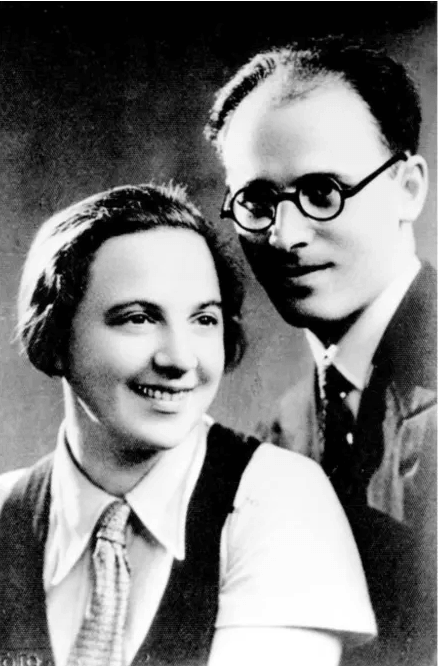
Academic stars in high school, Abrasha Blum and Luba Bielecka shared a slow burn romance and fervor for radical change. That hardly set them apart amid the ferment after the tsarist empire crumbled in 1919. No one would have predicted that Bielecka would go on to be awarded global nursing’s highest honor and Blum Poland’s equivalent of the Congressional Medal of Honor.
But their story poses a provocation in today’s hyper-polarized politics: Blum and Bielecka were devoted Bundists, and as such, they were not only socialists but anti-Zionists.
That combination can get you labeled today as anti-Israel and antisemitic, and even anti-American. Yet at the time they were Jewish heroes.
Bielecka repeatedly risked her life smuggling children out the Warsaw ghetto under Nazi occupation while directing the sole Jewish nursing school, sustaining its rigorous professional standards even as it was squashed into oblivion. Blum, a physically frail man, was dubbed the “ideological father of armed resistance” in the Bund; he led his band of militants into joining forces with the detested Zionists in the historic Warsaw Ghetto Uprising. When the insurgency was crushed — as all the combatants knew it would be — Blum, an engineer by training, led the surviving remnant through the cavernous sewer system to safety. But soon thereafter, in fleeing the police, he plummeted three stories from an apartment building. Badly injured, he was taken to Gestapo headquarters and never seen again.
Blum and Bielecka engaged the world as they found it and fought for justice for Jews and humanity. Blum’s photo is on display at Yad Vashem, Jerusalem’s Holocaust museum.
A lot has changed in 85 years. In 1939, most Americans Jews opposed Zionism and feared it would be misused by antisemites to justify allegations of dual loyalty. At the time, twice as many Jews lived in Warsaw as in all of British Palestine. The Bund swept 17 of 20 Jewish-designated seats on city council (Blum held one of them), far outdistancing all the Zionists parties together. Socialism made sense to Jewish voters, who were overwhelmingly “blue collar.” And so did doikayt (“hereness”), the doctrine that Poland’s three million Jews belonged there, not in a far-off desert, as the Zionists maintained.
The Holocaust radically and irrevocably changed the landscape. Ninety percent of Polish Jewry was exterminated. Even after the Nazis were vanquished, Jews continued to endure pogroms and were largely purged from Poland’s ruling communist party. By then, Israel was the sole destination in the world that welcomed large numbers of Jews.
Blum and Bielecka’s daughter, 17-year-old Aviva (née Victoria), was among the pioneers who migrated to a kibbutz in the new State of Israel. Zionism offered her the promise of milk and honey in a sanctuary free of antisemitism.

For years, her younger brother, Olek, held fast to his parents’ politics. But he too ultimately exited Poland, not for Israel but for the US, saddened that his father’s dream of “a prosperous Jewish minority inside Poland was impossible to realize.”
Like their parents, Aviva and Olek too engaged the post-WWII world as they found it and sought a better world.
Today, socialism and anti-Zionism are each experiencing something of a revival in the U.S. Self-described socialists have won mayoral elections in New York, Seattle and Washington, D.C. DSA-supported candidates won the Senate Democratic primary in Florida and narrowly lost Wisconsin’s gubernatorial primary. A recent CBS News poll found that 58% of Democrats now hold a favorable view of socialism, whereas only 32% view capitalism positively. The gap is even wider among young people. Jews, despite their relative affluence, remain among the most liberal voters in the U.S., although their current views on socialism have not been scientifically surveyed.
Anti-Zionism looks quite different in 2026 than in 1939, at least to Jews. Israel, approaching its 80th anniversary, is far from the desert mirage ridiculed by pre-war Bundists. While only a minority of American Jews self-describe as Zionists, an overwhelming majority support Israel as a Jewish and democratic state. Yet they are deeply troubled by Israel’s direction: Polls show that Zohran Mamdani, a socialist and anti-Zionist, is more popular among American Jews than Israeli Prime Minister Benjamin Netanyahu.
We’re left with this thought experiment: What if Abrasha and Luba resided in America today? What would they view as justice and how would they engage to achieve it? What if they resided in Israel?
And finally, a question about the rest of us: Would we recognize them as heroes?
The post These Bundist pioneers were heroes in their time. Would they be in ours? appeared first on The Forward.
Uncategorized
AIPAC couldn’t stop Michigan’s El-Sayed in the primary. Now it’s trying again.
AIPAC’s super PAC has re-entered Michigan’s closely watched U.S. Senate race less than a month before the general election, spending nearly $100,000 on mailers attacking Abdul El-Sayed, despite earlier concerns by allies of his Republican opponent, Mike Rogers, that it would boost the Democratic nominee.
The spending of $94,620 by United Democracy Project (UDP) on direct mailers was disclosed in a Friday campaign finance filing. It comes after Rogers publicly welcomed AIPAC’s support during a televised debate last week, reversing the position initially taken by people close to his campaign who worried the pro-Israel group’s involvement could hurt his chances.
A spokesperson for the group told Jewish Insider that the mailers target 130,000 identified Jewish voters in the swing state. It focuses on El-Sayed’s response to an attack on Temple Israel in West Bloomfield earlier this year. El-Sayed drew criticism for saying “hurt people hurt people” when discussing the attacker, whose brother was reportedly a Hezbollah commander killed in an airstrike on Lebanon. El-Sayed later apologized, saying he had been trying to provide broader context for the attack.
UDP spent more than $30 million trying to defeat El-Sayed in the Democratic primary this summer and in support of Rep. Haley Stevens, who lost by about one percentage point.
Following the primary, allies of the Republican nominee reportedly asked AIPAC not to run ads to boost him, fearing that the group’s involvement would give El-Sayed the same political foil that helped him overcome its massive spending in the primary. Axios reported that AIPAC officials didn’t take that rejection easily.
But Rogers appeared to change course last Thursday when asked whether he’d welcome AIPAC’s support.
“Anybody that wants to help my campaign stop a guy who can’t condemn terrorism in our own country because he’s so close to the people who are supporting the Muslim Brotherhood, again, I’ll take all of that help,” Rogers said at Thursday’s televised debate. El-Sayed interrupted to say he had condemned terrorism.
A new super PAC, Together for Michigan, aired an ad during the debate featuring Taylor Weintraub, whose child attends the Temple Israel preschool that was attacked in March.
Rogers went further on Friday at a campaign event with Sen. John Kennedy of Louisiana, accusing El-Sayed of being “so anti-Jewish” that a single mailer had upset him. Rogers said he welcomed help from Jewish supporters seeking to defeat his opponent. Kennedy also attacked El-Sayed, saying AIPAC would not be involved in the race if the Democrat did not “sleep in a Bin Laden jersey.”
El-Sayed, an Israel critic who has made opposition to AIPAC a central part of his campaign, responded by accusing Rogers of desperation. “You know Mike Rogers is in trouble when he begs AIPAC to start spending against me,” he wrote on X.
Some Jewish Democrats are publicly supporting Rogers, saying El-Sayed has failed to assuage concerns in his outreach to Jewish voters and in campaign appearances in recent months. If elected, El-Sayed would become the first Muslim member of the U.S. Senate.
Recent polls show El-Sayed with a narrow lead in the race to replace retiring Democratic Sen. Gary Peters. Recent elections in Michigan have been decided by narrow margins. Trump won the swing state in 2024 by about 80,000 votes, while Democratic incumbent Elissa Slotkin defeated Rogers in the Senate race that year by fewer than 20,000 votes. Four years earlier, Joe Biden won Michigan by about 2.8 percentage points.
The post AIPAC couldn’t stop Michigan’s El-Sayed in the primary. Now it’s trying again. appeared first on The Forward.
Uncategorized
In Israel’s election, Netanyahu faces a reckoning over Oct. 7 failure
With barely two weeks remaining before Israel’s Oct. 27 election, the country has been consumed by an extraordinary confrontation between Prime Minister Benjamin Netanyahu and senior former aides over what he knew before the Hamas massacre of Oct. 7, 2023, what he did with that knowledge and whether his office subsequently sought to rewrite the historical record.
The immediate catalyst was a bombshell television interview in recent days with Maj. Gen. (res.) Avi Gil, Netanyahu’s former military secretary, who served alongside him before and during the attack that killed approximately 1,200 people and saw 251 taken hostage. Gil had remained largely silent for three years, expecting to present his evidence to a state commission of inquiry. But with Netanyahu blocking such an inquiry, amid transparent scheming to deflect blame, Gil decided to speak publicly.
What he described went considerably beyond the failures of intelligence and military preparedness that have already been extensively documented. Gil accused Netanyahu’s office of attempting to falsify an official record from the morning of the attack. He challenged the prime minister’s account of early warnings he received. He confirmed that Netanyahu rejected recommendations for preventive military operations against Hamas. And he described how political considerations influenced decisions over hostage negotiations, potentially prolonging the captivity of people who could have been brought home earlier – and alive.
His testimony is particularly consequential because it directly challenges a 55-page document Netanyahu released in February, presenting his version of the events preceding Oct. 7. Submitted to Israel’s state comptroller, the document portrayed Netanyahu as having repeatedly advocated tougher action against Hamas while security officials underestimated the threat. It has become central to his defense against accusations that his longstanding policy of containing Hamas helped create the conditions for the catastrophe.
Gil, who attended the relevant meetings and recorded his experiences in 16 notebooks, described the published document as a profoundly incomplete and misleading account, containing lies and half-truths. It failed to reflect even half of what he witnessed.
A separate investigation published Friday by Yedioth Ahronoth, comparing Netanyahu’s account with original records of security deliberations, reported significant omissions and distortions, including instances in which Netanyahu allegedly rejected proposals to target Hamas leaders that his February document presented as initiatives of his own.
Most explosive was Gil’s account of an alleged attempt by Netanyahu’s then-chief of staff, Tzachi Braverman, to change the official time of a telephone conversation on Oct. 7 from 6:40 a.m. to 6:29 a.m. Moving the time backward could create the impression that Netanyahu had been issuing instructions from the first moments of the assault. Gil said a stenographer told him she had been instructed to alter the record, prompting him to notify the attorney general.
Nitzan Alon, another retired general who headed the government’s hostage release operation, and took part in negotiations throughout much of the war, also told reporters that “it was possible to end the war a year earlier” and save the lives of numerous hostages who eventually died in captivity.
Another remarkable confrontation involves Ronen Bar, the former head of the Shin Bet domestic security agency, whom Netanyahu has repeatedly blamed for the failures of Oct. 7. In late September, Bar announced plans to sue Netanyahu for defamation, accusing him of conducting a campaign of false allegations about his conduct before the massacre. Bar said he had warned Netanyahu about a looming security disaster and demanded disclosure of the original records of security meetings, communications and warnings, including the prime minister’s contacts with foreign officials.
Those demands have acquired additional significance amid reports that senior officials from Egypt and the United Arab Emirates warned Netanyahu about Hamas preparations shortly before the attack. Netanyahu categorically denies receiving such warnings and has threatened legal action over the reporting.
Gil’s revelations arrived alongside another striking intervention from a former Netanyahu confidant. Yoav Horowitz, , once Netanyahu’s chief of staff and director-general of the Prime Minister’s Office, told Kan’s Reshet Bet radio last week that he had gradually come to understand that Netanyahu’s decisions were driven primarily by considerations of personal political survival rather than the national interest.
Now a senior aide to leading opposition figure Gadi Eisenkot, Horowitz attributed that transformation to the corrosive effects of prolonged power, observing that “too much time in power corrupts,” and framed the approaching election as being about saving the country.
Horowitz now heads the team preparing its first 100 days in government. His criticism therefore comes from a former trusted aide who has become an active political opponent, adding another dimension to the dispute over Netanyahu’s leadership.
The question of political survival also figured prominently in Gil’s account of the hostage negotiations. Asked whether coalition pressures had influenced decisions that delayed agreements to free hostages, Gil said some hostages could have returned earlier and that political calculations had played a role in the decisions that kept them in captivity.
Netanyahu has rejected Gil’s allegations, and his Likud party has characterized the latest revelations as politically motivated propaganda. Netanyahu and his supporters maintain that senior security officials failed to recognize the imminent danger.
The country is still struggling to establish a common factual account of its most traumatic day in decades, while the officials who participated in the crucial decisions offer sharply conflicting versions of what happened. Meanwhile, the families of those killed on Oct. 7, survivors of the massacre and former hostages continue demanding answers about the decisions that shaped their lives.
The public appetite for an inquiry into the disaster is overwhelming. A September 2025 survey by the Israel Democracy Institute found that 74 percent of Israelis supported establishing a state commission of inquiry, including 68 percent of Jewish respondents identifying with the political right. A subsequent survey conducted in February 2026 found that 92 percent of Israelis considered it important to investigate the events.
The absence of such an inquiry has left journalists, former officials, politicians and bereaved families conducting an increasingly contentious public investigation of their own. Documents appear selectively, witnesses offer competing recollections, and allegations that might otherwise be tested through sworn testimony and access to classified evidence become weapons in an election campaign. With spiraling suspicions being leveled at Netanyahu, the election will take place amid unresolved questions – and a rage that grows more toxic by the day.
The post In Israel’s election, Netanyahu faces a reckoning over Oct. 7 failure appeared first on The Forward.
