



Uncategorized
‘Creates More Enemies’: Iran’s War Spreads to Turkey as Analysts Warn Regional Assault Is Strategic Mistake

Debris of a NATO air defense system that intercepted a missile launched from Iran is seen in Dortyol, in southern Hatay province, Turkey, March 4, 2026, in this screengrab from video. Photo: Ihlas News Agency (IHA) via REUTERS
Turkey became the latest unexpected target in the widening war in the Middle East on Wednesday after it intercepted an Iranian missile, as Iran’s retaliation for joint US-Israeli strikes spreads across the region.
Tehran appears to be betting that hitting countries beyond Israel will ignite regional pressure on Washington to stop its military operation, but Arab and Israeli diplomats say the strategy is backfiring, with the Islamic Republic “creating more enemies.”
Turkey said NATO air defenses destroyed a ballistic missile fired from Iran that was detected over Iraq and Syria and heading toward Turkish airspace. Turkey, a majority Sunni country and a NATO member, shares a roughly 310-mile border with Iran. Two days earlier, Turkish President Recep Tayyip Erdoğan called for “an end to the bloodbath,” describing the war, launched by joint US-Israeli strikes on Saturday, as “illegal.”
Since the strikes that killed Iranian Supreme Leader Ayatollah Ali Khamenei and other senior officials, the regime in Tehran has expanded its retaliatory missile and drone fire to hit a swath of American allies including Qatar, Bahrain, Jordan, Kuwait, Saudi Arabia, and the United Arab Emirates.
Iran’s interim national security chief, Ali Larijani, said on Sunday that Iran was “not seeking to attack” regional states and was acting only in self-defense against American bases. But in the days since, Iranian strikes have hit civilian infrastructure including power facilities and hotels across the Gulf.
New figures released Wednesday by Israel’s Institute for National Security Studies (INSS) show Iran has concentrated far more firepower on Gulf neighbors than on Israel in the war’s opening days. Over the first four days, INSS said Iran launched about 200 missiles and about 100 drones at Israel across 123 attack waves. Over the same period, it targeted the Gulf states with about 500 missiles and about 2,000 drones — 2.5 times more missiles and 20 times more drones than it fired at Israel.
According to Michael Eisenstadt, a military analyst and former US Army officer at the Washington Institute for Near East Policy, the attacks reflect Iran’s strategy of applying graduated pressure by “catalyzing opposition to the war” in the United States and other countries. Tehran hopes disruptions to oil infrastructure and higher energy prices will create pressure for a ceasefire.
But nearly every expert called Iran’s Gulf assault a blunder, saying the strikes have caused widespread anger in the Arab world. Six GCC states and Jordan condemned Iran’s attacks as “indiscriminate and reckless” and reaffirmed each country’s right to self-defense.
Jeremy Issacharoff, a former Israeli ambassador and arms expert, said the Iranian strategy was counterproductive, turning quasi-allies into adversaries.
“Attacking countries like Qatar that were pretty much positively inclined towards them was a huge mistake,” he told The Algemeiner. “They’ve created more enemies.”
Issacharoff said that Tehran’s leaders frame the conflict through hostility toward Zionism and the existence of a Jewish state in what they see as part of the Islamic world, adding that their driving strategic goal is hegemony. “In the end, they were looking to be much more in control of the region, and of the Arab world as a whole,” he said.
But the region was already moving in the opposite direction of what Iran wants, he said. Years of Iranian-backed missile attacks on Israel by proxy groups like Hezbollah in Lebanon had already pushed several countries to develop what he described as a regional defense mechanism, with Arab states cooperating with Israel and the US under the radar.
“It’s discreet, but it’s happening,” Issacharoff said, adding that the latest attacks could prompt the emerging coalition to expand cooperation even further, beyond the military arena into a broader framework for regional stability.
Former US Central Command (CENTCOM) communications director Joe Buccino took it a step further, telling Fox News that Iran’s move was a “stunning strategic miscalculation” that could “set the Gulf states on [a] path toward normalization with Israel.”
Abbas Dahouk, a retired US Army colonel who served as a senior military adviser for Middle Eastern Affairs at the US State Department, echoed Issacharoff’s view that years of quiet cooperation had already strengthened a regional coalition against Iran, but he tied the acceleration to a specific turning point: Israel’s inclusion in CENTCOM in 2021, which he said was a “transformative” inflection point that forced regional militaries that once avoided overt ties to “quietly mature counter-Iran plans over years of joint exercises and coordination.”
That groundwork is now showing up in the scale of coordination, Dahouk told The Jerusalem Post in comments published Tuesday, with “hundreds of aircraft” able to operate at once, refuel, strike concealed targets, and counter Iran’s drone and missile networks. He added that Iran’s retaliation has left Gulf states little room to stay on the sidelines.
“The region must view the Iranian regime as a common threat alongside the United States and Israel,” he said. “At this moment, they have little alternative.”
Former US General Jack Keane also told Fox that the Islamic Republic’s strategy had “backfired.”
“The Gulf states are responding, they’re adequately defending themselves … they’re frustrated with the Iranians,” Keane said, adding that several GCC states were preparing for combat.
Emirati analyst Mohammad Al Ali wrote in Gulf News that Iran’s only success in this war so far was in “uniting the region and much of the world against them, constructing a vast wall of isolation between [the] regime and the international community.”
“If Iran’s leaders have succeeded in any respect during this war, it is only in uniting the region and much of the world against them, constructing a vast wall of isolation between their regime and the international community,” he wrote.
Beyond the Arab world, Iran’s strikes have triggered outrage in Europe and led France, Greece, and Britan to deploy defensive military assets to the Mediterranean.
“Iran’s strategy is to sow chaos and set the region on fire,” European Union foreign policy chief Kaja Kallas told reporters on Wednesday, lambasting the Iranian regime for indiscriminately attacking its neighbors.
Polish Foreign Minister Radosław Sikorski expressed similar sentiments when asked about the Iranian ballistic missile headed into Turkish airspace.
Iran is broadening the war to countries that did not attack it … there is a well-known saying it’s worse than a crime, it’s a mistake,” he said.
Uncategorized
Venice Biennale Jury Resigns Amid Israel, Russia Controversy; Organizers Announce New Awards, Ceremony

A poster for the 61st Venice Biennale running from May 9 to November 22. Photo: IMAGO/Frank Ossenbrink via Reuters Connect
The jury for the 2026 Venice Biennale announced their resignation mere days before the 61st edition of the show is set to open to the public on May 9.
The move comes after the five members of the jury, which selects the winners for the exhibition’s top prizes, said on April 22 that they would not consider giving awards to artists from countries accused by the International Criminal Court (ICC) of crimes against humanity, which include Israel and Russia. Both countries are participating in this year’s Venice Biennale, a fact that has caused controversy in light of the Israel-Hamas war and the Russia-Ukraine war.
The ICC issued an arrest warrant in 2023 for Russian President Vladimir Putin, who has been accused of war crimes in Ukraine, and an arrest warrant in 2024 for Israeli Prime Minister Benjamin Netanyahu due to his country’s military actions in the Gaza Strip during its war against Hamas terrorists. Israel, which launched its military campaign in response to Hamas’s invasion and massacre of Israelis on Oct. 7, 2023, has strongly denied the ICC’s allegations, with officials saying the Israeli military has gone to unprecedented lengths to try and avoid civilian casualties.
“As of April 30, 2026, we, the international jury selected by Koyo Kouoh, artistic director of the 61st edition of La Biennale di Venezia ‘In Minor Keys,’ have resigned,” the jurors said in a released statement. “We do so in acknowledgment of our Statement of Intention issued on 22 April 2026.” No further information was provided regarding the resignation.
The Venice Biennale did not respond to The Algemeiner‘s request for comment about the decision but acknowledged the jury’s resignation in a released statement on April 30. Organizers announced in a separate statement that the event’s awards ceremony will be moved from May 9 to Nov. 22, which is the last day of the show. The decision to reschedule the awards ceremony was made in light of the jury’s resignation “as well as the exceptional nature of the current international geopolitical situation,” the Venice Biennale said.
The jury for the Venice Biennale typically selects the winners for the highly coveted Golden and Silver Lion prizes. With no jury this year, the Venice Biennale said it will instead establish two “Visitors’ Lions” awards. Visitors will be able to vote for “the Best Participant in the 61st Exhibition ‘In Minor Keys’ by Koyo Kouoh” and “the Best National Participation in the 61st Exhibition.”
Each Venice Biennale ticket holder who visited both of the exhibition’s venues during this year’s show will be eligible to cast one vote for each of the two new awards. All participants n the 2026 Venice Biennale, including those from Israel, will be eligible for the Visitors’ Lion award for Best National Participation “following the principle of inclusion and equal treatment among all participants.”
“This is consistent with the founding spirit of La Biennale, based on openness, dialogue, and the rejection of any form of closure or censorship,” organizers said. “La Biennale seeks to be — and must remain — a place of truce in the name of art, culture, and artistic freedom.”
An open letter calling for Israel to be banned from the 61st Venice Biennale exhibition was published in March and signed by 178 Biennale participants. Romanian artist Belu-Simion Fainaru is representing Israel in this year’s show and recently criticized the jury’s April 22 decision not to consider awarding artists from the country.
Because of backlash over Russia’s participation, the Venice Biennale announced on April 28 that the Russian Pavilion in this year’s show will be only open to the public during the four-day preview. The European Union has already decided to withdraw $2.3 million in funding from the Venice Biennale because of Russia’s inclusion this year.
Uncategorized
All Major Jewish Organizations in Norway Criticize Holocaust Center for Repeatedly ‘Relativizing the Holocaust’

A drone view of the “Arbeit macht frei” gate at the former Auschwitz concentration camp ahead of the 80th anniversary of its liberation, Oswiecim, Poland, Jan. 10, 2025. Photo: REUTERS/Kacper Pempel
Representatives from the largest Jewish organizations in Norway collectively published an open letter on Monday that accused the Norwegian Center for Studies of Holocaust and Religious Minorities (HL-Center) of repeatedly “relativizing the Holocaust.”
The open letter, which addressed the board and director of the HL-Center, accused the institution of using the Holocaust “in direct or indirect connection with the wars in the Middle East and other historical events.” The signatories noted that for “several years” there have been “repeated incidents” of the institution promoting “Holocaust revitalization.”
“When the Holocaust is systematically placed in parallel with other conflicts, there is a risk of relativizing its unique historical status. Over time, we have come to view this not as isolated judgments, but as a pattern,” wrote those representing the majority of Jewish life in Norway. They called on the HL-Center to “exercise far greater scholarly and institutional caution in how the Holocaust is discussed and contextualized.”
On April 30, the HL-Center hosted an event that drew parallels between the Holocaust and the Palestinian “Nakba” and how “they have functioned as competing cultural traumas.” “Nakba,” the Arabic term for “catastrophe,” is used by Palestinians and anti-Israel activists to refer to the establishment of the modern state of Israel in 1948.
Israel’s Embassy in Norway said the center’s decision to host the event was a “grotesque distortion of Holocaust memory.”
The open letter on Monday mentioned the April 30 event and also expressed concerns by Norway’s Jewish community about an upcoming event on June 3, titled “Holocaust Memorial after Gaza,” which will discuss Holocaust remembrance in relation to contemporary politics, specifically the Israel-Hamas war in Gaza.
“We wish to emphasize that it is both legitimate and necessary to acknowledge the suffering of civilians in armed conflicts, including the experiences of Palestinians after 1948,” Jewish community leaders wrote in the open letter, before noting “this is a subject that can be addressed without bringing the Holocaust into it.”
“A more natural parallel would be the consequences for the more than 1 million Jews who suffered in, and were forced to flee from, Arab countries after the establishment of Israel,” they added. “It is essential to maintain that the Holocaust represents a historical event without parallel: an industrial, ideologically driven genocide whose aim was the total extermination of the Jewish people.”
The letter was signed by B’nai B’rith Norway Lodge, The National Council for Jewish Communities in Norway, Kos & Kaos The Nordic Jewish Network, Chabad Lubavitch of Norway, Det Mosaiske Trossamfund (congregation) in Oslo, The Jewish Community of Trondheim, and The Jewish Community of Bergen, as well as The Jewish Community of Norway.
The groups asked the HL-Center board to issue a clarification about its role and mandate, “particularly with regard to comparisons between the Holocaust and contemporary conflicts.” They also want the center to establish clear guidelines about how its leadership and events will reflect “ongoing political conflicts,” most likely referring to the Israel-Hamas war.
“We expect the board to take this communication seriously. Our goal is to ensure that the HL Center remains a unifying and academically credible institution — also for the Jewish minority it was founded to protect and serve,” they noted. “We also wish to remind you of several previous communications concerning this matter, including the open letter from descendants of Holocaust victims and B’nai B’rith’s thorough report on the shortcomings we are again raising here. None of these has been answered in a satisfactory manner.”
Representatives from Norway’s major Jewish organizations said they previously reached out to the board of the HL-Center with their concerns regarding Holocaust trivialization, the director’s public statements, the center’s role in political conflicts, and how “Holocaust memory has been connected to contemporary wars during central commemorative events” at the center. Their concerns “appear to have led to little change,” they noted.
“The center has a particular responsibility to preserve the memory of the millions of Jews who were murdered, and to ensure that this memory is not relativized or instrumentalized for political purposes,” they added, after pointing out that the institution was established partially with funds from a restitution settlement following the liquidation of Jewish property during the Holocaust.
“The point is not to preclude criticism of Israeli policy, but to make clear how easily such parallels can contribute to trivializing the particular character of the Holocaust, and that such rhetoric can contribute to increased antisemitism,” the open letter pointed out.
Norway is a part of the International Holocaust Remembrance Alliance (IHRA). According to the IHRA definition of antisemitism, drawing a comparison between Israel and the Nazis is a contemporary example of antisemitism.
Uncategorized
Iran Hits Ships and UAE Oil Port in Show of Force After Trump Orders Navy to Open Strait
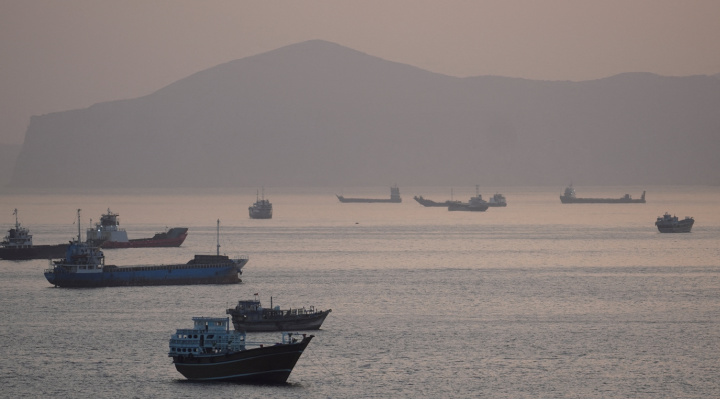
Ships and boats in the Strait of Hormuz, Musandam, Oman, May 1, 2026. Photo: REUTERS/Stringer TPX IMAGES OF THE DAY
Iran hit several ships in the Strait of Hormuz on Monday and set a UAE oil port ablaze, following President Donald Trump‘s announcement that he will use the US Navy to free up shipping.
The Iranian attacks marked the war’s biggest escalation since a ceasefire was declared four weeks ago.
Trump‘s new mission “Project Freedom,” which he announced on social media overnight to release ships stuck in the strait, was the first apparent attempt to make use of naval power to unblock the world’s most important energy shipping route.
But at least in the initial hours on Monday, the effort brought no surge of merchant shipping through the strait while provoking a show of force from Iran, which had long threatened to respond to any escalation with new attacks on its neighbors.
The US military said two US merchant ships had made it through the strait, without saying when. Iran denied any such crossings had taken place.
The commander of US forces in the region said his fleet had destroyed six small Iranian boats, which Iran also denied. Admiral Brad Cooper said he “strongly advised” Iranian forces to keep clear of US military assets carrying out the mission.
Iranian authorities, for their part, released a map of what they said was an expanded sea area now under their control, which went far beyond the strait to include swathes of international waters, including long stretches of the United Arab Emirates’ coastline on either side of the strait.
South Korea reported one of its merchant ships had been hit by an explosion and fire inside the strait. The British maritime security agency UKMTO reported two ships had been hit off the coast of the UAE, and the Emirati oil company ADNOC said one of its empty oil tankers was hit by Iranian drones while trying to cross.
“Iran has taken some shots at unrelated Nations with respect to the Ship Movement, PROJECT FREEDOM, including a South Korean Cargo Ship. Perhaps it’s time for South Korea to come and join the mission!” Trump posted on social media on Monday.
After reported drone and missile attacks inside the UAE throughout the day, including one that caused a fire at an important oil port, the UAE said Iranian attacks marked a serious escalation and it reserved the right to respond.
STRAIT STILL BLOCKED
Trump has struggled to find a solution to the disruption of international energy supplies caused by Iran‘s blockade of the strait, which carried a fifth of global oil and liquefied natural gas before the war.
In the more than two months since Trump launched an air war against Iran alongside Israel, Tehran has largely blocked the strait to ships apart from its own. Since last month, the United States has imposed its own blockade of ships leaving and entering Iranian ports, further crippling Iran’s already ailing economy.
The warring sides issued contradictory statements on Monday about the initial impact of the new US mission, and Reuters could not independently verify the full situation there.
But there was no immediate sign that large numbers of merchant ships were making new attempts to cross, and major shipping companies said they were likely to wait for an agreed end to hostilities before trying to sail through.
REVOLUTIONARY GUARDS SAY NO TRANSITS TOOK PLACE
In a post on X, US Central Command said some of its Navy guided-missile destroyers were inside the Gulf supporting the operation, and that two US-flagged merchant vessels had crossed the strait “and are safely headed on their journey.”
It did not identify either the warships or the merchant vessels or say when any of those crossings had taken place.
Iran‘s Revolutionary Guards said no commercial vessels had crossed the strait in the past few hours, and that US claims to the contrary were false.
Earlier, Iran said it had fired on a US warship approaching the strait, forcing it to turn around. An initial Iranian report had said a US warship was struck, but Washington denied this and Iranian officials later described the fire as warning shots.
South Korea’s Foreign Ministry said there was a fire and an explosion onboard the Namu, a merchant ship operated by South Korean shipper HMM. Yonhap news agency reported that the government was checking intelligence indicating the vessel may have been attacked.
The UAE, meanwhile, reported a fire at an oil installation in its port of Fujairah following an Iranian drone attack. Fujairah lies beyond the strait, making it one of the few export routes for Middle East oil that does not require passing through it.
SHIPPING INDUSTRY AWAITS CLARITY ON SAFETY
Oil prices jumped more than 5% in volatile trade as news of the increased Iranian attacks emerged.
In his social media post announcing the new mission, Trump gave few details of what action the US Navy would take to get ships through the strait.
“We have told these Countries that we will guide their Ships safely out of these restricted Waterways, so that they can freely and ably get on with their business,” Trump wrote.
In response, Iran‘s unified command told commercial ships and oil tankers:
“We have repeatedly said the security of the Strait of Hormuz is in our hands and that the safe passage of vessels needs to be coordinated with the armed forces … We warn that any foreign armed forces, especially the aggressive US Army, will be attacked if they intend to approach and enter the Strait of Hormuz.”
The United States and Israel suspended their bombing campaign against Iran four weeks ago, and US and Iranian officials held one round of face-to-face talks. But attempts to set up further meetings have failed.
Iranian state media said on Sunday that Washington had conveyed its response to a 14-point Iranian proposal via Pakistan, and that Tehran was now reviewing it. Neither side gave details of any US response.
The Iranian proposal would postpone discussion of Iran‘s nuclear program until after an agreement to end the war and resolve the standoff over shipping. Trump said over the weekend he was still studying it but would probably reject it.