



Uncategorized
Iran Parrots Isolationist Right-Wingers Opposing US-Israel Strikes as Trump Denounces Tucker Carlson, Megyn Kelly

Megyn Kelly hosts a “prove me wrong” session during AmericaFest, the first Turning Point USA summit since the death of Charlie Kirk, in Phoenix, Arizona, US, Dec. 19, 2025. Photo: REUTERS/Caitlin O’Hara
US President Donald Trump’s decision to launch joint military strikes on Iran with Israel has provoked an epic fury of opposition from parts of his so-called “America First” base, whose talking points have now apparently inspired Iranian officials to echo them.
“Mr. Rubio admitted what we all knew: US has entered a war of choice on behalf of Israel. There was never any so-called Iranian ‘threat.’ Shedding of both American and Iranian blood is thus on Israel Firsters,” Iranian Foreign Minister Abbas Araghchi posted Monday on X, referring to US Secretary of State Marco Rubio. “American people deserve better and should take back their country.”
A brief excerpt of statements offered by Rubio explaining the rationale for the war began circulating online suggesting Israel had directed the attacks, eliminating the full context of his remarks which emphasized his view that the Iranian regime posed a threat to the US and the world. “The imminent threat was that we knew that if Iran was attacked, and we believed they would be attacked, that they would immediately come after us,” Rubio said.
“No matter what, ultimately, this operation needed to happen,” he added, arguing that Iran was building up its missile arsenal to such an extent that it could “hold the whole world hostage” while having a degree of “immunity” from outside action due to the damage it could inflict.
Nonetheless, Ali Larijani, secretary of Iran’s Supreme National Security Council, wrote in all capital letters Monday on X that “TRUMP HAS BETRAYED ‘AMERICA FIRST’ TO ADOPT ‘ISRAEL FIRST.’”
In a Monday appearance on SiriusXM’s “The Megyn Kelly Show,” former US Rep. Marjorie Taylor Greene, a Georgia Republican and outspoken opponent of the Jewish state, said, “I was out there on the front lines for ‘Make America Great Again.’ And ‘Make America Great Again’ was supposed to be ‘America first,’ not ‘Israel first,’ not any foreign country first, not any foreign people first, but the American people first in our problems.”
Pointing her finger and raising her voice, Greene told Kelly that “[US Vice President] JD Vance promised it. [US intelligence chief] Tulsi Gabbard promised it. All of them promised it. And we’re a year in, and we’re in another f**king war, and we’ve got American troops being killed. I think it’s time for America to rip the band-aid off, and we need to have a serious conversation about what the f**k is happening to this country, and who in the hell are these decisions being made for and who is making these decisions?”
Greene later added to her comments on X: “And just like that we are no longer a nation divided by left and right, we are now a nation divided be those who want to fight wars for Israel and those who just want peace and to be able to afford their bills and health insurance.”
Kelly praised Greene’s posting on her show, saying that “X is completely saturated in neocons, the pro-Israel crowd, and people who would love to cheerlead us right into another Middle East ground war that’s endless. I was grateful for your contrary perspective, Marjorie.”
Making her position further explicit, Kelly added, “I don’t think those four service members died for the United States. I think they died for Iran or for Israel … this feels very much to me like it is clearly Israel’s war.”
The next day, Trump was asked at the White House if Israel dragged the US into conflict with Iran and rejected the notion.
“I might have forced their [Israel’s] hand,” Trump told reporters in the Oval Office as he met with German Chancellor Friedrich Merz. “We were having negotiations with these lunatics, and it was my opinion that they were going to attack first. If we didn’t do it, they were going to attack first. I felt strongly about that.”
Beyond Kelly, far-right podcaster Tucker Carlson promoted a comparable point of view as reports circulated that over the past month, he had met with Trump three times in the Oval Office to make the case against a regime change war in Iran.
On Monday, Carlson released a new installment of his show — a monologue running more than 100 minutes — titled “Israel’s war and what it means.”
Carlson said within the first 60 seconds, :First, why did this happen? Now in this case there’s a really simple answer. This happened because Israel wanted it to happen. This is Israel’s war. This is not the United States’s war. This war is not being waged on behalf of American national security objectives to make the United States safer or richer. This war’s not even about weapons of mass destruction.”
Far-right podcaster Candace Owens said the same thing in an interview with Piers Morgan.
“The reason America wants a regime change in Iran is because Bibi Netanyahu is demanding it,” she said, referring to Israeli Prime Minister Benjamin Netanyahu. “There was no imminent threat to the United States when Trump made this decision to do what Bibi wanted. I want to be clear here. This was not Trump’s decision; it was Bibi Netanyahu’s decision. And that is why he did it. We’re very aware that Israel is dictating our foreign policy and we would now like that to stop.”
Owens wrote in response to a clip of Trump saying that US soldiers could die that “Goyim always must die so the Khazarian mafia can expand their borders,” a promotion of the conspiracy theory claiming that the origins of the Jewish people trace back not to Israel but to a Turkic population in the Middle Ages.
Continuing with her months long-efforts to link Israel to the murder of her friend, Turning Points USA chief Charlie Kirk, Owens wrote on Saturday: “Remember when they tried to gaslight us last June by calling us ‘Panicans,’ claiming we were lying about serial killer Bibi Netanyahu’s aims? The ONLY reason this war didn’t begin last June was because of Charlie Kirk. They eliminated that reason on September 10th.”
White nationalist podcaster Nick Fuentes — who has celebrated Adolf Hitler and encouraged his “Groyper” followers to rape women — also filtered the attack on Iran through an antisemitic conspiracist ideology.
“This war has nothing to do with nuclear weapons, terrorism, or dead protesters,” Fuentes wrote on Saturday, referencing the Iranian regime’s recent massacre of tens of thousands of anti-government demonstrators. “For decades, Israel has openly pursued an agenda to topple Iraq, Syria, and Iran. They orchestrated all of these wars in order to eliminate their rivals and gain total hegemony over the Middle East.”
On Sunday, Fuentes wrote that “this is a war of aggression for Israel. Americans will die in terrorist attacks and in missile strikes so that Israel can expand its borders in every direction. Trump, Vance, and Rubio sold us out.”
Matt Walsh, a populist-nationalist podcast host for Owens’ former employer, The Daily Wire, said in response to Rubio’s comments that “he’s flat out telling us that we’re in a war with Iran because Israel forced our hand. This is basically the worst possible thing he could have said.”
Trump has rejected Carlson and Kelly’s criticism, however.
“I think that MAGA is Trump — MAGA’s not the other two,” he said in an interview with independent DC newsletter The Inner Circle on Monday night. “MAGA wants to see our country thrive and be safe. And MAGA loves what I’m doing — every aspect of it.”
Noting Kelly in particular, Trump stated she “was opposed to me for years when I ran the first time and nothing stopped me.” He said that “some people are against — and they always come back. She came all the way back. But now I guess she maybe doesn’t like the idea of this war, but I do because I have to keep nuclear weapons out of the hands of the Iranians.”
Giving Carlson an apparent green light to continue with his outbursts and conspiratorial provocations, Trump said that the podcaster “can say whatever he wants; it has no impact on me.”
Uncategorized
Iran Hits Ships and UAE Oil Port in Show of Force After Trump Orders Navy to Open Strait
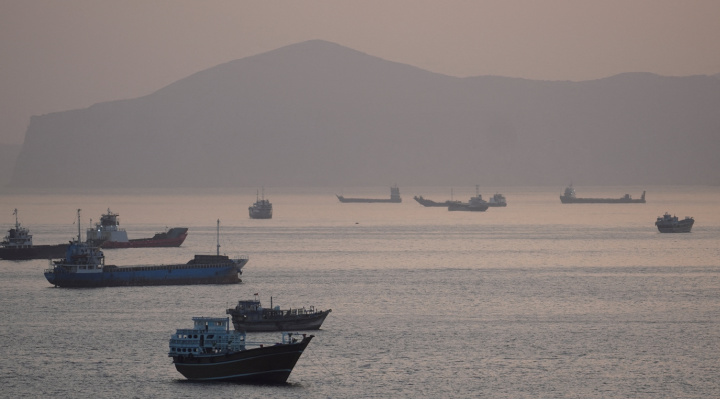
Ships and boats in the Strait of Hormuz, Musandam, Oman, May 1, 2026. Photo: REUTERS/Stringer TPX IMAGES OF THE DAY
Iran hit several ships in the Strait of Hormuz on Monday and set a UAE oil port ablaze, following President Donald Trump‘s announcement that he will use the US Navy to free up shipping.
The Iranian attacks marked the war’s biggest escalation since a ceasefire was declared four weeks ago.
Trump‘s new mission “Project Freedom,” which he announced on social media overnight to release ships stuck in the strait, was the first apparent attempt to make use of naval power to unblock the world’s most important energy shipping route.
But at least in the initial hours on Monday, the effort brought no surge of merchant shipping through the strait while provoking a show of force from Iran, which had long threatened to respond to any escalation with new attacks on its neighbors.
The US military said two US merchant ships had made it through the strait, without saying when. Iran denied any such crossings had taken place.
The commander of US forces in the region said his fleet had destroyed six small Iranian boats, which Iran also denied. Admiral Brad Cooper said he “strongly advised” Iranian forces to keep clear of US military assets carrying out the mission.
Iranian authorities, for their part, released a map of what they said was an expanded sea area now under their control, which went far beyond the strait to include swathes of international waters, including long stretches of the United Arab Emirates’ coastline on either side of the strait.
South Korea reported one of its merchant ships had been hit by an explosion and fire inside the strait. The British maritime security agency UKMTO reported two ships had been hit off the coast of the UAE, and the Emirati oil company ADNOC said one of its empty oil tankers was hit by Iranian drones while trying to cross.
“Iran has taken some shots at unrelated Nations with respect to the Ship Movement, PROJECT FREEDOM, including a South Korean Cargo Ship. Perhaps it’s time for South Korea to come and join the mission!” Trump posted on social media on Monday.
After reported drone and missile attacks inside the UAE throughout the day, including one that caused a fire at an important oil port, the UAE said Iranian attacks marked a serious escalation and it reserved the right to respond.
STRAIT STILL BLOCKED
Trump has struggled to find a solution to the disruption of international energy supplies caused by Iran‘s blockade of the strait, which carried a fifth of global oil and liquefied natural gas before the war.
In the more than two months since Trump launched an air war against Iran alongside Israel, Tehran has largely blocked the strait to ships apart from its own. Since last month, the United States has imposed its own blockade of ships leaving and entering Iranian ports, further crippling Iran’s already ailing economy.
The warring sides issued contradictory statements on Monday about the initial impact of the new US mission, and Reuters could not independently verify the full situation there.
But there was no immediate sign that large numbers of merchant ships were making new attempts to cross, and major shipping companies said they were likely to wait for an agreed end to hostilities before trying to sail through.
REVOLUTIONARY GUARDS SAY NO TRANSITS TOOK PLACE
In a post on X, US Central Command said some of its Navy guided-missile destroyers were inside the Gulf supporting the operation, and that two US-flagged merchant vessels had crossed the strait “and are safely headed on their journey.”
It did not identify either the warships or the merchant vessels or say when any of those crossings had taken place.
Iran‘s Revolutionary Guards said no commercial vessels had crossed the strait in the past few hours, and that US claims to the contrary were false.
Earlier, Iran said it had fired on a US warship approaching the strait, forcing it to turn around. An initial Iranian report had said a US warship was struck, but Washington denied this and Iranian officials later described the fire as warning shots.
South Korea’s Foreign Ministry said there was a fire and an explosion onboard the Namu, a merchant ship operated by South Korean shipper HMM. Yonhap news agency reported that the government was checking intelligence indicating the vessel may have been attacked.
The UAE, meanwhile, reported a fire at an oil installation in its port of Fujairah following an Iranian drone attack. Fujairah lies beyond the strait, making it one of the few export routes for Middle East oil that does not require passing through it.
SHIPPING INDUSTRY AWAITS CLARITY ON SAFETY
Oil prices jumped more than 5% in volatile trade as news of the increased Iranian attacks emerged.
In his social media post announcing the new mission, Trump gave few details of what action the US Navy would take to get ships through the strait.
“We have told these Countries that we will guide their Ships safely out of these restricted Waterways, so that they can freely and ably get on with their business,” Trump wrote.
In response, Iran‘s unified command told commercial ships and oil tankers:
“We have repeatedly said the security of the Strait of Hormuz is in our hands and that the safe passage of vessels needs to be coordinated with the armed forces … We warn that any foreign armed forces, especially the aggressive US Army, will be attacked if they intend to approach and enter the Strait of Hormuz.”
The United States and Israel suspended their bombing campaign against Iran four weeks ago, and US and Iranian officials held one round of face-to-face talks. But attempts to set up further meetings have failed.
Iranian state media said on Sunday that Washington had conveyed its response to a 14-point Iranian proposal via Pakistan, and that Tehran was now reviewing it. Neither side gave details of any US response.
The Iranian proposal would postpone discussion of Iran‘s nuclear program until after an agreement to end the war and resolve the standoff over shipping. Trump said over the weekend he was still studying it but would probably reject it.
Uncategorized
Australia Begins Hearings Into Bondi Beach Attack and Rising Antisemitism

Rabbi Levi Wolff lights a menorah at Bondi Pavilion to honor the victims of a shooting during a Jewish holiday celebration at Bondi Beach, in Sydney, Australia, Dec. 15, 2025. Photo: REUTERS/Hollie Adams
Australia began public hearings on Monday in an inquiry into the Bondi Beach mass shooting in December, with Jewish Australians giving evidence of their experience of rising domestic antisemitism.
The attack on a Jewish Hanukkah celebration killed 15, fueling calls for tougher gun controls and more action to tackle hatred toward Jews, following a spate of antisemitic incidents.
The first block of public hearings will investigate the nature and prevalence of antisemitism, said Virginia Bell, the retired judge leading the wide-ranging national inquiry known as a Royal Commission.
“The sharp spike in antisemitism that we’ve witnessed in Australia has been mirrored in other Western countries and seems clearly linked to events in the Middle East,” Bell said.
“It’s important that people understand how quickly those events can prompt ugly displays of hostility toward Jewish Australians simply because they’re Jews.”
‘WE DON’T FEEL SAFE HERE’
Witnesses from the Jewish community told the inquiry they felt increasingly unsafe amid rising hostility since the October 2023 start of the war in Gaza.
“What is happening in Australia today is not a faint echo of a distant past,” said Peter Halasz, an 86-year-old Holocaust survivor who fled to Australia from Hungary.
“For those of us who lived through the 1930s and 1940s, it is something we recognize, and that recognition is frightening and cause for alarm.”
Sheina Gutnick, who lost her father Reuven Morrison in the Bondi attack, said antisemitism had damaged her family’s sense of safety and freedom of movement.
“As a mother, I’m constantly weighing up the risk of exposing my children to environments where they may be witness, or subject, to antisemitism,” she told the panel.
She recounted an incident in which a stranger at a shopping center called her an “effing terrorist” for wearing a Star of David necklace.
Another witness said her family was relocating to Israel because of safety concerns.
“We never expected synagogues to be burned down,” said the woman, who used the pseudonym “AAM.” “We never expected Jews to be hunted on Bondi Beach.
“My family and I no longer want to live in Australia. We don’t feel safe here. We don’t feel welcome.”
JEWISH SCHOOL LOOKS ‘MORE LIKE A PRISON’
Stefanie Schwartz, the president of Sydney Jewish primary school Mount Sinai College, spoke of holding drills to prepare young students to deal with terrorist attacks, and requiring an “extreme” security presence on campus.
“You walk past our school, and it looks a lot more like a prison than a primary school.”
Antisemitism has “run riot,” with Jewish Australians being held responsible for the actions of the Israeli government, said Benjamin Elton, the chief minister of the Great Synagogue in Sydney.
The inquiry released an interim report of 14 recommendations last Thursday, urging greater security for Jewish public events and further counterterrorism and gun reforms.
A second block of hearings later in May will focus on the circumstances leading up to the Bondi Beach attack and issues raised in the interim report.
The commission is due to deliver its final report on Dec. 14, exactly a year after the attack.
Uncategorized
This graphic novel illustrates the story of America’s first Jewish congregation — pirates and all
Graphic novelist Julian Voloj was walking through Manhattan’s Chinatown when he stumbled across the cemetery of the United States’ oldest Jewish community, Shearith Israel. This inspired him to write Remnants, an interpretation of the story of 23 Jews from Brazil who established North America’s first congregation.
When people think about Jewish immigration to New York, it usually brings to mind the waves of Eastern and Central European Jewish migrants in the early 20th century. But Remnants sheds light on the Sephardic immigration that introduced Judaism to the Americas far earlier.
These Jews were originally from the Iberian Peninsula and had fled to the Netherlands during the Portuguese and Spanish Inquisitions that lasted from around the middle of the 15th century to the 19th century. When the Dutch began occupying Recife, Brazil in 1630, several Jews immigrated to the new South American colony and founded the first synagogue in the Americas, Kahal Zur Israel. Through the eyes of a young girl, Remnants recounts how they had to flee for their lives again in 1654, when Recife was seized by the Portuguese, who banished all Jewish and Dutch settlers. This group of Jews eventually arrived in New Amsterdam, now known as New York.
Voloj is used to challenging assumptions about the homogeneity of Jewish identity in his work. His graphic novel Ghetto Brother told the story of a Puerto-Rican gang member living in the Bronx who finds out later in life that he comes from a family of crypto-Jews. Recently, Voloj co-created the graphic novel Hyphen: Jewish Stories in Our Own Words, which features a dozen personal stories from Jews from across the globe. In Remnants, vibrantly illustrated by Brazilian comic book creator Andre Diniz, Voloj turns his attention to the diversity of American Jewish history.
Voloj weaves together multiple Jewish stories in Remnants. The young female narrator is a fictionalized daughter of Asser Levy (stylized in Remnants as Asher Levy), America’s first kosher butcher and an early advocate for Jewish civil liberties. (Although Levy was one of the first Jews to arrive in New Amsterdam, there are differing accounts of what ship he arrived on and it is unknown if he was on the ship with the group from Recife.) He was originally from Vilna, then part of the Polish-Lithuanian Commonwealth. Asser Levy Place, a section of Avenue A in Manhattan that spans 23rd to 25th Street, and the Asser Levy Recreation Center are both named for him.
Jacob Barsimon, another Jew who arrived in New Amsterdam a month before the group from Recife, also features prominently. In Remnants, he serves as the main advocate for the newly arrived Jews after they are jailed for allegedly not paying the ship that brought them to New Amsterdam. This is a slight historical liberty — it’s not known if Barsimon was directly involved with freeing the Jews from prison. But he did partner with Levy to abolish the ban on Jews serving in the military and the exemption tax imposed on them. Though their petition was refused, Levy later successfully petitioned the government of Holland as an individual and was allowed to serve as a soldier. Barsimon and other Jews later successfully appealed to Holland to overrule Governor Peter Stuyvesant’s discriminatory practices against the Jewish people.
It’s not just bigotry that puts the Jews in Remnants in danger; during their migration out of Recife, they face terror on the open waters when their ship is seized by pirates. The scene is inspired by a historical report from a Venetian rabbi, Saul Levi Morteira, although historians have debated whether or not these captured Jews were the same ones who arrived in New Amsterdam. If what Morteira wrote is accurate, the Jewish hostages were eventually saved by the French. However, in Remnants, the Jews find salvation in a different, unexpected source — another piece of Jewish history that Voloj has woven into the tale. But no spoilers.
Although it’s a complex history, Voloj and Diniz’s illustrative approach helps make the story of America’s first Jewish congregation accessible to readers of all ages. Through the optimistic perspective of Levy’s daughter, the story of Recife’s Jews is not solely about the tragedies of exile and discrimination, but a tale of strength, resilience and the occasional miracle. Although Voloj takes some liberties to bring the different historical narratives into one storyline, Remnants provides a well-timed look into America’s Jewish history. As the American semiquincentennial approaches, Jewish institutions across the country are creating programming about the stories of Jews in America. Remnants takes readers back to the colorful beginning.
The post This graphic novel illustrates the story of America’s first Jewish congregation — pirates and all appeared first on The Forward.