



Uncategorized
Redeeming the Time, Rabbinically
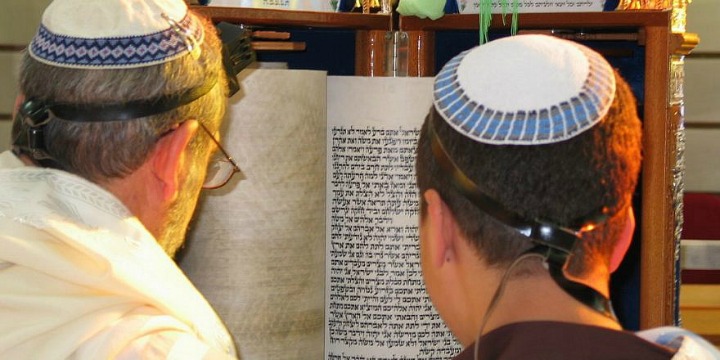
Reading from a Torah scroll in accordance with Sephardi tradition. Photo: Sagie Maoz via Wikimedia Commons.
We live in a culture that is very good at avoiding ultimate questions. Death is kept offstage. Time is treated as infinite. The modern self is trained to strive, consume, showcase, curate, and distract, but not often to reckon. The deepest matters are postponed, not necessarily out of malice, but out of habit: there is always another headline, another obligation, another performance of busyness.
That is why Ben Sasse’s recent conversation with Peter Robinson at the Hoover Institution lands with unusual force. On its surface, it is an interview with a former senator and university president. In reality, it is something rarer in modern elite discourse: an unsparing confrontation with mortality.
Sasse has been diagnosed with stage-four pancreatic cancer. The question hovering over the exchange is not legislative strategy or partisan maneuvering, but what remains when the usual distractions and ambitions are stripped of their power. He speaks candidly about regret, forgiveness, prayer, and what he calls “redeeming the time”: learning, as life narrows, to hold ambition lightly and to love more deliberately.
It is a moving reflection. But it is also, in a deeper sense, an ancient one.
Judaism has long insisted that the awareness of death is not a morbid fixation but a form of moral clarity. Kohelet – the book of Ecclesiastes – offers the sober verdict that modern life works so hard to avoid: “Vanity of vanities; all is vanity.” Not because nothing matters, but because so much of what we chase is mist: acclaim, accumulation, the restless display of importance.
The rabbis sharpen the point further. “Repent one day before your death,” the Talmud teaches. The student, understandably, asks: But how can a person know the day of death? And the answer is the point: Precisely because no one knows, one must repent today.
In other words, the moral task is not postponed until the final crisis. The human condition is already one of finitude. The question is whether we live as if we remember it.
This is what the Jewish tradition calls cheshbon hanefesh — an accounting of the soul. Not an exercise in self-obsession, but in proportion. What matters? What endures? What have we mistaken for ultimate that is, in truth, only temporary?
Judaism’s most piercing liturgical moment, recited each year on Rosh Hashanah and Yom Kippur, makes the matter unavoidable: “Who shall live and who shall die … Who by water and who by fire…”
Unetaneh Tokef does not offer comfort through denial. It offers clarity through truth: life is fragile, time is borrowed, and our pretensions are thin.
What mortality does, what Sasse’s diagnosis forces into view, is the stripping away of the false absolutisms that so often govern modern life. Reputation becomes less urgent. The metrics of elite success begin to look strangely weightless. And what remains, if we are fortunate, is relationship: family, forgiveness, obligation, love, and the hope that one’s days have been oriented toward something beyond the self.
Sasse, in his own Christian idiom, is showcasing ideas that Judaism has long institutionalized: the urgency of finitude, the moral demand of time, the necessity of living now as if the horizon is real.
His reflections are poignant precisely because modern America is, in so many respects, a culture of evasion. We have constructed entire systems – technological, professional, political – designed to keep first things at bay. Attention is scattered. Status becomes performative. The self becomes a brand. Seriousness is treated as optional.
And nowhere is this evasion more concentrated than among the people who govern our institutions. Our ruling class speaks endlessly in the language of urgency – power, justice, crisis – while quietly building lives organized around careerism, self-protection, and distraction. We have created a secular priesthood of ambition that cannot speak honestly about death, judgment, or the limits of human control.
The rabbis would recognize the spiritual danger immediately. They were never sentimental about public striving. Honor, they warned, is intoxicating. Recognition is fleeting. The pursuit of status can become a kind of idolatry; not because achievement is evil, but because the modern temptation is to treat achievement as ultimate.
“It is not your duty to finish the work,” Pirkei Avot teaches, “but neither are you free to desist from it.” The line captures Judaism’s balance: responsibility without grandiosity, obligation without self-worship. The work matters, but the work is not God.
That balance is precisely what our age lacks. We live amid unprecedented technological abundance, yet also amid unprecedented distraction. The self is curated. Attention is monetized. Institutions are hollowed out not only by ideology, but by exhaustion and drift.
Nowhere is this more visible than in higher education itself. Our most credentialed institutions often train young people to speak endlessly about justice and power, while offering them remarkably little formation in humility, duty, or the permanent things. They produce graduates fluent in moral performance, yet increasingly incapable of moral seriousness.
Even politics, which once demanded sacrifice, is increasingly consumed as spectacle: another theater of resentment, branding, and noise.
And yet a republic cannot survive on noise. Democracies depend on citizens capable of restraint, gratitude, seriousness, and moral perspective. They require people who can locate politics within a larger horizon of obligation – family, faith, community, the inheritance of civilization itself. A nation that cannot distinguish the urgent from the ultimate will not remain healthy or free for long.
Sasse’s conversation is powerful not because it offers a novel insight, but because it forces an old truth back into view: time is not infinite, ambition is not redemption, and the ultimate questions cannot be deferred forever.
The High Holy Day liturgy does not ask whether we will die. It assumes it. It asks instead what we will do with the time we are given: “Who shall live and who shall die…”
Death is the one fact no algorithm can curate and no institution can evade. It strips away our distractions and reveals what is real. The question is not whether life is short. The question is whether we will go on pretending otherwise – until we no longer have the luxury.
“Teach us to number our days,” we regularly pray, “that we may gain a heart of wisdom.”
And wisdom begins when we stop confusing busyness for meaning, ambition for redemption, and noise for life.
Samuel J. Abrams is a professor of politics at Sarah Lawrence College and a senior fellow at the American Enterprise Institute.
Uncategorized
London Police Set Up Specialist Jewish Protection Team

A police officer stands at the scene, after a man was arrested following a stabbing incident in the Golders Green area, which is home to a large Jewish population, in London, Britain, April 29, 2026. Photo: REUTERS/Hannah McKay
British police are setting up a new team of 100 officers including counter terrorism specialists to help protect Jewish communities across London after a series of antisemitic attacks including the stabbing of two men.
The plan announced on Wednesday for a dedicated protection team comes as officers announced more arrests for antisemitism, including detaining a 35-year-old man on Saturday after rocks were thrown at an ambulance belonging to the Jewish community.
London‘s top police boss Mark Rowley said Jewish communities were facing “sustained threats” from hostile state actors as well as extreme right-wing groups, elements of the extreme left, and Islamist terrorists.
Detectives are examining whether the arson incidents have possible Iranian links, after British security officials warned that Iran was using criminal proxies to carry out hostile activity.
Since late March, there have been a number of high-profile arson attacks with four Jewish ambulances burned and synagogues targeted. Last week, two Jewish men were also stabbed. Both victims survived the attack.
Over the past four weeks, police said they had arrested around 50 people for antisemitic hate crimes and charged eight individuals. On top of that, 28 arrests have been made as part of investigations alongside counter terrorism policing for arson and other serious incidents.
“This new team will be primarily focused on protecting the Jewish community, which faces some of the highest levels of hate crime alongside significant terrorist and hostile state threats,” said a statement from London‘s Metropolitan Police force.
British Prime Minister Keir Starmer convened a meeting on Monday with business, health and cultural leaders aimed at trying to tackle antisemitism.
Uncategorized
Iran Reviewing US Proposal to End War, Though Key Demands Remain Unaddressed
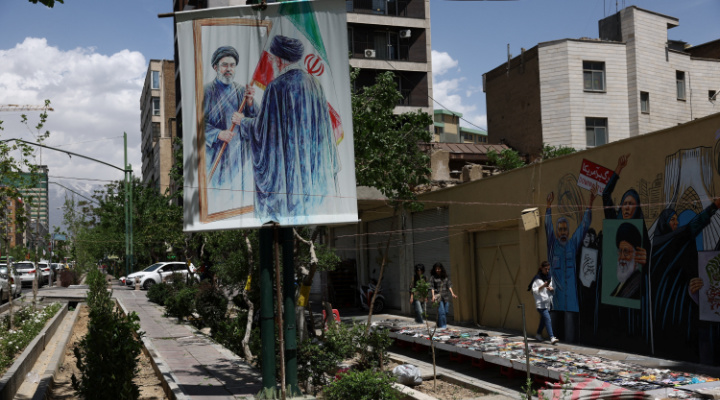
People walk on a street near a mural featuring an image of the late Supreme Leader of Iran, Ayatollah Ali Khamenei, in Tehran, Iran, May 6, 2026. Photo: Majid Asgaripour/WANA (West Asia News Agency) via REUTERS
Iran said on Wednesday it was reviewing a US peace proposal that sources said would formally end the war while leaving unresolved the key US demands that Iran suspend its nuclear program and reopen the Strait of Hormuz.
An Iranian foreign ministry spokesperson cited by Iran‘s ISNA news agency said Tehran would convey its response. US President Donald Trump said he believed Iran wanted an agreement.
“They want to make a deal. We’ve had very good talks over the last 24 hours, and it’s very possible that we’ll make a deal,” Trump told reporters in the Oval Office on Wednesday.
Earlier in the day, Trump had sounded more pessimistic about the chances of a deal. In a Truth Social post, he threatened to restart the US bombing campaign in Iran, calling the possibility of Tehran agreeing to the latest US proposal a “big assumption.”
Trump has repeatedly played up the prospect of an agreement that would end the war that started Feb. 28, so far without success. The two sides remain at odds over a variety of difficult issues, such as Iran‘s nuclear ambitions and its control of the Strait of Hormuz, which before the war handled one-fifth of the world’s oil and gas supply.
A Pakistani source and another source briefed on the mediation said an agreement was close on a one-page memorandum that would formally end the conflict. That would kick off discussions to unblock shipping through the strait, lift US sanctions on Iran, and set curbs on Iran‘s nuclear program, the sources said.
It was unclear how the memorandum differs from a 14-point plan proposed by Iran last week, and Iran has yet to respond to the latest US proposal.
Iran‘s semi-official Tasnim news agency, citing an unnamed source, said the US proposal contained some unacceptable provisions, without specifying which ones.
Iranian lawmaker Ebrahim Rezaei, a spokesperson for parliament’s powerful foreign policy and national security committee, described the text as “more of an American wish-list than a reality.”
“The Americans will not gain anything in a war they are losing that they have not gained in face-to-face negotiations,” he wrote on social media.
OIL PRICES TUMBLE
Reports of a possible agreement caused global oil prices to tumble to two-week lows, with benchmark Brent crude futures falling around 11% to around $98 a barrel at one point before rising back above the $100 mark.
Global share prices also leapt and bond yields fell on optimism about an end to a war that has disrupted energy supplies.
Trump on Tuesday paused a two-day-old naval mission to reopen the blockaded strait, citing progress in peace talks.
The US military has kept up its own blockade on Iranian ships in the region. US Central Command said forces fired at an unladen Iranian-flagged tanker on Wednesday, disabling the vessel as it attempted to sail toward an Iranian port in violation of the blockade.
NO MENTION OF KEY US DEMANDS
The source briefed on the mediation said the US negotiations were being led by Trump’s envoy Steve Witkoff and son-in-law Jared Kushner. If both sides agreed on the preliminary deal, that would start the clock on 30 days of detailed negotiations to reach a full agreement.
The full agreement would end the competing US and Iranian blockades on the strait, lift US sanctions, and release frozen Iranian funds. It would also include some curbs on Iran‘s nuclear program, with the aim of a pause or moratorium on Iranian enrichment of uranium.
While the sources said the memorandum would not initially require concessions from either side, they did not mention several key demands Washington has made in the past, which Iran has rejected, such as curbs on Iran‘s missile program and an end to its support for proxy militias in the Middle East.
The sources also made no mention of Iran‘s existing stockpile of more than 400 kg (900 pounds) of near-weapons-grade uranium.
Israeli Prime Minister Benjamin Netanyahu, Trump’s ally against Iran, said on Wednesday the two leaders agreed that all enriched uranium must be removed from Iran to prevent it from developing a nuclear bomb.
Tehran denies wanting to acquire a nuclear weapon.
Uncategorized
Brussels cathedral installs plaques apologizing for medieval antisemitic persecution depicted in stained glass
(JTA) — More than 650 years after Jews in Brussels were executed and expelled following false antisemitic accusations, church officials at the Cathedral of St. Michael and St. Gudula have installed a plaque apologizing for the persecution commemorated in its stained glass windows.
At a ceremony on April 27, Archbishop Luc Terlinden of Mechelen-Brussels and Rabbi Albert Guigui, the chief rabbi of Brussels, unveiled four plaques, written in Dutch, French, English and Hebrew, providing historical context for the windows and an apology for the antisemitic persecution tied to the events they depict.
The plaques, which Terlinden signed, state that “baseless accusations of the desecration of the Eucharistic host were made against Jewish communities” in medieval Europe and that the accusations “led to persecution, massacres, and unjustifiable expulsions.” The windows show Jews being executed at the stake in response to their alleged attacks on the Eucharist, bread that Catholic doctrine considers a literal representation of Jesus’ body.
“Theological and social anti-Judaism is in direct contradiction with the Gospel of Christ, which calls for truth, justice, and brotherhood,” the plaques say. “We ask forgiveness from the Jewish people for the suffering these accusations have caused.”
The stained glass windows in the cathedral depict the “Brussels Host Desecration,” an antisemitic accusation in 1370 that Jews had desecrated communion wafers, leading to the execution of Jews in Brussels and the expulsion of the city’s Jewish community.
The windows have drawn scrutiny for decades, particularly as the Catholic Church sought to reckon with its history of antisemitism. In 1969, shortly after the landmark Nostra Aetate declaration rejecting longstanding anti-Jewish Catholic doctrine, the Archbishop of Brussels ordered that several paintings be removed and a plaque be mounted to offer context about the remaining depictions.
Several years later, the European Jewish Congress noted last week, Catholic leaders did install a plaque that drew readers’ attention to “the biased nature of the accusations [against the Jews accused of the desecration] and to the legendary presentation of the ‘miracle.’”
But Flora Cassen, the director of the Brandeis Center for Jewish Studies and a scholar of European antisemitism, said the existing plaque was “very ambiguous about the responsibility and what happened” and installed in an easy-to-miss location. The new plaques, she said, contain a clear and “very moving” apology and cannot be missed by anyone who comes to see the windows.
“The significance is enormous of the church finally putting a plaque there that tells the story, that acknowledges the antisemitism behind it, that acknowledges that it was a slander and that it resulted in persecution and in the execution of Jews in Brussels and their expulsion,” Cassen said.
The new plaques cite Nostra Aetate and the Catholic Church’s subsequent effort under Pope John Paul II to reckon with historical antisemitism in 2000. They affirm the church’s “commitment to combat all forms of antisemitism, to deepen dialogue between Jews and Christians, and to pass on to future generations a clear remembrance, based on the acknowledgement of truth and mutual respect.”
While some have called for the historic windows to be removed, Guigui said in a statement that the plaques represented an appropriate way to address relics of historical antisemitism.
“What matters today is how we look at these images,” the rabbi said. “They must not be erased, because they are part of history, but they must be accompanied by explanation and moral insight in order to understand the context and avoid repeating past mistakes.”
The post Brussels cathedral installs plaques apologizing for medieval antisemitic persecution depicted in stained glass appeared first on The Forward.