



Uncategorized
Australia’s Largest Arts Festival to Open With Wave of Anti-Israel Artists, Led by Controversial Creative Director
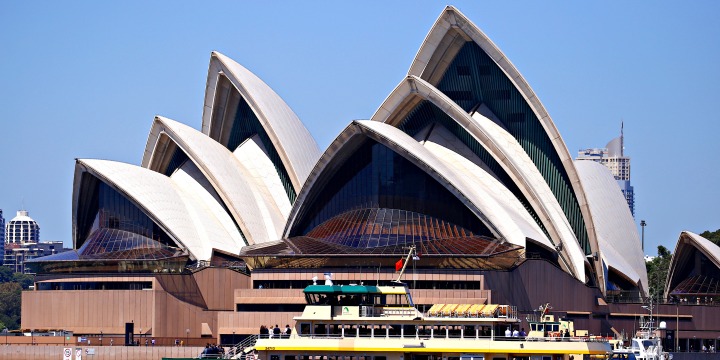
A view of Sydney, Australia. Photo: Reuters/David Gray.
The 25th edition of the Sydney Biennale, Australia’s largest arts festival, opens to the public on Saturday and will feature a slew of artists with anti-Israel views similar to those expressed by the festival’s artistic director, Emirati princess and curator Hoor Al-Qasimi.
The 25th Biennale of Sydney, which will take place from March 14-June 14 across multiple venues, receives taxpayer funding and support from the federal government of Australia, the state government of New South Wales, and the City of Sydney. However, several of the festival’s other partners and sponsors may be problematic for supporters of Israel.
Qatar Museums and Rubaiya Qatar, a new nationwide contemporary art quadrennial that will debut in November 2026, are the festival’s “major strategic” sponsors, according to the event’s website. Qatar has a long history of aligning itself with Hamas and the Muslim Brotherhood, providing a home for the senior leaders of both organizations.
Hamas and the Muslim Brotherhood are both internationally designated terrorist organizations. In the US, Hamas has carried the label for years, and the Trump administration has, in recent months, proscribed branches of the Muslim Brotherhood in Africa and the Middle East.
The festival’s “major partners” include the global property developer Arada, co-founded by Al-Qasimi’s brother-in-law, Sheikh Sultan bin Ahmed Al Qasimi. When the partnership was announced in November 2025, it caused significant concern among the Jewish community. Another partner of the festival, the Barjeel Art Foundation, is controlled by the princess’s family.
“There were grave concerns that the appointment of Hoor Al Qasimi would result in one of our flagship cultural institutions becoming a tool of ideology and exclusion,” Alex Ryvchin, co-chief executive of the Executive Council of Australian Jewry, said last year, as cited by The Australian Financial Review. “The announcement that Al Qasimi’s family is now financially sponsoring the festival increases those concerns significantly, given that the family has a record of villainizing Israelis and calling for their boycott. The immense creative and financial power the family now exerts over the festival is alarming and risks undermining the spirit of the festival.”
Al Qasimi is the daughter of the ruler of Sharjah, one of seven emirates that comprise the United Arab Emirates. She is also the founder, president, and director of the Sharjah Art Foundation, an independent public arts organization in the UAE. She has a history of making anti-Israel comments and declaring “Free Palestine.”
When she was the artistic director of Japan’s Aichi Triennale in 2025, she said, “I didn’t imagine we would be witnessing a genocide live-streamed through our phones … this ongoing violence that can no longer be ignored … we all live under the same sky and none of us are free until all of us are free.” She also talked about “ongoing ethnic cleansing, and genocides.”
In October 2023, shortly after the Hamas-led Oct. 7 massacre in southern Israel, she signed an open letter that voiced support for “Palestinian liberation.” The same open letter called for an end to Israel’s “human rights violations and war crimes” and “escalating genocide” in the “occupied and besieged Gaza Strip.” It further talked about “oppression,” “occupation,” and the “collective punishment of Gaza civilians,” but made no mention of the deadly rampage on Oct. 7 in which Hamas-led terrorists killed 1,200 Israelis and kidnaped 251 hostages.
Al Qasimi father also reportedly once said that “the Zionist presence in Palestine is a cancerous growth within the heart of the Arab nation.” Sheikha Jawaher Bint Mohammed Al Qasimi additionally “criticized the UAE’s cooperation with Israel in the education field,” according to The Middle East Monitor.
The Australian Financial Review reported that several donors and sponsors withdrew their support from the 2026 Sydney Biennale in response to Al Qasimi’s appointment. Al Qasimi’s decision to pick mostly pro-Palestinian artists for the Sydney Biennale also prompted the Carla Zampatti Foundation to withdraw funding for the festival, according to The Australian. In January 2026, Sydney Biennale ambassador Bhenji Ra cut ties with the festival after she faced criticism from the Jewish community over social media posts, including one message she shared that said, “Genocidal death cults do not have the right to exist.”
THE ARTISTS
The theme for this year’s Sydney Biennale is “Rememory,” a term adopted from Toni Morrison’s Pulitzer Prize-winning 1987 novel Beloved to describe “how we become subjects and storytellers of our collective present through events of the past.”
Out of the 83 artists and collections from 37 countries being featured in the 25th Sydney Biennale, more than half are Arab and Muslim and no Israeli artists are included the lineup. The only Jewish talent participating is New York-based Iraqi-American artist Michael Rakowitz, who has publicly made anti-Israel comments. In 2017, Rakowitz described his art as a form of “sumud,” an Arabic term meaning resilience, to “not allow Zionism to loot everything from the imagination, to keep alive the reality of what the Middle East was like before.”
French-Lebanese artist, DJ, and embroiderer Nasri Sayegh is also featured in this year’s Biennale, and he previously posted on social media that “Jewish supremacy is a disease.”
Richard Bell, an Australian artist showcasing his work in the festival, posted content on social media that has accused Israel of “genocide” in Gaza and been critical of Israeli Prime Minister Benjamin Netanyahu. In an Instagram Story on Wednesday, he shared a video from Middle East Eye of an economics professor accusing Israel and the United States of a “mass murder of civilians” in Iran, and indiscriminately “carpet bombing Tehran.”
In August 2025, Bell shared a message on Instagram that said in part, “colonial societies target children because they want to take away the future … it is happening in Gaza, where children are being starved to death.” He previously created a large painting in the shape and colors of the Palestinian flag and the piece was titled “From the River to the Sea,” a slogan that is widely interpreted as a call for the destruction of Israel and for it to be replaced with “Palestine.”
Aysenur Kara is an “emerging Turkish artist” featured in this year’s Sydney Biennale who “aims to use her material conceptions to platform those facing genocide in Gaza right now,” according to a description provided on the festival’s website. The festival additionally said that another one of its presenters, Palestinian artist Khalil Rabah, uses his work “to articulate the very real situation of occupation experienced by Palestinians.”
A series of photographs by Iranian photographer Hoda Afsha being featured in the Sydney Biennale depicts indigenous children who had been in the juvenile justice system and was inspired by the fate of children during the “genocide in Palestine.” In late October 2023 – the same month as the Hamas terrorist attack in Israel – the award-winning Melbourne-based photographer posted on Instagram that she wants “Zionists out of our cultural spaces.”
Palestinian-Australian artist Feras Shaheen will put on the dance performance “Blocked Duwar” at the Campbelltown Arts Centre as part of the 2026 Sydney Biennale. In September 2025, the Tasmanian-based artist compared Jewish businessmen to Nazis in a social media post. He uploaded a photo that said, “Treat your local Zionist like you treat your local Nazi: Equality.” The message was featured over images of neo-Nazi Thomas Sewell, and Jewish arts philanthropist John Gandel and former Biennale donor and board member Morry Schwartz.

Photo: Screenshot
Schwartz responded to Shaheen’s social media post in an open letter last year to Kate Mills, chairman of the Biennale of Sydney. “I’m sure you’ll agree with me that a line has been crossed,” Schwartz wrote. “To equate John Gandel and me with Nazis is shocking. The Biennale will not survive this if you don’t act immediately.”
The offensive social media post has not been taken down by Shaheen.
Schwartz told The Australian Financial Review Magazine he had withdrawn his support for the Sydney Biennale, worried that its artistic director might turn the event into a “hate-Israel jamboree.”
Jewish leaders were given the opportunity to preview the Biennale of Sydney but declined the offer after being frustrated that the festival’s senior figures took no action against “objectionable” social media posts by artists included in the event, The Daily Telegraph reported this week.
Uncategorized
Russians Retreat as Al Qaeda-Linked Jihadists, Tuareg Separatists Kill Mali’s Defense Minister, Capture Key Town
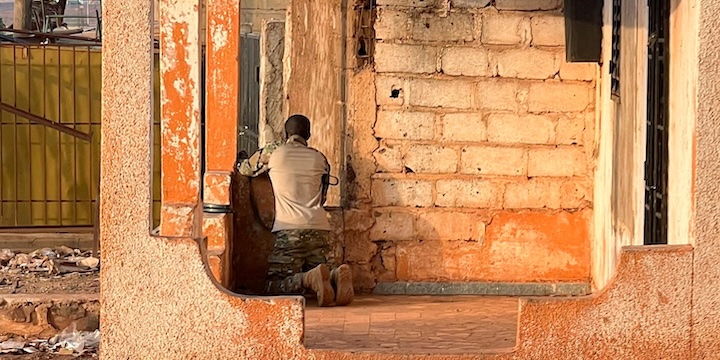
A Malian soldier stands in position with his weapon during an attack on Mali’s main military base Kati outside the capital Bamako, Mali, April 25, 2026. Photo: REUTERS/Stringer
The military junta in Mali came under attack this past weekend in multiple locations across the expansive desert nation, resulting in the death of Defense Minister Sadio Camara and the seizure of Kidal, a key town in the African country’s eastern region.
The strikes resulted from an alliance between Jama’at Nusrat al-Islam wal-Muslimin (JNIM,) an Al-Qaeda-linked jihadist group fighting to establish a state governed by strict Islamic Shariah law, and the Azawad Liberation Front (FLA), a Tuareg rebel separatist militia which seeks to form an independent nation in Mali’s northeast.
Local sources told France 24 that the groups had seized control of Kidal, a reported FLA stronghold, on Monday. This victory followed the retreat of Russia’s Africa Corps, the mercenary organization the Malian government had contracted at a monthly rate of $10 million to provide security.
Fox News Digital reported reviewing video of Russian mercenary casualties and Russian vehicles fleeing Kidal. An FLA spokesperson told the Associated Press that Russia’s Africa Corps had withdrawn and that a “white” agreement had been made.
Other locations hit by attacks included Kati, Gao, Sévaré, and Mopti.
JNIM took credit for bombings at Mali’s primary airport in Bamako.’
Meanwhile, JNIM is the suspect of a car bomb planted outside Camara’s home which exploded on Saturday, killing Mali’s top military leader and three other family members.
The attacks tell “every Malian, every regional capital, and every foreign partner that JNIM can operate at will inside the supposedly secure heart of the state,” Justyna Gudzowska, executive director of The Sentry, an investigative and policy group, told Reuters.
Mali’s military junta, which has ruled since August 2020, on Monday announced injuries sustained by two of its other leaders, Gen. Oumar Diarra, who serves as chief of the armed forces’ general staff, and Gen. Modibo Koné, director of the National Security Agency.
Yvan Guichaoua, a Sahel specialist at the German research center BICC, told Reuters that the attacks intended to “decapitate” the government.
A spokesperson for the US State Department said that the United States “strongly condemns” the terrorist attack in Mali.
“We extend our deepest condolences to the victims, their families, and all those affected,” the spokesperson added to Fox News Digital. “We stand with the Malian people and government in the face of this violence. The United States remains committed to supporting efforts to advance peace, stability, and security across Mali and the region.”
A statement from the office of UN Secretary-General Antonio Guterres said he is “deeply concerned by reports of attacks in several locations across Mali. He strongly condemns these acts of violence, expresses solidarity with the Malian people, and stresses the need to protect civilians and civilian infrastructure.”
Ulf Laessing, head of the Sahel program at the Konrad Adenauer Foundation in Germany, told Germany’s DW that the strikes were the biggest he had seen in the country in years.
“Remarkably, there has been a coordination between jihadists and Tuareg rebels, which have nothing in common, but they have a joint enemy,” Laessing said. “They staged together an attack in 2012 and took over northern Mali. Then later they fell out. The jihadists got rid of the Tuaregs. So, it’s remarkable that they made a comeback.”
According to a statement from Russia’s foreign ministry posted to Telegram, 250 militants struck the Bamako Senou International Airport and the military base nearby.
“The Malian Armed Forces repelled the attack and are currently taking further steps to eliminate the militia that may have been, reportedly, trained by Western security agencies,” the foreign ministry said. “Russia is deeply concerned about these developments. This terrorist activity poses a direct threat to the stability of friendly Mali and could have the most serious consequences for the entire region.”
Laessing also spoke to the Associated Press, calling the attack a major blow to Russia.
“The [Russian] mercenaries had no intelligence about the attacks and were unable to protect major cities,” he said. “They have unnecessarily worsened the conflict by not distinguishing between civilians and combatants.”
“The fact that the Malian military intelligence has not been able to detect that these attacks were about to take place is a major failure for them,” Nina Wilen, director for the Africa Program at Egmont Institute for International Relations, told DW, saying the attacks revealed how “strong JNIM has become over the past year.”
She noted that Camara had been a key figure in establishing relations with Russia, making him a symbolic figure to target and send a message opposing the presence of Russian troops.
Islamist activity in the Sahel of Western Africa has risen in recent years, causing analysts to label the region the most lethal place on the planet for terrorist deaths, with JNIM leading the body count.
The trend has caught the attention of Washington, DC.
“Across the Sahel in West Africa and in East Africa, terrorist groups are expanding, embedding, and operating with increasing capability,” US Sen. Ted Cruz (R-TX) said during a hearing last week on terrorism in Africa. “ISIS affiliates and al-Qaeda-linked groups are growing, controlling territory, and exploiting weak governance.”
“In region after region, terrorist groups are outpacing the ability of local governments to respond,” Cruz added. “The failures threaten our interest globally and endanger the American homeland. The threat is rapidly growing and demands attention.”
Uncategorized
US soldier charged for threatening to ‘kill every single Jew’ inside of a synagogue
(JTA) — A soldier stationed at Fort Polk in Louisiana was arrested last week after he told users on the popular messaging platform Discord that he planned to conduct a mass shooting at a synagogue.
Jakob Marcoulier, 22, was arrested last Thursday and charged with transmitting a threat in interstate commerce after the FBI’s National Threat Operations Center received a tip in February that he had made threats toward synagogues, according to the U.S. attorney’s office for the western district of Louisiana.
According to court documents, the FBI obtained audio from Discord in which Marcoulier allegedly said, “After this deployment if the Jews still have reign over our government, I am going to walk into a synagogue with my AK, with a 75-round drum mag, and all of my extra mags, with my level four plates, and my haka helmet that’s three plus, and I am going to kill every single Jew I know inside of that synagogue. And that’s my goal in life.”
During the communications, Marcoulier told the other users, “You guys will never do anything about but I will. I just have to finish this, I have to go back overseas and do what I have to do. And then you’ll see me in the news. I promise you.”
He also allegedly said that he would “kill these motherf—kers in order to make sure the white youth is f—king secured.”
It was not immediately clear when Marcoulier made the comments, but the United States and Israel jointly attacked Iran on Feb. 28 following a buildup of U.S. troops in the Middle East.
The Iran war has put Jewish institutions across the country and the around the world on high alert, with attacks on synagogues including arsons in Europe and a synagogue ramming in suburban Detroit last month.
“Threats against synagogues and Jewish Americans are threats to the religious freedom promised to every single one of us, and this Office and our law enforcement partners are committed to protecting those freedoms,” United States Attorney Zachary A. Keller said in a statement.
The post US soldier charged for threatening to ‘kill every single Jew’ inside of a synagogue appeared first on The Forward.
Uncategorized
J.D. Salinger asked publishers to remove references to his Jewish heritage, newly surfaced letters reveal
(JTA) — Acclaimed author J.D. Salinger asked his publisher to remove references to his Jewish heritage in the book jacket of “The Catcher in the Rye,” newly surfaced letters from 1951 reveal.
The request came in a letter from Salinger, a notoriously private man, and his editor, John Woodburn at publisher Little, Brown and Co. The correspondence, which took place in early 1951, predates the first publication of “The Catcher in the Rye,” Salinger’s hit coming-of-age novel.
“I don’t know that I’d like to have that Jewish-Irish business slapped on the jacket,” Salinger wrote. “Surely if it’s catchy, that is.”
The letter has come to light because Peter Harrington Rare Books, a bookseller based in London, has listed it as part of a package for sale in the New York International Antiquarian Book Fair, which begins on Thursday.
“The Catcher in the Rye,” a contemporary classic following the life of angsty boarding school student Holden Caulfield, is one of the best-selling books of all time.
Caulfield’s character is of Irish heritage, like Salinger’s mother. But Salinger was the son of Sol, a cheese salesman (whose wares might have been kosher) and the grandson of a rabbi on his father’s side. His mother, Marie Jillich, went by Miriam to appease her in-laws who disapproved of the mixed marriage. He learned his mother’s real name only around the time of his bar mitzvah.
To Woodburn, Salinger wrote that he worried about being pigeonholed as a Jewish-Irish writer if the book broadcast that information.
“My Jewish-Irishness isn’t quite so bizarre, as, say, [James] Thurber’s eyesight,” Salinger wrote, referring to the American author and cartoonist, who was legally blind by that time. “But nonetheless, second-rate reviewers would probably find the information just provocative enough to use and misuse over and over again, and I’d end up being expected to wear a Star of David and a Shamrock on the back of my sweatshirt. So, please, let’s be careful.”
Salinger’s other famous works include the 1948 short story “A Perfect Day for a Bananafish,” which follows the Irish Catholic-Jewish Glass family, who also make appearances in “Franny and Zooey.”
The letters, previously unpublished, were acquired from a private collector and will be on view at the New York International Antiquarian Book Fair at the Park Avenue Armory from Thursday to May 3.
The bookseller is also currently offering a first edition of the script of West Side Story, inscribed by all four writers of the play, book, and music: Leonard Bernstein, Jerome Robbins, Arthur Laurents, and Stephen Sondheim. Peter Harrington has also sold a rare, first printed edition of “De Bello Judaico” by Josephus Flavius, the first-century Roman-Jewish historian.
The triad of letters is currently offered at a set price of $47,500 and includes two typed letters by Salinger, with his signature, and a carbon copy of Woodburn’s reply. It also includes a reference to one of Salinger’s “lost stories,” a prequel to “Catcher in the Rye” that was not to be published until 50 years after his death.
Salinger died in 2010 at the age of 91. The “lost story,” “The Ocean Full of Bowling Balls,” was set to be published in 2060, but in 2013, it was pirated and leaked online.
The post J.D. Salinger asked publishers to remove references to his Jewish heritage, newly surfaced letters reveal appeared first on The Forward.