



Uncategorized
India and Israel Have the Same Response to Terrorism: Why Is Only One Treated Differently?

India’s prime minister, Shri Narendra Modi, addresses the gathering at the Indian Community Reception Event at the Singapore Expo in Singapore on November 24, 2015.
As Israel recently celebrated its Memorial and Independence days back to back, we were reminded that statehood comes at a cost, both on the battlefield and in ordinary moments shattered by terror.
One year ago in Pahalgam, India was confronted with that same reality — yet again.
Terrorists from across the border in Pakistan infiltrated Indian territory and killed 26 men in front of their wives and children. It was not an isolated act of violence, but a deliberate strike on civilians, designed to fracture trust and deepen fear.
I remember sitting in a café in Jerusalem when the news broke. My Israeli friends immediately understood what had happened. Their reaction was not just sympathy, but recognition. They knew instinctively why India would have to respond decisively. Israel understands India’s need for a zero-tolerance policy toward terrorism — because Israel has lived it for decades.
India’s response through Operation Sindoor reflected this shared reality. Addressing the nation, Prime Minister Narendra Modi framed it not merely as a military action, but as a national commitment to fighting terror. He made clear that every terrorist attack would be met with a decisive response, with no distinction between terrorists and their sponsors. His words captured the shift with unmistakable clarity: “Terror and talks cannot go together … water and blood cannot flow together.”
India’s response also reflected deepening defense cooperation with Israel, including the integration of Israeli-origin precision systems and air-defense technologies developed through years of strategic partnership.
One of the most consequential shifts triggered by Operation Sindoor was India’s suspension of key aspects of the Indus Waters Treaty after the Pahalgam attacks. India had previously shared hydrological data with Pakistan on river flows and water levels vital to its agriculture. Following the 2025 attacks, this cooperation was suspended.
This also aligns with Article 62 of the Vienna Convention on the Law of Treaties, which allows suspension under a “fundamental change in circumstances,” including sustained terrorism that undermines the basis of trust.
A parallel exists in Israel. Even amid conflict, it continues supplying water to Gaza. This mirrors India’s dilemma: how long can humanitarian resources remain separate from persistent security threats?
Beyond optics, the India–Israel partnership is most importantly an operational cooperation that saves lives and enables the dismantling of terror networks. Greater awareness of this reality is essential, as it is often overshadowed by simplified narratives that go unchallenged in global discourse. Terms such as “genocide,” “occupation,” or the casual labeling of democratically elected leaders like Narendra Modi or Benjamin Netanyahu as “terrorists” reflect this distortion.
What we have witnessed in the last 2.5 years is an information war, which is just as important as what happens on the battlefield.
Despite clear similarities between India and Israel in terms of threats and responses, global reactions differ sharply. Israel faces sustained criticism over the “Palestinian” issue, while India’s actions against Pakistan-based terrorism have drawn comparatively less sustained outrage.
As the prominent Muslim voice against antisemitism Soraya Deen has argued, the Palestinian cause has, in some contexts, taken on the role of a “sixth pillar of Islam,” capable of mobilizing mass sentiment across the world.
But another factor may also be at play: India has been effective in the information domain, communicating the operational success of Operation Sindoor with a focus on strategic outcomes rather than sensationalism, while simultaneously exposing Pakistan-based disinformation networks and strengthening public resilience through media literacy initiatives that help citizens identify and resist fake news. This is where Israel may need to look next. Intelligence and defense technology are no longer enough if they are not accompanied by clarity in communication.
India and Israel today stand on similar paths. Both face adversaries that exploit civilians, use human shields, and operate across borders. Both have security and response principles that emphasize surgical strikes, deterrence, and minimizing civilian harm. And both understand that this is not a battle they can fight alone. Greater intelligence sharing with allies in Europe and the United States, and a unified approach to countering terrorism — both physically and in the information domain — will be essential.
Because in the end, Modi’s words are not just a statement of policy, but a reflection of reality: water and blood cannot flow together. The real question is whether the world is willing to confront why those who fight it are judged by different standards.
Paushali Lass is an Indian-German intercultural and geopolitical consultant, who focuses on building bridges between Israel, India, and Germany.
Uncategorized
Cruz Calls for US to Join Israel, Taiwan in Recognizing Somaliland
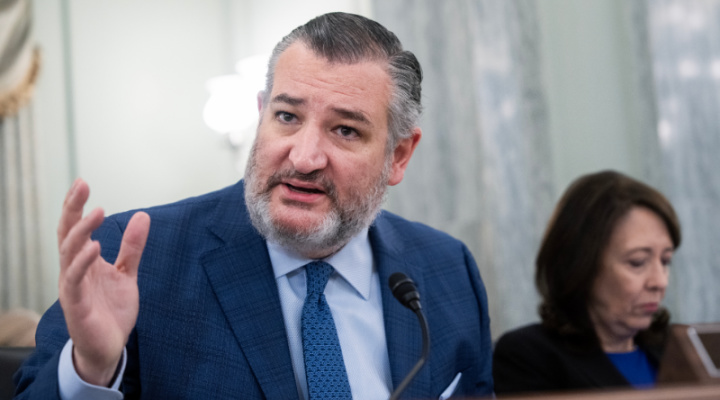
US Sen. Ted Cruz (R-TX) speaks during a Senate Commerce, Science, and Transportation Committee hearing on Capitol Hill in Washington, DC on April 15, 2026. Photo: Tom Williams/CQ Roll Call/Sipa USA via Reuters Connect
US Sen. Ted Cruz (R-TX) has renewed his calls for the Trump administration to recognize Somaliland as an independent and sovereign state, arguing the self-declared African republic would be a significant strategic partner if Washington were to formalize relations.
“Somaliland is a geo-strategic US maritime security partner in Africa,” Cruz said last week during a hearing on US counterterrorism approaches in Africa. “It sits along the Gulf of Aden near one of the world’s busiest shipping corridors and its forces actively contribute to counterterrorism and anti-piracy missions.”
Somaliland, which has claimed independence for decades in East Africa but remains largely unrecognized, is situated on the southern coast of the Gulf of Aden and bordered by Djibouti to the northwest, Ethiopia to the south and west, and Somalia to the south and east. It has sought to break off from Somalia since 1991 and utilized its own passports, currency, military, and law enforcement.
Unlike most states in its region, Somaliland has relative security, regular elections, and a degree of political stability.
“Somaliland stands with our allies, including Taiwan and Israel, and aligns with US interests in a region where China is aggressively expanding,” Cruz said. “Most recently, Israel’s decision to formally recognize Somaliland in December 2025 underscores its growing strategic relevance.”
In December, Israel recognized Somaliland’s independence, becoming the first UN-recognized country in the world to do so — Taiwan did in 2020 — while igniting a diplomatic firestorm in Somalia and dozens of Muslim nations which condemned the decision.
Israel announced the appointment of its first ambassador to Somaliland earlier this month. Less than two months earlier, the first official delegation from the self-declared African republic — 25 water sector workers — arrived in Israel for help on tackling their water crisis at home.
As for the US, Cruz noted that Gen. Dagvin Anderson, the Commander of US Africa Command, had met with partners in Somaliland last year “to assess the security environment and to review Berbera’s operational capacity.”
“This is the kind of partner we should be encouraging and one that will shape how we confront CT challenges in the Horn of Africa,” he added.
Anderson visited Somaliland’s capital Hargeisa and Berbera, the site of a rapidly developing trading port operated by Dubai’s DP World, one of the world’s top shipping and logistics companies which manages 10 percent of global container trade.
On Thursday, Somaliland President Abdirahman Mohamed Abdullahi visited the United Arab Emirates (UAE), responding to an official state invitation. The UAE has nurtured a longstanding relationship with Somaliland, previously supporting training for the country’s military in 2018. The deal for constructing the Berbera port will allow the UAE to maintain a presence for 30 years.
Israel’s recognition of Somaliland has “solidified a ‘Berbera Axis’ (Israel-UAE-Ethiopia) centered on port access and maritime monitoring,” according to an analysis by Marie de Vries, a researcher at the French think tank La Fondation Méditerranéenne D’études Stratégiques (Mediterranean Foundation for Strategic Studies), or FMES. In contrast, she added, a “Mogadishu Axis” has emerged due to a partnership of Somalia with Turkey, Egypt, and Saudi Arabia
Cruz’s comments came after US Rep. John Rose (R-TN) told The Algemeiner that he supported the US recognizing Somaliland.
“I think it’s also an important element that this is a relatively well-functioning democracy, and we think the United States should encourage that,” said Rose, who also touted the strategic benefits for the US. He introduced legislation to push the US government to study boosting economic ties with Somaliland.
Cruz addressed the arguments of those who oppose recognition of Somaliland in last week’s hearing.
“Critics argue that recognizing Somaliland could introduce new CT [counterterrorism] risks or undermine our posture in Mogadishu. I would argue the opposite,” Cruz said. “Working with a capable, willing partner like Somaliland strengthens our posture, particularly when Somalia itself continues to struggle with instability and persistent terrorist threats.”
Nick Checker, senior official in the US State Department’s Bureau of Africa Affairs who testified at the hearing, said that while Somaliland has been a “very good partner” on counterterrorism, US President Donald Trump’s current position is not to support formal recognition.
“I certainly agree with you that Somaliland has been a very good partner CT and otherwise with the United States. We’ve had a positive relationship with both them and other member states,” Checker said. “But you know the policy of the administration for now is that we do continue to recognize, as you know, the territorial integrity and sovereignty of the federal government of Somalia. But within that framework, we still do obviously look for opportunities to deepen our cooperation with Somaliland.”
Cruz expressed optimism that Trump would change his position.
“Well, I think the implications would be strengthening an ally, and I think clarity is powerfully effective in foreign policy and national security,” Cruz responded. “And I think that is an approach that President Trump has embodied. So, I have a high level of optimism that by the end of this term, President Trump will recognize Somaliland.”
Cruz previously called on Trump to recognize Somaliland in an August 2025 letter.
Somaliland “has proposed hosting a US military presence near the Red Sea along the Gulf of Aden and is open to critical minerals agreements that would support our supply chain resilience,” Cruz wrote in his letter. “The US-Somaliland partnership is robust, and it is deepening.”
Somaliland says it has significant mineral resources, and officials have expressed a willingness to offer the US a strategic military base at the entrance to the Red Sea and critical minerals as part of a deal that would include formal recognition.
However, China has strongly opposed any such moves.
“The Chinese Communist Party (CCP) is using economic and diplomatic coercion to punish Somaliland for its support for Taiwan, as well as to undermine that support,” Cruz wrote in last year’s letter. “The government of Somalia has played an unfortunate role in these efforts: In April 2025, the CCP arranged for Somalia to bar Taiwanese passport holders from transiting into Somaliland, and Chinese support to Somalia is benefiting anti-Somaliland groups working to erode its sovereignty.”
China’s embassy in Somalia released a statement in response to Cruz’s letter declaring that Beijing “firmly opposes this misconduct. Senator Cruz’s remarks constitute serious interference in the internal affairs of Somalia and reflect the hegemonic and bullying attitude of certain US politicians towards the Somali people.”
Cruz referenced China’s response during last week’s hearing.
“Unsurprisingly, the Chinese Communist Party immediately condemned my letter, which only shows how important Somaliland is to US national security,” he said.
De Vries described in her FMES report that “recognition of Somaliland risks normalizing Taiwan’s presence in a region where China has heavily invested in ports, telecommunications, and security partnerships. China’s reaction is driven less by the legal status of Somaliland than by a broader strategic calculus focused on preventing Taiwanese visibility and safeguarding Djibouti’s role as a primary regional hub.”
China established its first overseas military base in Djibouti in 2017.
Uncategorized
‘Scarier Than the Holocaust’: Survivor of Nazi Camps, Oct. 7 Dies at 92
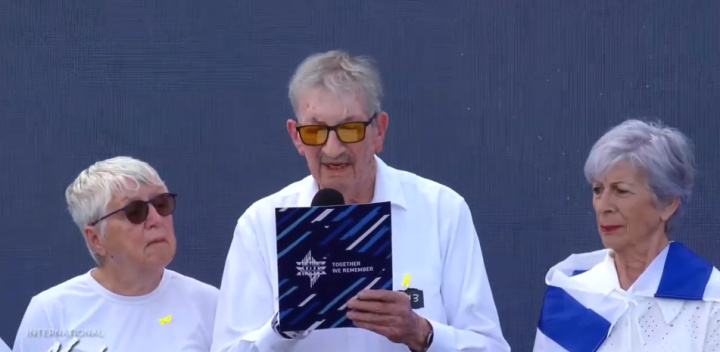
Daniel Louz speaks at Auschwitz-Birkenau as part of the annual March of the Living, May 2024. Photo: Screenshot
Less than two weeks after lighting a Holocaust Remembrance Day torch and saying the Oct. 7, 2023, attack on Israel was scarier than the Nazis’ genocide of European Jews, Daniel Louz, who escaped Nazi persecution as a child and survived the Hamas massacre at Kibbutz Be’eri eight decades later, has died at 92.
The nonagenarian lit a torch at the Israeli Holocaust Remembrance Day ceremony at Kibbutz Yad Mordechai, where the annual Holocaust and Heroism Memorial Rally has been held for decades. In an interview with the Yedioth Ahronoth newspaper before the ceremony, he spoke prophetically – and with humor – about his declining health.
“You see me happy and smiling in the photo, but my health is really not good,” he said. “Soon I will have to return my soul to the Creator, but I make an effort for the camera.”
Born in France, Louz was a child when Nazi Germany invaded in 1940. He and his family were held in three concentration camps in France, separated for years between different camps, with his mother and sister in one place and his father in another. The family survived, but most of his relatives, including 10 aunts and uncles and two cousins, did not.
Two years ago, on Holocaust Remembrance Day, Louz visited Auschwitz-Birkenau with the annual March of the Living, where he also took part in a torch-lighting ceremony.
Louz immigrated to Israel in 1949. He first lived on Kibbutz Nirim in the Negev and later made his home at Kibbutz Be’eri.
“I began to breathe again,” Louz said of the move to Israel.
Louz described the events of Oct. 7, 2023, in Be’eri, one of the communities hit hardest during the Hamas-led attack. On Oct. 6, like many Be’eri residents, Louz marked the kibbutz’s anniversary. The next morning, Hamas terrorists stormed the community. Of the kibbutz’s roughly 1,200 residents, 101 were murdered and 30 were kidnapped. Hundreds of homes were destroyed and more than two years later, most of the community is still living elsewhere.
Louz was inside his home as the attack unfolded.
“We were already hostages in our own home, when Hamas terrorists entered the kibbutz,” he said.
“It was a deathly fear. It was even scarier than I remember as a child during that war,” he added.
Louz said he had not recovered from the trauma of the attack and expressed his hope for an end to war, adding that while he no longer believed he would live to see peace himself, he hoped his grandchildren would.
At Birkenau, Louz tied the memory of the Holocaust directly to the massacre in southern Israel.
“We, the survivors of the Holocaust, who established a home and a state – that constitute our great victory over the Nazis and antisemitism – light this torch in memory of those who perished in the Holocaust, and in memory of those murdered on Oct. 7,” he said, his voice shaking.
Approximately 2,500 Holocaust survivors were in areas directly affected by Oct 7, according to Israel’s Ministry of Welfare and Social Affairs. Roughly 2,000 of these survivors were forced to evacuate their homes from the Gaza envelope and northern Israel due to the subsequent war.
Uncategorized
An Indiana town had no Jewish cemetery. When its mayor died, it built one
When Marcus Levy died in Aurora, Indiana, in September 1871, the city gathered.
Levy was 63 years old, a native of Prague, and the mayor of Aurora. After the upheavals of 1848, he left Europe and arrived in New York a stranger and without means before making his way west. He came to Aurora around 1855 and, over the years, served as city treasurer, county treasurer, school trustee, and then mayor at the time of his death.
He was unmarried and died a poor man after a failed business investment. At his funeral, one fraternal resolution noted the “entire absence of any one related to him by blood.” But he did not die unknown. He had, as The Israelite newspaper of Cincinnati put it, gained the respect of those around him through “his integrity, his talents, and his goodness of heart, both in his private and public life.”
His funeral was held in the Methodist Episcopal Church, the largest building in town. Rabbi Goldammer of Cincinnati had traveled roughly 40 miles to Aurora to officiate. When Levy’s death was announced, one local report noted, “the grief of his friends and the public at large was no less poignant.”
Aurora marked the death formally. The town council recorded its “unfeigned sorrow,” described Levy as “a competent, faithful, and honest public official,” ordered Council Hall draped in mourning for 30 days, and directed city officers to attend the funeral as a group.
At 1 p.m., according to an account of the day, the services began. The church was filled to capacity, and probably more than half of those who came could not get in. One account estimated the attendance at more than 4,000 people.
Then the procession formed.
A German band led. The Aurora lodge of Masons followed in full regalia. Then came the Odd Fellows lodges, also in regalia. Another band. The hearse. Ladies and gentlemen “of the Jewish faith” in carriages. Citizens on foot.
The procession moved under direction through the city to River View Cemetery. One account said it extended nearly three miles. Another called it the largest funeral procession Aurora had ever seen.
At the graveside, rites were performed. The Masons and Odd Fellows conducted their fraternal ceremonies. Afterward, Rabbi Goldammer read the Jewish funeral service.
‘The wind is favorable’
The burial itself had nearly taken place elsewhere.
Because Aurora’s Jewish population numbered just four families, local Jews had first agreed to send Levy’s remains to Cincinnati, where there was an established Jewish cemetery.
But Aurora resisted that plan. According to one report, the “impressive desire of the community” was to keep within the city “as a dear memory” the remains of the man they had respected for so many years. Another account stated Levy’s friends in the city, “irrespective of religious belief,” insisted that he should be buried where he had spent so much of his life.
And so he was.
Levy was interred in River View Cemetery, and Rabbi Goldammer consecrated the ground. Yet the work did not end with the funeral. Rabbi Isaac M. Wise later explained that the Jews of Aurora and neighboring Lawrenceburgh, “few in numbers,” attempted to purchase three adjoining lots so that Levy’s grave might become part of a Jewish burial ground.
A second effort followed: to place “an appropriate monument” above Levy’s grave.
To raise the money, local Jews turned outward. Wise wrote that Abram Epstein and Joseph Meyer of Aurora took the matter in hand and invited him to lecture in the city for the benefit of the monument fund. Wise had refused other outside engagements that winter, but he went to Aurora on Jan. 20, 1873.
The lecture was held in the Presbyterian church. Its pastor, the Rev. A.W. Freeman, with the unanimous consent of his congregation, offered the building for the occasion. Wise described it as “a very pleasant and spacious building.” Before the lecture, Freeman’s daughter played the organ, and four local vocalists, including “one of the most respected bankers of the place and his lady,” sang a quartet.
Though revival meetings were underway in two other churches that same evening, Wise said the church was well filled with “a highly intelligent class of people,” who listened patiently for an hour and a quarter as he lectured on episodes from Jewish history and the world’s progress since then.
Afterward, Freeman, who had introduced Wise, rose and proposed a vote of thanks, which was unanimously approved.
Wise did not know how much money had been raised. He hoped only that the work would continue until the fund was sufficient to erect “a respectable monument” to Levy. He added that he would willingly serve again for that purpose.
A local writer had remarked that the event would be a curious spectacle, a Jewish rabbi speaking in a Christian church before a Christian audience. Wise rejected the novelty. There was nothing peculiar in it, he wrote, for one “to whom all men are equals whatever their creeds, languages, or places of nativity may be.” He added, “We worship one God and love one human family,” and told readers afterward, “We are steering in that direction, and the wind is favorable.”
In Aurora, a Jewish mayor died, and the town did not send him away.
They buried him and then worked to mark the ground.
The post An Indiana town had no Jewish cemetery. When its mayor died, it built one appeared first on The Forward.