



Uncategorized
Shocking: How Palestinian Propaganda Mirrors Language Directly From the Nazis
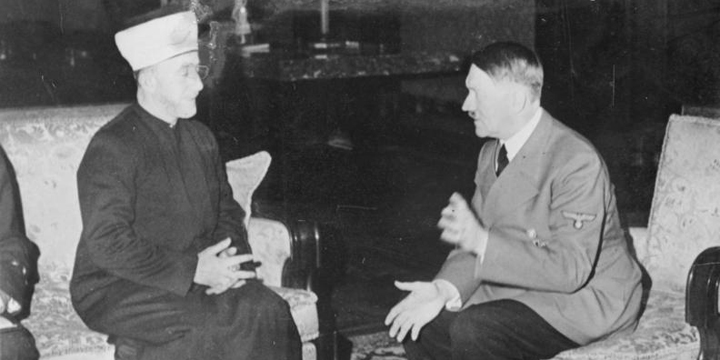
The Grand Mufti of Jerusalem, Haj Amin al-Husseini, meets with Adolf Hitler in 1941. Photo: German Federal Archives via Wikimedia Commons.
How similar are narratives presented in Palestinian society, and the words spewed by the Nazis? Read for yourself below and decide:
Hitler:
“The Jews are the eternal archenemy of the human race. They manipulate, corrupt, and destroy societies.”[Mein Kampf, Vol. 1, Chap. 11]
Palestinian Writers’ Union General Secretariat member Talal Abu Afifa:
“The Jews, wherever they settle, they try to take control of the country’s economy and wealth… They did this not just in Britain, but in most of the European states…”
Official PA TV host: “Indeed, wherever they arrived, destruction followed.”
[Official PA TV, In Memory, Nov. 2, 2024]

Hitler:
“The Jews … are a race of parasites… systematically undermining the fabric of societies”[Mein Kampf, Vol. 1, Chap. 10]
PA TV religious lesson:
Palestinian researcher Muhammad Al-Yahya: “Jews are by nature arrogant, do not accept the other… Their [Jewish] thinking is based on racism that caused them to be hated everywhere. The Zionist thinking is based on them being ‘God’s chosen people.’ [as written] In the Protocols of the Elders of Zion.”[Official PA TV, Returning, Jan. 17, 2023 and Feb. 27, 2023, May 14, 2023]

Hitler:
“If the Jew, with the help of his Marxist creed, is victorious over the peoples of this world, then his crown will be the funeral wreath of humanity”[Mein Kampf, Vol. 1, Chap.11]
Abbas’ advisor, Mahmoud Al-Habbash:
“The occupation (i.e., Israel) is the cause of all evils… of all crises and disasters that everyone … even possibly the whole world, experiences.”[PA leader Mahmoud Abbas’ Advisor on Religious Affairs and Islamic Relations Mahmoud Al-Habbash, YouTube channel, Jan. 19, 2025]

Hitler:
“The Jewish people, by virtue of their innate characteristics, were driven to world domination.”[Mein Kampf, Vol. 1, Chap. 11]
PA Daily:
“They [Jews] want to subjugate the entire world”[Official PA daily Al-Hayat Al-Jadida, Dec. 15, 2024]

Hitler:
“The danger represented by the Jews today finds expression in the undeniable dislike of them felt by a large section of our people.”[Letter from Hitler to Adolf Gimlich, 1919]
Fatah leader Tayseer Nasrallah:
“What happened in the Netherlands [attack on Jewish sports fans] is the best proof that the world is sick of the Jews.”TV host: “Right.”
[Official PA TV, Nov. 10, 2024]
Hitler:
“The personification of the devil as the symbol of all evil assumes the living shape of the Jew.”[Mein Kampf, Vol. 1, Chap. 11]
Mahmoud Abbas’ Advisor Mahmoud Al-Habbash:
“Satan does not have to be in the form of a demon, hidden, he can also be in your form, but he is Satan. In the form of man, but he is Satan. And they (i.e., Satan-Jews) are still fighting us until they turn us back from our religion.”
[Official PA TV, July 7, 2023]

Hitler:
“The Jew’s existence is a crime against humanity, and the only solution is his removal from our midst.”[Mein Kampf, Vol. 2, Chap. 13]
PA Ministry of Religious Affairs:
“The Hour [of Resurrection] will not come until the Muslims fight the Jews and kill them until the Jews hide behind rocks and trees, and the rock or a tree will say: ‘Muslim, O servant of Allah, there is a Jew behind me; come and kill him’”
[PA Ministry of Religious Affairs, Facebook page, Oct. 18, 2023]

Facebook page of the PA Ministry of Religious Affairs, Oct. 18, 2023
Hitler:
“The result will not be the … victory of Jewry but the annihilation of the Jewish race in Europe.”[Hitler to Reichstag, January 30, 1939]
PA Shari’ah Judge Abdallah Harb: “Allah, strike the aggressive Jews, count them and kill them one by one, and do not leave even one.”
[Official PA TV Live, July 5, 2024]

Hitler:
“I defend myself against the Jew.”[Mein Kampf, 1,2]
PA leader Mahmoud Abbas:
“They said that Hitler killed the Jews because they were Jews, and Europe hates the Jews because they are Jews. No!… They fought [the Jews] because of their social role…“Hitler … fought the Jews because they worked based on usury and money. In other words, they caused ruin in his opinion, and therefore he hated them”
[Official PA TV, August 24, 2023]

The author is the Founder and Director of Palestinian Media Watch, where a version of this article first appeared.
Uncategorized
Lebanon’s Internal Splits Over Talks With Israel Trip Up Saudi Mediation Efforts

An Israeli military vehicle drives past destroyed buildings in Lebanon, as seen from the Israeli side of the Israel-Lebanon border, April 30, 2026. Photo: REUTERS/Shir Torem
A growing rift between top Lebanese officials has thrown a wrench into Saudi efforts to help Lebanon’s leaders forge a united position over historic negotiations with Israel, Lebanese sources and foreign officials told Reuters on Thursday.
Saudi Arabia, which sponsored the 1990 agreement that ended Lebanon’s 15-year civil war, has deepened its engagement in recent days with Lebanon, where a shaky US-brokered ceasefire has failed to fully halt the nearly two-month war between Israel and Iran-backed terrorist group Hezbollah.
Ties between Riyadh and Beirut had been strained for years due to Hezbollah’s power over Lebanese politics and security, but the Sunni kingdom sees an opening after the group was severely weakened by war with Israel in 2024.
The US intended for the April 16 truce between Israel and Lebanon to allow for direct talks on a peace deal, potentially shaking up Lebanon’s internal dynamics and its role in the region. But Lebanese leaders remain at odds over the negotiation format and ultimate goal.
Lebanon’s President Joseph Aoun has defended face-to-face talks with Israel in Washington, and has said the ceasefire should be transformed into “permanent agreements.” Although he has stopped short of explicitly calling for a peace deal, two sources familiar with Aoun’s position told Reuters he had privately expressed his readiness to normalize ties with Israel to stop the war.
Speaker of Parliament Nabih Berri, a Hezbollah ally, is opposed to direct talks, reflecting the Shi’ite terrorist group‘s position. Berri believes Lebanon should seek a non-aggression pact with Israel but not a full peace deal, two Lebanese sources familiar with his position told Reuters.
PLANS DERAILED
Last week, Saudi envoy to Lebanon Prince Yazid bin Farhan visited Beirut to encourage Aoun, Berri, and Lebanese Prime Minister Nawaf Salam to set out a single position on the talks and to signal their unity through a tripartite meeting, according to two senior Lebanese political sources who met with bin Farhan and a Western official briefed on the talks.
But plans to hold such a meeting this week were derailed by rising tensions, all three sources said, after Berri publicly accused Aoun of making statements about negotiations that were “inaccurate, to say the least.”
There was no immediate response to requests for comment from Aoun’s office or from the Saudi government media office. Aoun met Salam on Thursday, the presidency said in a statement, without mentioning Berri.
The splits between Aoun and Berri, who hold their positions according to a power-sharing system that divides Lebanon’s top posts by religion, reflect broader divisions within Lebanese society over the negotiations with Israel.
Some Lebanese see direct talks and a swift peace deal as the only way to end a long history of Israeli invasions into Lebanon.
But Hezbollah and much of its broader Shi’ite Muslim constituency, who have borne the brunt of Israel‘s attacks, are firmly opposed to face-to-face talks and to normalizing ties. Some people protesting against talks earlier this month called for the government to be toppled.
Saudi Arabia’s intervention with Lebanese leaders was driven by the risk of such instability – as well as its concern that Lebanon was moving towards peace with Israel too swiftly, according to a Gulf source with knowledge of the matter, the two senior Lebanese political sources and the Western official.
Bin Farhan sought and received reassurances that Hezbollah would not seek to topple the Lebanese government, and cautioned Lebanese leaders last week that Beirut’s progress towards peace with Israel should not outpace Saudi Arabia’s, the four sources said.
Riyadh’s longstanding position has been that it will only sign up to the Abraham Accords normalizing ties with Israel if there is agreement on a roadmap to Palestinian statehood.
SAUDI KEEN FOR ‘DETENTE’ BETWEEN LEBANON AND ISRAEL
US President Donald Trump, keen to expand the accords, said this month he would invite Aoun and Israeli Prime Minister Benjamin Netanyahu to the White House for talks.
Bin Farhan advised Lebanese authorities against Aoun meeting Netanyahu soon, the two senior Lebanese political sources said.
However, Saudi Arabia does want Lebanon to work towards a “detente” with Israel that would halt instability, the Gulf source and one of the Lebanese sources said.
Israeli strikes have killed more than 2,500 people in Lebanon and displaced more than 1.2 million since the latest round of fighting between Israel and Hezbollah began on March 2, according to Lebanese authorities. Israel says the vast majority of those killed have been Hezbollah terrorists, who started the conflict by firing drones and rockets at the Jewish state.
The April 16 truce, which facilitated separate negotiations over the Iran war, stopped strikes on Beirut and its southern suburbs but not on other parts of Lebanon.
Uncategorized
Initial Australian Inquiry Into Bondi Beach Shooting Calls for Counterterrorism Reforms

People stand near flowers laid as a tribute at Bondi Beach to honor the victims of a mass shooting that targeted a Hanukkah celebration at Bondi Beach on Sunday, in Sydney, Australia, Dec. 16, 2025. Photo: REUTERS/Flavio Brancaleone
An interim report into last year’s Bondi Beach mass shooting on Thursday advised increased security around Jewish public events and further gun reforms among 14 initial recommendations, but found Australia’s legal and regulatory frameworks did not hinder security agencies in preventing or responding to the attack.
Prime Minister Anthony Albanese said his government would adopt all the initial recommendations made by the Royal Commission, the nation’s most powerful inquiry, into the Dec. 14 shooting at a Jewish Hanukkah celebration at Sydney’s Bondi Beach, which left 15 dead.
While the report did not propose urgent changes, it outlined recommendations to strengthen Australia’s counter–terrorism capabilities, Albanese told reporters.
“This is as the government envisaged – that the first task of the Royal Commission, the priority, was to look at the security elements of these issues,” he said.
Five of the recommendations remain classified due to sensitive national security concerns, Albanese added.
The attack at Bondi Beach stunned Australia, a country known for its strict gun laws, and prompted widespread calls for enhanced measures against antisemitism and tighter firearm controls. Authorities have said the alleged perpetrators, a father and son duo, were inspired by the Islamic State terrorist group. It was the deadliest mass gun attack in the country in three decades.
The Royal Commission was established in January following mounting pressure from Jewish advocacy groups and victims’ families, who criticized Albanese’s initial hesitation in launching the inquiry.
The 154-page interim report recommends a comprehensive review of the country’s joint counter–terrorism teams, with findings to be submitted to police commissioners and the director-general of security within three months.
It also calls for expanded security protocols during Jewish High Holy Days of Rosh Hashanah and Yom Kippur, to include other high-profile Jewish festivals and events.
Additional measures include updating the counter–terrorism handbook promptly and involving senior government officials in counter–terrorism exercises, and accelerating efforts to implement a proposed national gun buyback plan.
“The review has revealed aspects in which counter–terrorism capability at federal and state levels could be improved,” the report noted.
Public hearings by the commission are scheduled to start next week, with a final report due by the end of the year.
Uncategorized
Vessel Carrying Grain Ukraine Says Stolen by Russia Will Not Unload in Israel, Kyiv Says

A farmer operates a combine during the start of the wheat harvesting campaign in a field near the town of Starobilsk (Starobelsk) in the Luhansk Region, a Russian-controlled area of Ukraine, July 9, 2025. Photo: REUTERS/Alexander Ermochenko
A vessel carrying grain that Ukraine says was stolen from areas occupied by Russia will not unload in Israel, Ukraine said on Thursday, after Kyiv requested Israel to seize the cargo.
Ukraine‘s prosecutor general, Ruslan Kravchenko, said on the Telegram app that the vessel, Panormitis, left Israel‘s territorial waters and departed into neutral waters following “a range of procedural measures taken by Ukraine.”
“On the basis of the materials provided by the Ukrainian side within the framework of international legal cooperation, the competent Israeli authorities have begun to process the request,” he said.
Israel‘s foreign ministry said, however, that Ukraine‘s request for legal assistance, submitted late on Tuesday, “contained significant factual gaps and did not include any supporting evidence.”
In the meantime, the ministry said, it was informed that the vessel that was supposed to enter the port next week decided to depart from Israel‘s territorial waters.
The Panama-flagged vessel‘s manager was not immediately available for comment.
SIGNAL TO OTHER VESSELS
Ukrainian Foreign Minister Andrii Sybiha, writing on X earlier on Thursday, said the vessel would not be unloading in Israel, describing it as a “welcome development” which “demonstrates that Ukraine‘s legal and diplomatic actions have been effective.”
Sybiha added that Ukraine will continue to track the vessel and warn against any operations with it.
“This is also a clear signal to all other vessels, captains, operators, insurers, and governments: do not buy stolen Ukrainian grain. Do not become part of this crime,” Sybiha said.
The Jerusalem Post and other outlets earlier on Thursday cited a statement from Israel‘s Grain Importers Association saying that the company importing the grain had been forced to turn away the vessel.
Zenziper, the company named in the reports as the importer, did not immediately respond to an emailed request for comment.
Kyiv considers all grain produced in the four regions that Russia claimed as its own since invading Ukraine in 2022 as well as Crimea, annexed by Russia in 2014, to be stolen and has protested over its export by Russia to other countries.
Moscow has not commented on the legal status of grain harvested in regions that remain internationally recognized as Ukrainian.
Ukraine and Israel traded diplomatic barbs this week as Kyiv condemned what it said were purchases of grain produced in Ukrainian territory currently occupied by Russia, while Israel said Kyiv had not produced evidence for its allegations.