



Uncategorized
UK Raises Threat Level to ‘Severe’ After London Antisemitic Terror Attack
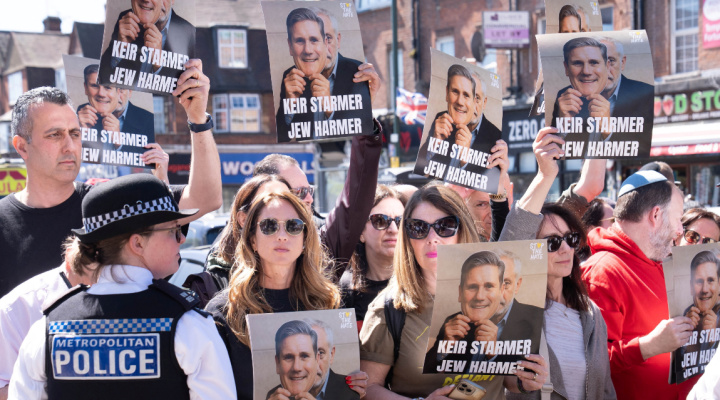
Protesters hold up placards against British Prime Minister Keir Starmer during his visit to Golders Green, northwest London, following a terror attack on April 29, 2026, in which two men were stabbed, in London, Britain, April 30, 2026. Photo: Stefan Rousseau/Pool via REUTERS
Britain on Thursday raised its national terrorism threat level to “severe,” signaling that a terrorist attack was considered “highly likely,” following an antisemitic stabbing in north London.
Interior minister Shabana Mahmood said the level had been increased from “substantial” after the attack in the Golders Green area on Wednesday, adding that the decision reflected a broader and rising threat environment rather than a single event.
“I know this will be a source of concern to many, particularly amongst our Jewish community, who have suffered so much,” the minister said in a statement. “As the threat level rises, I urge everyone to be vigilant as they go about their daily lives and report any concerns they have to the police. And I can assure everyone that our world-class security services and the police are working day and night to keep our country safe.”
Meanwhile, Prime Minister Keir Starmer vowed to take action to protect the Jewish community in Britain, acknowledging that Jews were scared a day after the stabbing left two Jewish men, one in his 70s and one in his 30s, hospitalized in stable condition.
The attacked followed a spate of antisemitic attacks in the British capital.
Starmer, who has faced severe criticism from some in the Jewish community for the government’s response, promised more police in Jewish areas, a crackdown on those spreading antisemitism, and new legislation to deal with state-sponsored threats from the likes of Iran.
He had earlier been jeered and heckled by a small crowd waving banners reading “Keir Starmer Jew Harmer” when he visited Golders Green where the two Jewish men were stabbed on Wednesday.
‘PEOPLE ARE SCARED’
“People are scared, scared to show who they are in their community, scared to go to synagogue and practice their religion, scared to go to university as a Jew, to send their children to school as a Jew, to tell their colleagues that they are Jewish,” Starmer said in a televised statement.
The suspect in the Golders Green attack, a 45-year-old British national who was born in Somalia, had a history of serious violence and mental health issues, police said.
They also confirmed he had previously been referred to the counter radicalization scheme Prevent in 2020, while local media reported he had served time in prison for an incident in 2008 when he stabbed an officer and a police dog.
Amid widespread calls for more to be done to protect the about 290,000 Jews living in Britain, Starmer said the government would do “everything in our power to stamp this hatred out,” with stronger powers to shut down charities promoting extremism and a clampdown on “hate preachers.”
The government has also said it would fast-track legislation allowing the prosecution of people acting as proxies of a state-sponsored group, so they can be dealt with in the same way as spies for foreign intelligence services.
“We need stronger powers to tackle the malign threat posed by states like Iran, because we know for a fact that they want to harm British Jews,” Starmer said.
A pro-Iranian government group has claimed responsibility for several recent attacks while last month, two men were charged under Britain’s existing National Security Act with being tasked by Iran to carry out hostile surveillance.
Tehran has rejected such accusations.
PROTEST PROBLEM
One of the major issues which has caused anger amongst the Jewish community in Britain has been anti-Israel marches, which have become commonplace since the October 2023 Hamas assault on the Jewish state that triggered the war in Gaza. Critics say the protests have generated hostility and become a hotbed of antisemitism.
“If you stand alongside people who say, ‘Globalize the Intifada,’ you are calling for terrorism against Jews, and people who use that phrase should be prosecuted,” Starmer said. “It is racism, extreme racism, and it has left a minority community in this country, scared, intimidated, wondering if they belong.”
The recent incidents in London are part of a rising number of antisemitic attacks.
Last October, two people were killed after an attack at a synagogue in the northern English city of Manchester. A week later, two men went on trial over a plot to kill hundreds in an Islamic State-inspired gun rampage against the Jewish community.
They were found guilty in December, just over a week after a mass shooting at a Jewish Hanukkah celebration on Australia’s Bondi Beach.
Britain’s independent reviewer of terrorism legislation, Jonathan Hall, told the BBC the British attacks had become “the biggest national security emergency” since 2017, when there was a string of high-profile attacks.
Mahmood said additional funding would pay for more protective security for the country’s synagogues, schools, places of worship, and community centers, boosting police numbers in areas with a large Jewish community.
According to the British government, an additional £25 million ($34 million) will be invested to increase security for Jewish communities.
“We are seeing a huge increase in antisemitism, and that’s why the government’s work on education and stamping out antisemitism across other parts of the public sector is also an incredibly important part of this picture,” Mahmood said.
She did not say the legislation would be used against Iran’s Islamic Revolutionary Guard Corps (IRGC) but told Sky News: “I expect to be making decisions in the very near future about the groups that we will be designating as state-linked.”
Several countries have designated the IRGC as a foreign terrorist organization.
Uncategorized
US Lawmakers Introduce Bipartisan Resolution Condemning Antisemitic Rhetoric by Candace Owens, Hasan Piker

Right-wing political commentator Candace Owens speaks during an event held by national conservative political movement ‘Turning Point’, in Detroit, Michigan, US, June 14, 2024. Photo: REUTERS/Rebecca Cook
US Reps. Josh Gottheimer (D-NJ) and Mike Lawler (R-NY) introduced a bipartisan resolution on Wednesday that condemns “antisemitic, hate-filled rhetoric and content” promoted by online streamer Hasan Piker and podcaster Candace Owens.
The resolution addresses the growing influence of online personalities around the world, as well as the global rise in antisemitism in recent years fueled partially by “online disinformation, conspiracy theories, and extremist rhetoric.” It calls on social media platforms and public leaders to denounce and take action against hatred.
“The rise of digital media platforms has enabled individuals with large audiences to disseminate disinformation, commentary, and political viewpoints to millions of viewers worldwide,” the resolution states. “Such influence carries a heightened responsibility to avoid rhetoric that promotes hatred, violence, or discrimination against any group, including Jewish individuals and communities.”
The resolution lists several hateful comments from both Piker and Owens.
Piker has repeatedly expressed support for Hamas and even said “it doesn’t matter” if sexual assault took place during the terrorist group’s Oct. 7, 2023, invasion of and massacre across southern Israel.
Owens is notorious for promoting antisemitic conspiracy theories, tropes, and blood libels about Judaism, Jewish figures, and Israel. She has claimed, for example, that Israel controls the US government and has also downplayed and denied verified details about the Holocaust.
The resolution states that efforts to “downplay or excuse antisemitic rhetoric under the guise of political commentary should be rejected.”
“Piker has openly applauded Hamas’ terrorism, downplayed the mass rape of civilians on Oct. 7, and dehumanized Orthodox Jews as ‘inbred,’” Lawler said in a statement. “Owens has trafficked in vile conspiracy theories, promoted blood libels, and platformed Holocaust deniers. With an audience of millions, they have a responsibility to confront hatred and bigotry in every form, not to amplify it to the masses. So, if they won’t call it out, I will.”
“Hatred is hatred, period,” Gottheimer added. “It doesn’t matter whether it comes from the far right or the far left. We cannot be selective in calling out antisemitism. When influential voices spread conspiracy theories, promote terrorism, or dehumanize Jewish people, it fuels real-world violence and intimidation. We must stand up and speak out.”
“I get that speaking up is not easy, but our constituents didn’t elect us to always take the easy path,” he noted. “That’s what principled leadership is all about.”
Owens has not publicly commented on the resolution, but Piker condemned it in a statement to the Jewish Telegraphic Agency (JTA).
“They are once again conflating legitimate critics of Israel with actual antisemites,” he said. “They would rather complain about fake antisemitism in defense of Israel than call out the real sources of Jew hatred with a full chest. I have spent my entire career combating all forms of bigotry including antisemitism and will continue to do so in spite [of] this cynical ploy to satisfy donors.”
Uncategorized
Peru’s President Under Fire Over Antisemitic Remarks Blaming Jews for ‘Pushing’ Germany Into World War II

José María Balcázar was elected as acting president of Peru on Feb. 18, 2026, and will serve until July 28, when the winner of the presidential elections takes office. Photo: ULAN/Pool / Latin America News Agency via Reuters Connect
Peru’s interim president, José María Balcázar, has sparked global outrage after claiming that Jews helped “push” Germany into World War II, drawing mounting calls from world leaders and advocacy groups to retract his remarks and issue a formal apology over what critics condemn as deeply antisemitic.
During a speech marking the 138th anniversary of the Chamber of Commerce of Lima, the Peruvian leader — who assumed power after Congress appointed him to replace ousted former president José Jerí amid corruption allegations — cited The Enemies of Commerce by Antonio Escohotado, invoking its arguments while amplifying long-discredited antisemitic tropes.
“It is a monument to the history of commerce: how bills of exchange were born, how international trade moved, what role Jews played in Germany’s national and international trade, how Germany was pushed into World War II, also partly because of the Jews, because they controlled all the banks, all the commerce, and practiced usury,” Balcázar said.
“All these historical details need to be remembered through Escohotado, so that we can better prepare ourselves and understand the history and hardships of those dedicated to commerce. It is truly interesting,” the left-leaning lawmaker and former judge continued.
Shortly after Balcázar’s remarks gained widespread media attention, leaders of Peru’s Jewish community, opposition figures, and officials from Israel and Germany, as well as other foreign diplomats, swiftly condemned his statements, demanding that he retract them and issue an unequivocal public apology.
In a joint statement, the embassies of Israel and Germany in Peru condemned Balcázar’s claims as “absurd, historically untenable, and a violation of the memory of millions of German Jewish citizens murdered by the Nazis.”
“It should be remembered that Adolf Hitler and the Nazi regime initiated World War II with the invasion of Poland in 1939. Nazi ideology, rooted in racism and antisemitism, not only discriminated against Jewish citizens but also led to the murder of six million Jews in concentration camps,” the statement read.
“The Holocaust must never be trivialized under any circumstances,” it continued.
Israel claramente rechaza en conjunto con Alemania, toda forma de Antisemitismo.@Agencia_Andina @PresidenciaPE @CancilleriaPeru pic.twitter.com/gnzZ3d1PTt
— Israel En Peru (@IsraelinPeru) April 29, 2026
The Jewish Association of Peru (AJP) also denounced the remarks, describing them as a dangerous revival of “outdated antisemitic theories,” and warning against the spread of such narratives.
“It is shocking that, in the 21st century, arguments reminiscent of the darkest medieval eras are still being used to blame victims of the Holocaust for their own persecution,” AJP said in a statement.
Amid growing domestic and international pressure, the government issued a statement expressing regret that the comments had “created a mistaken perception regarding the Jewish people in the context of the outbreak of World War II.”
“The Peruvian state has consistently maintained that Nazi fanaticism was the driving force behind the war and the perpetrator of the unforgivable genocide against the Jewish people. This longstanding position, which also led Peru to firmly support the creation of Israel, remains unchanged,” the statement read.
“President José María Balcázar strongly condemns the genocide perpetrated against the Jewish people during World War II, reaffirms his rejection of antisemitism and all forms of discrimination, and expresses his solidarity with the victims of the Holocaust,” it continued.
Balcázar will serve as interim president until July 28, when the winner of this year’s presidential election takes office.
Uncategorized
Lebanon’s Internal Splits Over Talks With Israel Trip Up Saudi Mediation Efforts

An Israeli military vehicle drives past destroyed buildings in Lebanon, as seen from the Israeli side of the Israel-Lebanon border, April 30, 2026. Photo: REUTERS/Shir Torem
A growing rift between top Lebanese officials has thrown a wrench into Saudi efforts to help Lebanon’s leaders forge a united position over historic negotiations with Israel, Lebanese sources and foreign officials told Reuters on Thursday.
Saudi Arabia, which sponsored the 1990 agreement that ended Lebanon’s 15-year civil war, has deepened its engagement in recent days with Lebanon, where a shaky US-brokered ceasefire has failed to fully halt the nearly two-month war between Israel and Iran-backed terrorist group Hezbollah.
Ties between Riyadh and Beirut had been strained for years due to Hezbollah’s power over Lebanese politics and security, but the Sunni kingdom sees an opening after the group was severely weakened by war with Israel in 2024.
The US intended for the April 16 truce between Israel and Lebanon to allow for direct talks on a peace deal, potentially shaking up Lebanon’s internal dynamics and its role in the region. But Lebanese leaders remain at odds over the negotiation format and ultimate goal.
Lebanon’s President Joseph Aoun has defended face-to-face talks with Israel in Washington, and has said the ceasefire should be transformed into “permanent agreements.” Although he has stopped short of explicitly calling for a peace deal, two sources familiar with Aoun’s position told Reuters he had privately expressed his readiness to normalize ties with Israel to stop the war.
Speaker of Parliament Nabih Berri, a Hezbollah ally, is opposed to direct talks, reflecting the Shi’ite terrorist group‘s position. Berri believes Lebanon should seek a non-aggression pact with Israel but not a full peace deal, two Lebanese sources familiar with his position told Reuters.
PLANS DERAILED
Last week, Saudi envoy to Lebanon Prince Yazid bin Farhan visited Beirut to encourage Aoun, Berri, and Lebanese Prime Minister Nawaf Salam to set out a single position on the talks and to signal their unity through a tripartite meeting, according to two senior Lebanese political sources who met with bin Farhan and a Western official briefed on the talks.
But plans to hold such a meeting this week were derailed by rising tensions, all three sources said, after Berri publicly accused Aoun of making statements about negotiations that were “inaccurate, to say the least.”
There was no immediate response to requests for comment from Aoun’s office or from the Saudi government media office. Aoun met Salam on Thursday, the presidency said in a statement, without mentioning Berri.
The splits between Aoun and Berri, who hold their positions according to a power-sharing system that divides Lebanon’s top posts by religion, reflect broader divisions within Lebanese society over the negotiations with Israel.
Some Lebanese see direct talks and a swift peace deal as the only way to end a long history of Israeli invasions into Lebanon.
But Hezbollah and much of its broader Shi’ite Muslim constituency, who have borne the brunt of Israel‘s attacks, are firmly opposed to face-to-face talks and to normalizing ties. Some people protesting against talks earlier this month called for the government to be toppled.
Saudi Arabia’s intervention with Lebanese leaders was driven by the risk of such instability – as well as its concern that Lebanon was moving towards peace with Israel too swiftly, according to a Gulf source with knowledge of the matter, the two senior Lebanese political sources and the Western official.
Bin Farhan sought and received reassurances that Hezbollah would not seek to topple the Lebanese government, and cautioned Lebanese leaders last week that Beirut’s progress towards peace with Israel should not outpace Saudi Arabia’s, the four sources said.
Riyadh’s longstanding position has been that it will only sign up to the Abraham Accords normalizing ties with Israel if there is agreement on a roadmap to Palestinian statehood.
SAUDI KEEN FOR ‘DETENTE’ BETWEEN LEBANON AND ISRAEL
US President Donald Trump, keen to expand the accords, said this month he would invite Aoun and Israeli Prime Minister Benjamin Netanyahu to the White House for talks.
Bin Farhan advised Lebanese authorities against Aoun meeting Netanyahu soon, the two senior Lebanese political sources said.
However, Saudi Arabia does want Lebanon to work towards a “detente” with Israel that would halt instability, the Gulf source and one of the Lebanese sources said.
Israeli strikes have killed more than 2,500 people in Lebanon and displaced more than 1.2 million since the latest round of fighting between Israel and Hezbollah began on March 2, according to Lebanese authorities. Israel says the vast majority of those killed have been Hezbollah terrorists, who started the conflict by firing drones and rockets at the Jewish state.
The April 16 truce, which facilitated separate negotiations over the Iran war, stopped strikes on Beirut and its southern suburbs but not on other parts of Lebanon.