



Uncategorized
US and Iran Explore Short-Term Deal to End Fighting
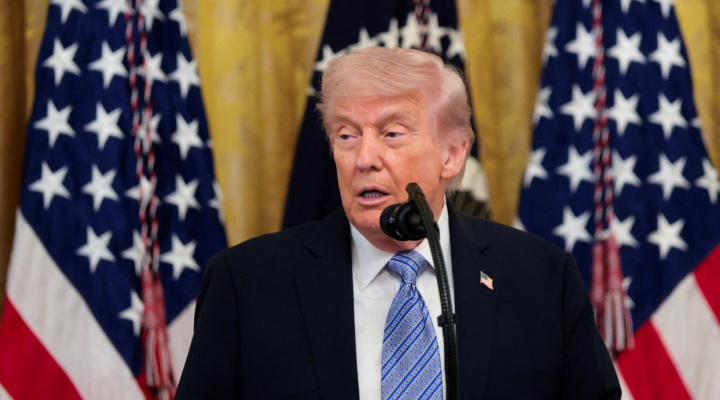
US President Donald Trump speaks during a Small Business Summit in the East Room at the White House in Washington, DC, US, May 4, 2026. Photo: REUTERS/Kylie Cooper
The United States and Iran are edging toward a temporary agreement to halt their war, sources and officials said on Thursday, with Tehran reviewing a proposal that would stop the fighting but leave the most contentious issues unresolved.
Iran‘s foreign ministry spokesperson said Tehran had not yet reached a conclusion on the emerging plan, which, according to the sources, centers on a short–term memorandum rather than a comprehensive peace deal, underscoring deep divisions between the two sides.
Hopes that even a partial deal could lead to the reopening of the Strait of Hormuz have already moved markets, with oil prices sliding again on bets that supply disruptions could ease and global stocks largely holding onto record highs.
Tehran and Washington have scaled back ambitions for a sweeping settlement as differences persist, particularly over Iran‘s nuclear program – including the fate of its highly enriched uranium stockpiles and how long Tehran would halt nuclear work.
Instead, they are working toward a temporary arrangement set out in a one-page memo aimed at preventing a return to conflict and stabilizing shipping through the strait, the sources and officials said.
“Our priority is that they announce a permanent end to war and the rest of the issues could be thrashed out once they get back to direct talks,” a senior Pakistani official involved in mediation between the two sides told Reuters.
The proposed framework would unfold in three stages: formally ending the war, resolving the crisis in the Strait of Hormuz, and launching a 30-day window for negotiations on a broader agreement, according to the sources and officials.
Tehran said Foreign Minister Abbas Araqchi held a phone call on Thursday with Ishaq Dar, his counterpart in Pakistan, which has taken a leading role in mediation efforts.
“We remain optimistic,” Pakistan’s foreign ministry spokesperson Tahir Andrabi told a briefing in Islamabad when asked how quickly a deal could come.
“A simple answer would be that we expect an agreement sooner rather than later.”
TRUMP OPTIMISTIC, IRAN SKEPTICAL
US President Donald Trump – who has repeatedly played up the prospect of a breakthrough since the war began on Feb. 28 with US-Israeli strikes on Iran – has also struck an optimistic tone.
“They want to make a deal … it’s very possible,” he told reporters at the White House on Wednesday, adding later that “it’ll be over quickly.”
The proposal would formally end the conflict in which full-scale warfare was paused by a ceasefire announced on April 7. But it leaves unresolved key US demands that Iran suspend its nuclear work and reopen the Strait of Hormuz, the sources said.
In a sign of the US keeping up pressure, it imposed sanctions on Thursday on Iraq’s deputy oil minister and three militia leaders over what it said was their support for Iran.
Israel, which has also been fighting Iran-backed Hezbollah in Lebanon, said on Thursday it had killed a Hezbollah commander in an airstrike on Beirut a day earlier, the first Israeli attack on the Lebanese capital since a ceasefire there was agreed last month.
Hezbollah triggered its latest conflict with Israel by opening fire in support of Iran on March 2. A halt to Israeli strikes in Lebanon is another key Iranian demand in negotiations with Washington.
Iranian officials signaled skepticism over the US proposal to end the wider war. A foreign ministry spokesperson said Tehran would respond in due course, while lawmaker Ebrahim Rezaei described the proposal as “more of an American wish list than a reality.”
Iran‘s parliament speaker Mohammad Baqer Qalibaf appeared to mock reports that indicated the two sides were close, writing on social media that “Operation Trust Me Bro failed” and portraying the talks as US spin after its failure to reopen the strait.
DEAL HOPES DRIVE OIL DOWN, SHARES RISE
Reports of a possible agreement pushed Brent crude down by 3% to around $98 a barrel, having tumbled nearly 8% on Wednesday.
Global share prices also rose, and bond yields fell on optimism about an end to a war that has disrupted energy supplies. [O/R] [MKTS/GLOB]
“The contents of the US-Iran peace proposals are thin, but there is an expectation in the market that further military action will not take place,” said Takamasa Ikeda, a senior portfolio manager at GCI Asset Management.
MILITARY, REGIONAL TENSIONS
Trump on Tuesday paused a two-day-old naval mission aimed at reopening the blockaded strait, citing progress in talks.
NBC News, citing two unnamed US officials, said Trump decided on the pause after Saudi Arabia suspended the US military’s ability to use a Saudi base for the operation.
Saudi officials were surprised and angered by Trump’s announcement that the US would help escort ships through the strait, leading them to tell Washington they would deny the US permission to fly military aircraft out of a Saudi base or through Saudi airspace, NBC reported.
The White House did not immediately respond to a request for comment on the report. The US military has kept up its own blockade on Iranian ships.
KEY DEMANDS LEFT OUT
The source briefed on the mediation said the US negotiations were being led by Trump’s envoy Steve Witkoff and son-in-law Jared Kushner. If both sides agreed on the preliminary deal, that would start the clock on 30 days of detailed negotiations to reach a full agreement.
The sources said the memorandum did not mention several key demands Washington has made in the past, which Iran has rejected, such as limits on Iran‘s missile program and an end to its support for proxy militias in the Middle East, including Hezbollah.
The sources also made no mention of Iran‘s existing stockpile of more than 400 kg (900 pounds) of near-weapons-grade uranium – one of Washington’s central concerns.
Uncategorized
Antisemitism Exploding on the Far-Right: The Conspiracy Doesn’t Need an Event Anymore

Dan Bilzerian arrives at the Fashion Nova x Cardi B Collection Launch Party held at the Hollywood Palladium on May 8, 2019, in Hollywood, Los Angeles, California, United States. Photo: Xavier Collin/Image Press Agency/NurPhoto via Reuters Connect
In April 2026, Dan Bilzerian — a social media personality with 29.6 million Instagram followers — filed to run for the US Congress against incumbent Randy Fine (R-FL). Within 10 days, he had been interviewed across right-wing, left anti-imperialist, manosphere, and tabloid outlets, calling his Jewish opponent a “fat Jew” and naming “Jewish supremacy” as the greatest threat to America.
My team at NYU’s Center for the Study of Antisemitism collected and coded 3,000 YouTube comments under six of these video appearances. Across the six videos, 41 percent of comments were antisemitic. The lowest single video came in at 23.6 percent. Under TMZ, where the hosts pushed back on Bilzerian on camera, the figure reached 52 percent — the highest of the six.
These are not numbers consistent with the way online antisemitism has usually been studied — including in my own previous work.
Most digital antisemitism research, including the studies my team has run after the Capital Jewish Museum shooting, the Charlie Kirk assassination, the Bondi Beach attack, the Temple Israel Synagogue attack, and the White House Correspondents’ Dinner shooting, treats the discourse as event-driven. Something happens; comment sections respond. The highest antisemitism rate I have ever documented in those event studies sits in the 12 to 20 percent range.
Sadly, even Bilzerian’s quietest video outran the worst spike I have ever seen after a major attack. There is no event driving these numbers. There is just a candidate.
Online antisemitism is still being produced on the left, by Islamist actors, and by foreign malign-influence operations. None of that has gone away — and on the left in particular, the post-October-7 surge has not receded.
What has changed is that a second front has opened among right-wing influencers with mass audiences, and it is moving fast. Bilzerian comes from there. So did Candace Owens before him. So did Tucker Carlson.
Antisemitism and adjacent conspiracy narratives are now being normalized by these figures at an unprecedented pace, inside the broader Republican coalition, using platform infrastructures and institutional vehicles existing monitoring rarely even looks at.
Jewish institutions calibrated mainly to track the left or external state actors are now watching one front while a second one widens.
The pattern holds across audiences that have nothing else in common. Owen Shroyer is a former Infowars right-populist. George Galloway is a heterodox left anti-imperialist who was expelled from Labour in 2003 over his Iraq War statements. Sneako is a manosphere influencer and Muslim convert. Jimmy Dore is a left-populist commentator.
The antisemitism saturation is steady under all of them, because what is producing it is not the host or the audience but the speaker each is platforming. Under Galloway, a typical comment ran: “It is the Zionists in control of all our western governments that have promoted the illegal immigration issues we have all been experiencing for the past decade.” Under Sneako, where the title named “Jewish supremacy” directly, the wordplay register surfaced — “very Cohencidental,” “Cohencidence” — alongside lines like “anyone who shits on Jews is a legend.”
Under Jimmy Dore, where antisemitism reached 42 percent, the historical-authority register dominated: a Hitler quotation got 71 likes, with a reply reading, “Yes we owe that man AH a big apology.”
Bilzerian’s candidacy is more than a single bad actor. It is a convergence: manosphere reach built up over a decade — poker, weapons, wealth display — converted into a pre-loaded political audience; anti-establishment positioning that reads as left or right depending on the listener but is coherent only as anti-Jewish-power (anti-Trump, anti-AIPAC, anti-Iraq War, pro-Palestinian); eliminationist content visible across the comment sections, including Hadrian endorsements, death wishes referencing the Nova massacre directed at named Jewish commenters, and the line “FINISH THE JOB THIS TIME”; and a Republican primary as the institutional vehicle that cleared the FEC filing process without friction.
The TMZ result shows what happens when this baseline meets resistance. Hosts Harvey Levin and Charles Latibeaudiere did exactly what mainstream-media accountability journalism is supposed to do. They named “fat Jew” as antisemitic on camera. They challenged Bilzerian’s redirection toward Palestinians as the “real Semites.” They refused his pivot from his own rhetoric to attacks on Fine’s record. By the standards of on-camera adversarial framing, this was a textbook intervention. The replies came in at 52 percent antisemitic.
The mechanism is the finding. The audience did not register the host pushback as journalistic accountability. It registered the pushback as further evidence of the conspiracy Bilzerian was naming. TMZ co-founder Harvey Levin’s documented appearance in the Epstein files — a real fact in the public record — became the activation trigger. One commenter, with 30 likes: “the owner of TMZ is in the Epstein files and plays the victim. These people support actual genocide. They are using words as a shield.” Another, with 73 likes: “He would win with ease but I don’t think the tiny hats would ever allow him to run.” A Goebbels quotation circulated through six different stations of one mega-thread, accumulating endorsements at each stop — “based,” “my daddy.” Latibeaudiere, the Black co-host, was recoded as a racial subordinate to a Jewish boss: “his boss and co-partner is a Jue,” “he figures it’s better to be in the house than in the fields.” A single counter-comment in the entire 500-comment sample, detailed and factually correct, arrived sixteen days late and received zero likes.
The dominant strategy that Jewish institutions, journalists, and platforms have for handling antisemitic public figures is on-camera adversarial framing: bring them on, push back, make them defend the indefensible. The assumption is that the audience will absorb the pushback as suppression. The TMZ case shows this assumption breaking. When the audience has already been primed — by years of speaker supply on other platforms — to read the host as part of the system being challenged, adversarial framing does not suppress the saturation. It feeds it.
Antisemitism in this material is not one hate register among several. It is the organizing logic for the others. Anti-Black framings, misogyny, anti-Muslim and anti-trans rhetoric all appear under the videos — but not as parallel categories. They appear under the conspiracy frame, organized by formulations like “the media is run by Jews and pushes X.” Monitoring systems that track hate categories separately measure each layer in isolation and miss the architecture connecting them.
Two things follow.
For Jewish institutions: a Congressional candidate with 29.6 million followers and a steady four-in-10 antisemitism saturation in his comment sections is not a fringe figure. The fact that he can be interviewed on TMZ and the replies come out at 52 percent is not a journalism problem. It is a structural condition. Strategies that depend on the host’s standing to push back will fail when the audience has already coded the host as compromised. And the threat is now coming from a direction the field has been slow to map: the Republican coalition, mass-audience right-wing creators, and the convergence of manosphere reach with anti-establishment populism.
For those tracking online antisemitism: the methodology to see this exists. The bottleneck is not detection. It is the analytical assumption that antisemitism is something that happens around events. When the speaker is the event, the existing framework cannot register what is in front of it.
The FEC filing was processed without friction. The primary ballot will list a candidate calling a sitting Jewish Congressman a “fat Jew” on national television. Both of those institutional doors opened on schedule. The architecture passing through them did not announce itself as extremism, because by the time it arrived it was wearing the credential of a federal Congressional campaign.
Matthias J. Becker, PhD, is AddressHate Research Scholar at NYU’s Center for the Study of Antisemitism. He is the founder and lead of Decoding Antisemitism — now its successor project, Decoding Hate — Research Advisor to AddressHate, and Editor-in-Chief of Digital Hate Review.
Uncategorized
Iranian Rapper Releases Persian Remix of Israeli Song, Calls for Revenge Against Regime
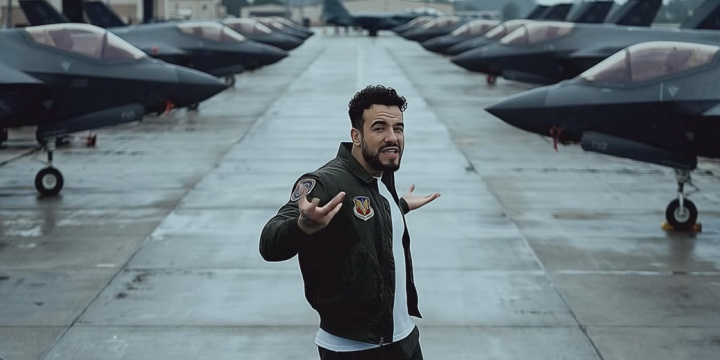
British-Iranian rapper 021Kid in the music video for his Persian remix of the song “Harbu Darbu” (feat. Stilla & Ness). Photo: Screenshot
British-Iranian rapper 021Kid has released a Persian remix of the song “Harbu Darbu” by Israeli rap duo Ness & Stilla, and in the lyrics, he calls for the death of the Iranian regime forces responsible for the killing and oppression of their own people.
The rapper, whose real name is Tony Mohraz, sings in both Farsi and English in “Harbu Darbu,” which was originally released by Ness and Stilla in 2023 in response to the deadly Hamas-led terrorist attack in southern Israel on Oct. 7.
In the Persian remix, 021Kid calls for the destruction of Iran’s Islamic Revolutionary Guard Corps (IRGC), an Iranian military force and internationally designated terrorist group, as well as the Basij parliamentary force that operates underneath it. The regime uses the Basij to violently suppress protests and crush political opposition across the country.
The rapper, who was born in Tehran but now lives in the United Kingdom, also sings about Iranian leaders and senior military figures who have been killed in US and Israel strikes. He mentions by name Supreme Leader Ali Khamenei, Islamic Revolutionary Guard Corps-Qods Force Commander Qasem Soleimani, former Iranian Air Force Commander Aziz Nasirzadeh, and Brig. Gen. Amir Ali Hajizadeh, the commander of the IRGC Aerospace Force.
021Ki further targets the People’s Mojahedin Organization of Iran (MEK), an Iranian opposition group that has been persecuted by the regime and seeks its overthrow but was a US-designated terrorist group from 1997 to 2012.
“We don’t want mullah, neither MEK. Smoke ’em on site, show no mercy,” 021Kid raps in English. He then sings in Farsi, “I’m standing with Iran till the end … We get our country back, just watch.”
The song includes some Hebrew phrases as well. “My Persian Jews, Irani Chai and that’s why Am Israeli Chai,” 021Kid raps in the song. “I pull up Tel Aviv, Ma Nishma? [How are you?].”
The music video also features clips from Ness and Stilla’s music video for the Hebrew version of “Harbu Darbu.”
021Kid explained the intention behind his new song in an Instagram post.
“After what happened in Golders Green, London a few days ago where a Jewish man was stabbed — it’s a reminder that hate doesn’t just live online, it shows up in real life,” he wrote, referring to the antisemitic stabbing attack in which two Jewish men were injured in late April.
“Since January, the people of Israel & the jewish [sic] community have shown strength, resilience, and unity and solidarity standing next to us Iranians. As Persians and sons of Cyrus the Great we see it we respect it,” 021Kid further wrote on social media. “In times like this, real allies don’t stay silent. We stand together against hate, against violence, and for something bigger than politics — humanity, strength, and loyalty … From Persians to Israelis — we stand with you, to the very end AM IRANI CHAI & AM ISRAEL CHAI.”
In the original “Harbu Darbu,” released after the Oct. 7 attack in 2023, Ness & Stilla call for revenge against Hamas and Hezbollah, and threaten celebrities who voiced support for the terrorist groups or condemned Israel. The rappers name Hezbollah leader Hassan Nasrallah and top Hamas officials Mohammed Deif and Ismail Haniyeh, saying “every dog’s day will come.” All three have since been killed by Israel.
In 2024, Ness & Stilla claimed that were denied visas to enter the United States because of the song. The track also received backlash from pro-Palestinian activists who called for it to be removed from YouTube, claiming that it violated the platform’s harassment policies, but YouTube ultimately decided to let the song remain on its website.
Watch the music video for 021Kid’s “Harbu Darbu [Persian Remix]” featuring Ness & Stilla below.
Uncategorized
California man pleads guilty in 2023 death of pro-Israel protester
The man accused in the 2023 death of a pro-Israel protester will avoid a prison sentence after pleading guilty this week to all charges against him.
Loay Alnaji, 53, was at a pro-Palestinian protest in Ventura, California, in November 2023 when he allegedly struck a pro-Israel counterprotester named Paul Kessler with a megaphone. Kessler, who was 69, then fell, hitting his head on the pavement. He died several hours later, with the death ruled a homicide by blunt-force trauma.
Trial proceedings had been set to begin next week, with Alnaji facing up to four years in prison. But Ventura County Superior Court judge Derek Malan offered Loay Alnaji, 53, a deal on Tuesday that allowed Alnaji up to one year in jail followed by three years on probation.
Alnaji accepted the offer. His attorney, Ron Bamieh, told the Ventura County Star that Malan had determined “two old guys had a dispute and an accident happened.”
Alnaji pleaded guilty to the two counts against him — felony involuntary manslaughter and felony battery causing serious bodily injury — and admitted aggravating factors, namely that he used a weapon and that the victim was particularly vulnerable.
He will be sentenced June 25.
The plea deal was too lenient in the eyes of Kessler’s family — which wanted the maximum sentence, according to the Star — as well as Ventura County District Attorney Erik Nasarenko.
“Alnaji should be sentenced to prison for his violent behavior, and our office strongly objects to any lesser sentence,” Nasarenko said in a statement. “While no amount of punishment will ever fully account for the Kessler family loss, a prison commitment underscores the severity of this crime and will deter others from committing similar acts of violence.”
The Kessler family could not be reached for comment.
The guilty plea brings a tragic saga that began in the early days of the Israel-Hamas war closer to an end. Kessler and Alnaji were among 75 to 100 people who descended upon a busy intersection in Thousand Oaks — about 25 miles north of Los Angeles — for dueling protests related to the Israel-Hamas war.
What happened during the altercation remains unclear. Bamieh said Kessler put his phone in Alnaji’s face; when Alnaji swatted the phone away, the megaphone inadvertently hit Kessler’s face. (He also said Kessler had previously been diagnosed with a brain tumor, though the coroner has stated the tumor was not a factor in his death.) After Kessler’s fall, he was bleeding from the head and mouth, but was responsive at the scene and evacuated to a hospital. His condition worsened overnight and he died there early the next day.
Alnaji, who at the time was a computer science professor at Moorpark College, was placed on administrative leave by the school after his arrest and subsequent release on $50,000 bail.
Rabbi Noah Farkas, chief executive of the Jewish Federation of Greater Los Angeles, welcomed the guilty plea for what he called a “heinous crime.”
“While we would have liked a harsher sentence that better reflects the pain of the Kessler family, we respect the legal process,” Farkas said in a statement. “Our hope is that today’s news helps bring closure to his family and gives our community the ability to demonstrate safely.”
The post California man pleads guilty in 2023 death of pro-Israel protester appeared first on The Forward.