


Uncategorized
My artist grandmother nearly made aliyah. I don’t know what she’d think of Israel today
With Mother’s Day coming up, I can’t help but think of my maternal grandmother, who passed away six years ago. And whenever I start thinking about my grandmother, my mind almost always turns to her art.
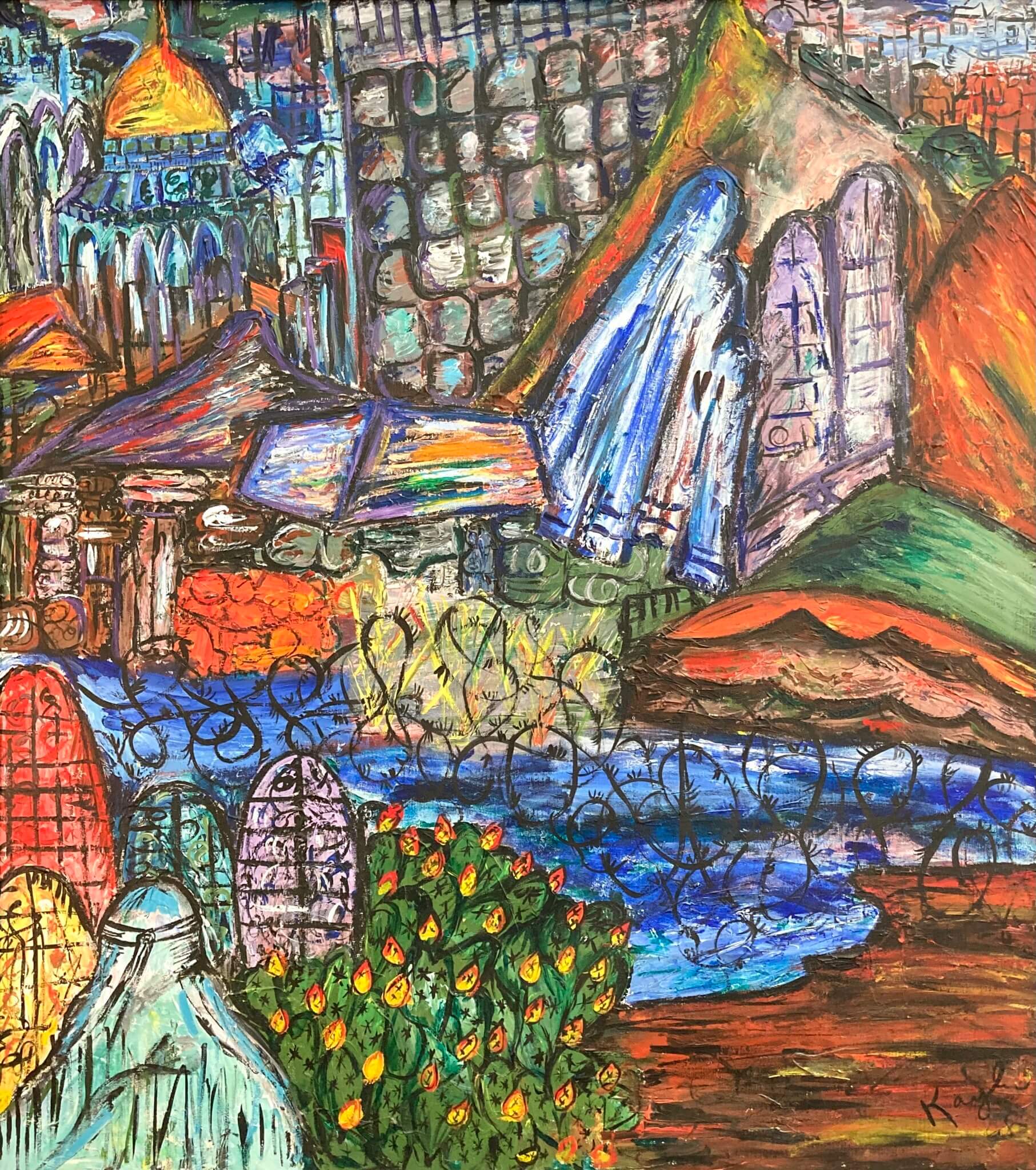
My grandmother, Kayla Silberberg, had a brief period where she showed her work in art shows in California, selling a few pieces, but most of her paintings from the ‘60s and ‘70s decorate my parents’ house. The majority of her art is multi-colored and not concerned with realism, the objects and figures often disproportionate, the people always bending in ways that implied a lack of a skeletal system. Only a few of her pieces are literal, and it was mostly early work. However, after she’d stopped painting in the ‘70s due to a career change and a reported lack of inspiration, she acquiesced to my mom’s request that she do a realistic sketch of me. (And she even did two!)
I’ve always been particularly fascinated with a painting she did of Israel in 1968. She compressed the country’s geography, the Western Wall practically attached to the Dome of the Rock, separated from a body of water by a handful of small buildings. The water is divided by barbed wire and on the other side, in the piece’s foreground, is a desert landscape, covered by bushes with orange-yellow flowers and multi-colored cacti. There also appears to be a person in the very front, their back turned to the viewer, wearing some type of full-body garment, the tie around their head waving in the back. A similarly shaped figure in what is more clearly a tallit floats near the Western Wall.
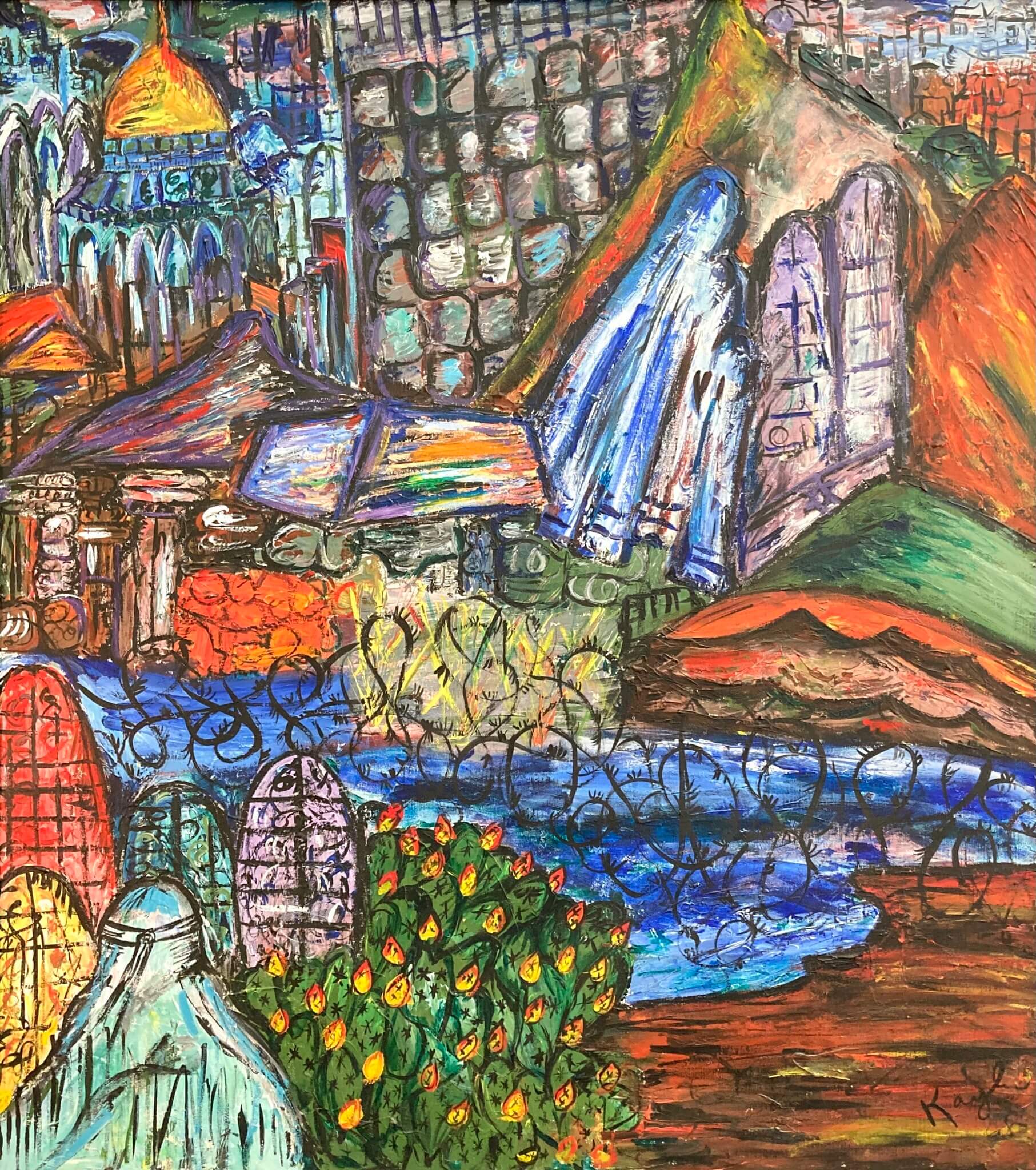
When I asked my mom about the barbed wire, she didn’t know what the impetus was for my grandmother to put it there. We’re not certain that our interpretation — that the foreground is Palestinian territory — is accurate. Is there anything to say about how she painted the figures on either side of the barbed wire in very similar shapes? Is the fact that she painted it one year after the Six-Day War relevant to why she painted it?
These weren’t conversations we had with my grandmother when she was alive, and these could very well be modern projections. My fascination with interpreting the work is more a reflection of the historical moment I’m living in than trying to guess what my grandmother would say about Israel today.
I actually have almost no memories of talking to my grandmother about Israel, with the exception of the story of her and my grandfather’s near attempt to immigrate there sometime in the 1960s. (The story goes that when the immigration office told my grandfather, who held a computer-engineering degree, that Israel already had too many engineers, my grandfather was so insulted that he abandoned the plan.)
It wasn’t that my grandmother was apolitical — one of her paintings is titled “Feminism,” a cryptic collage of male and female faces emerging from a colorful cloud. And no one could ever say she lacked strong opinions. It was just one of those conversations we never got around to.
I was 17 when my grandmother died, just on the cusp of being interested in talking about world events with the adults in my life. I imagine that just a couple years later, I would’ve developed more of a consciousness for talking about heavier topics.
That feeling has grown stronger since I moved to New York almost two years ago. My grandmother grew up in Sheepshead Bay, Brooklyn, in a duplex that had her immediate family on top and her grandparents on bottom. The only real story I have of this time in her life is that she used to tell her Orthodox parents she was going to be with her aunt on Shabbat nights, when actually she was sneaking out to go on dates with boys. When I visited Coney Island for the first time last summer, I wondered if she’d often come there herself, and tried to imagine what it would have been like in the ‘40s and ‘50s.
While talking about this story with my mom, she assured me that I was not alone in this. Her grandmother Chaia was 14-years-old when she immigrated to New York from the Pale of Settlement — the area that the Russian government restricted Jews to — in the early 1900s. My mom told me she never asked Chaia about her experiences before and during her immigration.
It’s not just my grandmother I wish I’d been able to have a relationship with as an adult. There’s also my paternal grandfather, who died when I was 14. I think about the conversations I could’ve had with my cousin Reverend Dr. Katie G. Cannon, the first Black woman ordained in the Presbyterian Church of the United States, if she’d lived just two more years, after I took my first sociology and religious studies classes. What would I have spoken about with my grandmother, who had a later career as a college guidance counselor, if she had lived to see me go to Penn? Or if she had been around for my start at the Forward, which she read every week while it was in print?
I’ve previously written about the project I worked on with my parents, where I recorded conversations with them about all the objects in our home (minus the modern appliances). Through that, I got answers to questions I would’ve never thought to ask about my parents’ lives and had many conversations about my grandmother’s art. But these were mostly surface level observations. And none were about the Israel painting, which ironically had to be moved to storage to make room for my grandmother’s other belongings after she died.
Although I wish I’d had the idea for the project while all four of my grandparents were still alive, I still have the chance to ask my paternal grandmother questions about her life — and his own — that I haven’t thought to ask before. Ultimately, it doesn’t really matter what made Kayla paint Israel the way she did. The fact that her paintings bring up so many emotions and questions for me tells me that she still lives on within my heart.
The post My artist grandmother nearly made aliyah. I don’t know what she’d think of Israel today appeared first on The Forward.
Uncategorized
Portuguese artists pull out of Jerry Seinfeld-headlined festival
(JTA) — Several Portuguese artists have dropped out of a comedy festival in Lisbon headlined by Jerry Seinfeld, citing their support for Palestinians and implying opposition to Seinfeld’s support for Israel.
At least six acts over recent days have canceled their appearances at the MEO Commedia a La Carte Fest, a new international comedy festival in the Portuguese capital. The event from Oct. 29 to Nov. 1 has advertised that it will host Seinfeld’s first live appearance in Portugal.
Though none of the artists who withdrew mentioned Seinfeld by name, some hinted at a boycott against his pro-Israel views. The Jewish comedian has become one of Hollywood’s most prominent advocates for Israel since October 2023.
Actress and comedian Inês Aires Pereira announced on Instagram on Saturday that “one of the names” featured at the festival “persistently defends ideas and acts that I consider indefensible,” adding, “We cannot relativize or normalize a genocide.”
The comedy duo Cebola Mol posted a graphic of themselves with a watermelon, widely recognized as a symbol of solidarity with Palestinians. “We will celebrate justice, freedom and joy with you on another occasion,” they said on Instagram.
The festival announced on Friday that performances by the groups Tributo Pop and Conjunto Cuca Monga were also canceled, but did not provide reasons. Two other acts, comedian Pedro Tochas and visual artist Vhils, shared their cancellations on Instagram without further details.
Seinfeld has aligned himself with Israel during its current conflict in Gaza, following decades of largely avoiding commenting on political issues. He visited Israel in December 2023 to meet with the families of hostages seized by Hamas on Oct. 7 of that year. Since then, he has attracted attention for a series of dismissive remarks toward pro-Palestinian advocates.
During an appearance last year at Duke University, Seinfeld compared pro-Palestinian activists with the Ku Klux Klan, saying, “The Klan is actually a little better here because they can come right out and say, ‘We don’t like Blacks, we don’t like Jews.’ OK, that’s honest.”
Representatives of Seinfeld and producers of the MEO Commedia a La Carte Fest did not immediately respond to requests for comment.
The post Portuguese artists pull out of Jerry Seinfeld-headlined festival appeared first on The Forward.
Uncategorized
UK, France, Canada to ban goods from Israeli settlements
(JTA) —
The United Kingdom, France and Canada will ban goods produced in the West Bank settlements and Jewish neighborhoods of East Jerusalem, British Foreign Secretary Ed Miliband told Parliament on Tuesday, explaining that all such communities were deemed by his country to be illegal.
The declaration exacerbated the rising tensions riling the traditionally strong Israel-U.K. alliance. Israeli Foreign Minister Gideon Sa’ar warned that these steps stoked antisemitism against British Jews in an on-camera statement to reporters in Jerusalem.
Sa’ar charged that the measures were a politicized hostile action deliberately taken ahead of Friday’s Jewish New Year holiday, with an eye toward influencing the country’s Oct. 27 elections.
Israel, he said, is responding by closing the British Consulate in Jerusalem that services Palestinians. It will also remove British representatives from the International Gaza Support Center in Kiryat Gat and halt the British training of Palestinian Authority security forces. He added that Israel would bar the entry of 12 British politicians and other nationals involved in anti-Israel activity.
France and Canada have also announced a ban on the import of settlement goods, Miliband told parliament. He noted that the Netherlands, Ireland, Belgium, Spain and Norway have either banned goods or in the process of doing so.
In the same address, Miliband affirmed Israel’s right to exist, reflected on his own Jewish roots and rejected the notion that there was a connection between the policy steps against West Bank settlement activity and the safety of British Jews.
What is motivating the U.K., Miliband said, is “a deep sense of shame about what has unfolded in Palestine under the eyes of the international community” as well as Israel’s “clear intent to bury the Palestinian state.”
In response, he said, the U.K. “will introduce an import ban on goods from illegal settlements in the occupied [Palestinian] territory” as part of a “new comprehensive sanctions regime” that will be put in place within nine months.
This will include, he said, “action against specific companies and individuals who provide services, such as construction, infrastructure, financing or real estate for settlement expansion.”
To those who “finance or facilitate illegal settlements, let me say this, you will face the full force of U.K. sanctions,” Miliband warned.
Miliband clarified that the ban would not affect the export of religious items or life-saving Israeli medications. He explained that trade with the settlements was minimal and that the greater impact would be the sanctions on services.
As part of declaring the ban, Miliband said that the British government is also adopting the International Court of Justice’s 2024 advisory opinion that all Israeli settlement activity over the pre-1967 border was illegal.
But others in Parliament pushed back against Miliband’s declaration. MP Richard Tice of Britain’s right-wing Reform party said that the sanctions were a grave mistake that would “embolden the scourge of antisemitism against British Jews on British streets,” endanger ties with the United States and lead to “tit for tat” sanctions from Israel.
Miliband shot back that “no British Jew is responsible for the policies of the Israeli government and it behooves all of us to make sure that there can be no confusion about that,” saying that Tice’s statement “fell foul” of that goal.
The U.K. action is the latest escalation in tensions between Israel and the Labour-led British government headed by Prime Minister Andy Burnham, who took power in July.
The prior government, led by former Labour Premier Keir Starmer, had already angered Israel by recognizing Palestinian statehood in 2025, suspending licenses for the export of arms to Israel and freezing talks toward a free-trade agreement.
France and Canada are also announcing a ban on the import of settlement goods, Miliband told parliament. He explained that the Netherlands, Ireland, Belgium, Spain, and Norway have either banned goods or in the process of doing so.
In concert with Miliband’s appearance at Parliament, Britain and 11 other countries issued a joint statement pledging “their intention to introduce national and/or support European restrictions on trade in goods with settlements which are illegal under international law.”
Those other countries were Canada, Denmark, Finland, France, Iceland, Ireland, Norway, Poland, Portugal, Spain and Sweden.
The 12-country bloc said it was taking this step to maintain the viability of the two-state resolution to the Israeli-Palestinian conflict, describing the situation in the West Bank as “rapidly deteriorating.”
In its statement, the bloc stressed that it was taking this step amid an “unprecedented level of settler violence and settlement expansion, including the unacceptable decision to publish tenders for the E1 settlement project.” That project is seen as cutting through land that would render a Palestinian state unviable.
The post UK, France, Canada to ban goods from Israeli settlements appeared first on The Forward.
Uncategorized
California Gov. Newsom, a presidential hopeful, slams Netanyahu and AIPAC in PBS interview
(JTA) — California Gov. Gavin Newsom, a 2028 presidential hopeful, ventured farther than ever in his criticisms of Prime Minister Benjamin Netanyahu, in a weekend interview that delved into the Democratic Party’s relationship with Israel.
“I think it’s overwhelmingly opposed to the current regime in Israel,” Newsom said of the party, in a PBS News Hour interview with Amna Nawaz.
Pressed by Nawaz on divisions among his colleagues on Israel, Newsom denied that the subject is “even controversial anymore,” stressing that “the condemnation of what Bibi Netnayahu’s doing is almost universal.” The governor slammed the Israeli military’s conduct in Gaza and condemned the settler violence that has expanded in the West Bank.
“We want a democratic and secure Israel, and we want a secure and democratic Palestinian state as well right next door,” Newsom said, adding that Netanyahu has proved counterproductive to achieving a two-state solution.
Though he repeatedly maintained that Democrats are not divided on Israel, the governor acknowledged that “some of the language” by fellow Democrats “has been weaponized.” Certain “aspects of rhetoric” from individual candidates, he added, are on “the spectrum of concern,” Newsom said.
A number of candidates from the party’s far left place most if not all of the blame on Israel for a war in Gaza that has resulted in tens of thousands of Palestinian deaths. and downplay the role of Hamas in launching the war with the Oct. 7, 2023 raid inside Israel in which 1,200 people were killed and more than 250 were abducted. Newsom’s rhetoric is of a piece with party moderates who are critical of the Israeli government but who call for a secure Israel, reject Hamas and who resist pressure from the left to call Israel’s actions “genocide.”
Newsom nonetheless insisted that the party is unified on the issue. “But I think universally, everyone agrees, even if you don’t think it’s genocide, that it’s been a moral catastrophe,” he said of the war in Gaza. “The vast majority of us also agree about the atrocities on Oct. 7th and how horrific and unacceptable it was, and the terrorism that was perpetrated by Hamas.”
Newsom was among the many U.S. politicians to visit Israel in October 2023, meeting with survivors and families impacted by the attacks.
During a March book tour, Newsom sparked a backlash when he said that some people were referring to Israel “appropriately as sort of an apartheid state.” He quickly walked back these remarks, telling Politico that he had used the term “in the context of the direction that Bibi is going.”
“I revere the state of Israel,” he declared at the time.
The governor warned, however, that if Netanyahu proceeds in the direction of West Bank annexation, apartheid could become “a word you may hear others use.”
In addition to amplifying his condemnation of Netanyahu this weekend, Newsom also addressed the fact that fewer Democrats are accepting funds from political action committees affiliated with the American Israel Public Affairs Committee, the pro-Israel lobbying group.
As for Newsom himself, Track AIPAC, an organization that compiles Federal Election Commission data to flag pro-Israel campaign contributions, did not log any such donations to the likely presidential candidate. But the group did flag him as “pro-Israel.”
“It’s a minority of Democrats that are accepting AIPAC,” the governor said, noting a “dramatic change” over the last couple years.
“The vast majority of Democrats I talk to, even Democrats in the past that have in the past have taken AIPAC money, are pledging not to now,” Newsom added. “That’s more of a mainstream position, interestingly, within the Democratic Party.”
The post California Gov. Newsom, a presidential hopeful, slams Netanyahu and AIPAC in PBS interview appeared first on The Forward.
