



Uncategorized
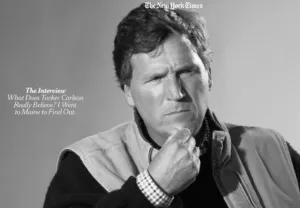
Exposing The New York Times’ Tucker Carlson Interview

Tucker Carlson speaks on first day of AmericaFest 2025 at the Phoenix Convention Center in Phoenix, Arizona, Dec. 18, 2025. Photo: Charles-McClintock Wilson/ZUMA Press Wire via Reuters Connect
Like everyone who has sat down in recent months to interview Tucker Carlson, The New York Times’ Lulu Garcia‑Navarro too often allowed him to do what he does best: answer anything and everything with a mixture of sophistry, dishonesty, and vagueness.
Overall, she did a better job than most. Economist editor‑in‑chief Zanny Minton Beddoes, for example, all but avoided Carlson’s most insidious claims about Israel and Jews in her own interview, preferring to spar with him on safer, domestic territory.
Garcia‑Navarro, by contrast, doesn’t duck the subject at all.
Naming the Trope Without Truly Challenging It
She pointedly asked him about “rhetoric where everything is blamed on Israel, where Israel is seen as the core of all of these problems,” and notes how his rhetoric “has echoes of the Protocols of the Elders of Zion,” rhetoric that “opens the door to this idea that there is a very powerful sect of Jewish people who want global war and global conflict.”
She challenged his platforming of Nick Fuentes and tied it to Holocaust denial and to the way dehumanizing language paves the way for mass violence.
“The Holocaust didn’t start with the gassing of Jews. It started with the dehumanization of Jews, with the way that they were spoken about, with the language that was used,” she told him. It is a powerful line.
But she followed it with a curiously soft question: “Why do you think you get tagged so often with antisemitism?”
“Tagged” as antisemitic? Why ask Carlson how he feels about the label rather than confront him with his own words?
Why press him him on his claim that Dick Cheney’s office was “completely controlled … by people who were putting Israel’s interests above America’s interests,” or his description of Donald Trump as a “slave” to Benjamin Netanyahu and his “advocates in the United States,” and ask him directly how that is not trafficking in classic antisemitic narratives about Jews driving wars?
Why not force him to account for his line that “Israel pushed the United States president” into war with Iran and sought to keep the conflict going until Iran was “destroyed and chaotic, which is the Israeli goal”?
The Question Garcia-Navarro Never Really Asked
What Garcia‑Navarro too often failed to do is what so many interviewers before her have also failed to do: ask Carlson for evidence and stay on the claim until he either substantiates it or admits he cannot. When he portrayed Trump as a “hostage” and “slave” to Netanyahu and suggested Israeli leaders drove both the Iraq and Iran wars, she largely let those claims stand without demanding proof in the moment.
At his most evasive, Carlson falls back on one of his most familiar tactics: either feigning ignorance or retreating into an undefined “they.”
To her credit, Garcia‑Navarro did at one point press him on that famous “they” — asking him explicitly who “they” are when he talks about shadowy forces pushing Trump toward war. That, precisely, is what a good interviewer should do.
Carlson’s “They” and the Return of Old Conspiracies
But then, at other moments, she let him wriggle away. She raised the Protocols of the Elders of Zion herself, clearly aware of how central that forged text is to the idea of a Jewish cabal manipulating global events. Carlson responds by saying he has merely “heard references to it” and that it is “like a Tsarist forgery or something.”
This is one of the most prominent right‑wing media figures in America, a man who opines constantly about antisemitism, Jews, and Israel. How is it conceivable that he has not properly “heard of” one of the foundational antisemitic texts of the last century? Why not simply ask that? Why not point out that he is disavowing knowledge of the book while reproducing its very structure in his claims about shadowy pro‑Israel forces controlling presidents and forcing wars?
Letting Conspiracy Theories Stand Unchallenged
Carlson deserves to be challenged at the level of evidence, not just rhetoric.
On Iraq, he made the claim that former Vice President Cheney’s office was being controlled before concluding, “I would say the Iraq war was to a great extent a product of that.” On Iran, he similarly claimed that “Israel pushed the United States president” and that Israeli strikes on civilians in Lebanon were designed to sabotage diplomacy and “keep this going until Iran was destroyed and chaotic, which is the Israeli goal.”
On the latter point, Garcia‑Navarro mostly restated his claims and tacitly accepted the framing by asking why Trump has been uniquely susceptible compared with previous presidents. On both wars, she never put to Carlson the obvious counter‑facts: post‑9/11 doctrine, US intelligence assessments, the role of Gulf states, or Iran’s own conduct. She never tests whether “Israel did it” is anything more than a monocausal conspiracy theory.
Israel’s Legitimacy Treated as an Open Question
The same pattern holds for Israel’s basic legitimacy. Carlson was allowed, repeatedly, to pivot to his preferred talking points. He questioned whether Israel has any “unique right to exist” based on scripture and whether “people whose ancestors didn’t live here now occupy the land.”
Garcia‑Navarro did note that this rhetoric veers into delegitimizing Israel as the homeland of the Jewish people, but she did not test his reasoning. Israel is not a case of “Bible or bust.” There are non‑theological bases for its legitimacy — UN partition, international recognition, state practice — that never entered the conversation.
By keeping the debate locked inside Carlson’s chosen frame — is Israel’s biblical claim valid? — the interview ended up treating the very question of Israel’s right to exist as an open, almost abstract dilemma.
Would Garcia‑Navarro ever entertain, in the same way, the question of whether Algeria or Pakistan “really” have a right to exist, on the grounds that their borders are disputed and their populations include people “whose ancestors didn’t live there” a hundred years ago?
The New York Times Problem
In that sense, Garcia‑Navarro becomes a proxy for broader New York Times tendencies. She is very good at naming labels: antisemitism, “cabal” tropes, the Holocaust, genocide, “delegitimizing Israel.”
But when Carlson made concrete empirical claims — that Israel decides US wars, that it deliberately targets civilians in Lebanon to blow up peace talks, that “hundreds” of people in Britain have been arrested simply for “criticizing Israel,” that Israel practices “collective punishment” — she rarely forced him to supply proof or confront counter‑evidence.
The Times is comfortable talking about antisemitism as a feeling or fear. It is much less comfortable adjudicating factual narratives about Israel, even when those narratives echo some of the oldest antisemitic myths in circulation.
Antisemitism as Rhetoric, Not Fact-Checking
That asymmetry runs through the interview. Throughout, Garcia‑Navarro seems more at ease challenging Carlson on certain narratives than others. She pushed repeatedly on his theological musings about Trump as a possible “Antichrist” and on Christian morality in the age of Trump. Yet she took a comparatively light touch toward Carlson’s sweeping claims about Israel’s agency and Israel as the prime driver of Middle Eastern conflict.
That choice is particularly striking because Garcia‑Navarro is not a novice on these issues. She has previously hosted ADL chief executive Jonathan Greenblatt to discuss antisemitism, anti‑Zionism, and “double standards” toward Israel, and she has reported extensively on Israel and the Palestinians. She knows that “Israel controls US policy” narratives are a staple of modern antisemitism. Precisely because she knows this, the decision to let so many of those claims pass without forensic challenge is important.
When Caveats Replace Journalism
When a platform as powerful as The New York Times invites Tucker Carlson to explain why Israel supposedly drives American wars, the minimum journalistic standard cannot be to name the antisemitic tropes and then leave his assertions hanging in the air.
It has to be to interrogate them, to demand evidence, and to put his story about Israel alongside the facts about how US policy is actually made. Otherwise, even a well‑meaning interview risks laundering a familiar narrative — that a small, uniquely suspect Jewish state and “its advocates” pull the strings — into the mainstream with only the thinnest of caveats.
The author is a contributor to HonestReporting, a Jerusalem-based media watchdog with a focus on antisemitism and anti-Israel bias — where a version of this article first appeared.
Uncategorized
The New Normal for Jewish Students: Security Checks and Police Presence
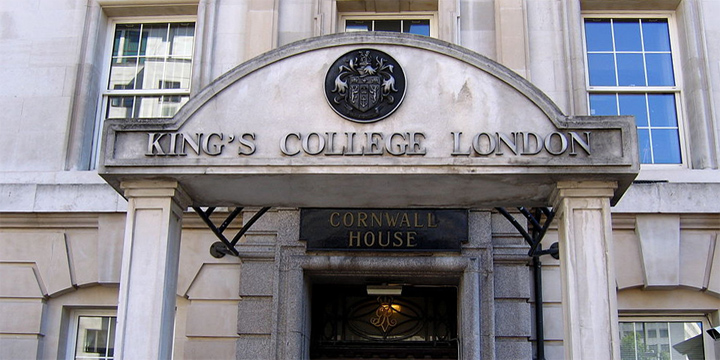
Cornwall House at King’s College London. Photo: C. G. P. Grey.
In February 2026, a university screening at King’s College London required an astonishing level of security: 30 police officers and 15 professional security personnel for 20 students and five members of the university’s staff.
The reason? A 47-minute film of raw footage from the October 7, 2023, Hamas attack was screened, showing what actually happened that day.
An earlier attempt by the local student Israel Society to hold the screening had been abandoned entirely because the university didn’t grant permission on security grounds.
Outside of the event, protesters from the university’s Students for Justice in Palestine chapter chanted “Get the Zios off campus.”
Jewish students must operate behind visible layers of protection simply to gather, pray, eat, or learn together. Activities that were once routine campus activities now demand the same level of protection more commonly associated with high-profile political events, raising serious questions about what the campus “normal” has become.
As someone who has experienced this situation firsthand, the heavy use of security is not symbolic. It reflects real, credible threats of disruption and intimidation that have already forced events to be cancelled.
Jewish students now require visible police protection for activities that every other group takes for granted — a film screening, a cultural night, a Shabbat dinner. This is not discomfort; it is unequal access to campus life. The activism that claims to defend the vulnerable has instead made Jewish students the ones who need defending.
The reason stories like these keep happening is clear and uncomfortable: Anti-Zionism has increasingly become the dominant expression of discrimination and bigotry against Jews on campus. What commonly presents itself as “political criticism of Israel” quickly turns into intimidation, harassment, and exclusion regardless of any individual Zionist-identified individual’s views.
Universities that continue to outsource safety to police cordons while wringing their hands about “tensions” are simply managing symptoms. They are not addressing the root cause.
Chants that single out “Zios,” accusations of collective guilt, and the assumption that any Jewish event is somehow provocative have turned Jewish identity into a liability. This is not abstract theory. Jewish students report being chased, threatened, verbally abused, and physically targeted simply for being visibly Jewish or Israeli. Many now hide Stars of David, stop speaking Hebrew in public, or avoid Jewish spaces altogether to stay safe.
And what happened at my school is happening to students all over the UK. The Union of Jewish Students’ March 2026 national polling of 1,000 students found that nearly a quarter had witnessed behavior specifically targeting Jewish students for their religion or ethnicity. The poll also found that 77% of those who see Israel-Palestine protests regularly witnessed slogans or chants directly justifying the October 7 attack.
The pattern is consistent: hostility that begins with Israel is commonly expressed through hostility toward the nearest Jews who don’t actively identify as anti-Zionist, and those who attempt to humanise the Jews of Israel. The political rhetoric saying “it’s only about Israel” is just a disguise.
This situation is bad for Jewish students, but it is also corrosive for universities themselves. When institutions must essentially militarize everyday student activity to keep one minority safe, they have already failed their basic duty to provide an equal learning environment.
Free speech is not the issue here. Protest and legitimate criticism of any government must be protected. However, what should not be protected is the right to harass, intimidate, or exclude Jewish students under the guise of activism. Distinguishing between the two is a key element of the widely accepted IHRA Working Definition of Antisemitism.
Universities know what needs to be done. Our leaders have been telling them for years. First, enforce existing codes of conduct without hesitation whenever harassment or intimidation occurs, without selective blindness or “context” excuses that only apply to Jews.
Second, apply free speech rules equally. Disruption that prevents Jewish students from accessing events or education is not protected speech; it is a violation of rights.
Third, publicly rebuke the notion that pro-Israel events are inherently provocative. A Shabbat dinner is not a political statement. A screening of actual footage is not a provocation.
These activists will wrongly argue that enforcing such policies amounts to censorship. But in Western civilization, nobody is free to do whatever they want, regardless of their effect on others. They are free to voice their opposition, but not to impose it on others.
Curtailing this behavior is the minimum requirement for any university campus and a healthy community.
A “fortified” campus is not a solution — it is an admission of failure. Until universities confront the reality that anti-Zionism produces the same result as antisemitism, Jewish students will continue to need physical protection to live normal student lives.
The question is no longer whether this climate exists; it’s whether university leadership — including at King’s College — has the courage to act on it.
Alena Rakitina is a student of the University of Exeter and a CAMERA on Campus 2025-2026 Fellow. Opinions expressed are those of the author and do not necessarily reflect those of CAMERA.
Uncategorized
Rahm Emanuel’s Call to Treat Israel ‘Like Every Other Ally’ Gets History Wrong

Rahm Emanuel speaks during a media interview with podcast host Megyn Kelly. Photo: Screenshot
Rahm Emanuel’s recent declaration that Israel should henceforth be treated “like every other ally” was not serious strategic analysis. It was the sound of a longtime Democratic operative adjusting himself to the increasingly radicalized gravitational pull of his party’s anti-Israel wing.
The same political ecosystem now mainstreaming figures like Hasan Piker — a man who declared that “America deserved 9/11” and routinely traffics in hateful anti-American and anti-Israel propaganda to millions — is steadily dragging Democratic rhetoric on Israel into territory that would have been politically radioactive even a decade ago.
Like others making similar arguments, Emanuel’s slogan collapses under even minimal historical scrutiny.
When looking at the evidence, it’s clear that Israel is already treated unlike many American allies.
First, some allies, like NATO members, are entitled to American military protection and defense if they are attacked. When Israel fights wars, Israelis fight them. That distinction matters enormously. Yet people like Rahm speak as though Israel is uniquely coddled rather than uniquely self-reliant.
Emanuel — who somehow served as ambassador to Japan while apparently learning little from the experience about how American alliances actually work — recently stated that the US should stop “subsidizing” Israel’s military and stop providing “financial aid” through the Memorandum of Understanding framework, and that Israel should instead simply “buy what they want” like every other ally.
The aid framework Rahm now caricatures as “subsidies” and “financial aid” was never an act of American charity. It emerged from strategic bargains and overlapping interests that benefited Washington enormously.
A major turning point in that strategic bargain came in the 1980s with Israel’s Lavi fighter project — an ambitious domestically developed fighter program that many in Washington feared could become a genuine export competitor to the F-16.
American pressure to terminate the program was immense because, contrary to today’s woke-right and far-left parody of the alliance, Washington was not interested in an Israeli aerospace rival competing with American defense giants globally.
Under that pressure, Israel closed the program.
The result was deeper Israeli integration into American military platforms and supply chains — strengthening American aerospace dominance while locking Israel more tightly into the American defense ecosystem.
In other words, the architecture Rahm now dismisses as though it were unilateral charity did not emerge because Washington was engaged in philanthropy for Jews. It emerged because American policymakers concluded that the arrangement benefited the United States strategically, militarily, technologically, and industrially.
Almost all US military assistance to Israel is effectively spent in America on American systems built by American workers in American factories. Meanwhile, Israel became one of the most battle-tested laboratories for American military doctrine and technology anywhere in the world — missile defense, cyber operations, tunnel warfare, counterterrorism, intelligence integration, and urban combat.
American defense officials do not maintain these relationships because they are sentimental Zionists at the Pentagon. They maintain them because Israel provides enormous strategic value to the United States.
But the most absurd part of Emanuel’s slogan remains the slogan itself.
Because when Rahm says Israel should be treated “like every other ally,” he ignores the fact that Israel receives less benefits than many “other allies.”
Japan gets treaty guarantees. South Korea gets treaty guarantees and American troops on its front line – the DMZ. NATO states get the full weight of American deterrence and outsized military spending – compared to all other NATO countries, as the US accounts for roughly 70% of all NATO defense expenditures.
The Gulf monarchies host sprawling American military infrastructure protecting regimes that likely would not survive long without it.
Israel often gets lectures about “restraint” while fighting enemies openly committed to its destruction.
Israel gets told that the world’s only Jewish state — smaller than New Jersey and surrounded for decades by forces openly calling for its annihilation — should somehow behave like Holland while confronting enemies that behave more like ISIS with better public relations.
And through all of this, Israelis themselves still do the fighting.
That is the part the “subsidy” rhetoric always conceals.
When Hezbollah launches rockets into northern Israel, American Marines do not fight in southern Lebanon. When Hamas massacres Israeli civilians, American reservists are not mobilized into Gaza. When Iran openly threatens both the United States and Israel, American parents are not preparing their children for compulsory military service. Israelis are. That is not “special treatment.”
That’s why Emanuel’s rhetoric sounds less like strategy and more like ideological adaptation – the repositioning of a Democratic politician trying to survive a party increasingly shaped by activists who understand the Middle East primarily through slogans, intersectional dogma, and social media propaganda rather than military history or strategic reality.
For decades, American policymakers understood that Israel represented something uniquely valuable to the United States — a stable, democratic, technologically advanced regional power willing to fight its own wars without demanding or requiring American soldiers to die for it. Now figures like Rahm Emanuel speak as though this arrangement was some kind of American charity or a bad deal.
But it’s not — it’s a strategic partnership, and one squarely in America’s interest.
That consensus, however, is increasingly being subordinated to internal party pressures. The Democratic establishment’s attempts to placate the anti-Israel activist left will likely work about as well as it worked for Biden and Harris in 2024 — never anti-Israel enough to satisfy the far-left and Islamist activist ecosystem, but anti-Israel enough to alienate moderates, independents, and pro-American voters.
The party will soon likely decide if it should become outright hostile to voters — but history rarely rewards political classes that mistake ideological fashion for strategic wisdom. Rahm Emanuel should know that by now.
Micha Danzig is an attorney, former IDF soldier, and former NYPD officer. He writes widely on Israel, Zionism, antisemitism, and Jewish history. He serves on the board of Herut North America.
Uncategorized
Sheila Reich, beloved LA Yiddish teacher, has died
שיינדל „שילאַ“ רײַך, אַ פּאָפּולערע לאַנגיאָריקע ייִדיש־לערערין אין לאָס־אַנדזשעלעס, איז לעצטנס אַוועק אין דער אייביקייט. זי איז געווען 80 יאָר אַלט.
איך האָב געקענט שילאַן במשך פֿון מער װי אַ פֿערטל יאָרהונדערט אָבער בײַ מיר האָט זי געהייסן בלויז שיינדל. ערשט הײַיאָר, אויף איר 80סטן געבורירן־טאָג האָב איך אױסגעפֿונען אַז בײַ אַלע אַנדערע האָט זי געהײסן „שילאַ“.
יאָרן לאַנג איז שײנדל געװען אַ ייִדיש־לערערין אין פֿאַרשידענע אינסטיטוציעס איבער לאָס־אַנדזשעלעס. איך אַלײַן בין קיין מאָל נישט געווען בײַ איר אין קלאַס אָבער מײַן װײַב טעמע האָט זיך יאָרן לאַנג געלערנט בײַ איר. אַלס לערערין איז שײנדל געװען אויסערגעוויינטלעך. אין אַ טיפּישן קלאַס זענען די סטודענטן געווען אױף פֿאַרשידענע ניװאָען, פֿון אַבסאָלוטע אָנהײבער ביז אַװאַנסירט. דאָך האָט זי זיך אָפּגעגעבן מיט יעדן אײנעם באַזונדער. ווי אַ רעזולטאַט האָט די ייִדיש־קענטעניש בײַ יעדן סטודענט זיך פֿאַרבעסערט.
װי איך אַלײן, און ווי אַ סך פֿון אירע סטודענטן, איז שיינדל געװען אַ קינד פֿון דער שארית־הפּליטה. זינט די קינדעריאָרן האָבן מיר בײדע גערעדט ייִדיש מיט אונדזערע טאַטע־מאַמע. (זי האָט אויך גערעדט ייִדיש מיט איר זון, אַבֿי.) פֿאַקטיש איז ייִדיש פֿאַר אונדז בײדן געװען די ערשטע שפּראַך. אַן אונטערשייד פֿון צען יאָר צווישן אונדז, איז שיינדל אין מײַנע אױגן געװען די עלטערע שװעסטער װאָס איך האָב נישט געהאַט. אין אונדזערע פֿיל שמועסן האָבן מיר גערעדט אױף מאַמע־לשון. חס־וחלילה מיר זאָלן רעדן אױף דער גױישער שפּראַך! אַזױ װי איך, האָט זי געקענט צענדליקער, אױב נישט הונדערטער יִידישע אױסדרוקן, שפּריכװערטער און חכמות. מיר האָבן אָפֿט זיך געטיילט מיט די אויסדרוקן און תּמיד הנאה געהאַט ווען מיר האָבן זיך דערוווּסט אַ נײַ ווערטל.
יאָרן לאַנג איז שײנדל אויך געװען אַ מיטגליד פֿון אונדזער לײענקרײַז אין לאָס־אַנדזשעלעס. טראָץ דעם װאָס זי איז געװען אַ ייִדיש־לערערין האָט זי זיך קיין מאָל נישט געהאַלטן העכער פֿון אונדז. . אָט זענען עטלעכע:
„זומער און װינטער ליגט אים אין מױל“ — אַ פּאַטאַלאָגישער ליגנער. דער ליגן בלײַבט אין זײַן מױל אַ גאַנץ יאָר.
„עס גײט מיר אן אַזױ ווי דער פֿאַריאָריקער שנײ.“
„איך האָב נישט אַפֿילו קײַן כּוח צו חלשן.“
„קושװאָך“ — „האָנימון“. איז דאָס נישט חנעװדיק?
שײנדל איז געװען אַן אשת־חיל, מיט אַ פֿינקל אין אױג. איך, צוזאַמען מיט די מיטגלידער פֿון אונדזער לײענקרײַז און די אָנצאָליקע סטודענטן במשך פֿון די יאָרן, װעלן שטאַרק בענקען נאָך איר. כּבֿוד איר אָנדענק!
The post Sheila Reich, beloved LA Yiddish teacher, has died appeared first on The Forward.