



Uncategorized
Rahm Emanuel’s Call to Treat Israel ‘Like Every Other Ally’ Gets History Wrong

Rahm Emanuel speaks during a media interview with podcast host Megyn Kelly. Photo: Screenshot
Rahm Emanuel’s recent declaration that Israel should henceforth be treated “like every other ally” was not serious strategic analysis. It was the sound of a longtime Democratic operative adjusting himself to the increasingly radicalized gravitational pull of his party’s anti-Israel wing.
The same political ecosystem now mainstreaming figures like Hasan Piker — a man who declared that “America deserved 9/11” and routinely traffics in hateful anti-American and anti-Israel propaganda to millions — is steadily dragging Democratic rhetoric on Israel into territory that would have been politically radioactive even a decade ago.
Like others making similar arguments, Emanuel’s slogan collapses under even minimal historical scrutiny.
When looking at the evidence, it’s clear that Israel is already treated unlike many American allies.
First, some allies, like NATO members, are entitled to American military protection and defense if they are attacked. When Israel fights wars, Israelis fight them. That distinction matters enormously. Yet people like Rahm speak as though Israel is uniquely coddled rather than uniquely self-reliant.
Emanuel — who somehow served as ambassador to Japan while apparently learning little from the experience about how American alliances actually work — recently stated that the US should stop “subsidizing” Israel’s military and stop providing “financial aid” through the Memorandum of Understanding framework, and that Israel should instead simply “buy what they want” like every other ally.
The aid framework Rahm now caricatures as “subsidies” and “financial aid” was never an act of American charity. It emerged from strategic bargains and overlapping interests that benefited Washington enormously.
A major turning point in that strategic bargain came in the 1980s with Israel’s Lavi fighter project — an ambitious domestically developed fighter program that many in Washington feared could become a genuine export competitor to the F-16.
American pressure to terminate the program was immense because, contrary to today’s woke-right and far-left parody of the alliance, Washington was not interested in an Israeli aerospace rival competing with American defense giants globally.
Under that pressure, Israel closed the program.
The result was deeper Israeli integration into American military platforms and supply chains — strengthening American aerospace dominance while locking Israel more tightly into the American defense ecosystem.
In other words, the architecture Rahm now dismisses as though it were unilateral charity did not emerge because Washington was engaged in philanthropy for Jews. It emerged because American policymakers concluded that the arrangement benefited the United States strategically, militarily, technologically, and industrially.
Almost all US military assistance to Israel is effectively spent in America on American systems built by American workers in American factories. Meanwhile, Israel became one of the most battle-tested laboratories for American military doctrine and technology anywhere in the world — missile defense, cyber operations, tunnel warfare, counterterrorism, intelligence integration, and urban combat.
American defense officials do not maintain these relationships because they are sentimental Zionists at the Pentagon. They maintain them because Israel provides enormous strategic value to the United States.
But the most absurd part of Emanuel’s slogan remains the slogan itself.
Because when Rahm says Israel should be treated “like every other ally,” he ignores the fact that Israel receives less benefits than many “other allies.”
Japan gets treaty guarantees. South Korea gets treaty guarantees and American troops on its front line – the DMZ. NATO states get the full weight of American deterrence and outsized military spending – compared to all other NATO countries, as the US accounts for roughly 70% of all NATO defense expenditures.
The Gulf monarchies host sprawling American military infrastructure protecting regimes that likely would not survive long without it.
Israel often gets lectures about “restraint” while fighting enemies openly committed to its destruction.
Israel gets told that the world’s only Jewish state — smaller than New Jersey and surrounded for decades by forces openly calling for its annihilation — should somehow behave like Holland while confronting enemies that behave more like ISIS with better public relations.
And through all of this, Israelis themselves still do the fighting.
That is the part the “subsidy” rhetoric always conceals.
When Hezbollah launches rockets into northern Israel, American Marines do not fight in southern Lebanon. When Hamas massacres Israeli civilians, American reservists are not mobilized into Gaza. When Iran openly threatens both the United States and Israel, American parents are not preparing their children for compulsory military service. Israelis are. That is not “special treatment.”
That’s why Emanuel’s rhetoric sounds less like strategy and more like ideological adaptation – the repositioning of a Democratic politician trying to survive a party increasingly shaped by activists who understand the Middle East primarily through slogans, intersectional dogma, and social media propaganda rather than military history or strategic reality.
For decades, American policymakers understood that Israel represented something uniquely valuable to the United States — a stable, democratic, technologically advanced regional power willing to fight its own wars without demanding or requiring American soldiers to die for it. Now figures like Rahm Emanuel speak as though this arrangement was some kind of American charity or a bad deal.
But it’s not — it’s a strategic partnership, and one squarely in America’s interest.
That consensus, however, is increasingly being subordinated to internal party pressures. The Democratic establishment’s attempts to placate the anti-Israel activist left will likely work about as well as it worked for Biden and Harris in 2024 — never anti-Israel enough to satisfy the far-left and Islamist activist ecosystem, but anti-Israel enough to alienate moderates, independents, and pro-American voters.
The party will soon likely decide if it should become outright hostile to voters — but history rarely rewards political classes that mistake ideological fashion for strategic wisdom. Rahm Emanuel should know that by now.
Micha Danzig is an attorney, former IDF soldier, and former NYPD officer. He writes widely on Israel, Zionism, antisemitism, and Jewish history. He serves on the board of Herut North America.
Uncategorized
Hormuz Standoff Continues as US-Iran Ceasefire Teeters
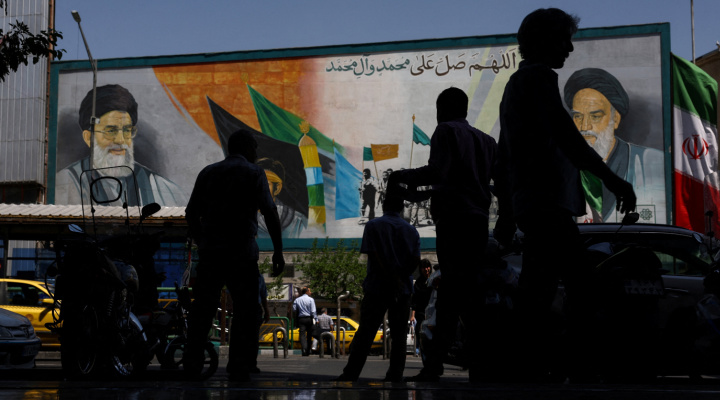
People walk past a mural depicting the late leader of the Islamic Revolution, Ayatollah Ruhollah Khomeini, and the late Iran’s Supreme Leader Ayatollah Ali Khamenei, in Tehran, Iran. Photo: Majid Asgaripour/WANA (West Asia News Agency) via REUTERS
Prospects of a peace deal with Iran dwindled on Tuesday after Donald Trump said a ceasefire was “on life support” as Tehran rejected a US proposal to end the conflict and stuck to a list of demands the US president described as “garbage.”
Iran has called for an end to the war on all fronts, including Lebanon, where US ally Israel is fighting Iran-backed Hezbollah terrorists. Tehran also emphasized its sovereignty over the Strait of Hormuz, demanded compensation for war damage, and an end to the US naval blockade, among other conditions.
Trump, who will discuss the war with Chinese President Xi Jinping during his trip to Beijing this week, said Iran‘s response threatened the status of a ceasefire announced on April 7.
“I would call it the weakest right now, after reading that piece of garbage they sent us. I didn’t even finish reading it,” Trump, who has repeatedly threatened to end the ceasefire, told reporters on Monday. “It’s on life support.”
OIL EXTENDS GAINS
The US had proposed an end to fighting before starting talks on more contentious issues, including Iran‘s nuclear program.
Brent crude oil futures extended gains, climbing to around $108 a barrel, as the deadlock left the Strait of Hormuz largely closed. Before the war began on Feb. 28, the narrow waterway carried a fifth of the world’s oil and liquefied natural gas shipments, and has since become a central pressure point in the conflict.
US Central Command said the aircraft carrier Abraham Lincoln was in the Arabian Sea continuing to enforce the US blockade against Iran, having redirected 65 commercial vessels and disabled four.
The Pentagon put the cost of the war at $29 billion so far, an increase of $4 billion from an estimate provided late last month. An official told lawmakers the new cost included updated repair and replacement of equipment and operational costs.
The war also has driven a roughly 50% increase in gasoline prices across the US, where consumer prices rose at a brisk clip for a second straight month in April, resulting in the largest annual increase in inflation in nearly three years.
TRUMP’S TRIP TO CHINA
Surveys show the war is unpopular with US voters less than six months before nationwide elections that will determine whether Trump’s Republican Party retains control of Congress.
Two out of three Americans, including one in three Republicans and almost all Democrats, think Trump has not clearly explained why the country has gone to war, according to a Reuters/Ipsos poll completed on Monday.
Trump is expected to arrive in Beijing on Wednesday.
Trump wants China to convince Tehran to make a deal with Washington to end the conflict. China maintains ties with Iran and remains a major consumer of its oil exports. China’s foreign ministry has said the US blockade of the strait does not serve the common interest of the international community.
The US on Monday imposed new sanctions on individuals and companies it said were helping Iran ship oil to China, part of efforts to cut off funding for Tehran’s military and nuclear programs, while also warning banks about attempts to evade existing curbs.
IRANIAN OFFICIALS USE TOUGH RHETORIC
Iranian officials, meanwhile, issued statements attempting to show continued resolve in the face of US pressure.
A Fars news agency report cited Mohammad Akbarzadeh, deputy political director of the Islamic Revolutionary Guard Corps Navy, as saying Iran had expanded its definition of the Strait of Hormuz into a “vast operational area” under a new plan.
There was no immediate reply from Iranian authorities to a request for comment on Akbarzadeh’s remarks, which defined the waterway as a zone stretching from the coast of the city of Jask in the east to Siri Island in the west.
In a post on X, parliamentary national security and foreign policy commission spokesperson Ebrahim Rezaei said Iran could enrich uranium up to 90% purity, a level considered weapons-grade, if the country is attacked once more.
Iran’s defense ministry spokesperson said any new attack by an enemy would be met with an immediate response, according to state media. In Tehran, the Guards held drills “centered on preparation to confront the enemy,” state TV reported.
TRICKLE OF SHIPPING THROUGH HORMUZ
Traffic through the Strait of Hormuz remains at a trickle. Shipping data on Kpler and LSEG showed that three tankers laden with crude exited the waterway last week, with trackers switched off to avoid any Iranian attack.
In the Qatari capital Doha, Turkish Foreign Minister Hakan Fidan said the strait should not be used as a “weapon.”
Lithuania said it could contribute minesweeping capabilities and resources for a potential mission to protect shipping in the strait. Britain said on Saturday it was deploying a warship to the Middle East in preparation for a potential multinational effort in the strait once conditions allow.
Kuwait summoned Iran’s ambassador and handed him a protest note over what it said was the infiltration of Bubiyan Island by armed members of Iran’s Revolutionary Guards and clashes with Kuwaiti armed forces, the foreign ministry said. There was no immediate reaction from Iran.
Uncategorized
New Israeli Law Sets Military Tribunal for Hamas Oct. 7 Terrorists

Hand prints and other markings made in the soot on a wall are seen, nearly a year since the deadly Oct. 7 attack by Hamas, in Kibbutz Beeri, southern Israel, Sept. 15, 2024. Photo: REUTERS/Amir Cohen
Israel’s parliament passed a law late on Monday establishing a military tribunal to try hundreds of Palestinian terrorists who took part in the Oct. 7, 2023, attack on Israel, a step lawmakers said would help heal national trauma.
The surprise attack, led by elite “Nukhba” force fighters from the Palestinian terrorist group Hamas, was Israel’s deadliest single day and the worst attack on Jews since the Holocaust. At least 1,200 people were killed, most of them civilians.
Israel responded with a military campaign aimed at dismantling Hamas’s military capabilities and political rule in neighboring Gaza.
Israel has been holding an estimated 200-300 fighters – the precise number is classified – captured in Israel during the attack, who have not yet been charged.
The special military court established by the law, to be presided over by a three-judge panel in Jerusalem, could also try others captured later in Gaza and suspected of participating in the attack, or of having held or abused Israeli hostages.
The new law was backed by a wide majority 93 of the Knesset’s 120 lawmakers, in a rare show of Israeli political unity.
The terrorists burst through the Gaza border and rampaged through southern Israeli villages, army bases, roads, and a music festival. Besides the killings, the fighters also took 251 hostages back to Gaza.
NO TRIAL DATE
Lawmakers from both the governing coalition and the opposition authored the bill, meant to ensure all assailants are brought to justice under existing Israeli criminal statutes for what it describes as crimes against the Jewish people, crimes against humanity, and war crimes.
Proceedings will be public, with major hearings broadcast live. While defendants will attend only key hearings in person and all others by video, surviving victims will be allowed in-person access, according to the new law.
Ya’ara Mordecai, an international law expert at Yale Law School, said the new law raised some concerns about due process, given the military court setting, as well as a risk of atrocity proceedings turning into politicized or symbolic “show trials.”
Knesset member Yulia Malinovsky, one of the bill’s authors, said that the legislation ensures a fair and lawful trial.
“They will be sentenced by Israel’s judges, not by the street or by what we all feel,” Malinovsky said before the vote. “At the end of the day, what makes us great is our spirit, our resilience, ability to cope and withstand this immense pain.”
OPTION OF CAPITAL PUNISHMENT
Israel’s penal code includes capital punishment for some of the charges which the terrorists are likely to face. If handed down, a death sentence would trigger an automatic appeal on behalf of the defendant, according to the new law.
The last person executed in Israel was Adolf Eichmann, an architect of the Nazi Holocaust, hanged in 1962 after being captured in Argentina by Israeli agents. Military courts in the West Bank can sentence Palestinian convicts to death but have never done so.
A separate law passed by Israel in March making death by hanging a default sentence for Palestinians convicted in military courts of deadly attacks drew criticism at home and abroad and is expected to be struck down by the Supreme Court.
HAMAS CONDEMNS NEW LAW
Hamas Gaza spokesperson Hazem Qassem said the new law “serves as a cover for the war crimes committed by Israel in Gaza.”
The International Criminal Court is probing Israel’s conduct of the Gaza war and has issued arrest warrants for Prime Minister Benjamin Netanyahu and former Defense Minister Yoav Gallant, as well as three Hamas leaders who have all since been killed by Israel.
Israel is also fighting a genocide case at the International Court of Justice. It rejects the allegations as politically motivated and has argued that its war is against Hamas, not the Palestinian people.
Israeli officials say the military has gone to unprecedented lengths to try and avoid civilian casualties, noting its efforts to evacuate areas before it targets them and to warn residents of impending military operations with leaflets, text messages, and other forms of communication.
Another challenge for Israel has been Hamas’s widely recognized military strategy of embedding its terrorists within Gaza’s civilian population and commandeering civilian facilities like hospitals, schools, and mosques to run operations and direct attacks.
Uncategorized
Man Suspected of Plotting Violent Attack Had Sought to Target Louvre, Jewish Community, Officials Say

A man talks on the phone at the renovated Gallery of Five Continents (Galerie des Cinq Continents) in the Denon wing (Aile Denon) during a press preview at the Louvre Museum in Paris, France, Dec. 2, 2025. Photo: REUTERS/Gonzalo Fuentes
A 27-year-old man suspected of plotting a violent attack and of planning to join Islamic State in Syria or Mozambique had sought to target a Parisian museum and the Jewish community, though no specific target was identified, a source close to the investigation said on Monday.
French newspaper Le Monde reported that the man, who was arrested on Thursday, had attempted to target the Louvre and the Jewish community in Paris’ 16th arrondissement.
Security gaps at the Louvre, the world’s most-visited museum, were spotlighted last October, when burglars made off with $102 million worth of jewels.
In France, as throughout Europe, antisemitic acts surged to record highs after the Palestinian terrorist group Hamas’s Oct. 7, 2023, massacre across southern Israel, amid the ensuing war in Gaza.