



Uncategorized
Trump Says No Need for China’s Help on Iran as Shippers Seek Way Through Hormuz
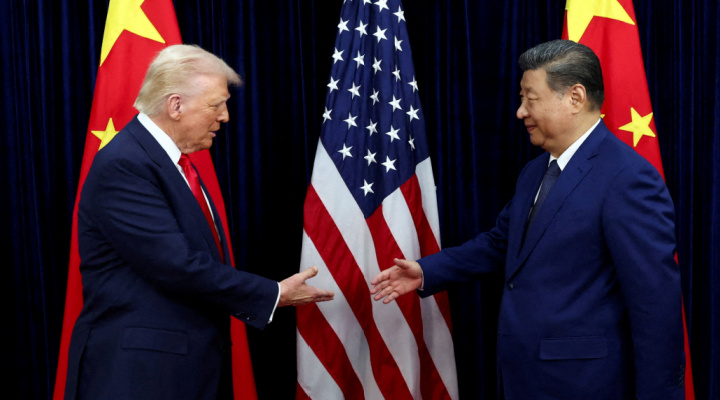
US President Donald Trump shakes hands with Chinese President Xi Jinping as they hold a bilateral meeting at Gimhae International Airport, on the sidelines of the Asia-Pacific Economic Cooperation (APEC) summit, in Busan, South Korea, Oct. 30, 2025. Photo: REUTERS/Evelyn Hockstein
US President Donald Trump has said he does not expect to need China’s help to end the war in Iran and ease Tehran’s grip on the Strait of Hormuz, in remarks made before he arrived in Beijing on Wednesday for a summit with President Xi Jinping.
The war is expected to feature in talks between Trump and Xi over the next two days, but Trump downplayed Beijing’s potential role in ending the conflict, which has choked off traffic through a key waterway that typically carries about one-fifth of the world’s oil supply.
“I don’t think we need any help with Iran. We’ll win it one way or the other, peacefully or otherwise,” he told reporters in Washington before departing for China.
Iran has appeared to firm up its control over the Strait of Hormuz in recent days, cutting deals with Iraq and Pakistan to ship oil and liquefied natural gas from the region, according to sources with knowledge of the matter.
Iranian officials have signaled they see that control as a long-term strategic goal. An army spokesperson said supervision of the waterway could generate revenue amounting to twice Iran‘s oil income, while strengthening its foreign policy leverage.
“After this war ends, there will be no place for retreat,” the spokesperson said, according to comments carried by ISNA news agency.
More than one month after a tenuous ceasefire took effect, US and Iranian demands to end the war remain far apart.
Washington has called for Tehran to scrap its nuclear program and lift its hold on the strait, while Iran has demanded compensation for war damage, an end to the US blockade, and a halt to fighting on all fronts, including in Lebanon, where Israel is battling Iran-backed Hezbollah. Trump has dismissed those positions as “garbage.”
CHINESE SUPERTANKER CROSSES STRAIT
The Trump administration said on Tuesday that senior US and Chinese officials had agreed last month that no country should be able to charge tolls on traffic through the region, in an effort to project consensus on the issue ahead of the summit.
China, a major buyer of Iranian oil that maintains close ties with Tehran, did not dispute that account.
On Wednesday, a Chinese supertanker carrying 2 million barrels of Iraqi crude sailed through the Strait of Hormuz, ship-tracking data showed, marking the third known passage by a Chinese oil tanker through the channel since the US and Israel launched strikes on Iran on Feb. 28.
Other countries are exploring shipping arrangements similar to Tehran’s deals with Iraq and Pakistan, sources said, potentially entrenching Tehran’s control of the waterway through which fertilizers, petrochemicals, and other bulk commodities vital to global supply chains normally flow.
PRICE OF WAR
As the costs of the conflict mount, Trump said Americans’ financial struggles were not a factor in his decision-making on the war.
Data released on Tuesday showed that US consumer inflation accelerated in April, with the annual rate posting its largest gain in three years as food, rent and airfares rose.
Asked to what extent the economic strain on Americans was motivating him to strike a deal, Trump replied: “Not even a little bit.”
“I don’t think about Americans’ financial situation,” Trump said before leaving for China. “I think about one thing: We cannot let Iran have a nuclear weapon.”
The remarks are likely to draw scrutiny as cost-of-living concerns remain a top issue for voters ahead of November’s midterm elections.
WAR HITS OIL SUPPLIES
The conflict is weighing heavily on global energy markets. Global oil supply will fall by around 3.9 million barrels per day across 2026 and undershoot demand due to disruptions caused by the Iran war, the International Energy Agency said on Wednesday, with more than 1 billion barrels of Middle East supply already lost.
Brent crude futures were steady at around $108 per barrel, after a three-day rally driven by the Hormuz deadlock.
Surveys show the war is unpopular with US voters less than six months before nationwide elections. Two out of three Americans, including one in three Republicans and almost all Democrats, think Trump has not clearly explained why the country has gone to war, according to a Reuters/Ipsos poll.
Uncategorized
Civil Rights Group Blasts ‘Drop Hillel’ Campaign as Attack on Jewish Identity

Anti-Israel protesters in New York City in April 2024. Photo: REUTERS/David Dee Delgado
A California-based civil rights advocacy group on Tuesday condemned a campaign to ban chapters of Hillel International from college campuses as a “transparent” assault on Jewish identity which aims to force the community and support for Israel underground.
StandWithUs, a nonprofit currently litigating a slew of antisemitism cases across the US, issued the comments in response to the “Drop Hillel” initiative being spearheaded by Students for Justice in Palestine (SJP) and a network of other anti-Zionists groups, some of which claim to be Jewish. The cause is being amplified by a robust social media effort, and at least one undergraduate student government attempted earlier this month to pass legislation based on it only to be vetoed by the administration.
“The campaign makes false and misleading accusations about Israel, then frames Jewish students and institutions as guilty by association simply because they refuse to erase Israel from Jewish life,” said StandWithUs, which is currently representing dozens of victims of antisemitism in legal cases across the US. “This campaign echoes a long history of Jewish communities facing pressure to abandon core aspects of their identity to gain acceptance and/or safety.”
Drop Hillel — a component of the boycott, divestment, and sanctions (BDS) movement against Israel — increased its presence on college campuses after Hamas’s Oct. 7, 2023, massacre across southern Israel triggered an explosion of extremist student activism. Students for Justice in Palestine says it targets the organization, which is the largest for Jewish college students in the country, for having “monopolized … Jewish campus life into a pipeline for pro-Israel indoctrination, genocide-apologia, and material support to the Zionist project and its crimes.”
Said the group in October 2024, “Across the country, Hillel chapters have invited Israeli soldiers to their campuses; promoted propaganda trips such as birthright; and organized charity drives for the Israeli military … Such actions reveal Hillel’s ideological and material investment in Zionism.”
The campaign, while not successful so far, has been operating within a campus ecosystem in which animus toward Israel and anti-Jewish discrimination are widespread and often go hand in hand.
In the 2024-2025 academic year, Drop Hillel almost caught on at the University of North Carolina at Chapel Hill. In that case, SJP planted the seed of the idea during a “no more Hillel” during a rally which, among other things, demanded removing Israel from UNC’s study abroad program and adopting the BDS movement. Addressing the comments to the school’s student newspaper days later, SJP, which has been linked to Islamist terrorist organizations, proclaimed that abolishing Hillel is a coveted goal of the anti-Zionist movement.
“Zionism is a racist supremacist ideology advocating for the creation and sustenance of an ethnostate through the expulsion and annihilation of native people,” the group told The Daily Tar Hell. “Therefore, any group that advocates for a supremacist ideology — be it the KKK, the Proud Boys, Hillel, or Heels for Israel — should not be welcome on campus.”
SJP recently targeted The New School in New York City for the campaign, an effort which yielded a successful student Senate vote to defund Hillel and revoke its university recognition on May 1. The measure conditioned restoration of the chapter’s status on its severing ties with Hillel International and shuttering a program which awards trips to Israel. While the New School’s administration blocked the measure, it declined to reject the ideology which motivated it.
“By distorting a qualified student organization and characterizing it as something it is not, the [student government] is using its platform to target fellow students in a misguided attempt to hold those students responsible for the acts of government,” the university said in a statement which also said the student Senate “does not have the authority to determine the recognition, funding eligibility, or official status of registered student organizations.”
Punching back, the student Senate vowed to continue its participation in Drop Hillel, saying that it “will continue to sanction Hillel” for its “direct material collaboration with a foreign military.” Meanwhile, in its own response, Hillel said, “We are not going anywhere.”
This week, StandWithUs implored Jewish students, faculty, and staff to continue fighting Drop Hillel wherever it appears.
“No one can ever sever the Jewish connection to Israel,” the group said. “As with all challenges like this, the Jewish people and our institutions will continue with solidarity and strength, and we will not only survive, but we will continue to thrive.”
Follow Dion J. Pierre @DionJPierre.
Uncategorized
Britain to Legislate to Tackle Threats From Hostile State Proxies After Wave of Antisemitic Attacks

Orthodox Jews stand by a police cordon, after a man was arrested following a stabbing incident in the Golders Green area, which is home to a large Jewish population, in London, Britain, April 29, 2026. Photo: REUTERS/Hannah McKay
Britain will legislate to strengthen its ability to deal with proxies for malign state actors, taking powers to make it possible to ban them in light of increased activity in Britain and a rise in antisemitic attacks.
Prime Minister Keir Starmer has said the government has to “deal with malign state actors” in the wake of a series of attacks on Britain‘s Jewish community.
In a speech outlining the government’s agenda, King Charles said it would “introduce legislation to tackle the growing threat from foreign state entities and their proxies,” and would also take urgent action to tackle antisemitism.
POSSIBLE BAN ON THE IRGC?
Several British lawmakers have called for the proscription of Iran’s Islamic Revolutionary Guard Corps (IRGC).
The IRGC is an elite military force whose purpose is to protect Shi’ite Muslim clerical rule in Iran. It controls large parts of Iran’s economy.
While Starmer has not publicly named the IRGC as being the target of the legislation, in an introduction to the King’s Speech, he said that Britain would tackle extremism “including where it is sponsored by foreign powers that are hostile to the UK, such as Iran.”
The move comes after a spate of arson attacks on sites in London linked to the Jewish community and the targeting of Iranian dissidents, with police saying they were examining possible Iran links.
Britain‘s security chiefs have for years warned about threats from “hostile“ states such as Iran, Russia, and China, with a number of convictions of people who had been accused of carrying out spying or other offences on their behalf.
The new law would allow the government to specify state-backed organizations that threaten national security through espionage, sabotage, interference, or other means. A review last year found that Britain‘s existing framework had a legal difficulty in proscribing state entities.
There will be new offenses created for belonging to such organizations or raising support for them, and the government said that collectively the measures would create a “tougher operating environment for foreign intelligence services and their proxies.”
The king’s speech also promised a new National Security Bill which would address those who were fixated on violence and planning mass killings, but were not obviously inspired by a particular ideology.
The new law would aim to criminalize the creation and sharing of the most harmful online material.
As part of an approach to align countering state threats with addressing terrorism risks, the bill would add “polygraph testing as an available license condition for state threat offenders,” the government said.
Uncategorized
‘Shame on Hollywood’: Cannes Jury Member Defends Actors ‘Backlisted’ for Anti-Israel Activism Over Gaza War
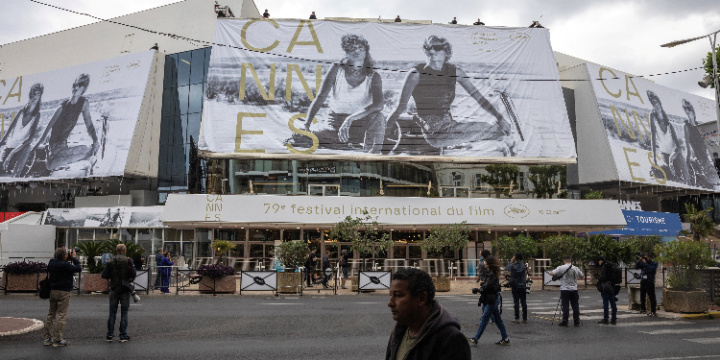
Workers set up a giant canvas of the official poster featuring actors Geena Davis and Susan Sarandon from Ridley Scott’s road movie “Thelma & Louise” on the facade of the Festival palace before the start of the 79th Cannes Film Festival in Cannes, France, May 10, 2026. Photo: REUTERS/ Marko Djurica
A jury member of the 79th Cannes Film Festival on Tuesday condemned the Hollywood film industry for “blacklisting” actors who have spoken out against Israel’s military actions in the Gaza Strip during the country’s war against Hamas terrorists controlling the enclave.
At the festival’s jury press conference, Cannes award-winning Scottish screenwriter Paul Laverty mentioned Susan Sarandon, Javier Bardem, and Mark Ruffalo, all three of whom have been outspoken in criticizing Israel’s military campaign against Hamas in Gaza. Sarandon’s character in “Thelma & Louise” is on the official 2026 Cannes poster.
“The Cannes Film Festival [and] the wonderful poster they have,” Laverty said at the end of the press conference on Tuesday, held before the opening of the film festival in France. “Absolutely iconic. Brilliant. And isn’t it fascinating to see some of them like Susan Sarandon, Javier Bardem, Mark Ruffalo blacklisted because of their views in opposing the murder of women and children in Gaza? Shame on Hollywood people who do that. My respect and total solidarity to them. They’re the best of us, and good luck to them.”
“I just hope we don’t get bombed now, because we’ve got this poster in Cannes,” the BAFTA winner added in conclusion.
Sarandon was dropped by her talent agency for castigating Israel while participating in a pro-Palestinian demonstration in New York City in November 2023. At the protest, the Oscar winner accused Israel of war crimes, encouraged others to have the “courage to speak out” in support of Palestinians, and compared the Hamas-led Oct. 7 massacre across southern Israel just weeks earlier to hardships Palestinians endure in Gaza.
She talked about the fallout with her agency during an interview in 2024, saying: “I was dropped by my agency, my projects were pulled. I’ve been used as an example of what not to do if you want to continue to work.” Earlier this year, Sarandon further spoke about being shunned in Hollywood for her views about the Israel-Hamas war.
“I was fired by my agency, specifically for marching and speaking out about Gaza, for asking for a ceasefire. And it became impossible for me to even be on television,” she said at a press conference in February before receiving a career achievement honor at the 40th Goya Awards in Spain. “I don’t know lately if it’s changed, but I couldn’t do any major film, anything connected with Hollywood. I found agents ultimately in England and in Italy, and I work there … I know this Italian director that just hired me — he was told not to hire me, so that’s still recently. He didn’t listen, but they had that conversation. Right now, I kind of specialize in tiny films with directors who have never directed, in independent films.”
At the Cannes jury press conference on Tuesday, Laverty further talked about Gaza in remarks about this year’s film festival.
“You see so much violence, genocide in Gaza and all these terrible things,” he said. “The idea of coming to a festival – which is a celebration of diversity, imagination, tenderness — when there’s such vulgar, vicious, systematic violence. The idea of attending to a festival where there’ll be contradiction and nuance and beauty and inspiration. It knocked me out, to be honest.”
Before the start of the Cannes Film Festival last year, more than 350 members of the film industry — including Bardem, Sarandon, Ruffalo, and Richard Gere — signed an open letter condemning the festival’s “silence” over Israel’s military campaign in Gaza targeting Hamas terrorists.
Emmy-winning actress Hannah Einbinder recently criticized Hollywood’s silence about the Israel-Hamas war during a guest appearance on an episode of Zeteo’s “Beyond Israelism” podcast that was released in full on Tuesday.
“It pisses me off,” said the “Hacks” actress. “Because I’m sitting here with [Algerian-Palestinian activist] Mahmoud [Khalil], who has so much to risk and who has risked so much who has sacrificed so much … And I look at these people who have absolutely every privilege imaginable to mankind and they cannot utter a single word. I guess it makes me naive, but I cannot understand it. I really can’t understand it. And I hear people say that they don’t know enough and I — I don’t, it’s like, OK, so what do you do all day?”
“People in Hollywood, unfortunately, need these issues to affect a white person for them to see it as relating to them,” she stated. “Like, they see Jimmy Kimmel getting taken off the air suddenly, they see Stephen Colbert’s show being canceled by CBS, which is owned by the Ellisons, and they go, ‘How could this possibly happen?’ And it’s like, we know how because we saw students and professors and journalists and authors and Palestinian folks be silenced and fired and expelled and imprisoned … it took it happening to these white men for people to be like, ‘Oh my God.’”
In her acceptance speech at the Emmys last year, Einbinder declared “Free Palestine.”