



Uncategorized
Assad Regime Remnants on the Ground in Lebanon Helping Hezbollah

Hezbollah fighters walk near a military tank in Western Qalamoun, Syria, Aug. 23, 2017. Photo: REUTERS/Omar Sanadiki
Senior officers from the former Assad regime in Syria are currently in neighboring Lebanon helping the terrorist group Hezbollah, raising tensions between Damascus and Beirut as the two governments seek to deepen their fragile cooperation.
The extensive coordination between Iran-backed Hezbollah and remnants of Assad’s security apparatus, which was also supported by the Iranian regime until its fall, has fueled fears of an emerging dynamic that could undermine Syria’s new government and deepen regional instability.
Last week, Lebanese Prime Minister Nawaf Salam met with Syrian President Ahmed al-Sharaa in Damascus as the two countries work to expand bilateral cooperation and engagement, with talks centered in part on former Syrian regime figures in Lebanon amid fears of emerging forces that could destabilize the new government.
Following the fall of long-time Syrian dictator Bashar al-Assad in December 2024, many officials in his regime are believed to have fled to or sought refuge in Lebanon, a development that has intensified diplomatic friction and security tensions between Damascus and Beirut.
Hundreds of pro-Assad military and intelligence officers and other security officials had reportedly entered the country through illegal border crossings in the Bekaa Valley in eastern Lebanon and via northern border regions.
In an interview with Saudi broadcaster Al Arabiya, Salam dismissed claims that most senior Assad-era officials have sought refuge in the country, while reaffirming the government’s commitment to help preserve Syria’s security interests.
“Most are in Russia and other countries, with just a small number still on Lebanese soil. But the government will work to ensure Beirut is not used as a base to undermine Damascus or to facilitate any political or military activity against it,” the Lebanese leader said.
During last week’s talks, Lebanese and Syrian officials agreed that any extradition of anti-regime forces would proceed under a joint legal framework to be coordinated through the justice and interior ministries in both countries.
The Syrian government has urged Lebanese authorities to arrest and extradite former Assad-era officers amid fears they are joining forces with Hezbollah and allied Alawite networks, where they have reportedly found refuge as part of a renewed effort to destabilize the country.
“We will not allow anyone on Lebanese soil to act against the Syrian government,” a Lebanese security source told Al Arabiya. “Lebanon will never serve as a platform for remnants of the former regime or militias operating against Arab states.”
Last year, al-Sharaa became Damascus’s president after leading the rebel campaign that ousted Assad, whose Iran-backed rule had strained ties with the Arab world during the nearly 14-year Syrian war, with an offensive spearheaded by al-Sharaa’s Islamist Hayat Tahrir al-Sham (HTS) group, a former al-Qaeda affiliate.
After years of intervening in Syria’s civil war to support Assad, the Lebanese terrorist group Hezbollah significantly expanded its political and military influence across the country as Iran’s chief proxy force.
However, the fall of Assad’s regime cut off Hezbollah’s key overland supply corridor through Syria, dealing a major setback to Iran’s “Axis of Resistance” and disrupting one of the group’s most vital strategic lifelines.
According to intelligence assessments, Assad regime supporters who fled into Lebanon have not simply gone into exile but are believed to have formed an organized network described by Syrian officials as the “operational brain” of Assad’s army on Lebanese territory, according to Arab and Israeli reports.
More than 200 former officers and senior figures from Assad’s military and intelligence apparatus have reportedly taken refuge in Hezbollah strongholds and heavily Alawite areas in northern Lebanon, where, Syrian officials warn, they are working to preserve the military infrastructure and strategic assets of the Iran-backed Shiite axis.
Arab media networks report that Hezbollah has provided former regime officers with protection and safe houses in exchange for intelligence expertise and operational support, aimed at helping establish armed cells and Alawite militias inside Lebanon.
Recently, Syrian authorities identified a covert Hezbollah-linked network allegedly plotting attacks against senior figures in the new Syrian government, with Damascus suspecting exiled Assad-era officers based in Lebanon are playing a central role in efforts to undermine the country’s stability.
Last week, Syria stopped a Hezbollah terrorist cell that was plotting to assassinate senior government officials, according to the Syrian Interior Ministry. With raids at multiple locations, Syrian security forces made 11 arrests and seized a cache of weaponry.
In April, the same Interior Ministry announced five arrests in another assassination attempt plotted by Hezbollah. The terrorists targeted Rabbi Michael Khoury in Damascus, with authorities identifying a woman who attempted to plant an explosive outside his home. The suspects later confessed to authorities they had drones supplied by Hezbollah they intended to use in an attack.
Uncategorized
Anti-Israel Rep. Thomas Massie Trails in Race as New Kentucky Ad Targets Jewish Donor With Rainbow Star of David

US Rep. Thomas Massie (R-KY) leaves a meeting of the House Republican Conference in the US Capitol on Wednesday, June 4, 2025. Photo: Tom Williams/CQ Roll Call/Sipa USA via Reuters Connect
A new poll is signaling growing trouble for US Rep. Thomas Massie in Kentucky’s Republican primary, with Trump-endorsed challenger Ed Gallrein now leading the incumbent congressman 53 percent to 45 percent among likely GOP voters in the state’s 4th Congressional District.
The poll comes as Massie faces intensifying backlash over an advertisement released by a pro-Massie super PAC targeting billionaire Republican donor Paul Singer, a prominent Jewish supporter of pro-Israel causes who has backed efforts to defeat the incumbent.
The ad characterizes Singer as a “pro-trans billionaire” and features a rainbow-colored Star of David behind his image while attacking Gallrein’s allies.
NEW: Take a look at this #KY04 ad called “LGBTQ Mafia” from a PAC affiliated w/ Jan. 6 rioter Derrick Evans.
It depicts Jewish donor Paul Singer with an unexplained rainbow Star of David.
More on this insane, now record-breaking $25 million primary: https://t.co/iT3YN8wYEz pic.twitter.com/0YIRYmaJwL
— Andrew Solender (@AndrewSolender) May 11, 2026
Critics condemned the imagery as antisemitic, arguing it invoked longstanding tropes about Jewish financial influence and used Jewish symbolism in a way designed to inflame cultural resentment. Many social media users accused the ad of crossing a red line at a time when antisemitic incidents in the United States remain elevated following Hamas’s Oct. 7, 2023, massacre across southern Israel.
The Kentucky ad was paid for by Hold the Line PAC — a group backing Massie that is “focused on Religious Liberty, 2A, and Restoring Election Integrity,” according to its website — not Massie’s official campaign.
The race has drawn national attention, with more than $25 million spent on ads, the most ever in a House primary election, according to AdImpact.
Outside groups have poured millions of dollars into the campaign, Because Kentucky’s 4th District is overwhelmingly Republican, the GOP primary is widely expected to determine who will ultimately hold the seat. According to data sourced from the Federal Election Commission (FEC), Massie has only garnered roughly $70,000 from in-state donors, compared to over $1.1 million from out-of-state, a whopping 94 percent of his total donations.
The latest survey showing Massie trailing was conducted on May 12 by Quantus Insights. It marks one of the clearest signs yet that US President Donald Trump’s endorsement may be reshaping the race in Gallrein’s favor. The Kentucky primary has rapidly evolved into one of the most closely watched Republican intraparty battles of the 2026 election cycle, drawing national attention over divisions surrounding Israel, antisemitism, and ideological loyalty within the GOP.
Massie, a libertarian-leaning Republican known for frequently breaking with party leadership, has a long track-record of voting against sending aid to all foreign countries, including Israel. Although he has received substantial criticism over his voting record, Massie has argued that his positions do not reflect an animus against the Jewish state but are reflective of his staunch fiscal conservatism. He has also condemned Israel’s military operations in Gaza and Lebanon, arguing that the Jewish state has targeted civilian infrastructure and should not receive assistance from the US.
Critics contend his voting record and anti-Israel rhetoric have increasingly isolated him from the Republican mainstream, particularly on issues involving Israel and national security. Skeptics also claim that Massie’s criticisms of Israel are devoid of nuance, oftentimes omitting Hamas’s tendency to use human shields, repurpose civilian infrastructure for military purposes, and intercept trucks intended to distribute food.
The race has become a major test of Trump’s continued influence over Republican primaries. Trump has repeatedly criticized Massie in recent months before formally endorsing Gallrein, framing the contest as a battle between party unity and ideological obstructionism.
“We got to get rid of this loser. This guy is bad,” Trump said at a March rally in Hebron, Kentucky. “He’s disloyal to the Republican Party. He’s disloyal to the people of Kentucky, and most importantly, he is disloyal to the United States of America. And he’s got to be voted out of office as soon as possible.”
Gallrein, a retired Navy SEAL officer, has sought to position himself as a firmly pro-Israel conservative aligned with Trump’s “America First” coalition. His campaign has emphasized strong US-Israel relations, expanded security cooperation, and staunch support for the Jewish state following Hamas’s Oct. 7 attack.
Political analysts say the outcome could reverberate far beyond Kentucky, shaping how Republican lawmakers navigate issues surrounding Israel, antisemitism, and loyalty to Trump heading into the 2026 midterm elections.
Uncategorized
Jewish Teens in France Tell US Ambassador About Enduring Antisemitism in Schools
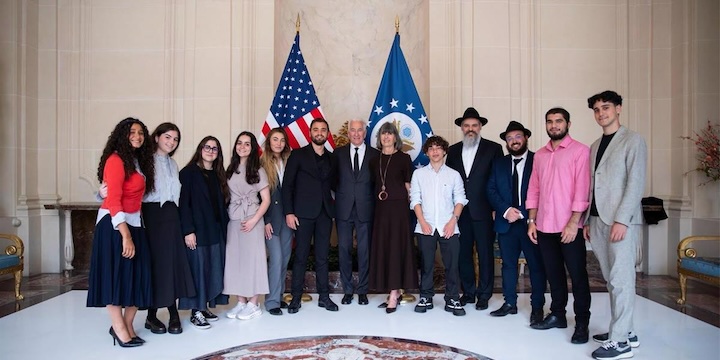
Members of French Cteen chapters meet with United States Ambassador to France Charles Kushner and his wife Seryl on Monday, May 4, 2026. They discussed their experiences with antisemitism and what keeps them motivated. Photo: US Embassy in France
Nine members of the Chabad youth group CTeen France met last week with US Ambassador to France Charles Kushner to discuss their experiences of antisemitism in the years since Hamas’s Oct. 7, 2023, attack on Israel, a massacre which left nearly 1,200 people dead and led to a surge in hate crimes targeting Jews around the world.
Following an invitation, the youth aged 14-18 visited the ambassador’s official residence at rue du Faubourg Saint-Honoré in Paris for a two-hour discussion also attended by Kushner’s wife Seryl. Rabbi Mendy Mottal, CTeen’s director, and his wife Chaya also participated.
One member of the group, 18-year-old Younes, declined when offered a letter from the embassy to explain his absence from school. He explained that he did not want anyone at his school to discover he was Jewish, that only his best friend knew the secret of his true identity.
Another student, Salomé, described living 90 minutes south of Paris in Orléans and not knowing any other Jews in her region until the launch of a CTeen group. “All week at school I’m just waiting for the moment when I can see my Jewish friends,” she told the ambassador.
“These are teens who walk into their public school every morning knowing they may be the only Jew in their classroom,” said Rabbi Mendy Kotlarsky, chairman of CTeen International.
Discussing the meeting on X, Kushner wrote, “I love seeing motivated young leaders! CTeen is developing youth across France and focusing, like me, on countering antisemitism by combatting all forms of hatred in our communities.”
The teenagers received a tour of the ambassador’s residence and enjoyed Kosher refreshments before receiving two gifts: a kippah custom-made for the embassy and an embassy medal.
“These are teens regularly experiencing antisemitism on the front line,” Mottal said. “The ambassador was very moved by them and how they spoke. Frankly, so was I.” He described how Kushner “wanted to know what actually happens in the hallways, what they feel when they walk into a classroom knowing they might be the only Jews in the room.”
Kushner stated during the meeting that he intended the gathering to be the start of his collaborations with the CTeen group and that combating antisemitism in France had become a top priority.
“The fact that the ambassador sits with them, listens to their stories, and acknowledges the weight they carry on their shoulders — that means something profound to these young people,” Kotlarsky said.
The students’ fears align with survey responses from Jews in France and Europe. A 2026 Jewish Agency report found 78 percent of French Jews expressed feelings of fear in their country while 43 percent of European Jews surveyed said they experienced antisemitism in the last year either themselves or through a member of their family.
Last year authorities in France documented 1,320 antisemitic incidents recorded nationwide, a fall of 16 percent from the previous year’s high of 1,570. While Jews make up less than one percent of the French population — totaling 500,000 to amount to Europe’s highest Jewish population — they account for 53 percent of hate crime victims. French officials warned that the numbers were certainly undercounts of the actual number of incidents.
Last month, lawmaker Caroline Yadan put forward legislation to expand penalties for antisemitic speech. Dubbed the “Yadan law,” the proposed measure would ban “implicit” justifications of terrorism, advocacy for obliterating any state recognized by France, and comparing Israel to Nazi Germany. The bill’s supporters chose to withdraw the plan on April 16 after determining they were unlikely to succeed.
The centrist party Ensemble pour la République (EPR) blamed the leftist La France Insoumise (LFI) party for allegedly obstructing the bill’s progression.
In March, Dov Maimon, a senior fellow at the Jewish People Policy Institute, described the ideological dynamics in local French politics today and the threat they posed against the Jewish people.
“On one side, Jean-Luc Mélenchon’s far-left party, La France Insoumise (LFI), which didn’t hold a single seat on any municipal council, has now entered hundreds of councils and captured real cities for the first time,” Maimon wrote. “On the other side, the far right took approximately 40% of the vote and clinched dozens of mayoral races.”
Maimon warned that “the center seems to have collapsed. According to current polls, Mélenchon has a real chance of reaching that final round as the standard-bearer of the left. His political movement has weaponized hostility toward Israel, and his ties to Islamist networks are well-documented.”
In March, French authorities arrested two brothers alleged to have planned an antisemitic terror attack. Investigators found a semi-automatic firearm, a bottle of acid, and an ISIS flag during a traffic stop.
Kushner is the grandson of Holocaust survivors. His son Jared is US President Donald Trump’s son-in-law and serves as the Special Envoy for Peace where he has acted as a key foreign policy negotiator during the ongoing conflict with the Islamic regime in Iran.
Uncategorized
Long Island school district pays $125K to settle lawsuit over erased pro-Palestinian student art
(JTA) — A Long Island school district agreed to pay a $125,000 settlement to a former student whose pro-Palestinian artwork was painted over in a high school parking lot.
The lawsuit stemmed from a September 2024 incident at Half Hollow Hills High School West, which permitted seniors to decorate their campus parking spots. A Muslim-American student, who was a senior at the time, painted a watermelon featuring a keffiyeh pattern alongside her name in Arabic and the phrase “Peace be upon you” on her space.
At the time, protests against the war in Gaza were at a peak, and the watermelon and keffiyeh, the traditional Palestinian headscarf, are both widely used symbols of Palestinian solidarity. The school painted over the artwork after it drew outcry from some Jewish parents in the district, determining that it had run afoul of the district’s rules barring political designs.
“For the school district, neutrality is the single most important issue when it comes to limiting speech,” the Half Hollow Hills School District’s attorney, Jacob Feldman, said at a school board meeting at the time, according to a contemporaneous Newsday report.
The student, who has not been identified publicly, testified at that meeting last year. “I was told by my principal that the watermelon was being interpreted as antisemitic by anonymous adults,” she said, according to the Newsday footage. “I feel deeply offended that the word antisemitic was used to describe a piece of my artwork.”
In March 2025, the New York chapter of the Council on American-Islamic Relations filed a lawsuit on behalf of the student alongside Stoll, Glickman & Bellina LLP, alleging that the district had violated her free speech rights and caused her emotional distress.
“The whitewash of Plaintiff’s pro-Palestinian speech was not to prevent substantial disruption of any school activity or threatened harm to the rights of others, as Half Hollow permitted and even amplified speech on other equally, even more, controversial issues,” the lawsuit stated, according to the Associated Press.
In court filings, Steven Stern, an attorney appointed by the district’s insurance provider, wrote that the watermelon image “symbolized anti-Semitic hate speech,” arguing that the district should be able to dictate art allowed in the parking lot.
“Any student, teacher, or member of the public could have driven into the parking lot and reasonably understood the school was endorsing a political message — or worse, anti-Semitic hate speech — by allowing it,” Stern wrote, according to Newsday.
The settlement, which was approved by the Half Hollow Hills school board at a meeting on April 21, will be paid by the district’s insurance carrier, according to Superintendent John O’Farrell.
In a statement obtained by Newsday, O’Farrell said that students were no longer allowed to paint their parking spaces “following the incident and the disruption it caused.”
The lawsuit was not the first time that the school district had courted controversy over Israel-related issues. Last year, the district drew scrutiny after a study guide distributed to some 10th graders described Zionism as “an example of extreme nationalism,” prompting condemnation from Rep. Elise Stefanik.
Christina John, a staff attorney for the New York chapter of the Council on American-Islamic Relations, which filed the lawsuit alongside Stoll, Glickman & Bellina LLP, welcomed the outcome in a statement.
“This settlement sends a clear message that viewpoint discrimination and the censorship of Palestinian expression cannot be justified under the guise of neutrality,” John said. “No student should be interrogated, silenced, or punished for peacefully expressing their identity or solidarity with oppressed people.”
The post Long Island school district pays $125K to settle lawsuit over erased pro-Palestinian student art appeared first on The Forward.