


Uncategorized
At the Venice Biennale, protests, self-mutilation and rage against Israel and Russia. Is anyone left to talk about the art?
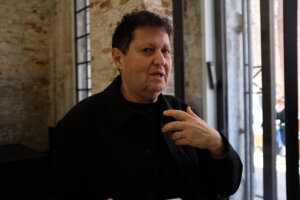
Belu-Simion Fainaru wanted very badly to talk about the water.
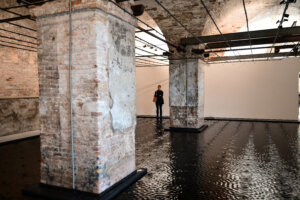
The Romanian-born Israeli artist had come to Venice with “Rose of Nothingness,” a quiet, ritualistic installation in Israel’s temporary pavilion at the Arsenale: water dripping into a rectangular black pool in a silent corner of the city’s former armory and shipyard, disturbing the stillness of the reflective surface, inviting visitors to focus on the movement from absence to presence — and back again to nothing.
There’s an explicit link to Paul Celan, above all to “black milk,” the central image of the German-speaking Romanian-Jewish poet’s “Todesfuge” (“Death Fugue”), one of his best-known works. The pool, with its dozens of circular ripples, evokes collective memory, ink and writing in the city where the Talmud was first printed.
Yet by the time I reached Fainaru during the professional preview of the 61st Venice Biennale, he had been forced to defend his art’s right to exist. The Israeli Pavilion had become one of the pressure points of an exhibition that seemed to be losing faith in the structure that had sustained it for more than a century: the national pavilion, that quaintly anachronistic yet oddly durable relic of late 19th century world’s-fair patriotism. Fainaru had been asked, he told me, about Benjamin Netanyahu, The Hague, Vladimir Putin and Gaza, but rarely about the work he had come to Venice to present.
“You are a cultural reporter; I am an artist,” he said. He had not come here as a politician, but this year’s Biennale had treated him as one.
“What I see now,” the 66-year-old artist said, “is total politicization of art.” If this continued, he warned, art would become “very limited, very narrow,” and eventually “a very violent arena.”
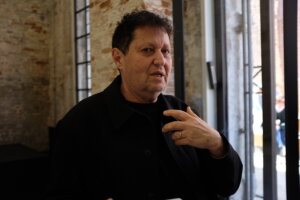
The phrase stayed with me throughout the preview. This year, the Biennale has indeed become a violent, chaotic and scandal-ridden arena. There were barricades, strikes, legal warnings, shuttered pavilions, the resignation of the Golden Lion jury, and art performances and actions meant to disquiet and to shock.
L’Esposizione internazionale d’arte di Venezia was founded in 1895. It is now the most prestigious international contemporary art exhibition in the world, although it still bears traces from the era in which it was born, an age of imperial prestige and competitive cultural display. The Giardini, with its permanent national houses (owned by the countries they represent), is not merely a garden. It is a geopolitical map of cultural power and prestige.
This year, it often looked like that map was being torn up before the spectators’ eyes.
The Biennale’s 2026 exhibition, “In Minor Keys,” opened to the public on May 9 and runs through Nov. 22. It was conceived by the late Cameroonian curator Koyo Kouoh and completed after her death, with 110 invited participants in the central exhibition representing 100 countries. But when I attended, the curatorial project masterminded by Kouoh and implemented by her assistants was eclipsed by a series of interlocking controversies: the participation of Israel and Russia; a €50 million gift to secure Qatar’s arrival in the Giardini with a temporary structure built on the site of a future permanent pavilion; Iran’s last-minute withdrawal; and the anger and bewilderment directed at the American pavilion due to the global havoc the Trump administration is only too happy to unleash.
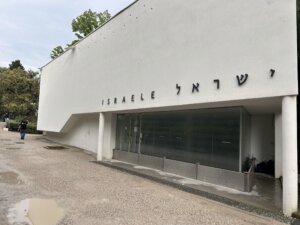
The Israeli Pavilion was not in its permanent building in the Giardini this year. That structure, built in 1952 by Zeev Rechter, remained closed, officially for renovation. (The pavilion also remained shut during the previous Biennale, in 2024; Ruth Patir, the artist representing Israel that year, installed her work but refused to open the pavilion until a ceasefire and hostage-release agreement was reached).
I had been told about sizable protests outside the temporary Israeli pavilion at the Arsenale, but by the time I arrived, all was calm. Two young carabinieri stood outside looking bored. Inside, I thought I spotted a plainclothes Israeli security guard, though the curators later denied that any such person was present. During my interview with Fainaru and his curators, Rabbi Ramy Banin of Chabad of Venice stopped by; he had supplied the klafim, the handwritten parchment scrolls, for the oversized black mezuzot, engraved with a stylized שַׁדַּי, that Fainaru had designed for the installation.
Fainaru was plainly relieved to be asked about the work. His installation is built around an Israeli irrigation system — technology devised to deliver water in places where it is scarce. In agriculture, he told me, such systems are used “to bring life in places that are not life.” In Venice, he had transformed that apparatus into “food for a spiritual dimension.”
The title, “Rose of Nothingness,” points to Celan’s evocative neologism Die Niemandsrose (“The No-One’s Rose”), the title of a 1963 volume that he dedicated to Osip Mandelstam as well as to the Kabbalistic understanding of nothingness not as nihilism but as a generative source.
“The origin comes from nothingness,” Fainaru told me. Presence emerges from absence; the visible world returns to abstraction.
This isn’t Fainaru’s first Biennale. In 2019, he represented Romania, a country he left in 1973. He won the Israel Prize in 2025 and is a professor in the Department of Architecture at the University of Haifa. He is a founder of the Mediterranean Biennale, which showcases works by artists from Europe, the Middle East and Northern Africa; its most recent edition was held in Sakhnin, an Arab city in Israel, where he also helped create the Arab Museum of Contemporary Art. It’s impossible to read Fainaru’s résumé and conclude that he’s a lackey of the Netanyahu government.
Avital Bar-Shay, one of the two curators of the Israeli Pavilion, took me aside and told me many Jewish visitors had come inside and said “Kol hakavod,” telling the team they were proud that Israel was exhibiting. Some spoke of antisemitism in London and other cities that have seen an uptick in violence against Jews since the start of the Israel-Gaza war. “They said, ‘You are giving us courage,’” she recalled. For those visitors, the pavilion was not an assertion of Israeli power, hard or soft. Rather, it was a modest sign that Israeli and Jewish cultural presence had not been expelled from the international stage.
The evening I arrived in Venice, I met a Turkish curator who told me he had spearheaded a “massive demonstration” in front of the Israeli Pavilion earlier that day. Fainaru disputed the scale of the protest. “There were perhaps 30 or 40 people shouting loudly” and shaming those who entered the pavilion. “The majority wants to see art,” he asserted, adding that he found attempts to cancel progressive Israeli artists, like the filmmaker Amos Gitai (whom he called a friend) and him not only wrong but counterproductive.
“We totally are against boycotts, not just against Israel, but against any other countries,” he said. “Artist or scientist or academics. And I think we should strive to live in a better world, not a world of dispersion, of hate and exclusion. I mean, there’s enough violence in our world. We have to keep art as an open space for dialogue.”
Though I didn’t doubt Fainaru’s sincerity, I wondered what led him to accept the unenviable job of being Israel’s art ambassador at this point in time. Was it naiveté? Defiance? Although I am staunchly opposed to banning, cancelling and boycotting artists on the basis of nationality, it also strikes me as disingenuous to claim that the Israeli Pavilion at the 2026 Venice Biennale is just another gallery space.
Fainaru’s display is the official Israeli representation during a war whose devastation in Gaza has become, for many in the world — and especially in the art world — the defining moral scandal of our time. Whether one calls Israel’s conduct genocide, ethnic cleansing, war crimes or massacre, no honest account can defend the scale of destruction.
When I asked Fainaru whether he would also defend the participation of artists from Russia, Iran, Saudi Arabia or Qatar, he said yes. Artists from authoritarian or repressive countries, he argued, belong here. “The artists have the right to expose and to try to keep a dialogue with other cultures,” he said. “That’s the meaning of Venice Biennale.”
Clearly, many saw the situation differently.
On Friday, May 8, the final day of the professional preview, a strike for Palestine and workers’ rights brought much of the Biennale to a grinding halt. Roughly a third of the national pavilions were partially or fully shut and some works in the central exhibition were removed from display or covered. Beginning at 4:30 p.m., hundreds — possibly thousands — marched along Via Garibaldi toward the Arsenale with Palestinian flags and banners that read “No artwashing. No genocide pavilion.”
Watching the parade wind its way down the Fondamenta Arsenale, hearing their slogans and reading their signs hammered home the extent to which Gaza has become a devastating emblem of the failure of the liberal postwar order, where international law is invoked yet ignored and American power underwrites destruction, while other nations, especially in Europe, oscillate between guilt and paralysis.
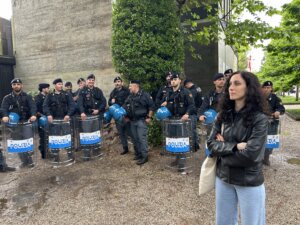
Even before it opened, this year’s Biennale was overshadowed by politics. On April 23, the five-member Golden Lion jury announced that it would not consider pavilions and artists representing countries whose leaders were charged with crimes against humanity by the International Criminal Court, a position that effectively rendered Russia and Israel ineligible. In response, Fainaru issued legal warnings to the Biennale, the Italian Ministry of Culture and the Italian prime minister’s office alleging antisemitism and nationality-based discrimination after the jury’s initial decision. According to the online art magazine Hyperallergic, the Biennale’s legal department warned jurors they could be personally liable for damages to Fainaru in the event of a dispute.
On April 30, nine days before the opening of the Biennale, all five members of the jury resigned. The Biennale then replaced its traditional Golden Lion with a “Visitor Lion,” to be voted on by ticket holders and awarded in November, at the end of the event, leaving many to wonder “What Did the Golden Lion Die Of?” to quote the title of a widely-circulated essay. Now perhaps more than ever before in the Biennale’s history, people are reassessing how much freedom art can ever claim when it arrives draped in a national flag.
In 2022, Russia’s curatorial team pulled out of the Biennale following the full-scale invasion of Ukraine. After skipping the 2024 event, Russia staged a bizarre and largely symbolic comeback this year with a pavilion that was only open during the professional preview and which has led the European Union to freeze a €2 million grant to the Biennale.
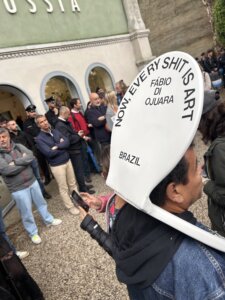
On opening day, the scene in the Giardini outside the Russian Pavilion was far more openly confrontational than anything else I witnessed at this year’s Biennale. There were riot police and carabinieri, demonstrators waving signs and trying to block people from entering the pavilion. Pussy Riot and members of the Ukrainian feminist group Femen protested with colored smoke, pink balaclavas and slogans like “Blood is Russia’s art” and “Disobey.” A Brazilian artist milled out outside with a toilet lid over his head that read “NOW, EVERY SHIT IS ART.”
When I squeezed past the protesters and entered the pavilion, I found very little going on: a few elaborately tangled clusters of flowers (“Why do flowers no longer smell?” the wall text queried forlornly), a man standing like a bodyguard and wearing a bunny mask, a DJ spinning records and a couple half-heartedly dancing.
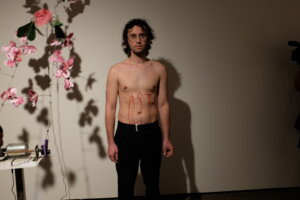
By far the most shocking act of protest I witnessed was on Friday morning, when Danila Tkachenko, a Russian artist who is a political refugee in Italy, entered the Scuola Piccola delle Zattere and used a scalpel to carve the word ART into his upper abdomen.
The 18th century palazzo houses a cultural institute that is funded by the Russian oligarch Leonid Mikhelson and owned by his daughter Victoria. Tkachenko’s grisly performance was intended to call attention to how, in the words of the journalist and curator Konstantin Akinsha, “money stained with Ukrainian blood feeds contemporary art in Venice.”
While Tkachenko stood next to a mechanical flower sculpture by Rachel Youn, blood trickling down to his belly, flummoxed ushers half-heartedly tried to clear the gallery. From a corner, a poker-faced Victoria Mikhelson looked on. She instructed the museum guards to do nothing. She clearly wasn’t going to give Tkachenko the satisfaction of being arrested.
And then there was the United States. In a year when Israel and Russia were treated as agents and emblems of world disorder, America remained oddly peripheral as a target, despite, well, everything. The U.S. Pavilion did not become a magnet for protest, although some artists and curators told me that they refused to enter on principle. For the most part, however, the art world’s revenge on America’s presence at Venice was limited to ridiculing this year’s Trump-approved artist, the sculptor Alma Allen.
Venice has always asked nations to appear through art. This year, they arrived damaged, accused, defensive, wealthy, frightened and enraged. The Biennale’s traditional structures — its garden of nations, its prizes, its diplomatic courtesies — did not collapse entirely. But they trembled.
And in the Israeli Pavilion, beneath the sound of black water falling into a pool, one could hear the tremor.
The post At the Venice Biennale, protests, self-mutilation and rage against Israel and Russia. Is anyone left to talk about the art? appeared first on The Forward.
Uncategorized
I was born after 9/11. I still carry the memories of that day.

Earlier this week, I was talking with my mother over the phone about her experience on 9/11. She walked me through the familiar parts — how she was in our Upper West Side apartment when she learned about the attacks from a relative, how she went to the garage to get the car so they could drive to a friend’s house upstate once she realized the attacks were acts of terror. There were still hijacked planes in the air, and she worried New York City might be targeted again. Then, she said, “This part is going to make me cry.”
I hadn’t remembered what came next, but suddenly it came back to me. “Oh no, me too,” I said.
While she waited for my father to come back uptown from his office in the Financial District, she stopped inside a fire station across from the garage. Inside was a lone firefighter, who’d stayed behind to man the station while the rest of his company was inside the towers. He was watching the news on television, and my mom stood next to him, watching too, when the towers fell.
“We just lost so many men,” he said.
I wasn’t there when it happened; I wasn’t even alive. But I’d heard this story before, I’d walked dozens of times past that same fire station, which now has a plaque commemorating the seven firefighters who died on 9/11. Hearing the story again on the phone, I found myself walking down the streets of Washington D.C., bawling.
I’m 23, born a year-and-a-half after 9/11. Most Americans my age learned about the attacks in school, as history. I’m part of the 16% who learned through family or friends.
The discovery happened by accident, when I was in kindergarten. My mom and I were in a children’s store on the Upper West Side, when we started flipping through a picture book about the history of New York City. Most of the book was unremarkable, but the end was unexpected: a scene of the smoldering twin towers.
I forget what exactly happened next, but here’s what I do remember: My mom was upset that the shop hadn’t provided a warning about the book’s end, and I was confused about why she was upset. I was five, too young to understand the image and never one to let a question go unanswered; I must have pestered her until she offered up an explanation.

She hadn’t been prepared to tell me about terrorism. She’d been evading the topic for some time, telling half-truths to avoid it. When I’d ask her why we had to take our shoes off in line at the airport, she’d just say it was to make sure no one had anything dangerous, leaving out the part about how a man had tried to get on a flight with bombs hidden in his shoes.
“9/11 is a huge thing for a parent to have to tell a kid about,” my mom told me this week. “You were a happy kid, and I didn’t want you to get scared or traumatized.”
The events, and impacts, of that day slowly unfolded for me as the years passed. I learned that my father had watched from Battery Park as the South Tower fell; he ran westward as plumes of smoke billowed toward him. I learned that my parents had friends who’d died in the towers, one of whom was the father of a boy I grew up with. I remember going to the 9/11 Memorial and Museum when it opened in 2014, feeling sick as I watched footage of people jumping out of the towers.
The New York Times recently interviewed dozens of Gen Z Americans about 9/11. I was struck by how disconnected many felt from the event. “It’s hard to feel sad about something that you don’t remember,” said Annika Heegaard, a 25-year-old now living in New York.
But for me, 9/11 doesn’t feel quite so far away. By now I’ve lived through other mass casualty events, like the Parkland shooting and the Oct. 7 Hamas attacks. But 9/11 is the only tragedy that my family members had such a direct connection to. “It was devastating,” my mom said.
I think the reason I can remember the exact moment I found out about 9/11 is because it changed my view of the world. I remember being almost unable to comprehend that anyone would do what the hijackers did. I wasn’t, as my mom feared, traumatized by learning about the attacks; I didn’t fear for my safety each day. But the knowledge was in some ways a loss of innocence — a discovery that people could do awful things and that the world wasn’t as safe a place as I had assumed.
The post I was born after 9/11. I still carry the memories of that day. appeared first on The Forward.
Uncategorized
The DSA’s latest win was not about Israel — and it hurts the Jewish community to insist it was
When Democratic socialist David Morales defeated the incumbent mayor of Providence, Brett Smiley, in a historic primary win this week in Rhode Island, the election quickly became part of a narrative that has been coalescing around progressive political wins in the last year — the election of Zohran Mamdani as mayor of New York City, Abdul El-Sayed’s primary win in Michigan, the sweep of DSA-backed candidates in New York City’s recent primaries. The idea is that this race was all about Israel — that it turned on a struggle between Zionists and pro-Palestinian activists.
A Jewish Telegraphic Agency story on Morales’s win features a quote from the founder of the Rhode Island-Israel Collaborative that Morales’s campaign was “fueled by pro-Palestinians and Israeli haters.” The founder of the far-right Rhode Island Coalition for Israel called some of Morales’ stances “anti-Israel and anti-Jewish.” Jewish Insider published a story the day before the primary headlined, “Antisemitism roils Providence mayoral race.” The Times of Israel’s story on the election is titled, “Jewish mayor of Providence loses Democratic primary to anti-Israel challenger.” (Smiley converted to Judaism in 2024, and made a controversial visit to Israel in 2025.)
But this narrative is false: Israel did not play a decisive role in this election. In reality, Morales was laser-focused on affordability, and — like most progressive candidates this year — rarely, if ever, brought up Israel unprompted. Indeed, the defining issue for the Morales campaign was not Israel, but rent stabilization.
Last April, Smiley vetoed legislation passed by Providence’s City Council to cap annual rent hikes at 4%. This ordinance is desperately needed: A recent study found that Providence is the least affordable city for renters in the country. Longtime residents are getting priced out, and essentially everyone who rents — and renters comprise 59% of the households in the city — understands that our trajectory is simply not sustainable.
By vetoing the most significant-ever attempt to bring this crisis under control, Smiley made this a race about a challenger fighting to make Providence affordable and an incumbent prioritizing his corporate donors, who gave Smiley a historically large $1.3 war chest for his campaign. (Morales had less than $300,000, largely from individual donors.)
This issue served as precisely the kind of defining contrast that pro-Israel Super PAC spending became in recent congressional elections elsewhere. Support from AIPAC has provided an impossible-to-obscure contrast to Democratic primary voters in races such as Illinois’s 9th Congressional District, New York’s 10th Congressional District, and Michigan’s Senate primary. But in Providence, the scandal wasn’t AIPAC donors — it was the wealthy developers and corporate landlords who funded Smiley’s campaign.
It is true that Morales criticized Smiley’s active participation in the Combat Antisemitism Movement, a project so Trumpian that the Jewish Federations of North America and Jewish Council for Public Affairs both left the group after it released a video claiming that diversity, equity, and inclusion efforts are antisemitic. Morales also came out in support of a ballot initiative that would require the City of Providence to divest from the debt of foreign countries “conducting ethnic cleansing, apartheid, illegal military occupation, or genocide,” as determined by U.S. and international law. Some of Morales’s supporters — and in particular some portion of his army of campaign volunteers — were undoubtedly motivated by an appreciation for Morales’s willingness to take a moral stance. But it simply wasn’t a top five, or even (by my estimation) a top 10 issue in this race.
And I don’t understand the inclination to claim otherwise. Certainly it doesn’t make sense for members of the Israel lobby; after all, having another election be lost due to voters’ anger over a politician’s fealty to Israeli Prime Minister Benjamin Netanyahu is not good for their political project. But more importantly, these allegations — particularly the false claim that this race was somehow “roiled” by antisemitism — are harmful to Rhode Island’s Jewish community as a whole.
Take, for example, the “antisemitism” referenced by Jewish Insider, which consisted, in total, of a few instances in which a Hitler mustache and devil horns were drawn on Smiley’s campaign signs. Of course, defacing political signs is never good, and Morales immediately condemned the vandalism. But as a Jewish former elected official who experienced actual antisemitism over the course of my time in Rhode Island politics, I have to laugh at the idea that this graffiti was antisemitic.
To compare someone to Hitler is basically to say they’re the worst person ever. It’s often a problematic comparison (because almost nobody is actually as evil as Hitler), but it’s not antisemitic to say, in effect, “Hitler was bad, and so is this other guy.” And vandals were drawing devil’s horns on pictures of Smiley years before he converted. In fact, I don’t think the average Providence voter even knows Smiley is Jewish; it’s certainly not an important part of his political identity, given that he literally wasn’t yet Jewish when he first won election to the mayor’s office in 2022, or during his prior run for the seat in 2014.
Antisemitism is a real and growing problem — in our country, and here in Rhode Island. Just a few years ago, dozens of swastika-brandishing neo-Nazis rallied a block from my home. Every time that cynical politicians cry wolf on this threat, they are minimizing its danger in the eyes of most people, making our community less prepared to respond to actual incidents of antisemitism when they occur.
Even worse, when some partisans of Israel claim that everyone who dares to say Israel is committing genocide and apartheid is an antisemite — that is, someone who hates all Jews — the implication is that Israel’s wars and violence against Palestinians are somehow projects undertaken by all Jews, rather than the crimes of a specific far-right government and its supporters. And if you repeat that message often enough, some people are going to start believing it — which certainly does not make me or my young Jewish sons safer.
David Morales ran on a pledge to build a Providence for all. “All” includes members of the Jewish community, many of whom — including myself, and Morales’s campaign manager and field director, to name just a few — are excited to support his vision. It is to no one’s benefit — least of all Providence’s Jews — to try to seed conflict and distrust in what should be a moment of profound hope and possibility for our whole city.
The post The DSA’s latest win was not about Israel — and it hurts the Jewish community to insist it was appeared first on The Forward.
Uncategorized
Jewish and Muslim leaders avoided the hardest interfaith topic for years, and now face a ‘massive fault line’
It’s been a quarter century since a wave of distrust and violence against Muslims swept across America in the wake of the Sept. 11, 2001 terror attacks. But in some pockets of New York City and across the U.S., Jewish neighbors extended a hand of friendship and an interfaith movement was reborn.
Dialogues turned into dinners. Dinners spawned theatrical collaborations. Collaborations turned out volunteers to feed the homeless and sent interfaith teams to Capitol Hill.
Still, as the Palestinian uprising known as the Second Intifada continued to unfold in the Middle East, even the most promising partnerships avoided the Israeli-Palestinian conflict.
“We deliberately parked it on the side,” said Daisy Khan, the former executive director of American Society for Muslim Advancement and founder of the Women’s Islamic Initiative. “We called it the elephant in the room that none of us could handle.”
Now, 25 years after the terrorist attacks that inspired a movement, leaders realize that silence was a critical mistake.
As this year’s Jewish High Holidays, a time of remembrance and repentance, begin at sundown on the 25th anniversary of the Sept. 11 attacks, American Jewish leaders are reflecting on mistakes made and words they wish they could take back, confronting rising antisemitism, and along with their longtime Muslim partners, asking: Where do we go from here?
“Rosh Hashanah is known as Yom Hazikaron, the day of remembrance,” said Rabbi Joshua Davidson of Manhattan’s Temple Emanu-El, adding that remembrance usually refers to the hope that God will remember the covenant with the Jewish people. “When you talk about a day of remembrance, you also talk about the experiences that have shaped us into who we are. 9/11 certainly is an experience that has shaped us into who we are. Anyone who lived in New York is forever changed by that day.”
Interfaith bridge-building
On Sept. 11, 2001, Davidson was a young associate rabbi at another Manhattan institution, Central Synagogue. Feeling otherwise helpless that morning as the towers fell, he headed straight to the nearby mosque on 55th Street to assure his Muslim neighbors that they would not be judged by the actions of the terrorists – his instinct born from years of interfaith dialogue already underway.
The same instinct led President George W. Bush to the Islamic Center of Washington D.C., a week later to proclaim, “Islam is peace.” But that perspective did not prevail in all corners.
Prominent evangelical figures condemned Islam as “evil and wicked.” Mosques were set ablaze, and the Justice Department in the three months after the attacks labeled nine murders as “possible hate crimes.” Despite the community’s fear, the term “Islamophobia” was not widely embraced, as if it was a product of Muslims’ imaginations.
“So many American Muslims were experiencing the anxiety that President Bush recognized right away,” Davidson told the Forward. “So 9/11 crystallized for many the importance of the work of interfaith bridge building … We can learn from one another. When the world becomes complicated and your own community is in jeopardy or is being targeted, you realize how valuable it is to have those friendships.”
Those existing friendships and the ground rules that had sustained them laid the foundation for the aftermath of Sept. 11 and propelled many individuals and groups working behind the scenes to publicly counter what seemed to be an anti-Muslim zeitgeist. While the previous approach to interfaith work had been intimate Shabbat dinners, Ramadan iftars, and discussion groups, the new approach involved rallies, live performances and large-scale programs.
On the morning of Sept. 12, Israeli cellist Udi Bar-David called someone with whom he had collaborated a few times – Majid Alsayegh, an Iraqi-born Muslim engineer and architect in Philadelphia. Determined to offer a constructive response, they formed a team and in Spring 2002 launched a nonprofit for creative intercultural exchanges.
“Because of the tensions of Muslim and Jewish, Arabic and Jewish communities, because of the violence, we felt we needed to speak up and do more,” Alsayegh told the Forward, “to help them understand that dialogue in many forms, including music, is much more powerful than shooting each other.”
Seeking to help audiences listen with less anger, more empathy, artists from B’nai Jeshurun, a synagogue on New York’s Upper West Side, teamed up with Methodists and Muslims to present hard truths gathered from more than 100 New Yorkers. The project titled “Same Difference” later became a documentary.
In the years that followed, connections became more purposeful and direct. In 2008, Rabbi Marc Schneier’s Foundation for Ethnic Understanding launched an annual Weekend of Twinning, which paired scores of synagogues and mosques to explore the parallels and similarities within their traditions. It also enabled them to compare notes about the discrimination each faced as religious minorities and band together to fight the hatred that targeted both.
Khan cherishes the time she spent in synagogues and the friendships she formed there.
“We had such deep ties and such deep relations we weren’t afraid to go to bat for one another,” Khan said. “I think those relationships have even served us to this day.”
‘A massive fault line’
Still, cracks began to show. In 2010, Khan and her husband at the time, Imam Feisal Abdul Rauf, proposed Cordoba House, a mosque and community center in Lower Manhattan. Modeled after JCCs across the country and named for a city in Spain that once had been a center of peaceful coexistence, the proposed facility would offer prayer space, a wedding venue and a swimming pool.
Opponents focused on the location: two blocks from Ground Zero. Many Jewish leaders endorsed the project. Abe Foxman, longtime leader of the Anti-Defamation League, did not.
“We believe that in this place of tragedy and pain and anguish … if you want to heal, the best way to heal is not to do it in your face.”
Foxman, who died in May, never apologized for his remarks, but his successor Jonathan Greenblatt later acknowledged “we were wrong, plain and simple.”
In 2011, when U.S. Congressman Peter King of New York, then-chairman of the Homeland Security Committee, held hearings on Capitol Hill denouncing the radicalization inside American mosques, Jewish friends showed their support by helping to organize a “Today, I am Muslim too” rally in Times Square.
Those shows of solidarity grew throughout the years. Jewish partners joined crowds at airports to protest the Trump administration’s executive order on immigration. Congregations helped each other pick up the pieces when their houses of worship or sacred sites came under assault. But the tougher conversation, probing where people stood on the Middle East conflict and why, remained largely untouched.
As anyone in interfaith relations or diplomacy of any kind will tell you, constructive conversations are best had before there’s a crisis. That crisis arrived on Oct. 7, 2023, when Hamas attacked Israel, murdering more than 1,200 and taking 250 hostages. The war that followed in Gaza sparked virulent protests on college campuses and in public squares and a spike in antisemitic incidents. It also created a chasm of grief too deep and wide for many partnerships to survive.
“When Gaza happened, it created a massive fault line,” Khan said. “For Jews it reinforced existential fears about Jewish safety. For the Palestinians: ‘It’s our existential thing too. We feel we’re getting wiped out.’”
But because many conversation partners had for years avoided the hardest topic of all, they missed the opportunity to feel the emotional weight carried on both sides and hold that tension. When the grief, trauma and fear of Oct. 7 was thrust upon them, leaders could not adequately navigate the emotional landscape to offer moral clarity or comfort, Khan said.
“We could have called for calm,” she said. “We could’ve said that human loss is terrible. We could’ve said a lot of things that calmed people down. None of that happened. It became very tribal.”
Laboratory phase
Dr. Ari Gordon, director of Muslim Jewish Relations for American Jewish Committee, said while some Muslim partners have walked away from their joint advocacy work, some have stayed in touch. Khan and Alsayegh remain committed and hold out hope that their Muslim peers will return and give it another try.
“Everyone in this space has had the hits they’ve taken after Oct. 7,” Gordon said. “Relationships are a long-term investment. They can take dips and turns, peaks and valleys. On a personal level, as a friend, you have the right to say I want to engage with a person. I don’t want to. As a Jewish community we have a responsibility to keep our doors open.”
But it’s also important to keep the trajectory and time frame in perspective. The transformation of Christian-Jewish relations offers a lesson in that regard.
“The idea that a relationship can be beset by conflict and challenges for centuries and undergo transformation,” he said, “is one that I carry in my mind all the time.”
Gordon calls the past 25 years a “laboratory phase of Muslim-Jewish relations.” The Shabbat dinners, iftars, dialogue groups, coalitions, concerts – they all have fortified a connective tissue between American Muslims and Jews that did not exist 25 years ago.
“That trust may not have been sufficient to meet the stress test of October 7 and the continued war but it was definitely there and it didn’t go away,” he said. “After October 7 we entered a new phase and it’s one where we’re not going to go back to the way it used to be, but build something new.”
The post Jewish and Muslim leaders avoided the hardest interfaith topic for years, and now face a ‘massive fault line’ appeared first on The Forward.
