



Uncategorized
UK Man Appears in Court Over Stabbing of Two Jewish Men in London

A police officer stands by a cordon at the scene, after a man was arrested following a stabbing incident in the Golders Green area, which is home to a large Jewish population, in London, Britain. Photo: REUTERS/Hannah McKay
The trial of a 45-year-old man charged with attempted murder over a knife attack during which two Jewish men were stabbed will take place next March, a London court heard on Friday.
Essa Suleiman, a British national who was born in Somalia, is alleged to have tried to kill two Jewish men on April 29 in north London‘s Golders Green area, which is home to a large Jewish population.
The incident was the latest in a spate of attacks targeting Jewish premises in the area, which have left Jewish communities fearing for their safety, prompting British Prime Minister Keir Starmer to vow stronger action.
Suleiman is also charged with a third count of attempted murder, relating to an unconnected incident at the home of a former acquaintance earlier the same day, and with possession of a bladed article.
He appeared at London‘s Old Bailey court on Friday and was not asked to enter pleas to any of the four charges he faces. A date of March 1, 2027, was set for his trial, and he remains in custody.
Uncategorized
US May Ask Israel to Put Palestinian Tax Money Toward Trump’s Gaza Plan, Sources Say

US President Donald Trump takes part in a charter announcement for his Board of Peace initiative aimed at resolving global conflicts, alongside the 56th annual World Economic Forum (WEF), in Davos, Switzerland, Jan. 22, 2026. Photo: REUTERS/Denis Balibouse
The US is considering asking Israel to give some tax money it is withholding from the Palestinian Authority to Donald Trump’s Board of Peace to fund the US president’s post-war plan for Gaza, five sources familiar with the matter said.
The Trump administration has not yet decided whether to make a formal request to Israel, said three of the sources, officials with knowledge of US deliberations with Israel.
The two other sources, Palestinians with knowledge of the deliberations, said that under the proposal a portion of the tax money would go to a US-backed transitional government for Gaza and other funds to the PA if it makes reforms.
The PA puts the amount of tax being withheld at $5 billion.
The prospect of the Palestinians’ own tax money being repurposed toward Trump’s Gaza rebuilding plan, over which their government has had no input, could further sideline the Western-backed PA even as Israel‘s withholding of the funds begets a financial crisis in the West Bank.
The PA exercises limited self-rule in the West Bank but has not had any sway over Gaza since it was exiled from the territory after a brief civil war with terrorist group Hamas in 2007.
Trump’s plan for Gaza, shattered after more than two years of war, has been held up by a refusal by Hamas to lay down their weapons.
‘MONEY HELD IN A BANK DOES NOTHING’
The Board of Peace declined to comment on whether a proposal to use Palestinian tax money was under consideration.
A Board official said it had asked all parties to leverage resources to support Trump’s rebuild plan, estimated to cost $70 billion.
“That includes the Palestinian Authority and Israel. There is no doubt that money held in a bank does nothing to further the President’s 20-Point Plan,” the official said.
That appeared to refer to the PA tax revenue that Israel has withheld from the body in a long-running dispute over payments it makes to Palestinians and their families for carrying out terrorist attacks against Israelis.
Under this policy, official payments are made to Palestinian prisoners held in Israeli jails, the families of “martyrs” killed in attacks on Israelis, and Palestinians injured in terrorist attacks.
Reports estimate that approximately 8 percent of the PA’s budget has been allocated to paying stipends to convicted terrorists and their families.
Israel collects taxes on imported goods on behalf of the PA and is meant to transfer the revenue under a longstanding arrangement. The PA is supposed to use the funds to pay civil servants and fund public services.
The sources did not say how much of the tax money Washington was considering asking Israel to transfer to the Board.
The US State Department, Israeli government, and PA did not immediately respond to requests for comment.
The US and Israel have long pressured the PA to abolish payments to Palestinian prisoners and families of those killed by Israeli forces, arguing it encourages violence.
In response to US pressure, the PA in February 2025 said it was reforming the payment system, but the US said those changes did not go far enough. As punishment, Israel has withheld taxes it collects on the PA’s behalf, an amount that Palestinian officials say has reached $5 billion – well over half of the PA’s annual budget.
That has set off a financial crisis in the West Bank, with the PA slashing salaries of thousands of civil servants.
Israel accepted a US invitation to join the Board of Peace. The PA was not invited.
Under Trump’s plan, a group of Palestinian technocrats dubbed the National Committee for the Administration of Gaza would take control of Gaza from Hamas as the terrorists lay down their weapons.
Nickolay Mladenov, Trump’s Board of Peace envoy for Gaza, said during a press conference in Jerusalem on Wednesday that reconstruction planning was in advanced stages.
“We’re doing it sector by sector. We’re costing things. We’re coordinating with donors and we’re ready to begin in earnest once the conditions allow it,” Mladenov said, without mentioning the tax issue.
Uncategorized
Trump Leaves Beijing With No Major Breakthroughs on Iran, Trade

Chinese President Xi Jinping inspects an honor guard with US President Donald Trump during a welcome ceremony at the Great Hall of the People, in Beijing, China, May 14, 2026. Photo: REUTERS/Maxim Shemetov/Pool
US President Donald Trump left China on Friday with no major breakthroughs on trade or tangible help from Beijing to end the Iran war, despite two days spent heaping praise on his host, Xi Jinping.
Trump‘s visit to America’s main strategic and economic rival, the first by a US president since his last trip in 2017, had aimed for tangible results to lift his sagging approval ratings before midterm elections in November. Xi will visit the US in the fall at Trump‘s invitation, China’s Foreign Minister Wang Yi said.
The summit was filled with pageantry, from goose-stepping soldiers to tours of a secret garden. But behind closed doors, Xi issued a stark warning to Trump that any mishandling of China’s top concern, Taiwan, could spiral into conflict.
During a huddle with reporters on the way back to the US, Trump said Xi told him he opposed Taiwan’s independence.
“I heard him out. I didn’t make a comment … I made no commitment either way,” said Trump. He added that he will decide on a pending arms sale to Taiwan shortly, after speaking to “the person that right now is … running Taiwan.”
It was unclear if Trump was referring to Taiwan’s president, Lai Ching-te.
A direct conversation between a sitting US president and Taiwan’s leader would be unprecedented in the period since Washington shifted diplomatic recognition to Beijing from Taipei in 1979, and would likely anger China, which sees the democratically governed island as its own territory.
These were the first freewheeling remarks after two days in Beijing during which Trump stayed unusually restrained, with his off-the-cuff comments mainly focused on feting Xi‘s warmth and stature.
“It’s been an incredible visit. I think a lot of good has come of it,” Trump told Xi at their final meeting at the Zhongnanhai complex, a former imperial garden.
While Trump searched for immediate business wins, such as a deal to sell Boeing jets that did not impress investors, Xi talked up a long-term reset and pact to maintain stable trade ties with Washington, underscoring their differing priorities.
Xi pushed a new term by describing the relationship as “constructive strategic stability” – a sharp departure from the framing of “strategic competition” used by former US President Joe Biden, which Beijing disliked.
“Until now, China hasn’t proposed an alternative – now they have – if the US side agrees, that is progress,” said Da Wei, director of the Center for International Security and Strategy at Tsinghua University in Beijing.
NO HELP ON IRAN
A brief US summary of Thursday’s talks highlighted what the White House called the leaders’ shared desire to reopen the Strait of Hormuz off Iran, and Xi‘s interest in American oil purchases to pare its dependence on the Middle East.
But just before the leaders met for tea on Friday, China’s foreign ministry issued a blunt statement outlining its frustration with the war.
“This conflict, which should never have happened, has no reason to continue,” the ministry said, adding that China supported efforts to reach a peace deal in a war that had disrupted energy supplies and the global economy.
At Zhongnanhai, Trump said the leaders had discussed Iran and felt “very similar,” though Xi did not comment. On the flight back home, Trump added that he wasn’t “asking for any favors” on Iran.
Still, US Treasury Secretary Scott Bessent had urged Beijing to use its leverage with Tehran to make a deal. But analysts doubt Xi will be willing to push Tehran hard or end support for its military, given Iran’s value to Beijing as a strategic counterweight to the US.
“What’s notable is that there’s no Chinese commitment to do anything specific with regards to Iran,” said Patricia Kim, a foreign policy fellow at the Brookings Institution.
BOEING SHARES SLIDE ON UNDERWHELMING DEAL
In another sign of a diminished scale of the summit, Trump’s readout did not mention the broad structural reforms on which previous presidents pressed Xi.
Unlike his previous trip in 2017, Trump did not discuss “structural reforms,” “global economic governance,” or the “international trading system” with Xi, according to the readout.
Even the deal touted as the biggest single deliverable from the meetings underwhelmed. Boeing stock fell 4% when Trump said on Thursday that China would buy 200 Boeing jets, significantly fewer than the roughly 500 that sources told Reuters had been under discussion.
He later added that the order could go up to 750 planes “if they do a good job with the 200.”
US officials said they had agreed deals to sell farm goods and made progress on mechanisms to manage future trade, with both sides expected to identify $30 billion of non-sensitive goods.
There were scant details of the deals, however, and no signs of a breakthrough on selling Nvidia’s advanced H200 AI chips to China, despite CEO Jensen Huang’s dramatic last-minute addition to the trip.
Trump also left without official resolution to the rare earths supply problem that has dogged ties since China imposed export controls on the vital minerals in response to Trump‘s tariff barrage in April 2025.
While the leaders struck a truce last October for Washington to lower tariffs in exchange for China keeping rare earths flowing, Beijing‘s controls have caused shortages for US chipmakers and aerospace companies.
When asked if the two sides extended the truce beyond later this year, Trump said he and Xi “did not discuss tariffs.”
Such an extension would be “the most basic benchmark” for the success of the summit, said Brookings’ Kim.
Xi‘s remarks to Trump that mishandling Taiwan, the democratically governed island Beijing claims, could lead to conflict, delivered a sharp warning during a summit that otherwise appeared friendly and relaxed.
Taiwan, 50 miles (80 km) off China’s coast, has long been a flashpoint in ties, with Beijing refusing to rule out use of military force to gain control of the island and the US bound by law to provide it the means of self-defense.
“US policy on the issue of Taiwan is unchanged as of today,” Secretary of State Marco Rubio told NBC News. Taiwan Foreign Minister Lin Chia-lung said Taiwan would continue to deepen ties with the US and like-minded countries in the Indo-Pacific, adding that China was increasing regional “risks.”
Uncategorized
Trump Says He Is Losing Patience With Iran, Did Not ask China for Any Favors
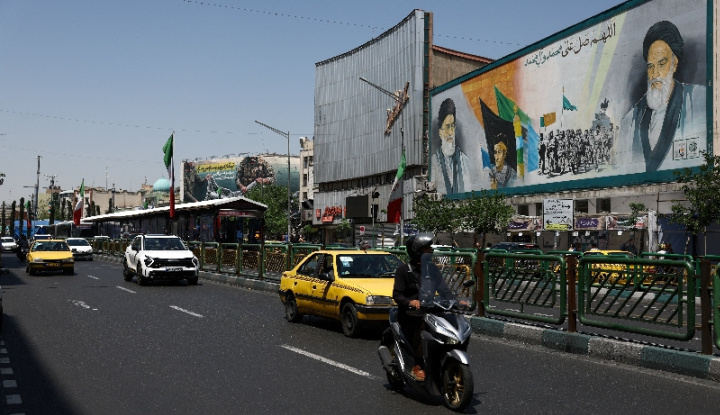
A mural depicting the late leader of the Islamic Revolution, Ayatollah Ruhollah Khomeini, and the late Iran’s Supreme Leader Ayatollah Ali Khamenei, in Tehran, Iran, May 12, 2026. Photo: Majid Asgaripour/WANA (West Asia News Agency) via REUTERS
US President Donald Trump said his patience with Iran was running out and that Chinese President Xi Jinping had agreed that Tehran must reopen the Strait of Hormuz, but China gave no indication it would weigh in.
As he flew back from Beijing on Friday after two days of talks with Xi, Trump said he was considering whether to lift US sanctions on Chinese oil companies buying Iranian oil. China is the biggest buyer of Iranian oil.
His comments shed no light on whether Beijing might use its influence with Tehran to end a conflict it said should never have started.
“I’m not asking for any favors because, when you ask for favors, you have to do favors in return,” Trump said, when asked by a reporter on his plane home whether Xi had made any firm commitment to put pressure on the Iranians to reopen the strait.
“We’ve wiped out their [Iran‘s] armed forces, essentially. We may have to do a little cleanup work.”
Xi did not comment on his discussions with Trump about Iran, although China‘s foreign ministry issued a blunt statement outlining Beijing’s frustration with the Iran war.
“This conflict, which should never have happened, has no reason to continue,” the ministry said.
‘WE WANT THE STRAITS OPEN,’ SAYS TRUMP
Iran effectively shut the strait to most shipping in response to US-Israeli attacks that began on Feb. 28, causing an unprecedented disruption to global energy supplies.
The US paused its attacks on Iran last month but began a blockade of its ports. Tehran said it would not unblock the strait until the US ended its blockade. Trump has threatened to attack Iran again if it does not agree a deal.
“We don’t want them to have a nuclear weapon, we want the straits open,” Trump said in Beijing, sitting alongside Xi.
Iranian Foreign Minister Abbas Araqchi said Tehran had received messages from the US indicating Washington was willing to continue talks.
“We hope that, with the advancement of negotiations, we will reach a good conclusion so that the Strait of Hormuz can be completely secured and we can expedite the normalization of traffic through the strait,” he told reporters in New Delhi.
Iran, which has long denied that it intends to build a nuclear weapon, has refused to end its nuclear research or relinquish its hidden stockpile of enriched uranium, to Trump‘s frustration.
“I am not going to be much more patient. They should make a deal,” Trump said in an interview aired on Thursday night on Fox News’ “Hannity” program, suggesting the enriched uranium only needed to be secured by the US for “public relations” rather than practical necessity.
Oil prices rose around 2% to around $108 a barrel on concerns over a lack of progress in resolving the conflict.
US Treasury yields hit their highest in around a year as traders anticipated the Federal Reserve may need to hike rates to rein in inflationary pressures from the blockade.
After talks between Trump and Xi on Thursday, the White House said Xi had made clear China‘s opposition to any Iranian effort to charge a toll for use of the strait.
Trump said Xi also promised not to send Iran military equipment. “That’s a big statement,” Trump said on “Hannity.”
Asked about US sanctions on Chinese oil refineries buying Iranian oil, he told reporters on his plane: “We talked about that and I’m going to make a decision over the next few days.”
IRAN SAYS IT DOES NOT TRUST THE AMERICANS
China has dismissed reports it had plans to supply weapons to Iran as “groundless smears,” but analysts doubt Xi will want to push Iran hard or end support for its military, given its value as a strategic counterweight to the US.
Talks on ending the war, which has become a liability for Trump ahead of key US midterm elections in November, have been on hold since last week when Iran and the US each rejected the other’s most recent proposals passed via Pakistan.
Iran would welcome any Chinese input, Foreign Minister Araqchi said on Friday, adding that Tehran was trying to give diplomacy a chance but did not trust the US., which has curtailed previous rounds of talks by launching air wars against Iran.
Iran is prepared for a resumption of fighting as well as for diplomatic solutions, Araqchi said, reiterating that vessels not linked to states attacking his country could traverse the Strait of Hormuz if they coordinated with Iran.
Before the war, about a fifth of global oil and liquefied natural gas as well as fertilizer and other vital supplies passed through the waterway. Attacks on shipping have prevented almost all traffic, although a huge Chinese tanker and another linked to Japan crossed the strait on Wednesday.
The UAE said it would speed up building a new pipeline to its port in Fujairah just outside the strait, after a vessel heading to it was sunk this week and another was boarded and redirected to Iran.
Thousands of Iranians were killed during the US and Israeli air strikes, and thousands have been killed in renewed fighting in Lebanon between Israel and the Iran-backed terrorist group Hezbollah.
With a fragile ceasefire in Lebanon due to expire on Sunday, discussions between Lebanese and Israeli officials were set to resume on Friday. Hezbollah opposes the talks, in which Israel is insisting on the group’s disarmament.