


Uncategorized
At Trump’s Christian revival on the National Mall, one rabbi made a Jewish case for America
On the National Mall Sunday, Christian worship music boomed from giant speakers as “Adonai” and other names of God flashed across jumbo screens behind a praise band. Pastors invoked America’s biblical destiny. Sadie Robertson, the Christian social media personality and granddaughter of Duck Dynasty patriarch Phil Robertson, preached from both the Old and New Testaments.
And then Rabbi Meir Soloveichik — the lone Jewish speaker at the planned nine-hour “Rededicate 250” rally called by President Donald Trump, billed as a national “jubilee of prayer, praise and thanksgiving” — stepped to the podium and began talking about Irving Berlin.
Soloveichik, 48, a scion of one of modern Orthodoxy’s most revered rabbinic families and a member of Trump’s Religious Liberty Commission, used his remarks to offer a Jewish case for American exceptionalism, a contrast to the explicitly Christian vision of the nation’s founding that defined the day.
Recalling how Berlin wrote “God Bless America” as fascism spread across Europe and antisemitism consumed the continent, Soloveichik described the song as both a patriotic anthem and a prayer of gratitude from a Jewish immigrant who found refuge in the United States. The hymn, he said, represented “a plaintive prayer to God that America continue to be blessed.”
The four-minute speech fit squarely within Soloveichik’s broader worldview. A senior scholar at the conservative Tikvah Fund and rabbi of Congregation Shearith Israel in Manhattan, the oldest Jewish congregation in the United States, he has long argued that America’s civic ideals are aligned with traditional Judaism and biblical morality. His 2024 book, Providence and Power: Ten Portraits in Jewish Statesmanship, examines Jewish political leadership through the lens of faith and moral responsibility.
For Soloveichik, the connection between Judaism and American identity culminated in the Second World War. He noted that “God Bless America” was first broadcast publicly the day after Kristallnacht, when Nazis destroyed Jewish homes and synagogues across Germany. “At the very moment when darkness deepened,” Soloveichik said, “America raised its voice united in the song that Irving Berlin wrote.”
He added that “in the years that followed 1938, the prayer that is ‘God Bless America’ was carried by American soldiers who defeated evil, liberating Europe and the world.”
Then came the line that drew some of the loudest applause of his remarks: “It is a reminder, as hatred of Jews makes itself manifest again, that antisemitism is utterly un-American.”
Separation of church and state
The moment captured the complicated role Jews increasingly occupy within the Trump-era religious right: embraced as part of America’s Judeo-Christian heritage, even as critics warn that the broader movement surrounding events like Rededicate 250 blurs the line between religious pluralism and Christian nationalism.
Rachel Laser, the Jewish CEO of Americans United for the Separation of Church and State, denounced the rally before the event. “If President Trump and his allies truly cared about America’s legacy of religious freedom, they would be celebrating church-state separation as the unique American invention that has allowed religious diversity to flourish in our country,” she said in a statement. “Instead, they continue to threaten this foundational principle by advancing a Christian Nationalist crusade to impose one narrow version of Christianity on all Americans.”
Sunday’s event — part revival meeting, part patriotic pageant — was the centerpiece of the Trump administration’s religious programming tied to this year’s 250th anniversary of the founding of the United States. Secretary of Defense Pete Hegseth and House Speaker Mike Johnson were slated to appear alongside evangelical pastors, worship leaders and conservative Christian influencers. President Trump and Vice President JD Vance were scheduled to address the crowd by video, while Trump himself spent the weekend golfing after returning from an overseas trip to China.
“This is a recognition of the deeply embedded history and religious and moral tradition of the country,” Johnson said Sunday on Fox News, dismissing criticism that the rally blurred the separation of church and state. Those objecting to the event, he added, “want to erase the history of America.”
No Muslim speakers appeared on the lineup. Organizers promoted Trump’s declaration of a national “Shabbat 250” observance the day prior as evidence of interfaith inclusion.
One of the Sunday event’s chief promoters, Trump spiritual adviser Pastor Paula White-Cain, had reassured supporters beforehand that the gathering would celebrate America’s Christian foundations without “praying to all these different Gods.”
Soloveichik did not address those tensions. Instead, he closed by returning to the image of America as a nation uniquely capable, in his telling, of transforming a Jewish refugee into the composer of one of the country’s most enduring patriotic hymns.
“To sing this song,” he said, “is to be reminded that America’s story is unique.”
“GOD BLESS AMERICA IS NOT JUST A SONG. IT’S A PRAYER.” 🇺🇸🙏
Rabbi Meir Soloveichik delivers a powerful reminder that America’s love of liberty has always been tied to faith — tracing its story and why anti-Semitism is fundamentally un-American. pic.twitter.com/aKMg42nS2I
— Real America’s Voice (RAV) (@RealAmVoice) May 17, 2026
The post At Trump’s Christian revival on the National Mall, one rabbi made a Jewish case for America appeared first on The Forward.
Uncategorized
A comedian went viral for saying he supports Israel onstage — he wasn’t even there
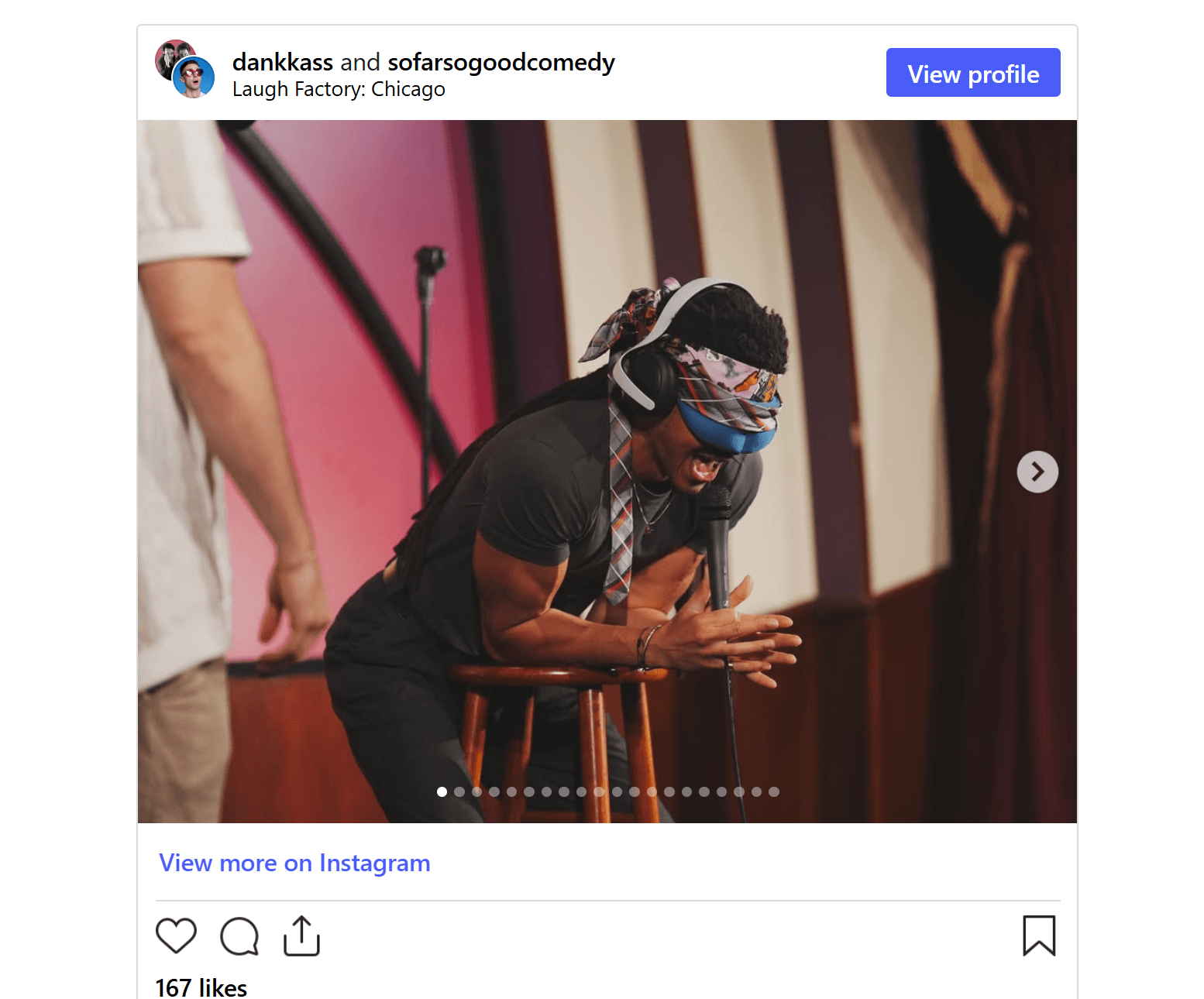
Menachem Silverstein’s High Holidays were interrupted by what he calls a beautifully ironic “monkey paw situation.”
“Like any good Jewish comedian, I’m in Rosh Hashanah services praying to God for a little bit of a boost in my career, for something to go viral, for something to hit,” Silverstein, a 30-year-old comic in Los Angeles, told me. “I turn my phone after hag. I have about 40-plus messages from people being like, ‘What the hell’s happening? Is this you?’”
Friends were sending him links to a video of a crowd leaving a theater in the middle of a standup set. The caption overlaid on the clip said, in English and Arabic, “audience walks out after comedian backs Israel.” On an X post with more than 2 million views, an account named “Truthseeker” identified the comic as Silverstein.
Silverstein knew immediately the video was of the Laugh Factory in Chicago, a venue he last played this summer. He had no memory of the crowd walking out — a traumatic experience for any standup. In fact, as he took a closer look at the video, he realized it wasn’t even him onstage.
“My most viral thing was not showing up to a comedy club, which is hilarious in itself,” said Silverstein, who estimates across platforms the clip has been seen more than 10 million times. “If I would have known, I would have missed more shows.”
By the time Silverstein was clued into his virality, it was too late to contain the disinformation.
Alex Jones picked the clip up, commenting, “It’s got one guy in a yarmulke. He literally says, ‘If you don’t support what Israel is doing in this war, leave.’”
No such statement is made in the clip. There’s no guy in a yarmulke, only a man in a dark t-shirt who appears to be blindfolded. This didn’t stop news outlets like Palestine Chronicle and the 1.1 million follower Global Reports Instagram account from running with the story.
Someone captioned the original clip — now deleted — indicating the comedian stated their support for Israel, leading to a mass exodus. From there, Truthseeker identified Silverstein as the comic, based, Silverstein believes, on a joke he retired about three years ago.
“Basically, the joke was, ‘Hi, my name is Menachem. I stand with Israel. It’s not political; they’re just the only people that can pronounce my name.’”
Grok and other AI models reinforced the claim that Silverstein was the person in the clip. But the real reason for everyone leaving their seats was something much less loaded: a prank.
David Fuhrer, president of the Laugh Factory said, based on an account confirmed by the Chicago Laugh Factory’s head of operations, that the video was from a Sept. 10 performance of a regular show called “What Could Go Wrong?,” in which practical jokes are played on comics.
“In this particular case, we had a comedian named Kieron Harrell and we blindfolded him and put headphones on him,” Fuhrer said. “They walked the entire audience out into the lobby as a joke so he had an empty room he was performing to.”
Fuhrer said it had “nothing to do with antisemitism or people walking out on Menachem.” He doesn’t know who repurposed the video, only that it had gone viral.
“It’s a shame because he’s a wonderful person and a great performer and a part of our family here.”
If you go to the “What Could Go Wrong?” Instagram, you’ll see a better image of the real comic, Harrell, who looks nothing like Silverstein.

Daniel Cassilagio, who produces “What Could Go Wrong,” captioned the images of the performer, saying the show was “so good that it was used as a geo political [sic] disinformation campaign.”
Cassilagio wrote on Instagram that the clip was recorded, uploaded without the producers’ knowledge and “then virally shared by what are most likely bots from China.”
People who don’t check their sources have “been harassing both the comic that was on stage, and a comic from LA who I’ve never even heard about or met,” Cassilagio wrote on a post that, judging by its 166 likes, has far less visibility than the fake account. “He wasn’t even in Chicago at the time.”
Silverstein told me that, while he added around 200 followers, he’s been inundated with hateful comments and his reach has dropped as people have been reporting his account. If you search his name now, the top hits are for his nonexistent scandal. When he’s looking to play clubs, he’s concerned that bookers will see he “walked a crowd” and deny him a slot.
Beyond the made-up controversy, there’s not much about geopolitics in Silverstein’s act. His material includes jokes on fatherhood, being 5’9” (“a Jewish 6’2”) and some well-deserved ribbing of Kanye West. In videos, he can be seen circumcising a baby carrot.
In an age when performers like Macklemore and Jerry Seinfeld have been canceled for their views on Israel and Palestinians, Silverstein sees a new frontier in his experience.
“It used to be you watch a podcast or watch a stand-up clip, clip someone out of context, post it, and get them canceled,” he said. “Now they’re getting away with just posting a random thing, putting your name on it, and then people believe it.”
The post A comedian went viral for saying he supports Israel onstage — he wasn’t even there appeared first on The Forward.
Uncategorized
‘Run, hide, fight’: Synagogues make threat preparedness part of High Holiday services
Rabbi Yosef Kanefsky plans to open his Yom Kippur sermon this year in an unusual way: with an emergency evacuation plan.
It’s how he opened his Rosh Hashanah sermon, too.
“I mentioned [that] people should understand where the exits are,” Kanefsky said. “I mentioned what our plan is, God forbid, if we need to evacuate the children in the youth program — that we have volunteers for that.”
Kanefsky, senior rabbi at B’nai David-Judea Congregation in Los Angeles, acknowledged that the reminder to prepare for the worst could be “potentially a little bit jarring” on the holiest days of the year. But with synagogues on heightened alert, he said, it felt unfortunately necessary.
“It’s just part of our lives right now,” he said. “That extra measure of vigilance.”
Extra security measures at synagogues are nothing new. Since the 2018 shooting that killed 11 worshippers at Pittsburgh’s Tree of Life synagogue, Jewish institutions have invested heavily in infrastructure, personnel and training to counter the threat of violence. But this High Holiday season, several synagogues are taking the unusual step of integrating emergency preparedness into the services themselves, whether through verbal instructions like Kanefsky’s or written plans handed out alongside prayer books.
A flyer distributed at Beth Tzedec Congregation in Toronto outlines a three-point plan in the event of an attack: Run, hide or — as a last resort — “Be prepared to defend yourself.”
“Remember: Your actions before police arrive may save your life,” it reads in all-caps.
In August, the Jewish nonprofit Secure Community Network released a safety card that synagogues can customize with their own evacuation maps then place in their pews. While a range of scenarios could prompt a building evacuation, like a fire or earthquake, the card focuses on reacting to an attack.
It includes instructions for how to make a tourniquet to stop bleeding and tips for fleeing or fighting “the shooter.”
And at Congregation Emanu-El in San Francisco, a flyer advising congregants to run, hide, or fight in the event of an attack was placed on every other seatback during Rosh Hashanah.
“It brought home the potential dangers in a way I hadn’t seen before,” Frances Dinkelspiel, a member of Congregation Emanu-El, told the Forward. “You’re going in for services. You’re opening your heart. There’s a sense of community. You’re embracing one another. And then there’s this piece of paper that’s reminding you: Don’t relax too much.”
Kanefsky said he felt a responsibility to his congregation to provide safety instructions, noting that the High Holidays may attract out-of-town visitors unfamiliar with the building.
But he also acknowledged that such warnings “can take away from the spiritual mood that we’re working so hard on building,” he said.
Kanefsky said he tried to make the announcement as unobtrusive as possible — giving the instructions in what he called “a spiritual and emotional envelope” by thanking the synagogue’s security team and framing preparedness as “part of the devotion to one another and our devotion to God.”
Michael Masters, Secure Community Network’s CEO, said the High Holidays present an elevated security risk at synagogues compared with other times of year. Even basic preparedness measures, like knowing where the exits are, can make a meaningful difference in a threat situation, he said.
He cited the ramming attack on Temple Israel in West Bloomfield, Michigan, in March as a prominent recent example. Seconds after the assailant drove a truck filled with explosives through a building entrance, a security guard opened fire on the vehicle; after the vehicle caught fire, the campus was safely evacuated.
“The guard was there, and he was well trained, and he did an amazing job, as did law enforcement,” Masters said. “But the faculty and the staff and the students were all trained as well.”
Dinkelspiel emphasized that she feels safe at her synagogue, which has a modern security system and bollards around the sidewalk to prevent cars from driving onto the property. But that sense of safety, she said, was part of what made the flyer so unnerving.
“After all these security measures the congregation has,” Dinkelspiel said, “there was still this reminder on this flimsy piece of paper that Jews can be attacked at any time.”
The post ‘Run, hide, fight’: Synagogues make threat preparedness part of High Holiday services appeared first on The Forward.
Uncategorized
Mamdani once vowed to arrest Netanyahu. Now he won’t join protests against him.
New York City Mayor Zohran Mamdani said Wednesday that he will not join protests against Israeli Prime Minister Benjamin Netanyahu when he arrives in the city to address the United Nations annual gathering next week and pushed back on the suggestion that he ever encouraged New Yorkers to protest the Israeli leader.
“I do not have any plans to attend any protest at the U.N. General Assembly,” Mamdani told reporters. “To New Yorkers, I have never encouraged them to protest. What I have always told them is that they have the right to do so in the city.”
But two months ago, when Mamdani was asked what New Yorkers frustrated with Netanyahu should do when the Israeli leader came to the city for the annual fall U.N. event, the mayor repeatedly pointed to protest as an option. “I think one of the bedrocks of our city is protest,” Mamdani said at a July 22 press conference. “It is something that has been a part of what makes our city so special: that New Yorkers can express themselves, whether they are in support or in opposition, no matter the topic.”
Mamdani’s July remarks came after a legal review the mayor ordered concluded that he lacks the power to order the arrest of Netanyahu, a pledge he made during his mayoral election campaign.
In July, when a reporter followed up directly, “Are you urging them to protest?” Mamdani stopped short of saying yes. But he again pointed to protests as a way for New Yorkers who oppose Netanyahu to make their voices heard. “I’m simply saying that this is a city where — if anyone feels a level of frustration or opposition, protest is something that we will always respect,” Mamdani said. “I leave it to New Yorkers themselves to make that decision,” he added.
From arrest pledge to protest rights
Mamdani had campaigned on ordering Netanyahu’s arrest based on a warrant issued by the International Criminal Court in November 2024, which accused the Israeli prime minister, former Israeli Defense Minister Yoav Gallant and Hamas military commander Mohammed Deif of war crimes and crimes against humanity. Netanyahu has rejected the charges. The United States is not a member of the International Criminal Court and the Trump administration imposed sanctions on the ICC months after it issued the warrants.
After taking office, Mamdani ordered a legal review and acknowledged in July that New York City does not have the authority to execute the ICC warrant.
He made that announcement in an unusual video address describing Netanyahu as “a war criminal, the architect of a horrific genocide against the Palestinian people” and declared that the Israeli leader would not be welcome in New York, home to the largest concentration of Jews in the United States.
The address drew criticism from Jewish leaders who questioned why the mayor was devoting so much attention to an arrest he acknowledged he could not legally carry out. The criticism came amid growing tension between Mamdani and parts of New York’s Jewish community over his rhetoric about Israel. Jewish organizations have also raised concerns about it contributing to a hostile climate for Jews across the city.
It was against that backdrop that Mamdani was pressed at the July press conference about what he would tell Palestinian supporters who had welcomed his promise to arrest Netanyahu, and were disappointed that he could not fulfill it. That is when he turned to protest as a remaining option. “I want to make it very clear that that welcome ends with me,” Mamdani said. “ I will not be welcoming Benjamin Netanyahu or any other war criminals when they come to this city.”
Netanyahu is expected to arrive in New York City next Wednesday under heavy security measures and address the U.N. General Assembly on Thursday before returning to Israel. One Israeli media outlet reported that the official plane carrying the Israeli leader, known as “Wings of Zion,” will land at Newark International Airport in New Jersey instead of John F. Kennedy International Airport in New York due to concerns that Mamdani could try to prevent the aircraft from remaining parked at JFK during Netanyahu’s visit.
Protests against Netanyahu are planned outside his hotel and near the United Nations during his address. Jewish groups are also planning a mass rally against antisemitism on Wednesday.
At Wednesday’s press conference, Mamdani drew a sharper distinction between encouraging protests and defending the right to hold them. “We respect that right,” he said. “And this is a city that is proud of the Constitution, proud of the First Amendment; we’ll continue to do so.”
Mamdani cited the same First Amendment right when asked about students from Ramaz and SAR, two prominent Modern Orthodox schools, who are planning a prayer vigil outside the mayor’s residence on Friday morning in support of Israel. “They can have a vigil, or I’ve heard some describe it even as a ‘protest,’” he said. “Whatever it is intended to be, they have the room and space to do so outside of Gracie Mansion. Though, he added, he would “probably be somewhere else across the city” when they gather.
The post Mamdani once vowed to arrest Netanyahu. Now he won’t join protests against him. appeared first on The Forward.
