



Uncategorized
Thomas Massie, Leading Anti-Israel Republican, Faces Trump-Backed Challenger on Primary Day in Kentucky

Uncategorized
Trump Says US May Strike Iran Again but That Tehran Wants Deal
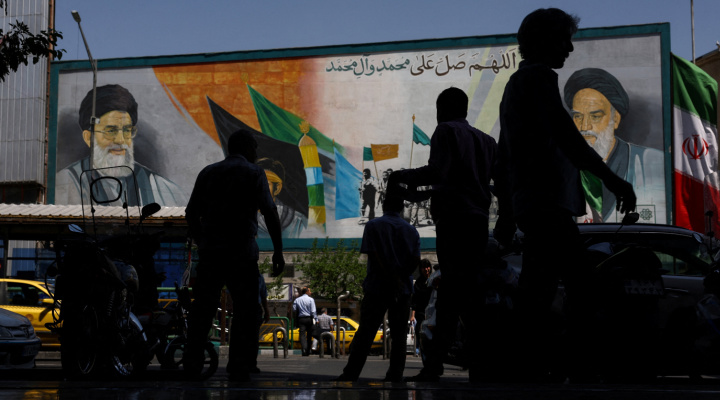
People walk past a mural depicting the late leader of the Islamic Revolution, Ayatollah Ruhollah Khomeini, and the late Iran’s Supreme Leader Ayatollah Ali Khamenei, in Tehran, Iran. Photo: Majid Asgaripour/WANA (West Asia News Agency) via REUTERS
President Donald Trump said on Tuesday that the United States may need to strike Iran again and that he had been an hour away from ordering an attack before postponing it.
Trump made the comments a day after saying he had paused a planned resumption of hostilities following a new proposal by Tehran to end the US-Israeli war.
“I was an hour away from making the decision to go today,” Trump told reporters at the White House on Tuesday.
Iran‘s leaders are begging for a deal, he said, adding that a new US attack would happen in coming days if no agreement was reached.
The United States has been struggling to end the war it began with Israel nearly three months ago. Trump has previously said that a deal with Tehran was close, and similarly threatened heavy strikes on Iran if it did not reach an accord.
The US president is under intense political pressure at home to reach an accord that would reopen the Strait of Hormuz – a key route for global supplies of oil and other commodities. Gas prices remain high and Trump‘s approval rating has plummeted as congressional elections loom in November.
Oil prices settled lower on Tuesday after Vice President JD Vance said Washington and Tehran had made a lot of progress in talks and neither side wanted to see a resumption of the military campaign. “We’re in a pretty good spot here,” he said.
Speaking to reporters at a White House briefing, Vance acknowledged difficulties in negotiating with a fractured Iranian leadership. “It’s not sometimes totally clear what the negotiating position of the team is,” he said, so the US is trying to make its own red lines clear.
He also said one objective of Trump‘s policy is to prevent a nuclear arms race from spreading in the region.
IRAN PROMISES RESPONSE TO ANY NEW ATTACK
In Tehran, Ebrahim Azizi, head of the Iranian parliament’s national security committee, said on X that pausing an attack was due to Trump‘s realization that any move against Iran would mean “facing a decisive military response.”
Iranian state media said Tehran‘s latest peace proposal involves ending hostilities on all fronts including Lebanon, the exit of US forces from areas close to Iran, and reparations for destruction caused by the US-Israeli attacks.
Tehran also sought the lifting of sanctions, release of frozen funds, and an end to the US marine blockade, according to Deputy Foreign Minister Kazem Gharibabadi as cited by IRNA news agency.
The terms as described in the Iranian reports appeared little changed from Iran‘s previous offer, which Trump rejected last week as “garbage.”
BOTH SIDES ‘CHANGING GOALPOSTS,’ SAYS PAKISTANI SOURCE
Reuters could not determine whether military preparations had been made for strikes that would mark a renewal of the war Trump started in late February.
Trump said on Monday that Washington would be satisfied if it could reach an agreement that prevented Tehran from obtaining a nuclear weapon.
A Pakistani source confirmed that Islamabad, which has conveyed messages between the sides since hosting the only round of peace talks last month, had shared the Iranian proposal with Washington.
The sides “keep changing their goalposts,” the Pakistani source said, adding, “We don’t have much time.”
CEASEFIRE MOSTLY HOLDING
The US-Israeli bombing killed thousands of people in Iran before it was suspended in a ceasefire in early April. Israel has killed thousands more and driven hundreds of thousands from their homes in Lebanon, which it invaded in pursuit of the Iran-backed Hezbollah terrorist group.
Iranian strikes on Israel and neighboring Gulf states have killed dozens of people.
The Iran ceasefire has mostly held, although drones have lately been launched from Iraq towards Gulf countries, including Saudi Arabia and Kuwait, apparently by Iran and its allies.
The US seized an Iran-linked oil tanker in the Indian Ocean overnight, the Wall Street Journal reported on Tuesday, citing three US officials. The tanker, known as the Skywave, was sanctioned by the US in March for its role in transporting Iranian oil, the report said.
Trump and Israeli Prime Minister Benjamin Netanyahu said they launched the war to curb Iran‘s support for regional militias, dismantle its nuclear program, destroy its missile capabilities, and create conditions for Iranians to topple their rulers.
But the war has yet to deprive Iran of its stockpile of near-weapons-grade enriched uranium or its ability to threaten neighbors with missiles, drones, and proxy militias.
The Islamic Republic’s clerical leadership, which had faced a mass uprising at the start of the year, withstood the superpower onslaught with no sign of organized opposition.
Uncategorized
Somaliland Says It Will Open an Embassy in Jerusalem, Israel to Reciprocate

Israeli Foreign Minister Gideon Saar meets with Somaliland President Abdirahman Mohamed Abdullahi on Jan. 6, 2026. Photo: Screenshot
Somaliland, a self-declared republic in East Africa, will set up an embassy in Jerusalem soon, its ambassador said on Tuesday, after Israel became the first country to formally recognize it as an independent and sovereign state.
In turn, Israel is expected to set up an embassy in Somaliland‘s capital Hargeisa, Ambassador Mohamed Hagi said in a post on X.
Somaliland, which has claimed independence for decades but remains largely unrecognized, is situated on the southern coast of the Gulf of Aden and bordered by Djibouti to the northwest, Ethiopia to the south and west, and Somalia to the south and east. It has sought to break off from Somalia since 1991 and utilized its own passports, currency, military, and law enforcement.
Unlike most states in its region, Somaliland has relative security, regular elections, and a degree of political stability.
Last month, Israel appointed Michael Lotem as its first ambassador to Somaliland, after the two governments formally established full diplomatic relations.
Lotem, who was serving as a non-resident economic ambassador to Africa at the time of his appointment, will now shift to work as a non-resident ambassador to Somaliland. He previously served as Israel’s ambassador to Kenya, Uganda, Tanzania, Malawi, and Seychelles, a position he concluded in August.
Israel recognized Somaliland as an independent and sovereign state in December, a move Somalia rejected and termed a “deliberate attack” on its sovereignty.
Over the years, Somalia has rallied international actors against any country recognizing Somaliland.
The former British protectorate hopes that recognition by Israel will encourage other nations to follow suit, increasing its diplomatic heft and access to international markets.
Israel‘s Foreign Minister Gideon Saar said on Tuesday that the opening of the embassy in Jerusalem would be another significant step in strengthening relations with Somaliland. Once opened, the Somaliland embassy would be the eighth embassy in Jerusalem, he said.
Most countries maintain their embassies in Israel in Tel Aviv, although the United States moved its embassy to Jerusalem during President Donald Trump’s first administration. Fiji, Papua New Guinea, and a small number of other countries have also established embassies there.
Israel considers all of Jerusalem to be its capital. However, Palestinians seek East Jerusalem, where the holiest sites in Judaism are located, as the capital of a future state.
Uncategorized
Lebanese People Broadly Support Hezbollah’s Disarmament, Peace With Israel, New Poll Finds

Rescuers work at the site of an Israeli strike that took place yesterday, in the southern suburbs of Beirut, Lebanon, May 7, 2026. Photo: REUTERS/Mohamad Azakir
In a notable shift in Lebanese public sentiment, a new opinion survey finds growing support for disarming Hezbollah and increased openness to a peace agreement with Israel, even as deep sectarian divisions persist and as the regional landscape remains volatile and uncertain.
According to the poll conducted by the research firm Information International and published on Monday by Lebanese broadcaster Al-Jadeed, a significant share of respondents supports direct negotiations between Lebanese and Israeli officials and a potential peace agreement with the Jewish state, while expressing strong opposition to the continued influence of the Iran-backed terrorist group Hezbollah in Lebanon.
Among the survey’s key findings, respondents were almost evenly split on responsibility for the current conflict, with 33.8 percent attributing blame to Hezbollah and 32.9 percent to Israel.
The newly released survey also found strong overall backing for disarming Hezbollah (58 percent in favor and 34 percent opposed), with support concentrated among Maronite, Orthodox, and Druze respondents, while opposition remained overwhelmingly high among Shiite participants.
By sectarian breakdown, support for curbing Hezbollah’s armed capabilities reached 89 percent among Orthodox Christians, 87 percent among Maronites, 77 percent among Druze, and 70 percent among Sunnis, whereas about 88 percent of Shiite respondents opposed the measure.
Most notably, the survey indicated relatively strong backing for a peace agreement with Israel among non-Shiite communities, with Druze respondents recording the highest support at 84 percent, followed by 77 percent of Maronites and 72 percent of Orthodox Christians, while 92 percent of Shiites opposed such an agreement. A striking 52 percent of Sunnis said they supported a peace deal.
With direct talks between Israeli and Lebanese officials resuming last week, the poll also showed varying levels of support for negotiations, including 78 percent among Maronites, 74 percent among Orthodox respondents, and 72 percent among Druze, compared with 93 percent opposition among Shiite participants.
Despite most Lebanese expressing support for negotiations and a potential peace deal to end the war, normalization with Israel remains unpopular, with only about 30 percent in favor and roughly 59 percent opposed.
By sectarian lines, support for normalization stood at 58 percent among Maronites, 49 percent among Orthodox Christians, and 79 percent among Druze, while opposition reached 94 percent among Shiites and 74 percent among Sunnis.
Last week, Israeli and Lebanese officials held a third round of talks in Washington aimed at advancing the negotiations, even as Hezbollah continued to reject disarmament and oppose any potential peace deal.
Inside Lebanon, fears are mounting that Hezbollah could trigger a new wave of political violence and destabilization as pressure intensifies to dismantle the Iran-backed terrorist group’s military grip.
Lebanese officials have reiterated that the decision to establish a state monopoly over weapons is final, though its implementation remains contingent on securing a broader security arrangement with Israel under US guarantees.
The Iranian proxy has accused Lebanese President Joseph Aoun and Prime Minister Nawaf Salam of betraying the “resistance” and collaborating with Israel amid ongoing direct bilateral negotiations, branding them “traitors” aligned with foreign interests.
The terrorist group has repeatedly defied international calls to disarm, even threatening protests and civil unrest if the government tries to enforce control over its weapons.
According to a new report from the Meir Amit Intelligence and Terrorism Information Center (ITIC), an Israel-based research institute, Hezbollah could once again resort to political assassinations in an effort to block moves perceived as existential threats to the organization and restore its power.
Hostilities between Hezbollah and Israel reignited on March 2, when the terrorist group opened fire in support of Iran two days after the start of the joint US-Israeli military campaign against the Iranian regime.
Since then, Israeli forces have established a “buffer zone” extending into southern Lebanese territory, which officials say is meant to shield northern residents from Hezbollah attacks amid thousands of rockets and drones fired throughout the war.
Even though a US-backed ceasefire has sharply reduced violence, negotiations and prospects for lasting peace remain fragile, with Israeli forces still launching strikes while positioned in southern Lebanon to maintain its buffer zone and dismantle Hezbollah military infrastructure.