


Uncategorized
Jewish, LGBTQ and progressive groups denounce Pride harassment of Jewish politician Scott Wiener
(JTA) — A growing number of Jewish, Democratic and LGBTQ figures are condemning the harassment of Jewish congressional candidate Scott Wiener by anti-Zionists at the San Francisco Trans March on Friday.
Wiener’s political opponent, meanwhile, did not condemn the incident directly when asked, instead disavowing “threats of violence and hate speech” more generally.
Wiener had been filmed at the march while several activists, including the man filming him, surrounded him and yelled at him about Gaza and Israel; he ultimately left the scene. The incident followed another at which Wiener was accused of supporting genocide while at a sports bar, and preceded a filmed anti-Zionist harassment of another local Jewish LGBTQ politician at a San Francisco Pride march.
The incidents have retriggered discourse about Jewish inclusion in LGBTQ and other left-wing spaces as anti-Zionist activists become more numerous and strident.
Assigned Media, a popular trans news outlet, denounced the Trans March harassment of Wiener led by local activist Dimitry Yakoushkin as “left antisemitism.”
“We need to reckon with the fact that Yakoushkin was able to incite an outpouring of rage against a Jewish man by mentioning Gaza,” the author, Evan Urquhart, wrote on Monday. “The only explanation for that is antisemitism. Enough attendees at the Trans Pride March were open to seeing a Jewish man as a proxy for Israel that Yakoushkin was able to whip them into a frenzy for his own purposes.”
Donations have also poured into Wiener’s campaign following the incident, with his campaign telling the San Francisco Standard that he received his highest single-day donation numbers afterward. Yet the harassment has raised questions about the viability of Jewish candidates like Wiener, who has said Israel committed genocide in Gaza while still seeking to maintaining a liberal Zionist identity.
Wiener, who is gay and is running for the seat being vacated by former U.S. House Speaker Nancy Pelosi, wrote in a lengthy statement that he had been chased out of the annual Trans March event while on his way to a Pride Shabbat. It was, he said, the first time he had been unable to participate in the event since it launched 22 years ago.
“They were so physically and verbally aggressive that it was impossible for me to safely remain in the park,” Wiener said in his statement, noting the protesters had “made statements about my ‘Israeli handlers,’ among many other inaccurate, extreme, and vile statements.”
The California Senate’s Democratic statehouse caucus condemned the harassment as “unacceptable,” calling Wiener “a fearless champion for the LGBTQ+ community even when it was not politically popular.” The caucus did not mention Israel or antisemitism in its statement.
“We are saddened and appalled that Senator Scott Wiener experienced antisemitic invectives, harassment, and physical intimidation while attempting to join the Trans March,” Jaimie Krass, president of the LGBTQ Jewish organization Keshet, said in a statement to the Jewish Telegraphic Agency.
San Francisco’s Jewish mayor Daniel Lurie, the local Jewish Community Relations Council, and The Nexus Project, a national antisemitism watchdog group that is more forgiving of anti-Zionist critiques than the Anti-Defamation League, all called Wiener’s harassment antisemitic.
At a Pride breakfast Sunday morning hosted by a historic San Francisco LGBTQ Democratic group, other local and national leaders expressed support for Wiener.
“Hate has no place in our community,” Imani Rupert-Gordon, president of the National Center for LGBTQ Rights, told Wiener at the breakfast, according to the Bay Area Reporter, a local LGBTQ news site. “Scott, you were treated horribly.”
San Francisco Board of Supervisors president Rafael Mandelson, who is gay and Jewish, said that what happened to Wiener “happens to gay Jewish electeds far too often. It is about Jew hatred. It is wrong.” Wiener himself did not mention either of his harassment incidents in his speech at the breakfast, according to the Reporter.
A spokesperson for Wiener did not respond to a JTA request for further comment. A request for comment to the Trans March was also unreturned; the march has released a statement on a separate incident, in which several participants were arrested following an altercation with police.
The targeting of Wiener was especially notable given that he has been celebrated locally for years as a lawmaker with a strong record on trans rights — something acknowledged by Yakoushkin, who in a video he filmed and posted, yells, “I think your policy on the genocide in Gaza is terrible,” as others yell expletives at the state senator.
“It’s sad because while he’s written some good legislation for queers, hes [sic] ultimately a genocidal-supporting center right shill,” Yakoushkin wrote on social media in a post accompanying his video of himself harassing Wiener. On Instagram, Yakoushkin called Wiener a “Yimby zionist,” using a shorthand for activists who push for more housing.
A JTA request to Yakoushkin for comment was not returned. A life coach, Yakoushkin told one critic on X, “i[f] he was great on Gaza I’d still roast his ass.”
Wiener had said during his primary campaign earlier in the month, in which he came in first, that he believed Israel had committed genocide in Gaza — a shift that came after pressure from the left and one that cost him a leadership role in the statehouse’s Jewish caucus and led to backlash from the Bay Area Jewish community.
Local anti-Zionist activists have continued to target him. The Trans March incident was the second such harassment Wiener faced in the past week. Days earlier, a local artist filmed himself confronting the candidate at a sports bar, shouting, “Wiener, you gotta get the f-ck up out my hood, bro,” and “It’s free Palestine here, you already know what it is — we against the genocide.”
The artist, Jesus “Frisco Lens” Coba, did not return a JTA request for comment. In his statement, Wiener said that Coba had in 2023 “stalked me on a plane and in an airport, shouting at me about my ‘tainted bloodline.’”
San Francisco Supervisor Connie Chan, who is running against Wiener in the November congressional runoff, did not directly address Wiener’s harassment in a statement she sent after JTA requested comment.
“As an elected leader, and a candidate running for office, I have experienced the rough and tumble of San Francisco politics including folks who disagree with us publicly and sometimes vehemently,” she said. “And I accept and understand this responsibility. And as someone who has been a target of hate and threats of violence, I stand firm against threats of violence and hate speech. There is no place for hate and violence in our City.”
Chan had also attended the Trans March and was feted there, including by some of the activists who harassed Wiener on camera. Asked by JTA if the harassment of Wiener was antisemitic, a Chan spokesperson responded, “In this moment, what matters is how State Senator Scott Wiener felt and feels about the interactions. We must stand in solidarity against hate whenever someone tells us they are experiencing hate.”
Democratic Rep. Ro Khanna, who represents a different Bay Area district, called the harassment of Wiener “simply wrong.” In the same statement, he promoted legislation to end the sale of military weapons to Israel.
“There is no place for harrasment [sic] or physical violence in our democracy,” Khanna, among the House’s fiercest Israel critics, wrote on X. “Let’s focus on passing @RepThomasMassie amendment to zero aid to Israel. Hold elected officials accountable. But do so in the spirit of building a politics of conviction and dignity, not insult and aggression.” A representative for Khanna did not return a JTA request for further comment.
Also over the weekend, an anti-Zionist activist filmed themselves harassing Manny Yekutiel, a local Jewish restaurateur running for San Francisco’s board of supervisors, while Yekutiel marched in a Pride event. The activist criticized Yekutiel, who is also queer, over having hosted Hen Mazzig, an LGBTQ pro-Israel activist, at his restaurant, because Mazzig served in the Israel Defense Forces.
Yekutiel’s campaign did not return a JTA request for comment; Yekutiel’s restaurant, Manny’s, has been targeted multiple times by anti-Zionists in the past.
“The person that you’re talking about, he was Israeli. I didn’t know that he was an IDF soldier,” he told the activist who confronted him in video from the march. The activist responded, “Well, maybe having Israelis at the cafe isn’t a good idea because it’s an apartheid state committing a genocide.”
Some local politicians jointly condemned the harassment of both Wiener and Yekutiel, linking their identities as Jews.
“The harassment campaign against Jewish candidates @Scott_Wiener + Manny Yekutiel is gross and unacceptable,” Trevor Chandler, a member of the San Francisco Democratic County Central Committee, wrote on X. Chandler added that the local Democratic group “condemns antisemitism.”
The day after Wiener’s harassment, two different groups of LGBTQ Jews had contrasting receptions at a New York Pride march.
One, Jewish Queer Youth, experienced a largely peaceful march; a second, fronted by Zioness, a more explicitly Zionist group, faced harassment. Another prominent Pride event, the NYC Dyke March, was staged on Saturday without many of its longtime Jewish participants, the Forward reported, after organizers stated for the second year in a row that anti-Zionism was a core value of the event; many Jewish former Dyke March organizers split away to form their own group.
Some Jewish LGBTQ leaders say the majority of such spaces remain welcoming. Krass, the Keshet president, said in her statement to JTA that “nearly every instance” of the “nearly 100 Pride events Keshet has organized this year” were “met almost entirely with celebration.”
In a newsletter on Monday, Krass told Keshet’s followers that she was “appalled” by some of the reactions to Wiener’s harassment.
“Some people are refusing to acknowledge that antisemitism played any role. Others are using this incident as an opportunity to project false, harmful generalizations onto the entire trans community,” Krass wrote. “I have even seen fellow Jews call for the Jewish community to abandon the LGBTQ+ community and our shared fight for equality. This is not the way.”
The post Jewish, LGBTQ and progressive groups denounce Pride harassment of Jewish politician Scott Wiener appeared first on The Forward.
Uncategorized
Vance, who’s drawn ire of Jewish conservatives, will speak at Republican Jewish confab
(JTA) — Vice President JD Vance, who has drawn the ire of a number of Jewish conservatives, will speak at the Republican Jewish Coalition’s annual summit in Las Vegas on Monday, the RJC confirmed.
“The Republican Jewish Coalition is proud to welcome Vice President JD Vance to our National Leadership Summit in Las Vegas,” said an RJC spokesperson. “JD Vance is a friend, who is coming back after first joining us in 2022 as a candidate for the US Senate.”
Vance’s appearance comes as a number of Jewish Republicans and major GOP donors have indicated that they would rather support Marco Rubio for the presidential nomination in 2028 than Vance, who is seen as Donald Trump’s likeliest successor. Some of those donors will be in the room on Monday at the Venetian Resort, which is owned by the billionaire Adelson family — a major backer of Trump and various Jewish and Israeli causes.
The vice president has lost the confidence of the pro-Israel crowd with his reprimanding of Israeli officials, indulgence of anti-Israel conspiracy theories and silence on Tucker Carlson, the prominent pundit who has spread antisemitic conspiracy theories. Multiple donors told the Jewish Telegraphic Agency during last year’s confab that they would not support Vance in 2028.
Carlson, meanwhile, was a major focus of the discussion at the RJC’s 2025 summit, where signs reading “Tucker is not MAGA” were handed out to attendees. His son, Buckley Carlson, is a former Vance staffer.
An agenda sent by the RJC lists Vance as a speaker during a Monday evening session that will be closed to press. A spokesperson confirmed that Vance will be speaking in a “fireside chat.”
A number of high-profile Republican candidates are also expected to speak at the RJC confab, which is being held on Sunday and Monday, a few months ahead of the midterm elections. Speakers include U.S. Senate candidates Mike Collins, the Georgia congressman who is challenging Jewish Democrat Jon Ossoff, and former Rep. Mike Rogers, who is running against Abdul El-Sayed in Michigan.
Collins has faced accusations of antisemitism and having ties to the far right. He has said that some of his statements were misunderstood, and has defended himself by citing his support for Israel.
This article originally appeared on JTA.org.
The post Vance, who’s drawn ire of Jewish conservatives, will speak at Republican Jewish confab appeared first on The Forward.
Uncategorized
Israeli expats push for voting rights in Oct. 27 election
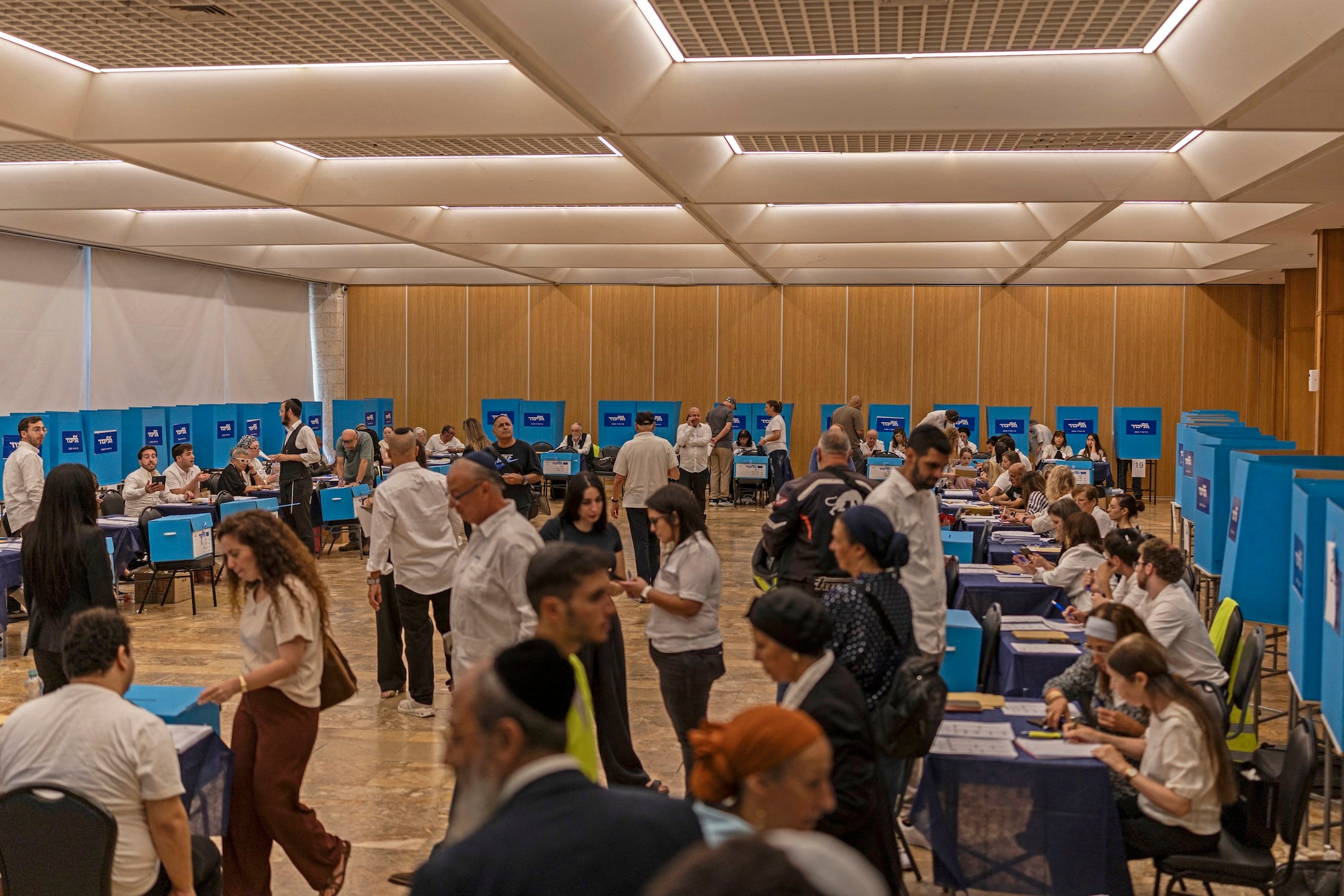
(JTA) — When Ilana Mittman, a retired social scientist with American and Israeli citizenship, began arranging a trip to Israel from her home in Baltimore, she planned to observe her late father’s Yahrzeit and cast her ballot in the national elections on Oct. 27. Checking her voter registration status online, she made a startling discovery: She had been excluded from the voter registry and was ineligible to vote.
The discovery came as a shock. Mittman’s mother was born in pre-state Palestine. Her parents had drained swamps in order to create arable land and served in the Haganah pre-state military organization.
Mittman has lived in the United States since 1980, having moved for her husband’s medical studies and career. But she has never viewed her life abroad as severing her ties to Israel. She watches television in Hebrew, follows the country’s news, stays in frequent contact with family, donates to the country’s emergency services and engages in pro-Israel advocacy efforts.
“I didn’t really choose to leave the country; I fell in love with a man who came from overseas, and I followed him,” she said. “I’ve grieved for the loss of my country and my friends … It’s been a constant, chronic sorrow.”
Puzzled by the discovery of her voter status, Mittman reviewed her records through the Ministry of Interior online portal and noticed that on March 7, 1986, her residency status had been altered under administrative “Code 51.”
That date matched a visit to the Israeli Consulate in San Francisco shortly after the birth of her son, where she went to register him as an Israeli citizen in accordance with consular requirements. She said that during that routine appointment, consular staff took away her state-issued ID card without explanation, leaving her with only her passport for foreign travel.
“I remember how bad of a feeling it was to give that document away,” Mittman recalled. “I felt I gave a part of myself away when that happened. But I didn’t know that my biggest right as a citizen – the right to vote – was just robbed from me.”
When she spoke with friends in the expat community, it turned out that others had found themselves in a similar situation. Some only made the discovery after they had already made expensive travel arrangements to return to Israel for the election, since voting must be done in person.
Trading notes in WhatsApp
Under Israel’s Basic Law: The Knesset, every Israeli citizen aged 18 or older has the right to vote, unless a court has deprived them of that right. In practice, however, voting is limited to those included in the voter registry.
Israelis whom the government classifies as nonresidents are assigned a designation known as Code 51 and removed from the voter registry, even though they retain their citizenship.
As expats across North America, Europe, Australia and South Africa began to realize in the lead-up to the October vote that they were no longer in the voting registry, they began comparing their experiences in a WhatsApp group that grew to some 120 members.
Some, like Mittman, had not voted in Israel for decades. Others, like kibbutz-born Ayala Graham, had returned to vote in the previous elections, held just four years ago. Yet others retained their eligibility, such as Graham’s husband, who hadn’t cast a ballot in Israel in four decades.
“My blood is boiling from this situation,” said Graham, who left Israel in 1986. “I am a citizen through and through, and I was very offended by this arbitrary rejection. I feel that in these elections, the situation is even more acute than in 2022.”
With the grounds for rescinding voting eligibility opaque and no easy path to appeal the exclusion, the disenfranchised Israelis decided to pursue legal action. They are calling the grassroots initiative to restore their voting eligibility “Our Right to Vote – Code 51.”

To challenge the Code 51 exclusions, the group raised money for legal representation through crowdfunding. Then they initiated a multi-stage legal strategy designed to exhaust administrative remedies before escalating to Israel’s Supreme Court.
Represented by attorney Gilead Sher, they submitted a Freedom of Information request to compel the Israeli Ministry of Interior to disclose the criteria behind the administrative “Code 51” designations. Then they sent letters to the Ministry of Interior, the attorney general and the Central Elections Commission requesting the immediate restoration of their status.
The Israeli Ministry of Interior has not yet responded to the group’s letter about Code 51, the criteria used to remove expats from the voter registry, or the total number of citizens affected by the regulation.
Israeli Ministry of Interior spokesperson Yaffa Shai did not address questions about the meaning of Code 51 posed by the Jewish Telegraphic Agency. Instead, she pointed to Israeli election law, which requires voters to be listed in the Population Registry as residents, with an address in Israel, and stressed that the ministry had conducted “an extensive multilingual campaign” urging citizens to check their voter status.
Since the law requires that the voting registry be finalized on Sept. 3, the legal team set a one-week deadline for administrative responses. If the matter remains unresolved, they intend to file an emergency petition directly with the Central Elections Commission and the High Court of Justice.
There is no known official count of how many Israeli expats have been excluded from the voter registry. “We received a rough, totally unofficial estimate of several dozen thousands, out of whom we represent about 120,” said Sher, the lawyer.
He stressed that there is also no clarity regarding the criteria used to remove citizens living abroad from the voter registry. “Our argument is that whatever this arbitrary Code 51 stands for or signifies, it cannot override the constitutional right to vote,” he said.
Sher acknowledged the possibility that some expats who travel to Israel to vote may only discover their status on election day. Given the tight timeframe before the election, Sher is seeking both temporary relief and an interim injunction in the petition to ensure eligible citizens are not disenfranchised while bureaucratic procedures are reviewed.
‘Essentially voter suppression’
On the West Coast, another Israeli expat, Silicon Valley attorney Rony Sagy, was struck by the arbitrariness of the system, particularly given her past travels to Israel during election cycles.
For the IDF elite unit veteran, maintaining a close connection to Israel has been consistent over decades of living in the U.S. Her career as a San Francisco–based lawyer has included serving as a legal bridge between Israeli startups and American tech companies, and she travels to Israel several times a year, renews her passport and keeps a permanent address in the country.

She suspects that her name was removed from the voter roll following a routine consulate visit for passport renewal sometime in the 1980s, during which she was required to surrender her domestic Israeli ID card. She noted that the experience was difficult enough for someone with deep connections to the country, but the lack of transparency surrounding the act added insult to injury.
“Voting was always very, very important to me,” Sagy emphasized. “My understanding was that my voting rights would not be hampered by the confiscation of my ID card. The uneven, unidentified way or form of removing certain people from the voter rolls is essentially voter suppression.”
The debate over Israeli citizens’ inability to cast ballots from abroad with limited exceptions (for example, official government representatives stationed abroad), has been ongoing for decades. Proponents of overseas voting note that most Western democracies allow it. Opponents argue that the large number of Israelis living abroad could potentially sway an election, even though those living in Israel bear the consequences of its outcome more directly.
Public opinion in Israel on overseas voting is split, though polls typically focus on whether expats should be allowed to cast ballots from abroad rather than retain their eligibility to vote if their center of life is elsewhere.
A survey last year by the Israel Democracy Institute found that 51% of Israelis opposed allowing citizens living abroad to vote from overseas, while 39% supported it. Opposition was particularly high among Arab respondents – 55% opposed, 36% supported – relative to Jewish respondents. Among Jewish respondents, opinion was evenly divided, with 45% supporting and 45% opposing overseas voting.
Attitudes were also strongly associated with respondents’ own willingness to leave the country. Among Israelis considering moving abroad, 52.5% supported overseas voting and 40% opposed it, compared to 34% support and 55% opposition among those not considering leaving Israel.
Members of the group challenging the denial of their eligibility to vote point to the global economy, which facilitates remote work, as well as the rising number of Israelis who have left the country since Oct. 7, 2023, due to Israel’s enmeshment in several regional wars. Some have deliberately chosen to disconnect. Mittman, however, believes that the number of years spent living abroad should not define the strength of one’s connection.
“What do you mean by center of life?” she asks. “If I spend hours a day immersing myself in Israeli culture, if I am supporting friends and relatives in Israel and charitable causes in every way I can … I feel that my heart is there, that I’ve never ceased to be an Israeli. So, what does it mean to be a citizen if you cannot vote?”
She insisted that this initiative to restore expats’ voting rights is not partisan: “If somebody told me today that I can vote, I don’t know who I’m going to vote for. I have not decided.”
Regardless of whether the legal challenges are resolved ahead of the election, she plans to make the trip, spending election day volunteering to help elderly and mobility-impaired voters reach their polling stations.
This article originally appeared on JTA.org.
The post Israeli expats push for voting rights in Oct. 27 election appeared first on The Forward.
Uncategorized
Jon Ossoff joins Democrats distancing from Hasan Piker
(JTA) — Georgia Sen. Jon Ossoff distanced himself from left-wing streamer Hasan Piker, who has called Ossoff a “dark-horse” presidential candidate, citing Piker’s “reckless and dangerous rhetoric” about American Jews.
Ossoff is facing criticism from some of his state’s local Jewish community over his votes to block certain arms sales to Israel. He has joined a chorus of Democrats who criticized Piker this week over recent comments that many interpreted as justifying threats to American Jews, including a number of democratic politicians.
Speaking on a Twitch livestream on Aug. 20, Piker stated, “If Jews in America keep putting this idea out there that they are singularly invested in Israel, eventually someone’s going to come around and take action.” Piker added, “Not against the state of Israel, mind you, but against American Jews.”
An Ossoff spokesperson told the Atlanta Journal-Constitution on Thursday that he “unreservedly rejects reckless and dangerous rhetoric suggesting that policy advocacy invites violence against the Jewish community or any community.”
“American Jews and all Americans must have the freedom and security to speak out and petition their government without fear of reprisal,” the spokesperson added.
Ossoff’s politics and sharp criticism of Trump have generated buzz about him potentially running for president in 2028, and have attracted some left-wing figures who have lauded his messaging.
Piker was initially among those figures, telling the Jewish Telegraphic Agency in April that he was “intrigued” by Ossoff.
“I think he’s very charismatic, and he’s done things that I’ve found to be interesting, given his position in Georgia, when he was one of the first lone voices in the Senate that actually was critical about sending aid to Israel early on,” Piker said at the time. “I was like, that’s a unique position for — he’s Jewish as well — for a young American Jew to take in Georgia.”
Piker said that he heard from young Georgian Jews in his online community who “could not believe that their synagogues and their rabbis and their organizations in their communities took out like a full page ad yelling at Jon Ossoff for taking a stance against arming the State of Israel.”
Ossoff’s campaign had never responded to requests for comment about Piker until Thursday, as a slew of Democrats condemned the anti-Israel streamer’s comments.
Later that day, Piker was decidedly less enthusiastic about Ossoff when speaking on his stream.
“I don’t like Jon Ossoff,” Piker said, adding that he had “wanted to see if he had the right instincts” before declaring himself a full-fledged supporter.
“This is a moment where it’s very clear that he does not have the right instincts.” he added.
In a post on X, Piker also explained how Ossoff’s Israel stance was what sparked his initial excitement about the senator.
“i think jon ossoff’s best strengths came from his lack of interest in attacking his left flank & focusing on trump’s corruption & scandals instead,” Piker wrote. “i said he was a dark horse because he’s been smart enough to back restrictions on weapons transfers to israel at times regardless of his incredibly conservative voting track record otherwise.”
The clash between Ossoff and Piker comes as members of the Jewish community in Atlanta have criticized the Jewish Democrat, largely over his votes to block certain arms sales to Israel. Ossoff is running for reelection in November in a high-profile battle against Republican Rep. Mike Collins that could determine which party controls the Senate.
Ossoff first voted to block weapons sales to Israel in November 2024, spurring a critical open letter from several Georgia Jewish organizations including synagogues, Jewish schools, the local Anti-Defamation League chapter and other groups. His vote also drew the attention of AIPAC, which released 30-second ads attacking U.S. senators — including Ossoff — who had voted to block weapons sales.
Michael Morris, publisher of the Atlanta Jewish Times, penned an open letter earlier this month blasting Ossoff for voting to block weapons sales to Israel again in July 2025 and April 2026.
“I hear you claim, over and over again, that you support Israel — that your support is ‘ironclad,’” Morris wrote. “It is not.”
Morris accused Ossoff in the letter of “lying to me and your constituents” about his support for Israel. Days later, Republican House Speaker Newt Gingrich appeared to run with that accusation in a post that attacked Ossoff, in response to the Senator’s remark about Donald Trump and his aide Natalie Harp.
“Ossoff routinely lies as the Jewish leaders in Atlanta pointed out recently and we should accept that he is a profoundly dishonest politician with no sense of honor,” Gingrich wrote.
Asked about Ossoff’s comments on Piker, Morris told JTA he agreed with the statement, but that it wasn’t enough to win his support.
“It’s better than him supporting Piker — absolutely, 100%,” Morris said. “But, you know, talk is cheap, and trying to push one extremist a little bit out of the envelope — it’s one little step forward. Very little.”
This article originally appeared on JTA.org.
The post Jon Ossoff joins Democrats distancing from Hasan Piker appeared first on The Forward.
