


Uncategorized
Israel’s Ethiopian asylum seekers fight deportation efforts

(JTA) — This story was supported by the Pulitzer Center.
TEL AVIV – When Endalkew Yemani Tesma fled Ethiopia in 2005, he did not know what awaited him on the way to Israel, nor that once he arrived, he would spend nearly two decades without permanent status.
He passed through Sudan, then Libya, then Sudan again, and reached Israel in 2008 by way of Egypt’s Sinai Peninsula. There, Yemani Tesma said, he was held captive and abused by Bedouin traffickers, treatment that refugee rights organizations in Israel have documented extensively among those who crossed the same route.
After claiming asylum due to civil unrest in his home country, Yemani Tesma was given a 2(a)5 visa, the renewable permit that lets asylum seekers stay while their claims are pending. He settled in Jerusalem, married a fellow Ethiopian asylum seeker and started a family. His children have grown up in Israeli schools and, by every measure that matters to them, as Israelis. Although they are not Jewish, their first language is Hebrew, and they learned Israeli history alongside Jewish traditions and holidays.
Yemani Tesma works at a hummus restaurant in Jerusalem, the kind of job he described as paying the bills and supporting his six children, but nothing beyond that. National Security Minister Itamar Ben-Gvir ate there once, Yemani Tesma recounted, “And he didn’t even try to deport me.”
But Yemani Tesma and his family are still in danger. A High Court decision last December allowed their group protection to be revoked. After years of feeling that they had found an oasis of safety, the family now faces the possibility of deportation. To prevent that from happening, a Jewish organization originally founded to help Jews fleeing Eastern European pogroms is taking the Israeli government to court.
Few given refugee status
Israel’s asylum approval rate is roughly 0.1%, or about five people a year, according to the UN High Commissioner for Refugees.
It’s so low that Sigal Rozen, the public policy coordinator at the Hotline for Refugees and Migrants, an Israeli NGO she helped found in 1998, can name those whose applications have been approved by first and last name. In the European Union, by comparison, 39% of asylum decisions in 2025 were approvals.
She claimed that the bureaucracy, and the deferral of decisions on some files for years, is deliberate. “They want to make life as difficult as possible, so that people give up and leave,” she asserted.
According to Israel’s Population and Immigration Authority, 1,334 asylum applications from Ethiopian citizens are currently pending. And Ethiopians are just a sliver of the asylum-seeking population. Roughly 30,000 asylum seekers live in Israel, a country of just over 10 million people. Most of those asylum seekers are Eritrean and Sudanese who crossed the Sinai before Israel completed its border fence with Egypt in 2013.
Eritreans still hold group protection that shields them from deportation, because Israel accepts that conditions in the country are too dangerous for them to return, and most Sudanese have obtained status through the courts, as Israel does not have official diplomatic relations with Khartoum and cannot deport them there. Ethiopians have no such shield.
Israel had granted group protection to Ethiopian nationals in light of the civil war between the Ethiopian armed forces and the Tigray People’s Liberation Front back in November of 2021. In January 2024, Israel’s then-Interior Minister Moshe Arbel withdrew it, citing advice that the security situation in Ethiopia was sufficiently stable for nationals to return. Arbel declined to be interviewed for this story.
In December 2025, the High Court upheld that decision, rejecting an appeal by the Hotline, HIAS Israel and the Aid Organization for Refugees and Asylum Seekers in Israel. The three-judge panel gave them four months to prepare to leave.
The Population and Immigration Authority has since begun pulling individual case files — some untouched for years — to the front of the queue in order to reject them, telling asylum seekers to leave the country or risk deportation.
Ethiopians whose claims have been rejected can now be detained if they come to a government office for any reason, Shahar Mandil, policy advocate at the Forum of Refugee and Asylum Seeker Organizations in Israel, said. Some do not know they have been rejected, as notices were sent to email addresses they no longer use or to lawyers who no longer represent them.
“A decision on an asylum application is delivered through the contact channels provided by the asylum seeker,” the Population and Immigration Authority told the Jewish Telegraphic Agency. “It is the asylum seeker’s responsibility to keep those contact details updated,” adding that every asylum seeker whose application is rejected is asked to leave the country.
The Population and Immigration Authority’s position is that conditions in Ethiopia no longer justify group protection, and that asylum seekers can return to the country’s capital of Addis Ababa even if other areas remain unstable.
Under international refugee law, a state can reject a claim of asylum by arguing that the applicant could move somewhere safer within their own country (known as an internal flight alternative). But that argument carries a requirement, said Nimrod Avigal, director of legal aid at HIAS Israel: “You need to show that this specific person can actually move within the country.”

Yordanos, who declined to give her last name for fear of deportation, said it was not possible to go elsewhere in Ethiopia. “We can’t move from one place to another,” she explained. “Any police checkpoint can stop you, depending on who you are and where you’re from.” When it comes to Addis Ababa, she continued, “Even if it were safe, it’s not possible. You can’t bring 130 million people to live in Addis,” referring to the entire population of Ethiopia.
Yordanos reached Israel in 2022 after securing a visa for a religious pilgrimage to Jerusalem, another route that many Ethiopian asylum seekers described taking to JTA. She and her husband hold advanced degrees and once ran a business that took them to more than 11 countries. In Israel, she cleans houses.
Israel historically backed refugee rights
On Sept. 22, the district court in Tel Aviv will hear a case seeking a new way to prevent the deportation of non-Jewish Ethiopians currently in Israel. A petition from HIAS Israel argues that the government has never created a mechanism for asylum seekers to claim protection from deportation under the principle of non-refoulement, which bars states from returning people to countries where they face danger.
HIAS was founded in 1881 as the Hebrew Immigrant Aid Society, to help Jews fleeing persecution in the Russian Empire. It spent the following century assisting Jewish refugees fleeing pogroms and the Holocaust. As Jewish migration slowed in the 2000s, the organization expanded its work to non-Jewish refugees, including Syrians, Afghans, Ukrainians and Somalis, dropping “Hebrew” from its name in 2014. Its Israel branch now represents non-Jewish asylum seekers, with the government of the Jewish state as the defendant.
Israel was among the first countries to ratify the 1951 Refugee Convention, and Israeli jurists helped write it, including Jacob Robinson, a Lithuanian-born legal adviser to Israel’s UN delegation who was a central figure in its drafting. The treaty’s cardinal principle is non-refoulement, that no state may return a person to a country where they face serious danger. Israeli courts operate on what Anat Ben-Dor, a clinical instructor at Tel Aviv University’s Refugee Rights Clinic who is currently handling several Ethiopian cases, called an interpretive presumption: “Unless there is clear contradictory legislation, the government should be assumed to abide by international law.”
James Loeffler, the Felix Posen Professor of Modern Jewish History at Johns Hopkins University, who studies the Jewish role in building the postwar human rights system, said the people who wrote those rules would not recognize what Israel is doing now. Robinson and his contemporaries “were committed to non-refoulement. They would have seen that as the cardinal principle above all and would be gravely disappointed by a situation in which Israel is sending thousands of people back to a country where they still face serious peril,” Loeffler said.
Not everyone sees the low asylum recognition rate as a failure, however. Yonatan Jakubowicz, founder and executive director of the Israeli Immigration Policy Center, which advocates for tighter immigration controls, argues that Israel has struck a deliberate balance between “maximum compliance with the principle of non-refoulement” and restricting long-term settlement and the “pull factor” it creates for mass migration.
Israel, he notes, is the only developed country with a land and sea border with Africa, apart from the Spanish enclaves of Ceuta and Melilla, into which roughly 70,000 people crossed from Morocco in a matter of days last month, prompting an emergency EU meeting.
Israel’s granting permanent residence to Ethiopians, Eritreans and Sudanese “could collapse its immigration policies, triggering a massive influx of illegal and mixed migration” over the Egyptian fence or by sea, “followed by a wave of family reunification requests.”
The route he described has been effectively closed for more than a decade; crossings from the Sinai all but stopped after the border fence went up. Most Ethiopians reached Israel by other means – on tourist or work visas or, like Yordanos, on visas for religious pilgrimage to Jerusalem – and applied for asylum after arriving.

Jakubowicz’s arguments are echoed elsewhere in the Western world. Earlier this month, a U.S. district judge cleared the way for the Trump administration to terminate Temporary Protected Status for Ethiopians, after the Department of Homeland Security announced in December that conditions in Ethiopia “no longer pose a serious threat to the personal safety of returning Ethiopian nationals.” The language is nearly identical to the advice Israel’s former interior minister, Arbel, cited in Jerusalem two years earlier.
Mola, who asked to be identified by his first name only as he still has family in Ethiopia and also fears deportation, worries that Israel will follow the U.S. lead and step up deportations of Ethiopian asylum seekers ahead of the national elections scheduled for Oct. 27 as a campaign victory for the right-wing coalition now in power.
“Every time there’s an election, asylum seekers suddenly become a target,” said Mandil of the Forum of Refugee and Asylum Seeker Organizations. “Because there are many groups, in many parts of the Israeli public, and it’s both the coalition and the opposition that make promises, trying to convince people to vote for them if only they can take care of this situation.”
In addition to repeating common tropes in the developed world tying migrants to theft and violence, Israelis who support cracking down on immigration often invoke another argument: demography. They worry that letting asylum seekers stay permanently in Israel would erode the Jewish majority of the Jewish state.
“The logic is, if we allow groups of non-Jewish people to stay here, they could, God forbid, marry Israelis, and that threatens Jewishness, the Jewish majority,” Mandil said. Loeffler traces the same anxiety to Israel’s unresolved conflict with the Palestinians. Non-Palestinian refugees, he said, have “absolutely gotten caught up in that struggle,” because Israeli leaders resist any move they fear “might open up more opportunities for Palestinians to make legal claims.”
Sivan Carmel, country director of HIAS Israel, calls the numbers argument a non-starter. “Israel has a population of about 10 million, this is 50,000, 60,000 people. It doesn’t make a dent in the demography of the country,” she said.
A clock that keeps ticking
The children of asylum seekers have long been a focus of civil society organizations working on their behalf. They argue that the state should treat them as cases separate from their parents and that even if Israel tries to deport the parents, the children are a different question. Mandil has spent years making that case in the Knesset.
“How can they be asylum seekers when 94% of them were born in Israel?” she said. Asked whether they speak Hebrew, she answered: “Completely. Better than I do.” Yet they are classified, she noted, not as asylum seekers but as infiltrators. “How can you be an infiltrator when you were born in Israel?”
Ethiopian asylum-seeking parents who spoke with JTA described a particular kind of parenting, shielding their children from what their lack of status would eventually cost them, while preparing them for the moment they turned 18 and found out.
Yemani Tesma likened it to a “a clock that keeps ticking. I know the alarm will ring, and I have to decide what to do by the time it does.”
Eventually, the time came.
When his son turned 16, his classmates began preparing for the military draft. His son, however, was left out. No call-up notice, no aptitude test, none of the photographs with families at the recruitment office. So he asked his father why.
“It is because you are not Israeli, and cannot become Israeli,” his father told him. His son shut his bedroom door, Yemani Tesma said, and did not open it for a day.
Israel, like most countries outside the Americas, does not grant citizenship on the basis of birth alone. A child’s status is derivative of a parent’s, said Ben-Dor of the Refugee Rights Clinic. Courts will occasionally make exceptions – for a child with a disability, or one whose integration into Israeli society is exceptional, say – but the government, she said, is wary of any principle suggesting that being born in Israel could confer legal status.
Ben-Dor is representing two Tigrayan mothers of children with special needs whose humanitarian applications cannot be considered at all because the Interior Ministry demands Ethiopian passports the women do not have in order to process their claims.
In early 2012, then-interior minister Eli Yishai lifted collective protection for South Sudanese nationals, clearing the way to deport 1,500 people. The first flight left Tel Aviv for Juba on June 17 of that year, in an operation the government called “Returning Home.” Civil war broke out the following year.
“Children who had studied in Israeli schools found themselves drawing water from wells in South Sudan,” HIAS Israel’s Avigal said. “These are Hebrew-speaking children.”
Why did we come here?
Most asylum seekers in Israel hold a 2(a)5 visa. “It’s a specific visa whose only function is to say you can’t be deported,” said Mandil. The visa is stamped “This permit is not a work permit.” Asylum seekers are able to work, however, because the state promised the High Court it would not fine their employers.
“Every right, every basic right, every social service, we have to fight for,” Mandil said. “They aren’t eligible for anything, not a driver’s license, not the ability to leave the country and come back, not health insurance, not higher education. Certain professions are closed to them because they have no status.”
That has left many Ethiopian asylum seekers in a cycle of poverty in the country where they sought refuge. Now, with a deportation deadline already behind them, 18 years after Yemani Tesma arrived and raised a family here, some are asking why they came at all.
Mola is a community leader and translator and spends his unpaid hours helping asylum seekers file petitions with the Interior Ministry.
“When I am not doing my backbreaking work,” he told JTA, “I do all I can to help asylum seekers fill out paperwork.” He once worked as a project coordinator and Amharic translator at the Canadian Embassy in Israel.
“Anyone who has had the option or ability to leave Israel for a third country has done so. Everyone who is left here has nowhere else to go,” he said.
In the aftermath of the Hamas-led attacks of Oct. 7, 2023, it seemed there might be an opening for the Ethiopian asylum seekers to cement their place in Israel.
As Israel’s largely foreign agricultural workforce was evacuated and Palestinian work permits were suspended, some of the people the Interior Ministry is now preparing to deport went to farms along the Gaza border to pick fruit.
Members of the Ethiopian asylum-seeking community bought supplies at supermarkets and delivered them to Israeli soldiers, Mola said.
Multiple busloads of asylum seekers traveled to farms in the envelope to harvest crops that would otherwise have rotted. None of them were paid. “After Oct. 7, we saw asylum seekers volunteering to assist people in the south, distributing food, volunteering in agriculture. I’ve seen it with my clients, and I’ve seen it with groups of asylum seekers,” Avigal, of HIAS, said.
Three months later, the Interior Ministry revoked their protection from deportation.
Asked whether any of this had left him bitter toward Israel, one Ethiopian asylum seeker, who asked not to be named for fear of deportation, rejected the premise. “I don’t hate,” he said. “Bless Israel.”
Told that someone else in his position might feel differently, he answered, “No. What we hate is the decision.”
Avigal added, “What we say at HIAS is, we used to help people because they’re Jewish, and now we’re helping people because we’re Jewish.”
This article originally appeared on JTA.org.
The post Israel’s Ethiopian asylum seekers fight deportation efforts appeared first on The Forward.
Uncategorized
Vance, who’s drawn ire of Jewish conservatives, will speak at Republican Jewish confab
(JTA) — Vice President JD Vance, who has drawn the ire of a number of Jewish conservatives, will speak at the Republican Jewish Coalition’s annual summit in Las Vegas on Monday, the RJC confirmed.
“The Republican Jewish Coalition is proud to welcome Vice President JD Vance to our National Leadership Summit in Las Vegas,” said an RJC spokesperson. “JD Vance is a friend, who is coming back after first joining us in 2022 as a candidate for the US Senate.”
Vance’s appearance comes as a number of Jewish Republicans and major GOP donors have indicated that they would rather support Marco Rubio for the presidential nomination in 2028 than Vance, who is seen as Donald Trump’s likeliest successor. Some of those donors will be in the room on Monday at the Venetian Resort, which is owned by the billionaire Adelson family — a major backer of Trump and various Jewish and Israeli causes.
The vice president has lost the confidence of the pro-Israel crowd with his reprimanding of Israeli officials, indulgence of anti-Israel conspiracy theories and silence on Tucker Carlson, the prominent pundit who has spread antisemitic conspiracy theories. Multiple donors told the Jewish Telegraphic Agency during last year’s confab that they would not support Vance in 2028.
Carlson, meanwhile, was a major focus of the discussion at the RJC’s 2025 summit, where signs reading “Tucker is not MAGA” were handed out to attendees. His son, Buckley Carlson, is a former Vance staffer.
An agenda sent by the RJC lists Vance as a speaker during a Monday evening session that will be closed to press. A spokesperson confirmed that Vance will be speaking in a “fireside chat.”
A number of high-profile Republican candidates are also expected to speak at the RJC confab, which is being held on Sunday and Monday, a few months ahead of the midterm elections. Speakers include U.S. Senate candidates Mike Collins, the Georgia congressman who is challenging Jewish Democrat Jon Ossoff, and former Rep. Mike Rogers, who is running against Abdul El-Sayed in Michigan.
Collins has faced accusations of antisemitism and having ties to the far right. He has said that some of his statements were misunderstood, and has defended himself by citing his support for Israel.
This article originally appeared on JTA.org.
The post Vance, who’s drawn ire of Jewish conservatives, will speak at Republican Jewish confab appeared first on The Forward.
Uncategorized
Israeli expats push for voting rights in Oct. 27 election
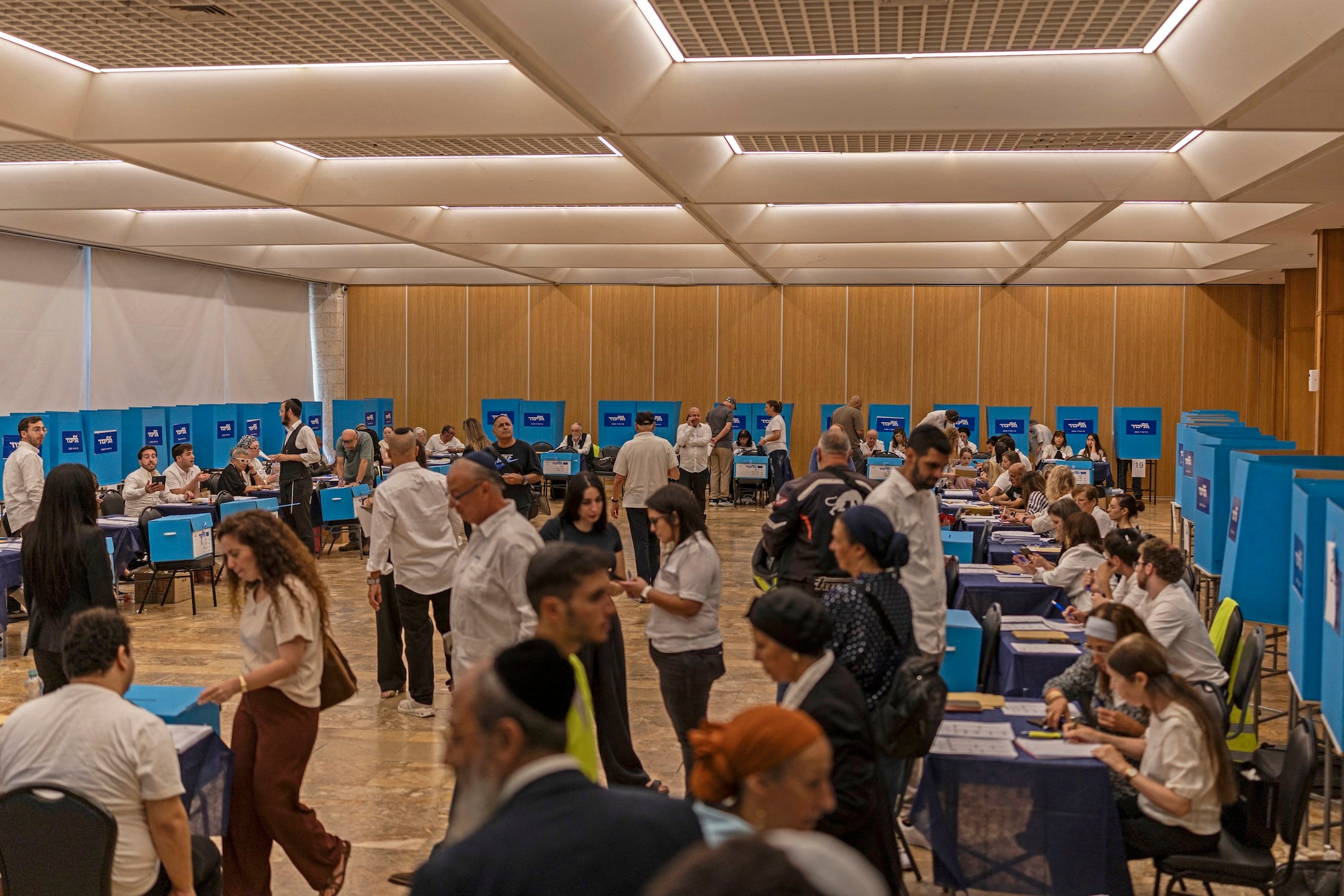
(JTA) — When Ilana Mittman, a retired social scientist with American and Israeli citizenship, began arranging a trip to Israel from her home in Baltimore, she planned to observe her late father’s Yahrzeit and cast her ballot in the national elections on Oct. 27. Checking her voter registration status online, she made a startling discovery: She had been excluded from the voter registry and was ineligible to vote.
The discovery came as a shock. Mittman’s mother was born in pre-state Palestine. Her parents had drained swamps in order to create arable land and served in the Haganah pre-state military organization.
Mittman has lived in the United States since 1980, having moved for her husband’s medical studies and career. But she has never viewed her life abroad as severing her ties to Israel. She watches television in Hebrew, follows the country’s news, stays in frequent contact with family, donates to the country’s emergency services and engages in pro-Israel advocacy efforts.
“I didn’t really choose to leave the country; I fell in love with a man who came from overseas, and I followed him,” she said. “I’ve grieved for the loss of my country and my friends … It’s been a constant, chronic sorrow.”
Puzzled by the discovery of her voter status, Mittman reviewed her records through the Ministry of Interior online portal and noticed that on March 7, 1986, her residency status had been altered under administrative “Code 51.”
That date matched a visit to the Israeli Consulate in San Francisco shortly after the birth of her son, where she went to register him as an Israeli citizen in accordance with consular requirements. She said that during that routine appointment, consular staff took away her state-issued ID card without explanation, leaving her with only her passport for foreign travel.
“I remember how bad of a feeling it was to give that document away,” Mittman recalled. “I felt I gave a part of myself away when that happened. But I didn’t know that my biggest right as a citizen – the right to vote – was just robbed from me.”
When she spoke with friends in the expat community, it turned out that others had found themselves in a similar situation. Some only made the discovery after they had already made expensive travel arrangements to return to Israel for the election, since voting must be done in person.
Trading notes in WhatsApp
Under Israel’s Basic Law: The Knesset, every Israeli citizen aged 18 or older has the right to vote, unless a court has deprived them of that right. In practice, however, voting is limited to those included in the voter registry.
Israelis whom the government classifies as nonresidents are assigned a designation known as Code 51 and removed from the voter registry, even though they retain their citizenship.
As expats across North America, Europe, Australia and South Africa began to realize in the lead-up to the October vote that they were no longer in the voting registry, they began comparing their experiences in a WhatsApp group that grew to some 120 members.
Some, like Mittman, had not voted in Israel for decades. Others, like kibbutz-born Ayala Graham, had returned to vote in the previous elections, held just four years ago. Yet others retained their eligibility, such as Graham’s husband, who hadn’t cast a ballot in Israel in four decades.
“My blood is boiling from this situation,” said Graham, who left Israel in 1986. “I am a citizen through and through, and I was very offended by this arbitrary rejection. I feel that in these elections, the situation is even more acute than in 2022.”
With the grounds for rescinding voting eligibility opaque and no easy path to appeal the exclusion, the disenfranchised Israelis decided to pursue legal action. They are calling the grassroots initiative to restore their voting eligibility “Our Right to Vote – Code 51.”

To challenge the Code 51 exclusions, the group raised money for legal representation through crowdfunding. Then they initiated a multi-stage legal strategy designed to exhaust administrative remedies before escalating to Israel’s Supreme Court.
Represented by attorney Gilead Sher, they submitted a Freedom of Information request to compel the Israeli Ministry of Interior to disclose the criteria behind the administrative “Code 51” designations. Then they sent letters to the Ministry of Interior, the attorney general and the Central Elections Commission requesting the immediate restoration of their status.
The Israeli Ministry of Interior has not yet responded to the group’s letter about Code 51, the criteria used to remove expats from the voter registry, or the total number of citizens affected by the regulation.
Israeli Ministry of Interior spokesperson Yaffa Shai did not address questions about the meaning of Code 51 posed by the Jewish Telegraphic Agency. Instead, she pointed to Israeli election law, which requires voters to be listed in the Population Registry as residents, with an address in Israel, and stressed that the ministry had conducted “an extensive multilingual campaign” urging citizens to check their voter status.
Since the law requires that the voting registry be finalized on Sept. 3, the legal team set a one-week deadline for administrative responses. If the matter remains unresolved, they intend to file an emergency petition directly with the Central Elections Commission and the High Court of Justice.
There is no known official count of how many Israeli expats have been excluded from the voter registry. “We received a rough, totally unofficial estimate of several dozen thousands, out of whom we represent about 120,” said Sher, the lawyer.
He stressed that there is also no clarity regarding the criteria used to remove citizens living abroad from the voter registry. “Our argument is that whatever this arbitrary Code 51 stands for or signifies, it cannot override the constitutional right to vote,” he said.
Sher acknowledged the possibility that some expats who travel to Israel to vote may only discover their status on election day. Given the tight timeframe before the election, Sher is seeking both temporary relief and an interim injunction in the petition to ensure eligible citizens are not disenfranchised while bureaucratic procedures are reviewed.
‘Essentially voter suppression’
On the West Coast, another Israeli expat, Silicon Valley attorney Rony Sagy, was struck by the arbitrariness of the system, particularly given her past travels to Israel during election cycles.
For the IDF elite unit veteran, maintaining a close connection to Israel has been consistent over decades of living in the U.S. Her career as a San Francisco–based lawyer has included serving as a legal bridge between Israeli startups and American tech companies, and she travels to Israel several times a year, renews her passport and keeps a permanent address in the country.

She suspects that her name was removed from the voter roll following a routine consulate visit for passport renewal sometime in the 1980s, during which she was required to surrender her domestic Israeli ID card. She noted that the experience was difficult enough for someone with deep connections to the country, but the lack of transparency surrounding the act added insult to injury.
“Voting was always very, very important to me,” Sagy emphasized. “My understanding was that my voting rights would not be hampered by the confiscation of my ID card. The uneven, unidentified way or form of removing certain people from the voter rolls is essentially voter suppression.”
The debate over Israeli citizens’ inability to cast ballots from abroad with limited exceptions (for example, official government representatives stationed abroad), has been ongoing for decades. Proponents of overseas voting note that most Western democracies allow it. Opponents argue that the large number of Israelis living abroad could potentially sway an election, even though those living in Israel bear the consequences of its outcome more directly.
Public opinion in Israel on overseas voting is split, though polls typically focus on whether expats should be allowed to cast ballots from abroad rather than retain their eligibility to vote if their center of life is elsewhere.
A survey last year by the Israel Democracy Institute found that 51% of Israelis opposed allowing citizens living abroad to vote from overseas, while 39% supported it. Opposition was particularly high among Arab respondents – 55% opposed, 36% supported – relative to Jewish respondents. Among Jewish respondents, opinion was evenly divided, with 45% supporting and 45% opposing overseas voting.
Attitudes were also strongly associated with respondents’ own willingness to leave the country. Among Israelis considering moving abroad, 52.5% supported overseas voting and 40% opposed it, compared to 34% support and 55% opposition among those not considering leaving Israel.
Members of the group challenging the denial of their eligibility to vote point to the global economy, which facilitates remote work, as well as the rising number of Israelis who have left the country since Oct. 7, 2023, due to Israel’s enmeshment in several regional wars. Some have deliberately chosen to disconnect. Mittman, however, believes that the number of years spent living abroad should not define the strength of one’s connection.
“What do you mean by center of life?” she asks. “If I spend hours a day immersing myself in Israeli culture, if I am supporting friends and relatives in Israel and charitable causes in every way I can … I feel that my heart is there, that I’ve never ceased to be an Israeli. So, what does it mean to be a citizen if you cannot vote?”
She insisted that this initiative to restore expats’ voting rights is not partisan: “If somebody told me today that I can vote, I don’t know who I’m going to vote for. I have not decided.”
Regardless of whether the legal challenges are resolved ahead of the election, she plans to make the trip, spending election day volunteering to help elderly and mobility-impaired voters reach their polling stations.
This article originally appeared on JTA.org.
The post Israeli expats push for voting rights in Oct. 27 election appeared first on The Forward.
Uncategorized
Jon Ossoff joins Democrats distancing from Hasan Piker
(JTA) — Georgia Sen. Jon Ossoff distanced himself from left-wing streamer Hasan Piker, who has called Ossoff a “dark-horse” presidential candidate, citing Piker’s “reckless and dangerous rhetoric” about American Jews.
Ossoff is facing criticism from some of his state’s local Jewish community over his votes to block certain arms sales to Israel. He has joined a chorus of Democrats who criticized Piker this week over recent comments that many interpreted as justifying threats to American Jews, including a number of democratic politicians.
Speaking on a Twitch livestream on Aug. 20, Piker stated, “If Jews in America keep putting this idea out there that they are singularly invested in Israel, eventually someone’s going to come around and take action.” Piker added, “Not against the state of Israel, mind you, but against American Jews.”
An Ossoff spokesperson told the Atlanta Journal-Constitution on Thursday that he “unreservedly rejects reckless and dangerous rhetoric suggesting that policy advocacy invites violence against the Jewish community or any community.”
“American Jews and all Americans must have the freedom and security to speak out and petition their government without fear of reprisal,” the spokesperson added.
Ossoff’s politics and sharp criticism of Trump have generated buzz about him potentially running for president in 2028, and have attracted some left-wing figures who have lauded his messaging.
Piker was initially among those figures, telling the Jewish Telegraphic Agency in April that he was “intrigued” by Ossoff.
“I think he’s very charismatic, and he’s done things that I’ve found to be interesting, given his position in Georgia, when he was one of the first lone voices in the Senate that actually was critical about sending aid to Israel early on,” Piker said at the time. “I was like, that’s a unique position for — he’s Jewish as well — for a young American Jew to take in Georgia.”
Piker said that he heard from young Georgian Jews in his online community who “could not believe that their synagogues and their rabbis and their organizations in their communities took out like a full page ad yelling at Jon Ossoff for taking a stance against arming the State of Israel.”
Ossoff’s campaign had never responded to requests for comment about Piker until Thursday, as a slew of Democrats condemned the anti-Israel streamer’s comments.
Later that day, Piker was decidedly less enthusiastic about Ossoff when speaking on his stream.
“I don’t like Jon Ossoff,” Piker said, adding that he had “wanted to see if he had the right instincts” before declaring himself a full-fledged supporter.
“This is a moment where it’s very clear that he does not have the right instincts.” he added.
In a post on X, Piker also explained how Ossoff’s Israel stance was what sparked his initial excitement about the senator.
“i think jon ossoff’s best strengths came from his lack of interest in attacking his left flank & focusing on trump’s corruption & scandals instead,” Piker wrote. “i said he was a dark horse because he’s been smart enough to back restrictions on weapons transfers to israel at times regardless of his incredibly conservative voting track record otherwise.”
The clash between Ossoff and Piker comes as members of the Jewish community in Atlanta have criticized the Jewish Democrat, largely over his votes to block certain arms sales to Israel. Ossoff is running for reelection in November in a high-profile battle against Republican Rep. Mike Collins that could determine which party controls the Senate.
Ossoff first voted to block weapons sales to Israel in November 2024, spurring a critical open letter from several Georgia Jewish organizations including synagogues, Jewish schools, the local Anti-Defamation League chapter and other groups. His vote also drew the attention of AIPAC, which released 30-second ads attacking U.S. senators — including Ossoff — who had voted to block weapons sales.
Michael Morris, publisher of the Atlanta Jewish Times, penned an open letter earlier this month blasting Ossoff for voting to block weapons sales to Israel again in July 2025 and April 2026.
“I hear you claim, over and over again, that you support Israel — that your support is ‘ironclad,’” Morris wrote. “It is not.”
Morris accused Ossoff in the letter of “lying to me and your constituents” about his support for Israel. Days later, Republican House Speaker Newt Gingrich appeared to run with that accusation in a post that attacked Ossoff, in response to the Senator’s remark about Donald Trump and his aide Natalie Harp.
“Ossoff routinely lies as the Jewish leaders in Atlanta pointed out recently and we should accept that he is a profoundly dishonest politician with no sense of honor,” Gingrich wrote.
Asked about Ossoff’s comments on Piker, Morris told JTA he agreed with the statement, but that it wasn’t enough to win his support.
“It’s better than him supporting Piker — absolutely, 100%,” Morris said. “But, you know, talk is cheap, and trying to push one extremist a little bit out of the envelope — it’s one little step forward. Very little.”
This article originally appeared on JTA.org.
The post Jon Ossoff joins Democrats distancing from Hasan Piker appeared first on The Forward.

You must be logged in to post a comment Login