


Uncategorized
At Jewish Republican summit, GOP casts midterms as a battle against DSA
(JTA) — LAS VEGAS – Speakers at the Republican Jewish Coalition’s annual convention at the Venetian Resort cast the upcoming midterm elections as a battle against not just the Democratic Party, but specifically its left-wing Democratic Socialists of America faction.
“A Democrat majority in November is not just a political setback for our party and our movement, it is a direct threat to the Jewish community,” said Joe Gruters, chairman of the Republican National Committee. “The people in charge would not be moderate Democrats who have occasionally pushed back on antisemitism. It would be the Squad. It would be the DSA.”
Ed Gallrein, the farmer and former Navy SEAL who defeated Kentucky Rep. Thomas Massie in a Republican primary back in May, said that “radical socialism sentiment is gaining ground across our nation,” calling November’s elections a battle between “the Constitution versus the Communist Manifesto.”
Georgia Rep. Mike Collins, who is challenging Democratic Sen. Jon Ossoff, accused the Jewish senator of using November’s election as a springboard to run for president in 2028 as “the DSA candidate.” (Ossoff has repeatedly denied having interest in running for president. He is also neither a DSA member, nor has he been endorsed by the group.)
Even the WiFi password for the Vegas confab — “DSA=AntiUSA” — offered a rejection of the group.
The RJC’s summit comes after a string of victories by DSA members and DSA-backed candidates in Democratic primaries across the country, sparking criticism from Republicans and moderate Democrats who oppose tenets of the group’s left-wing ideology, including its anti-Zionist stance.
The total number of House members endorsed by a DSA chapter could rise from two to seven, depending on how November shakes out, in addition to candidates in downballot races. Though there are 212 Democrats in the House, Republican officials on Sunday and Monday painted the Democratic party as one that is ceding control to the DSA.
China, Russia and Iran, Gallrein said, are hoping that “Democrats controlled by the DSA take the House and the Senate, and that they can exploit and divide America.”
Speakers panned other DSA-backed politicians such as New York City Mayor Zohran Mamdani and Michigan Rep. Rashida Tlaib, as well as the streamer Hasan Piker, who has fundraised for numerous DSA-endorsed candidates.
Florida Rep. Randy Fine specifically attacked Muslim politicians in the Democratic party, saying he was addressing “the elephant in the room.” He was among the speakers to say that there are anti-Israel and antisemitic voices on both ends of the political spectrum. The difference, he said, is that Republicans “repudiate this evil” with actions like voting out Kentucky’s anti-Israel congressman Massie, while Democrats elect anti-Israel candidates.
Tucker Carlson, the former Fox News personality who has spread antisemitic conspiracy theories in recent years, was repudiated by the RJC and also cast aside by the party’s leader, President Donald Trump. Trump’s second-in-command JD Vance, however, has made no such condemnation, to the chagrin of many Jewish Republicans.
With Vance set to speak at the RJC’s summit on Monday night, multiple Jewish Democratic groups blasted the RJC for hosting him, particularly in a session that is closed to the press.
“JD Vance may be speaking behind closed doors, but he should not be able to avoid questions about his attacks on Israel, his failure to confront antisemitism within the MAGA movement, and his continued alliance with Tucker Carlson,” said Brian Romick, president and CEO of Democratic Majority for Israel, in a statement.
“What’s next, a live taping with Tucker Carlson on the main stage?” the Jewish Democratic Council of America wrote.
In a statement to the Jewish Telegraphic Agency, the JDCA’s CEO Halie Soifer said, “The RJC may choose to highlight the less than ten DSA candidates on the ballot in November for their own cynical political purposes, but Jewish voters see past their deflection and lies, just as they see the Republican Party for what it is — the party of Donald Trump.”
This article originally appeared on JTA.org.
The post At Jewish Republican summit, GOP casts midterms as a battle against DSA appeared first on The Forward.
Uncategorized
Vance courts Jewish Republicans, but leaves Tucker Carlson ties unanswered
(JTA) — LAS VEGAS – Vice President JD Vance emphasized the importance of the American-Israel relationship, pinned rising antisemitism on immigration, and sidestepped a question about podcasters like Tucker Carlson, during a highly-anticipated, closed-doors appearance at the Republican Jewish Coalition’s annual summit on Monday.
Vance’s appearance came at a moment when a number of Jewish Republicans have turned against him over his reprimanding of Israeli officials, indulgence of anti-Israel conspiracy theories and his silence on Carlson, a prominent media personality who promotes such narratives.
Some donors have indicated that they would prefer Secretary of State Marco Rubio to Vance as the presidential nominee in 2028. Yet Vance was met with a standing ovation as he took the stage, and received another one as he left, according to multiple people who were in the room.
Following the event, RJC leaders said they felt the appearance was a positive step in the relationship.
“Today is not primary day. But I think today was progress day for JD Vance and the Jewish community,” RJC board member Ari Fleischer told reporters.
The summit’s Monday evening portion was closed to the press, but an audio recording of Vance’s 35-minute conversation with Norm Coleman — the RJC’s chairman — was sent to the Jewish Telegraphic Agency.
During the conversation, Coleman asked Vance where he drew the line when deciding which podcasts he could appear on. Coleman named Carlson, Megyn Kelly, Joe Rogan and Nick Fuentes as examples of hosts who have platformed antisemites, but Vance avoided mentioning Carlson, answering only about Rogan and Fuentes.
“I do not think that Joe Rogan and Nick Fuentes are the same, just substantively,” Vance said.
“Obviously I’m not going to talk to a guy who’s attacked my wife or said that Hitler is a good guy — but outside of some pretty bright lines, I try to talk to as many people as I can,” Vance said.
Vance’s response, which advocated for a wide-tent approach, drew applause in the room, though some were not pleased with the answer — nor the openness of the question.
“You might think that Norm Coleman — who owed his audience a bit more — would have said, ‘Let’s address this Tucker question once and for all: Where do you stand with him?’” said Neil Cooper, an RJC member who said he’s run out of patience with the vice president.
Sid Rosenberg, the right-wing firebrand radio host, wrote that Vance “had a chance to hammer @TuckerCarlson and @megynkelly but instead spent all his time defending @joerogan over Nick Fuentes.”
Ann Rubinfeld, an RJC member who supports Vance for 2028, said she is deeply opposed to Carlson but didn’t feel that the vice president needed to address Carlson head-on. “I don’t think that needs to be said,” she said.
Vance received a number of ovations during the conversation, including after Coleman commended him and Trump for leading what he said was the most pro-Israel administration in American history. Chants of “USA!” rang out as Vance took the stage. The warm reception may have come as a surprise for some in the room.
“This will be a tough crowd for him tomorrow,” Florida Rep. Randy Fine told reporters on Monday. In the morning leading up to Vance’s appearance, Rosenberg called on attendees to “give Vance a chance.” Ron Dermer, who has served as Israeli Ambassador to the United States and Strategic Affairs Minister, told the crowd, “I hope you all give him a warm welcome,” and thanked Vance for his “critical role” behind the scenes of the 12-day war fought with Israel against Iran in 2025.
Cooper said he’d expected “more skepticism, even bordering on stony silence” heading into the event, but hoped to be won over.
He added, “People get too excited by celebrities.”
Vance had made a stop in Michigan earlier on Monday, and told the room that he met with the rabbi of Temple Israel, as well as the security guards who helped prevent an antisemitic attack on the synagogue. Vance also referred to Michigan’s Republican nominee in the November senate race, Mike Rogers, who is facing Democratic nominee Abdul El-Sayed, in what he called “maybe the single most important candidate right now in this midterm election.”
Asked about his opinion on the U.S.-Israel relationship, Vance said Israel is “certainly one of our most important alliances in the world,” and that Israel and America or any of its allies must always be pursuing their own interests.
“I’m very much a foreign policy realist,” he said.
Vance also brought up the “growing suspicion” of the U.S.-Israel relationship among people under 40, and said “we have to articulate why this is in the best interest of the United States of America,” listing benefits such as intelligence collection and technology sharing.
Some of the heat Vance has drawn from Jewish Republicans has stemmed from comments he has made about Israel. In June, in response to criticism of the Iran deal, Vance said that Israeli cabinet members should not attack “the only powerful ally that I have anywhere left in the entire world.”
“We don’t forget statements like that,” Valerie Greenfeld, an RJC member who lives in Jerusalem, said in a text to JTA.
Speaking about the rise of antisemitism in the United States, Vance blamed it partly on immigration policy. He said that the increase comes from “people who are bringing ancient ethnic hatreds into the United States,” and that it is not a problem by-and-large among white Americans.
“You know, the Fuentes character who really does hate Jews — and also by the way, really hates me and my family, so you’re in good company — that is real,” Vance said. “But it’s not common among most of our fellow citizens.”
Vance condemned antisemitism, and drew applause when he told attendees, on behalf of the White House administration, “We love you guys, we appreciate you guys, and you will very much always be on the team so long as I have any say in it.”
Vance spoke about his own Christian faith and the connections between it and Judaism. He said he noticed similarities during a previous RJC event and at the wedding of his Jewish former chief of staff, Jacob Reses, where Vance did a reading.
“There were all these liturgical similarities between Judaism and Catholicism that are very fascinating,” Vance said.
Shabbos Kestenbaum, a Jewish conservative activist who attended the RJC confab, wrote afterwards that he appreciates Vance’s commitment to his religious beliefs, and that he agrees on forming foreign policy from an “America first” perspective. But Vance had more to prove, he said.
“His refusal to unequivocally denounce and condemn Tucker, who just called for Trump’s immediate removal, will make it very hard for the American Jewish community to consider his otherwise stellar policies,” he said.
This article originally appeared on JTA.org.
The post Vance courts Jewish Republicans, but leaves Tucker Carlson ties unanswered appeared first on The Forward.
Uncategorized
Israel and Greece ink defense deal to protect against regional threats
(JTA) — Israel and Greece finalized on Monday a $3.5 billion deal providing the Hellenic Republic with a multilayered antimissile system designed to protect the European Union country against aerial attacks from nations such as Iran and Turkey. It is one of the largest defense export deals in the history of the Jewish state.
The two countries “share common strategic interests and face shared regional challenges,” Israeli Defense Minister Israel Katz said in a press statement sent out after the deal was signed at Tel Aviv’s Ministry of Defense.
Called the “Achilles Shield,” the agreement was inked by the General Director of the General Directorate for Defense Investments and Armaments of Greece, Maj. Gen. Ioannis Bouras, and Israel’s Ministry of Defense Director-General reserve Maj. Gen. Amir Baram.
“At a time when actors with hegemonic ambitions are seeking to expand their influence and undermine stability in the region, Israel and Greece will continue to deepen their defense and strategic cooperation, and will act with determination to preserve stability and safeguard their security and shared interests.” Katz said.
Katz didn’t name Iran or Turkey in his remarks, but it was widely understood that the two countries pose regional concerns for both countries. Turkey and Greece are not just neighbors but historic enemies with several current disputes. As Israel’s relationship with President Recep Tayyip Erdogan has deteriorated, Jerusalem and Greece have drawn closer in an effort to counterbalance Turkey’s growing power.
At the same time, Iran launched ballistic missiles at Israel multiple times since 2024. Greece has not been under Iranian fire, but Tehran has threatened to attack European countries. Greece hosts a U.S. naval base and is among those European countries that are closer to Iran.
The agreement isthe “largest defense export deal in the history of Israel-Greece relations, and one of the largest in the history” of the country, Israel’s Defense Ministry noted.
The multilayered system Israel will build for Greece will mark the first time that it provides a country with a system that can combat a wide array of threats from ballistic missiles to drones, the ministry explained.
Among the systems included in the “Achilles Shield” architecture are David’s Sling, SPYDER, BARAK MX and MMR multi-mission radars for air surveillance.
The two countries on Monday also signed a supplementary deal valued at $30.2 million for the sale of the Israeli company Rafael’s Drone Dome systems.
Chairman of Israel Aerospace Industries Boaz Levy said during the recent fighting with Iran that Israel’s aerial defense systems had shown they could intercept “a range of threats, chief among them exoatmospheric ballistic missiles.” The same systems that defended Israel could also be used to help allies in Europe, Levy explained.
“We are proud to take part in the important ‘Achilles Shield’ project, and will continue to be key partners in additional projects in Greece and around the world, as we develop and build the next generation of defense technologies,” he added.
This article originally appeared on JTA.org.
The post Israel and Greece ink defense deal to protect against regional threats appeared first on The Forward.
Uncategorized
He was a privileged Jewish kid from NYC’s Upper East Side. Donald Trump was his greatest invention.
American Scoundrel: Roy Cohn’s Dark Journey from Joe McCarthy to Donald Trump
By Kai Bird with Susan Goldmark
Scribner, $32, 528 pages
By the beginning of the new millennium, Roy Cohn, the red-baiting scourge of the McCarthy hearings, lived largely in the pages of U.S. history books, trotted out on occasion to illustrate how America always manages to overcome its worst nativist impulses. But just in case someone never knew or had forgotten about Cohn’s malign influence on U.S. politics, Tony Kushner brought him back as a villain in his brilliant drama of the early 1990s, Angels in America.
Then, in 2016, Donald Trump was elected president and suddenly, Cohn was breaking news again. The very next year, when Trump was furious at then-Attorney General Jeff Sessions for recusing himself from an investigation into whether Russia meddled with the election, the president cried out to his advisers, “Where’s my Roy Cohn?”
Now, as if in answer to that question, Kai Bird has written a magisterial biography of the notorious lawyer and Trump whisperer that is indispensable reading for anyone who wants to understand the current political moment. Bird, the co-author of American Prometheus, the Pulitzer Prize-winning biography of Robert J. Oppenheimer and inspiration for the Oscar-winning movie, began it in 2022, a couple years before Trump’s re-election. He collaborated with his wife, Susan Goldmark, who did the research for this riveting account of the unseemly, outrageous life of the hustler and con man about whom Trump once said, “If you need somebody to get vicious, hire Roy Cohn.”
Though Cohn has been long gone from public life — he died of AIDS at age 59 in 1986, insisting to the very end that he had succumbed to liver cancer — Bird demonstrates how he practically invented the dark political arts of resentment and division adopted by his former client, protégé and future president of the U.S.
Indeed, over the recent 4th of July weekend — decades after the collapse of the Soviet Union — Trump used Cohn’s divisive, inflammatory rhetoric in back-to-back speeches, including one at Mount Rushmore, branding his political opponents as evil, godless communists.

Bird walks us through Cohn’s life decade by decade. He grew up as an only child in a wealthy Jewish family on the Upper East Side and attended elite private schools, where his boyhood friends included Si Newhouse Jr., heir to the Condé Nast media empire, Gene Pope Jr., who would go on to found the National Enquirer, and, improbably, Al Lowenstein, later a well-known liberal Democratic activist and politician.
After Cohn graduated from Columbia Law School, his father, a judge, pulled strings to get him a job in the U.S. attorney’s office for the Southern District of New York, where he made a name for himself as the boy prosecutor who sent Julius and Ethel Rosenberg to the electric chair in 1953 for passing nuclear secrets to the Soviets. His tactics were highly irregular, including private meetings with the trial judge.
Not long after that, he went to work as chief counsel to Wisconsin Senator Joe McCarthy, using his position to force U.S.-funded libraries abroad to purge 30,000 books on the flimsy pretext that the authors were communists or Soviet sympathizers. He was also a central figure in the so-called Lavender Scare, when hundreds of federal employees thought to be gay lost their jobs because they were deemed a security risk.
By the 1960s, Cohn was back in New York, hanging out at the Stork Club and 21, squiring Barbara Walters around town, and representing mobsters though still living at home with his mother at 1165 Park Avenue. Over the next decade he would be indicted three times by U.S. Attorney Robert Morgenthau Jr. for bribery, perjury, extortion and other white-collar crimes. In each case, he managed to beat the rap though months before his death he was finally disbarred for unethical conduct.
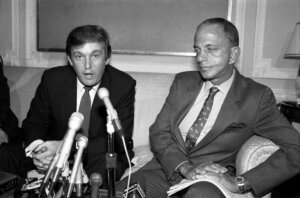
After Cohn’s mother died in 1967, he moved into a stately townhouse on East 68th Street, where he established his law practice and stopped the pretense of dating women though he never publicly came out as gay. Then, in 1973, Cohn met his most consequential client. At the time, Trump was the 27-year-old son of a Queens real estate mogul trying to break into the Manhattan market and living in a rent-controlled studio on East 75th Street with a view of a water tank on an adjacent building.
Cohn advised the family on how to fight a Justice Department lawsuit accusing the real estate company of violating the Fair Housing Act by refusing to rent to Black tenants. Over the course of the litigation, Cohn taught Trump his signature moves: Keep your name in the paper. Never settle. Countersue. Claim victory. Don’t pay the bills.
Cohn also advised Trump on his first major real estate deal in Manhattan — buying the dilapidated Commodore Hotel on East 42nd Street, next to Grand Central Terminal. To get the deal done, Cohn worked his extensive connections to New York’s first Jewish mayor, Abraham Beame, a player in Democratic machine politics and an old friend of Cohn’s father.
For more than a decade, Trump continued to model himself after his mentor, adopting his penchant for personalized license plates and his snarling, scowling demeanor. Bird argues that in the decades since Cohn died, the McCarthyism of the 1950s has morphed into a nativist, America Firster politics that transformed the Republican Party into one of resentments against the old establishment, multiculturalism, globalization and liberal culture — in other words, the MAGA movement of today.
Cohn’s “values, his unethical behavior, and his political mindset have survived and replaced the values of the establishment he so resented,” Bird writes. “Perhaps his life is proof of the ability of one individual to change the arc of history. Certainly, he gave us the narcissistic politics of Donald Trump.”
The post He was a privileged Jewish kid from NYC’s Upper East Side. Donald Trump was his greatest invention. appeared first on The Forward.

You must be logged in to post a comment Login