


Uncategorized
Massachusetts progressive Markey, a longtime Israel critic, expected to rout centrist challenger
(JTA) — Massachusetts incumbent and Israel critic Sen. Ed Markey, 80, is expected to handily fend off the more moderate 47-year-old Rep. Seth Moulton on Tuesday, in the state’s Democratic Senate primary.
Although polls project that Markey, a progressive stalwart, will retain his seat, this race began as a neck-and-neck battle between the old and new guard. Yet in contrast to many recent primaries, the junior candidate in this case is the more centrist of the two.
If current numbers hold, Markey could go from leading Moulton by just single digits two months ago, to trouncing him by 30 percentage points. The incumbent recently “opened a large lead,” with the University of New Hampshire’s Bay State Poll projecting a 63% to 28% victory. That’s a dramatic shift from June, when the survey estimated a 41% to 35% margin. Since then, according to Bay State, Moulton lost moderate support while Markey consolidated socialist and progressive backing.
The University of Massachusetts Amherst offered similar predictions, placing Markey far ahead of his competitor, 60% to 32%. Emerson College Polling, meanwhile, showed a comparable lead for Markey, with the incumbent at 60% and Moulton at 33%.
“At the end of the day, one of the reasons for Moulton’s flame-out is that he had no case to make other than ‘I’m younger than Ed Markey,’” Jeff Robbins, a Boston-based attorney and former Senate investigative counsel, told the Jewish Telegraphic Agency.
“He wasn’t able to obscure that very well,” added Robbins, who also served as delegate to the United Nations Human Rights Commission under President Bill Clinton. He also began organizing rallies in support of Israel in 2012, during his time serving as chairman of the New England Board of the Anti-Defamation League.
Markey began serving in the U.S. House of Representatives 50 years ago, staying in that role until he was elected to the Senate in 2013. During his time in the House, he was a member of the Congressional Progressive Caucus, and in the Senate, he has voted for multiple resolutions aimed at cutting military aid and munitions sales to Israel.
Moulton, meanwhile, was born two years after Markey arrived on Capitol Hill. He has been serving in the U.S. House since 2015 and has been critical of both the Democratic socialist agenda and the aging establishment, instead calling for “new energy, new ideas and leaders willing to put people over politics.”
He established the Serve America PAC in 2017 to support the campaigns of “military veterans, other service-driven candidates and next generation leaders” in the 2020 election cycle. The Boston Globe recently threw its support behind Moulton, calling for “new vision and vigor” in “an aging, ailing and deeply unpopular Democratic Party.”
Yet a recent New York Times piece described Moulton as a “rebel without a cause,” who has “tried to drift where he thinks the political winds are blowing.” One such drift relates to his breakup with the American Israel Public Affairs Committee last October, when he announced that he would be “returning AIPAC donations and refusing to accept any donations or support from them.”
“In recent years AIPAC has aligned itself too closely with Prime Minister Netanyahu’s government,” Moulton said. “I’m a friend of Israel, but not of its current government.”
Track AIPAC, a group that documents political spending by pro-Israel lobbies, declared in response that “returning AIPAC’s blood money is better late than never.” The group demanded that Moulton call the war in Gaza a genocide and “stop writing blank checks” to Israel’s “tyrannical regime.”
Citing Federal Election Commission records, Track AIPAC found that pro-Israel PACs have spent about $101,500 on Moulton over his career — a relatively modest amount for a six-term congressman..
“It is clearly the safe thing to do, if you are running for a nomination in the Democratic Party, to aggressively distance yourself from Israel,” said Robbins.
He described the situation as “reflective of the reality that we have seen play out in spades over the last year,” in which Democratic candidates are “running for the hills about AIPAC and treating it as a boogeyman.”
Not only was Moulton’s decision insufficient to recruit AIPAC detractors to his campaign, but it also rattled many members of the Jewish community.
Political scientist Samuel Abrams at the time described the decision as “the moment when an ambitious, mainstream Democrat concluded that distancing himself from the organized Jewish community is a political asset, not a liability.”
“In today’s Democratic ecosystem, the act of rejecting traditional Jewish institutions has become a badge of progressive credibility,” wrote Abrams, a senior fellow at the American Enterprise Institute, a center-right public policy think tank.
David Frum, a writer for The Atlantic and former speechwriter for President George W. Bush, suggested that Moulton was “opening the door *just a little* to anti-Jewish feeling,” In other words, Moulton would seek to win his primary by borrowing some “Mamdani energy,” Frum added, referring to the popular progressive mayor of New York City, Zohran Mamdani.
“If you want to have a prayer of being elected in a Democratic primary in this country, you had better be able to say, ‘I don’t take money from AIPAC. In fact, I never heard of it before,’” Robbins said.
But he stressed Moulton’s 30-point lag in the polls has nothing to do with Israel and everything to do with his opponent’s political shrewdness and refusal to allow anyone “to run to the left of him.”
Markey is not new to staving off a younger, center-left candidate. In 2020, at 74, he defeated the then-39-year-old Rep. Joe Kennedy III — marking the first loss for a Kennedy in a Massachusetts election, according to the Cook Political Report.
If the current polls prove accurate, Tuesday’s race could “mirror Markey’s successful ‘peak-late’ approach to winning in 2020,” Spencer Kimball, executive director of Emerson College Polling, said in a statement. “Younger voters appear more likely than older voters to support Markey, suggesting the campaign did not create the generational divide Moulton may have anticipated.”
As for Moulton’s relationship toward American Jews, he has historically denounced hate crimes and voted for resolutions on antisemitism. He also condemned Claudine Gay, former president of his alma mater, Harvard University, when she refused to say that calling for the genocide of Jews would violate the institution’s code of conduct.
Prior to his rejection of AIPAC money, Moulton’s stance on Israel was fairly balanced, with consistent messages on Israel’s right to defend itself, alongside criticisms of the country’s military operations in Gaza and calls for expansions of humanitarian aid.
Moulton’s objections have paled in comparison to Markey’s stance, which has ranged from demanding an end to arms sales to accusing the country of committing war crimes.
Markey did condemn Hamas’s Oct. 7, 2023 attack on Israel as terrorism, continuing to deplore the “dark day” as “heinous” in a statement two years later. But in that same statement, he also stressed that “more than 65,000 Palestinians have lost their lives in the brutality of the war in Gaza” and called “to stop the bloodshed.”
However, the senator didn’t always disapprove of Israel.
“For a long time he was right there with the Jewish community,” Barry Shrage, a professor of practice at Brandeis University and the longtime former president of the Combined Jewish Philanthropies of Greater Boston, told JTA.
In fact, Shrage and Robbins recalled in a recent Boston Herald column that during a November 2012 Hamas-Israel conflict, Markey asked them to help him organize a pro-Israel rally. The event, they wrote, was “full of appreciation for the fundamental fact that Israel is surrounded by non-state and state actors committed to annihilating it.”
But less than two years later, the tides had turned. After winning a 2013 special election to serve out the remainder of John Kerry’s Senate term, Markey then faced a general election in 2014 for a full Senate term. That summer, Hamas rockets rained down on Israel again, and the military responded to the attacks, as it did in November 2012.
Robbins said that when he and his colleagues decided to organize another rally in support of Israel at the time, he reached out to Markey.
“He ducks. He dodges. He doesn’t return the phone calls. He doesn’t return the emails,” Robbins recalled. “He had calculated correctly that it was not in his interest to have anything to do with Israel anymore.”
Shrage echoed these sentiments, observing that “it turned out to be at least from a political standpoint, if not from a moral standpoint, the right path.”
“It’s not a surprise that Markey is separating himself from Israel in every way that he can,” he added.
Looking toward the future, Shrage said that he had some hope for a turnaround on Israel in the Democratic party if, perhaps, a recent progressive primary winner lost against a Republican in the general election. Some possible examples could include Senate candidates Angie Nixon in Florida or Abdul El-Sayed in Michigan.
While Robbins agreed that a loss for El-Sayed could give a slight bump to Democratic supporters of Israel, he was pessimistic about the long-term ability to reverse the party’s increasing hostility toward the Jewish state.
“The only conceivable trigger for a walking back of this trend would be some massacre of Israelis so terrible that even the left would have to concede that Israel had the right to do what it did,” Robbins said.
“The problem with that is, it’s already occurred,” he added.
This article originally appeared on JTA.org.
The post Massachusetts progressive Markey, a longtime Israel critic, expected to rout centrist challenger appeared first on The Forward.
Uncategorized
For graphic novelist Joann Sfar, drawing after Oct. 7 was a way to put stones on Jewish graves
For many Jews, the morning of Oct. 7 remains seared into memory. In Joann Sfar’s case, it was also the day of his birthday party, which included “as many Muslims as Jews,” he told me. Amidst tragedy, Sfar felt a profound gratitude for life, which seemed especially precious. It was a day of fear and uncertainty, followed by many more over the following months. For Sfar, drawing was the only way out.
To Life is Sfar’s illustrated journal of his experience after Oct. 7, a reflection of his fierce peace advocacy coupled with a profound connection to Israel. It follows several previous books by Sfar, who is a French Jewish graphic novelist best known for The Rabbi’s Cat. His works touch on his Sephardic heritage, highlighting a history of friendship and brotherhood between Arabs and Jews.
To Life is the English translation of Nous Vivrons, which was published in June 2024 as the first of a three-part series. It was followed by Que Faire Des Juifs? (What To Do with the Jews?), a nearly 600-page graphic novel that chronicles the history of the Jewish people. Sfar concluded the series with Terre de Sang: Le Temps du Désespoir (Land of Blood: The Time of Despair), which shares Palestinian voices and which Sfar describes as the “saddest” volume of the trilogy.
I spoke with Sfar in July after reading To Life, which will be officially released on September 8. At present, the translations of the second and third volumes are not yet scheduled to be published. Our conversation has been edited for length and clarity.
Now that you’re expanding To Life’s audience to English speakers, what do you expect non-French audiences to learn? What do you hope that they take from your piece?
What I would really love is a new vision on the Middle East. I’m really surprised how New York has made the Middle East American, using it in the Trump and Mamdani debate, which I have to say has very little interest from Europe. What I would love is for people to see real lives from the Middle East to see how similar people are. I come from a part Ukrainian and part Algerian Jewish family. When I went to Palestinian cities, I was surprised how many Palestinian seniors look like my father, and how many Moroccan Jews from Israel look Palestinian.
These are people who are very similar and who are trapped in a conflict which is older than them. I really would love readers to dig into personal experience, rather than abstractions. I think embracing this region is really putting hope into individuals, because if you start to put faith into narrative, you’re lost.
In your work, you make an interesting distinction between individuals denying each other’s peoplehood on both sides — Israelis saying there was never a Palestine, anti-Zionists saying Israel never existed — and your emphasis on interviews in your piece. Why was it important for you to have such a connection to real humans throughout the process?
It’s a very strange thing to say because there was real tragedy, but it made me happy because I love these people. I’ve been lucky enough to spend a lot of time in Palestinian and Israeli cities. If you take it from an individual level, I believe in them and I have a hope for them. Something beautiful is that even if they don’t want it, they are interconnected. Their economies are interconnected; no one is going to exterminate anyone. They’ll be there still.
In this region, no one ever talks to me about Zionism. People deal with their everyday issues; they have no idea what’s going to occur in two months. I know people who are smarter than me have a big political essay about this region, but that’s not my job. My job is to do what I love, like an adventure novel, where you go to the place, you meet the people, and you bring back a story.
Were there any illustrations in the book that you found particularly interesting or meaningful?
There are some photographs that are so shocking you cannot see them in the news, and making a drawing makes it more acceptable. One picture that blew me away is the burial of a father who was killed during October 7. His kid is crying on the grave, and there are the small stones you put on Jewish Ashkenazi tombs. This kid is a Jew, but he could be an Arab, and he mourns his father with a stone. I did a very simple drawing, and somehow that’s what war is about. War is not about heroism, it’s not about glory, it’s not about victory, it’s about kids who are going to mourn their fathers or mothers or family.
This reminds me of a quote from the book where you say that your writing “is like putting little rocks on top of Jewish graves.” Are there any moments in the book that you feel are the most important to hear and remember?
In some fields of France today, and especially among artists, it’s almost forbidden to recall October 7 because of the mass murder of Gaza. But my feeling is you need to be able to cry for both. October 7 was the worst murdering of Jews after WWII, and the mass massacre in Gaza is something we shall remember in 100 years. We should be able not only to cry for both, but also to consider the situation as a whole and to say, okay, what’s next? Are we waiting for the next slaughter or can we do better than this?
As an American, I know about the Jewish experience in the U.S. over the past few years, but I didn’t know exactly what was going on in France and the antisemitism there that you described in your book. Can you tell me more about your experience?
I’m more worried about America because for French Jews, we never let people harass us without responding. We still have a very strong connection to the Arab world, so when people try to oppose Jews and Arabs in France, it somehow doesn’t work. I would love to say that in an optimistic way, but there’s also a lot of violence and harassment. The minute a Jewish artist starts to work, there’s a threat of boycott and everyone starts to treat him like a ‘genocidal Zionist.’
I’ve been talking of Palestine for 30 years, doing reporting in Palestinian towns for two years, but somehow it’s not enough. But we really fight back, because violence here is very often. I had a performance in Marseille, and people gathered at the front to prevent me from drawing on stage. Luckily, many people showed up to defend me, because they knew my show was humane, about peace. At some point, it’s because I’m a Jew that pisses them off. But we know it’s a fight, and we’re ready for it.
What were people’s reactions to your book when it first came out in France? I’m especially curious about the non-Jewish and anti-Zionist population, and whether they read your work.
Everything online is hell. In bookstores, it’s heaven. For To Life, it’s been two years of performing in huge bookstores. I also went to all the universities in France which were blocked by the pro-Gaza crowd, like Columbia, but in France I went to talk in front of them and they were very nice talks. The book sold more than 60,000 copies in France, which is huge. It has a very mainstream audience, not just a Jewish audience. When you go to bookstores, people are very okay to talk, and especially when you go to my meetings, it’s okay to disagree. At my meetings, you can be pro-Palestine — you’re welcome. You can be pro-Israel — you’re welcome, and you can know nothing and you’re welcome also.
I’ve been dealing with Arab and Jewish topics for more than 30 years, and I have a huge amount of readers in France. The Arabs and Jews of my age know what they lost, in the real brotherhood and friendship we had fighting against the extreme right party. We have political history together, and many people remember that. I have a lot of hope, but we need to stay vocal.
Since the book was written in 2023, are there any moments that feel surprising or strange for you to read today?
One thing which is really surprising is that October 7 is less than three years ago, and it’s almost as if everyone forgot. Somehow, people have made political use of this slaughter by any means. The historical moment is almost forgotten. If my book is worth something, it is as an immediate report on the immediate aftermath of October 7 on site. I was in the south of Israel, I was with kibbutzniks, I was with the military, I was with Arab people. One thing we risk is to forget what occurred on October 7, and then forget what occurred during the Shoah, because in France today all the memory sites for WWII are being attacked as pro-Israel. So, we need to keep our memory. Without memory, there’ll be no peace.
One moment in your book that I found very powerful was when you parallel a famous image of Jews being shot in the Holocaust to one of two teenagers being killed on October 7. I’d love to hear more about your thoughts connecting October 7 to previous tragedies, especially with how you refer to the events as a pogrom.
In France, most of the people don’t know about the Jewish oppression in the Arab world, how many of us had to leave the Arab countries after the fall of the Ottoman Empire. When October 7 occurred, in many Sephardic families and Jewish families from Israel, it recalled what occurred in many oriental countries. There’s a history of killing Jews in the Arab world, and it’s as if people awake to that. We have memories — nothing is the same — but we have a history. Amongst the things that really terrify me today is the dislocation of the link between Israeli Jews, American Jews, and European Jews. I was sad to see how many young American Jewish readers have no connection at all to Israel. You can criticize Israel, it’s okay, but pretending you have no connection to Israel is a lie to the face of your family.
In your opinion, why do you feel like this is the case for so many American Jews? Is there a way that you feel like this changes?
I would say Israel is also to blame because Israel has taught the diaspora Jews that it should be a constant exchange. You cannot raise a child making him guilty about not being pro-Israel enough. I’m not asking anyone to be pro-Israel — it’s a very dysfunctional country with an extreme right government. But the connection exists through your parents, your grandparents, their history. Pretending there is no connection is a lie. In the Jewish story, every moment a Jew tries to pretend he’s not part of the Jewry is going to be the first to be slaughtered. I’m not an Israeli, but I’m part of this history and I’m really proud to be part of this history.
Throughout the book, you imagine many conversations with your late grandfather, and I was interested in why this was something that felt so connected to you at this time. Why did you want to include this dialogue in your book?
He really raised me, and everything I do or say is considering what my grandfather would have said. He did not believe in any narrative. He was not a nationalist; he would not believe in all the right wing crap about pride, country, anything. It was only about survival. Regarding Europe, he was very pessimistic. He was saying that we’ll have some decades of peace after Auschwitz, and then it’s going to go back to normal Jew hatred. I’m afraid to say he was right.
The post For graphic novelist Joann Sfar, drawing after Oct. 7 was a way to put stones on Jewish graves appeared first on The Forward.
Uncategorized
Christian lawmakers want Trump to fast-track Jewish Canadians to the U.S. Tulsa says it’s ready.

Eitan Israelov, 34, was noshing on bagels and coffee at a co-working space in downtown Tulsa, when he met the city’s mayor, Monroe Nichols.
Israelov and his family — wife, Nicole, 31, and their two children, Liam, 10, and Melody, 8 — were among nearly 50 Canadian Jews who traveled to Oklahoma in February, part of an audacious recruitment trip to lure Jews worried about rising and often violent antisemitism north of the border, to leave Canada and move to the U.S.
Nichols greeted the group like a host welcoming guests into his home. “As a Black man in America,” Nichols said, “I can identify with some of the hate that you all have felt.” Then he used a word that landed differently in a room full of people who’d begun to wonder whether they still belonged where they came from.
“Tulsa,” he said, “is a refuge.”
For Israelov, the words spoke volumes. “For us,” he said, “it’s a piece of heaven.”
Six months later, it sounds prescient.
Oklahoma Gov. Kevin Stitt sent a letter to Trump in July, pledging that “Oklahoma would proudly welcome” any Jewish families who “lawfully come to the United States in search of safety and opportunity.”
Now a group of Christian lawmakers are appealing to President Donald Trump to fast-track immigration for Jewish Canadians, touting Tulsa as a destination of choice. “These individuals and families should not be viewed merely as people fleeing hatred,” the lawmakers wrote in a letter last week. “They are prospective neighbors.”
Trump shared the letter in a social media post on Sunday, signaling his support, but did not commit his administration to anything specific — no order, no directive, no timeline. But for Canadian Jewish communities that have spent three years watching antisemitism intensify with little response from Ottawa, the presidential spotlight was still notable.
Since the Hamas attacks of Oct. 7, 2023, Jewish schools, synagogues and businesses across Canada have faced harassment, vandalism, bomb threats and violence. B’nai Brith Canada counted 27 violent antisemitic incidents in just the first six months of 2026, nearly triple all of 2025.
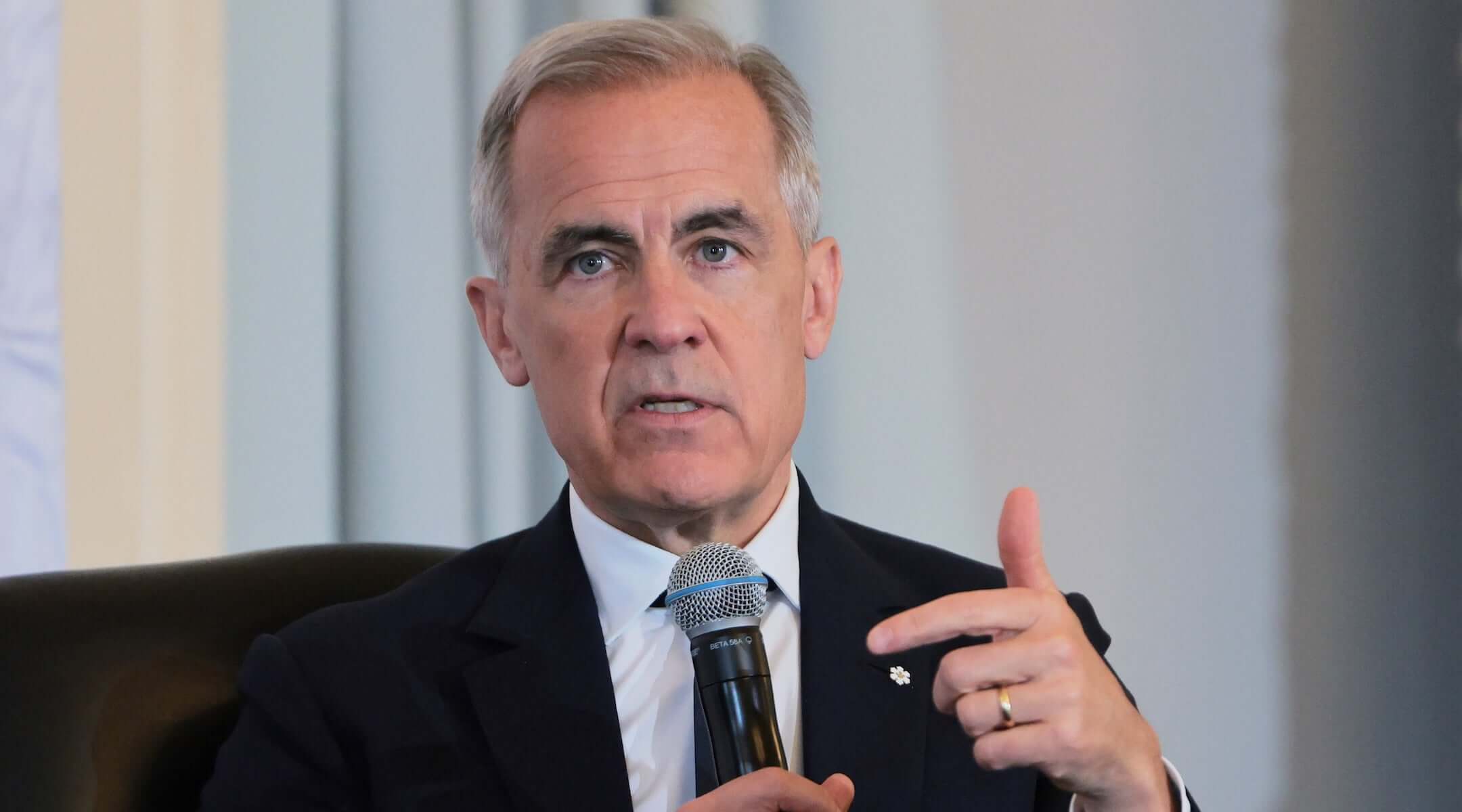
In early August, an arsonist gutted Nöam, a kosher restaurant in Montreal. Even Canadian Prime Minister Mark Carney has acknowledged the scale. Jews, he’s noted, are roughly 1% of Canada’s population but the target of two-thirds of its religiously motivated hate crimes.
“Canada’s civic compact,” he said, “is failing Jewish Canadians.”

The letter Trump shared was drafted by Jason Rapert, founder of the National Association of Christian Lawmakers, asking Trump to “establish an appropriate lawful immigration and humanitarian pathway for Jewish Canadians who are experiencing persecution.”
Fifty-four people signed it including sitting state legislators from across the country, as well as Sam Brownback, the former U.S. ambassador for international religious freedom.
The letter cited Tulsa as an example of where a “willingness already exists,” and which has spent the better part of a decade building exactly the kind of pipeline that letter is describing.
Tulsa Tomorrow is a Jewish community-run recruitment program that started in 2017. It flies prospective transplants in for a weekend of house tours, meet-and-greets and a pitch for why they should relocate. So far, 144 people have come through, and 113 have stayed.
Lately, more of them have been Canadian. Of 52 people on a trip in February, 41 came from Canada, and organizers expect the roughly 50 people signed up for another trip in October to skew just as heavily north of the border.
Two people helping with that pitch are Canadian transplants themselves. Joe Roberts, who leads Jewish Tulsa — the umbrella organization overseeing the city’s federation, JCC and Jewish museum — moved there in 2024 from Ontario. Michael Sachs, senior director of the Jewish Federation of Tulsa, moved from Vancouver last year.
“Oklahoma is a state where these people can feel openly Jewish, and feel that as a Jew they’re valued,” Sachs said.
The families waiting
Getting there is another story. Israelov works in IT for a mining company headquartered in Canada, and he said the company won’t let him work remotely from the U.S. — closing off the route that would let an employer sponsor his visa. Another route, a visa that would require Israelov to invest $800,000 in a U.S. business, is out of reach financially.
Fear compounds the financial obstacles. In January 2024, someone was caught on the Israelovs’ home security camera cutting an Israeli flag off their front porch and fleeing into the night.
Later, a neighbor told Israelov, “I heard you’re Jewish,” and that “your kind is in the wrong place.” He belonged in Israel, the neighbor said, “but not here.”

Not everyone watching this unfold from inside the Canadian Jewish community is rooting for the exodus. Jesse Brown, a Canadian Jewish journalist who has spent years documenting the country’s rising antisemitism, says he fears “the next Bondi Beach massacre,” the December 2025 Hanukkah attack in Australia that killed 15 people, “is going to take place in Canada.”
But watching fellow Jews plan their departure unsettles him in a different way. “There’s a sadness,” he said. “I’m not enthused or compelled by what I see as a re-shtetling.”
A murkier picture
It’s hard not to notice the echo of last year’s program resettling white South Africans as refugees, which critics called selective and its architects called a response to persecution. Roberts sees Canadian Jews less as refugees than as candidates for what he calls “a legal humanitarian pathway that’s expedited.”
The timing also invites skepticism. The NACL letter and Trump’s post came in the middle of a trade war between the U.S. and Canada. Fifty percent tariffs on roughly $20 billion of Canadian goods took effect Aug. 22. Canada has announced a matching retaliation.
Rabbi Yehuda Kaploun, the U.S. special envoy to monitor and combat antisemitism, visited Ottawa in early August and said: “You need to do better,” citing 788 antisemitic hate crimes reported to Canadian police in 2025, up from 492 in 2021.
Carney’s office said new laws and funding show the government is responding. A spokeswoman said officials want “a country where our differences are honored and where Jewish Canadians can live visibly, fully, and joyfully in public life.”
But Rapert, who is based in Arkansas, sees things differently. When Trump shared the letter on Sunday, Rapert was leading a delegation of U.S. elected officials on a tour of Israel. They had just visited the Ghetto Fighters’ House Holocaust museum, which has on display the glass booth used in the trial of Adolf Eichmann for his role in the Holocaust.
Canada’s climate, he said, is “not unlike what you were beginning to hear in the early days of Germany, that led to government decisions that brought forward what we now all know is the Holocaust.”
Rapert’s letter is far from his final push. He hopes to persuade U.S. Sen. Ted Cruz of Texas and U.S. Rep. Marlin Stutzman of Indiana to hold congressional hearings on the issue. And he’s working on setting up a meeting with Trump.
“My prayer is that Donald Trump paves the way for the people that want to come, to come,” he said. “But what would be even better is if Prime Minister Carney apologized and repented.”
The post Christian lawmakers want Trump to fast-track Jewish Canadians to the U.S. Tulsa says it’s ready. appeared first on The Forward.
Uncategorized
California lawmakers pass bills to address antisemitism, deem ‘Jewish’ an ethnicity, and protect religious observance
(JTA) — California is poised to become the first state to deem “Jewish” an ethnic and racial identity, after lawmakers gave final approval to the groundbreaking legislation on Monday.
The SB 1387 bill, which would expand the definition of ethnicity “to include Jewish identity” in demographic data collection, will now head to the governor’s desk. If the legislation becomes law, state agency forms that allow for voluntary disclosures of ethnicity or race would also need to offer a “Jewish” option.
Both the State Assembly and Senate granted final approval to the bill in the last few hours of California’s 2026 legislative session, which concludes at the end of the day on Monday. Gov. Gavin Newsom, a Democrat, has until Sept. 30 to sign bills into laws or veto them.
The SB 1387 ethnicity legislation has been a priority among many California Jewish organizations, who argue that Jewish peoplehood should be connected to much more than just religion — and that the law should reflect that understanding.
This bill, which would take effect in 2030, would affect forms issued by agencies ranging from public schools to unemployment offices to prisons. Data collected would serve to inform research initiatives, identify disparities and guide policy decisions, while banning the disclosure of personal information, per the bill.
Joining SB 1387 in heading to the governor’s desk are five other bills that are relevant to the state’s 1.2 million Jews and that had the support of the Jewish California coalition.
On Sunday, the legislature passed AB 1853, a bill that bars threatening false and misleading information from California voter guides. Jewish California, which represents 43 organizations, praised the legislation’s advancement, stressing that 54 Jewish groups voiced their support for the bill within 48 hours of its introduction.
“Hate speech does not belong in a state-approved document paid by tax dollars,” David Bocarsly, CEO of Jewish California, said in a statement.
“AB 1853 boldly declares that our state’s official election documents can’t be used to spread conspiracy theories and bigotry,” added Bocarsly, whose coalition was not only a sponsor of this bill but also of SB 1387.
Also on Sunday, lawmakers approved AB 2664, the Safe Worship Zone Act, which would create a 100-foot zone around the entrances of houses of worship, where no one would be able to come within 8 feet of a congregant without their consent.
The bill, which received the backing of a wide-ranging interfaith coalition, is modeled after Colorado’s bubble zone law that offers patients protection around reproductive health clinics.
“The rise of antisemitism is undeniable, and our communities must be protected,” Democratic Assemblymember Rebecca Bauer-Kahan, the bill’s author, said in a statement.
“AB 2664 gives communities an important tool to push back against harassment and intimidation and protect the sanctity of our houses of worship,” Bauer-Kahan added.
Meanwhile, on Thursday, the legislature approved AB 395, which would require government agencies, K-12 schools and public universities to avoid scheduling major events or meetings on days “that members of the public would be unable to participate or be present due to the ritual observance of a religious, cultural, or ancestral holiday.”
Among the Jewish observances that would be codified on a list of such holidays are Rosh Hashanah, Yom Kippur and the first and last two days of Passover.
“For too long and in too many communities, religious minorities and other people of faith have been asked to make difficult choices on the days that matter most to them,” Democratic Assemblymember Jesse Gabriel, the bill’s author, said in a statement.
“This legislation would help to prevent that injustice and ensure that Californians of all backgrounds can fully participate, particularly when important decisions are being made,” added Gabriel, who chairs the California Legislative Jewish Caucus.
Lawmakers on Thursday also approved another Gabriel bill, AB 1836, which seeks to close a gap in the current structure of the California State Nonprofit Security Grant Program. Because the program allocates security funds only for a nonprofit’s physical building, off-site events like menorah lightings on Chanukah were not eligible.
A fifth bill relevant to the Jewish community, AB 1763, is also heading to Newsom’s desk, after passing in the legislature last Tuesday. This bill would include religious holiday observance as a type of excused absence in schools, without requiring a written request from a parent or guardian.
This article originally appeared on JTA.org.
The post California lawmakers pass bills to address antisemitism, deem ‘Jewish’ an ethnicity, and protect religious observance appeared first on The Forward.

You must be logged in to post a comment Login