


Uncategorized
How a Jewish, German-averse writer came to love Berlin

Berlin Before and After: A Cautionary Mirror for Our Times
By Wendy Lesser
Harper, 352 pages, $32
For years, Wendy Lesser was a proud, Germany-avoiding Jew with what she calls “an ingrained distaste for the nation that gave rise to the Third Reich.” Then, in 2003, Lesser, founder and editor of The Threepenny Review and a prolific critic and author, was the recipient of a fellowship from the American Academy in Berlin. Those few months in residence started her love affair with that history-embattled city, where she now returns regularly and feels surprisingly at home.
“One of the things I discovered, when I eventually got to Berlin,” she writes in her latest book, Berlin Before and After, “was how deeply Jewish that city’s culture still is. Or…how thoroughly the German and Jewish cultures at one time entered into each other, so that the versions we now have of them…are still colored by that mutual infusion.”
Berlin Before and After is Lesser’s highly idiosyncratic, selective take on the city — as much travelogue as cultural history. Its subtitle, A Cautionary Mirror for Our Times, evoking the civil rights abuses of the Trump era, reveals something of its raison-d’être. But Lesser doesn’t belabor the comparison, by now a cliché of American political discourse. She is at least as interested in the diverse artistic pleasures of contemporary Berlin as in the historical shadows that shape its landscape and personality.
The conceit of the book is simple: Lesser begins with an admiring look at Berlin in the year 1929, which she defines as “the last year in which it was possible to turn a blind eye” to impending disaster. “Runaway inflation, widespread economic despair, and violent social unrest were just around the corner,” she writes, “but they were invisible to most people.”
Lesser skips over the rise of the Third Reich, the Holocaust and the devastation of World War II and resumes her narrative in the contemporary city, with its wealth of museums, memorials and other cultural attractions. An aficionado of Berlin’s public transit, she ends, somewhat bizarrely, by taking readers on an extended bus ride across the city.

Some of the greatest achievements of the Weimar period, she argues, date to 1929. Lesser proceeds chronologically but also associatively, touching on architectural treatises, novels (including Alfred Döblin’s Berlin Alexanderplatz, Erich Maria Remarque’s All Quiet on the Western Front and Vicki Baum’s Grand Hotel), and the photography, paintings, silent film, dance and theater of the era. Though her focus isn’t political, she lauds the achievements of chancellor and, later, foreign minister Gustav Stresemann. She also remarks on the celebrity of Albert Einstein, one of the many German Jewish scientists and intellectuals who eventually found refuge in the United States.
In the section “Berlin Now,” Lesser is concerned with the impacts of two separate, but related traumas: the Nazi era and the Cold War, epitomized by the Berlin Wall dividing the city into east and west. Berlin’s intense memorial landscape has by now been the subject of countless articles and books, but that doesn’t impede Lesser from digging in. “Berlin is the companion who never shuts up, and what it wants to tell you about is itself,” she writes. The city “lives on a daily basis with its history in a way that is true of no other place I know.”
Lesser is right on the big picture. But her patience for dissection of both the history and its memorialization is limited. She rushes through the Topography of Terror museum (admittedly, a heavy lift), built on the site of Gestapo and SS headquarters and the Reich Security Main Office. She has little to say about the German Resistance Memorial Center, another site-specific museum, located in the military headquarters where the failed July 20, 1944, assassination plot against Adolf Hitler was planned. And she contemptuously dismisses what she calls “the self-glorifying architecture” of Daniel Libeskind’s generally acclaimed Jewish Museum Berlin in a single paragraph, without any reference to the many important shows it has mounted over the years or to its revamped (in 2020) core exhibition.
Nor does Lesser explicitly consider the notion of the “counter-memorial” — those self-effacing monuments that serve as a critique of more conventional, celebratory memorials. She nevertheless describes several of them. Among the earliest is Bibliothek, the underground “empty library” memorial on Bebelplatz, commemorating the 1933 book burnings that took place there. She visits Peter Eisenman’s vast, unmissable (and controversial) Memorial to the Murdered Jews of Europe, but makes no mention of its excellent underground museum. She examines the now ubiquitous Stolpersteine (Stumble-Stones), recording the last known residences, deportation dates and fates of Berlin’s Jewish residents, and Renata Stih and Frieder Schnock’s Places of Remembrance, whose playful signs attached to lampposts catalog the plethora of anti-Jewish ordinances enacted by the Third Reich.
She also covers memorials to Germany’s division, including remnants of the Wall, the Stasi Museum, the Spandau Zitadelle (with its collection of “toxic monuments”) and the gruesome Hohenschönhausen Prison, whose brutal past clearly captures her imagination.
Berlin’s greatest draw for Lesser is arguably its culture, though it, too, is inseparable from history. She delves into the art of Gerhard Richter, the music of the Russian-born conductor Vladimir Jurowski, the television series Babylon Berlin, and the literature and film of East Germany.
The resulting narrative is an intellectual potpourri, probably most engaging to those who know Berlin (but not too well) or who might be contemplating a visit. Lesser follows her own wide-ranging curiosity and assumes that we’ll tag along. “Viscerally and consciously, with a kind of self-awareness that is rare in a collective entity,” she writes, radiating enthusiasm, “Berlin has continued to reveal itself to me in ways I never cease to find moving.”
The post How a Jewish, German-averse writer came to love Berlin appeared first on The Forward.
Uncategorized
What Black voters can teach Michigan Jews about Abdul El-Sayed
Jewish Democrats in Michigan face a tough choice. They can vote for Abdul El-Sayed, a candidate whose views clash with their own, or withhold their support for the Democratic candidate for senator in a razor-close election that may determine which party controls the Senate.
In a race where a single percentage point separates the two candidates, and in which Jews make up 1.4% of the electorate, every Jewish vote counts. That’s why it’s instructive to look at the history of another minority voting bloc — Black Americans.
Black Americans have faced a version of the El-Sayed dilemma for a century: Should they support a candidate who is imperfect or even hostile on issues they care about intensely, or hold their noses, be pragmatic and vote for the larger prize of institutional power?
Black Americans “don’t have the luxury of picking a candidate who is purely for their interests,” Sam Fulwood III, a Pulitzer Prize-winning journalist who specializes in race and public policy, told me in a phone interview. “I don’t think there’s ever been a moment in history where there’s been a pure choice.”
I get why so many Michigan Jewish voters see El-Sayed as the ultimate “impure” choice. He said he’d cut off both offensive and even defensive military aid to Israel. He called the Israeli government evil, comparing it to Hamas. He has campaigned with Hasan Piker, the influencer who called Israel “the Jewish ISIS” and said that American Jews bring violence on themselves by supporting Israel.
Amid a storm of criticism and calls to distance himself from Piker, El-Sayed reiterated his support for Jews. “I love and revere Judaism and the Jewish people,” he said.
At the same time, El-Sayed’s progressive stances on health care, education and economic justice and even his sharp criticism of the Israeli government have resonated with some Jewish voters.
Others have been satisfied by his pledges to fight antisemitism and his call for a solution to the Israeli-Palestinian conflict that, in his words, guarantees equal rights “for Palestinians and Jewish Israelis alike.”
“So many young Jewish people are active in Abdul’s campaign, and it’s their Judaism that leads them to that position,” said former U.S. Rep. Andy Levin, a self-described Zionist.
Many Michigan Jewish Democrats remain unconvinced. Just before the High Holidays, dozens of Michigan rabbis and Jewish leaders signed onto a list of “non-negotiable” principles about Jewish safety and Israel that any candidate hoping to earn their support must espouse. The petition, called Non-Negotiable Michigan, didn’t name El-Sayed directly, but it’s clear he was its target.
Ultimatums cut both ways. In setting terms for El-Sayed Jewish leaders have created one for themselves. Elections, despite what we learned in high school, aren’t popularity contests. A vote isn’t an approval. It’s a choice.
The Democratic Jews on the fence over El-Sayed may ultimately be faced, come November, with the prospect of an imperfect candidate representing a wing of the party they fear, versus two more years of a Republican majority that will continue to rubber-stamp the Trump administration’s damage to the economy, democracy, the environment, the social safety net, health care and immigrant rights.
If the choice is novel for many Jewish Democrats, it’s old news for Black Americans.
The dilemma goes back at least as far as the 1936 election, when Black voters shifted to the Democratic Party to vote for Franklin D. Roosevelt, even though FDR, fearful of losing Southern support, repeatedly refused to support federal anti-lynching legislation.
Or consider Lyndon Johnson. In 1957, Johnson, then Senate Majority Leader, stripped the enforcement teeth out of that year’s Civil Rights Act to get it passed, bypassing the objections of civil rights leaders. Seven years later, after Johnson became president and signed the Civil Rights Act, Black voters delivered him about 94% of their vote — despite a legislative record on civil rights that had been mixed at best.
Even more recently, Black voters have had to sacrifice the perfect for the good, supporting Hillary Clinton despite the impact of Bill Clinton’s 1994 crime bill that contributed to mass incarceration.
In all these cases, Black voters didn’t overlook or excuse these records. Instead, they made a strategic calculation to focus on the bigger goals, realizing politicians are often imperfect vehicles to get us there.
“Black Democrats have overlooked differences in the Democratic Party and even overlooked prejudice because they knew the Democratic Party was much better than the alternative,” Ada Horwich, a longtime Democratic Jewish activist in Los Angeles told me. “We need to learn from their political behavior.”
Perhaps the best example, Fulwood reminded me, was John F. Kennedy, who saw the civil rights movement as a domestic distraction. But in 1960, after Martin Luther King Jr. was jailed, Kennedy privately — so as not to offend Southern Democrats — called Coretta Scott King to offer support, while his brother Robert worked behind the scenes to secure King’s release. That persuaded King’s father, King Sr., to throw his considerable electoral influence behind the Democrat.
“He took a lot of Black voters with him,” said Fulwood, “even though Kennedy was not great.”
Fast-forward to 1963, and JFK came around to support the movement.
“It’s a difficult thing,” King Jr. said at the time, “to teach a president.”
One lesson is that politicians are teachable. Stances that seem “non-negotiable” now can change.
That mixture of cold calculation and hope is exactly what this election is asking Jewish Michiganders to negotiate. Or, as Fulwood said of so many electoral choices Black Americans have faced, “One candidate is very bad, and one is less bad.”
The post What Black voters can teach Michigan Jews about Abdul El-Sayed appeared first on The Forward.
Uncategorized
South Florida Democrat Moskowitz airs campaign ad targeting antisemitism with concentration camp footage
(JTA) — South Florida U.S. Rep. Jared Moskowitz pulled on his family’s story as Jews in the Holocaust in a campaign ad targeting antisemitism, as he strives to retain his seat in the November general election.
“In every generation, they rise against us,” the Jewish incumbent says in the ad over a background of somber music and black-and-white photos from a concentration camp. “My great-grandparents were murdered in Auschwitz.”
“In our generation, right here, the Parkland shooter had swastikas carved into his gun,” he continues, standing in front of Marjory Stoneman Douglas High School, referring to the 2018 fatal shooting that killed 14 students and three educators.
Moskowitz, a top Democratic supporter of Israel in Congress, who fended off progressive challenger Oliver Larkin in a heated August primary, emphasizes in the ad that he has worked to fight antisemitism through bipartisan laws. Some of this legislative action has involved increasing security at synagogues and Jewish nonprofits and expanding education to reduce hate crimes.
“Never again is now,” Moskowitz concludes.
Moskowitz won the August primary with 63.5% of Democratic voter support, to Larkin’s 36.5%. But Larkin was vocal throughout the race about his opposition to arms sales to Israel, going so far as to label the country as a “religious supremacist” nation.
As Moskowitz prepares to face former Boca Raton Mayor Scott Singer, a Republican who is also Jewish, the Democrat may be facing a tight race in a region that had previously been solidly blue.
The 25th Congressional District, which includes parts of Delray Beach, Boca Raton and Miami Beach, is about 25% Jewish, according to local estimates.
Yet recent redistricting efforts have transformed the region into territory that President Donald Trump would have likely won in the 2024 elections. In fact, the Cook Political Report declared a shift from “solid D” to “toss up.”
“There’s no doubt that the race for the new 25th District will be highly competitive in a favorable environment for Democrats,” the report stated.
Moskowitz’s team emphasized the “deeply personal” nature of the congressman’s battle against antisemitism, in a statement issued alongside the ad’s release. He is confronting this challenge, his team explained, by “connecting his family’s experience during the Holocaust to the hatred that continues to threaten our communities today.”
While Moskowitz’s great-grandparents died in Auschwitz, his grandparents were able to escape Europe right before the war. His grandmother left on the Kindertransport, an organized effort that rescued Jewish children from Nazi-controlled territories beginning in 1938.
By Tuesday evening, the Google Ads Transparency Center, which includes data on YouTube ads, did not yet reflect how much money the campaign had spent on its ads there. Meta’s Ad Library also did not yet have data as to how much had been spent on the Facebook version of the ad posted there.
Stephen Sussman, a professor of public administration at Barry University, told the Jewish Telegraphic Agency that although “Holocaust imagery should never become routine campaign material,” he doesn’t believe that this ad has crossed a line.
“The Holocaust was, of course, a real event that continues to shape Jewish life and memory,” Sussman said, recognizing that Moskowitz’s great-grandparents were murdered at Auschwitz and that many Jews today feel threatened by antisemitism.
“He is not comparing his opponent to Hitler or using the Holocaust to make an unrelated political attack,” Sussman added.
The professor also noted the ad’s direct connections to the congressman’s record, such as his leadership in passing bipartisan legislation on antisemitism awareness and in boosting funding for synagogue security.
Sussman acknowledged that when Holocaust imagery becomes part of a campaign, there “is a legitimate concern” that other people might deploy that imagery less responsibly. But he stressed that given Moskowitz’s history and work record, as well as the current political climate, this particular ad is “powerful but defensible.”
Ken Goldstein, a politics professor at the University of San Francisco, offered a similar perspective, explaining that of the thousands of ads he has watched in his lifetime, he found this one to be powerful but not particularly controversial.
“He was certainly using pictures of the Holocaust, jarring images, but they were his family’s story,” said Goldstein, who is an expert on the impacts of political advertising.
“I don’t think he’s using it to personally attack anybody else except the Parkland shooter,” he added, noting that the ad isn’t being used to attack an opponent. “This one does not strike me as particularly harsh, unfair, or out of bounds at all.”
This article originally appeared on JTA.org.
The post South Florida Democrat Moskowitz airs campaign ad targeting antisemitism with concentration camp footage appeared first on The Forward.
Uncategorized
A new grocer is moving into Squirrel Hill. Its rival says the deal isn’t kosher.
PITTSBURGH — Mister Rogers was from Squirrel Hill, and it was here that he built a career on a small, perhaps radical idea: that showing up for your neighbor, day after day, is its own kind of moral work.
It is a strange thing, then, that the neighborhood that made him famous — the same one that gathered in 2018 after the deadliest antisemitic attack in American history — is now consumed by a fight over what neighborliness is worth when there’s money, and a family’s retirement, on the line.
For three decades, one grocery store has anchored Squirrel Hill’s kosher life. Soon it will have new company: a rival supermarket opening just blocks away. The family that runs the original store says the new store was built in part on their own private financial records, shared in confidence during a sale that fell through. The newcomer, for its part, says it has “acted properly” throughout.
The dispute is now headed to a rabbinical tribunal, where both sides will make their case.
This is a very Squirrel Hill kind of story, intimate enough that it’s hard to separate the business from the relationships underneath it. It’s also part of something bigger: the fight reflects a broader shift already underway in kosher retail, where small, single-location grocers are increasingly competing not just with each other but with regional chains and delivery networks that didn’t used to reach a market this size.
‘Cheek by jowl’
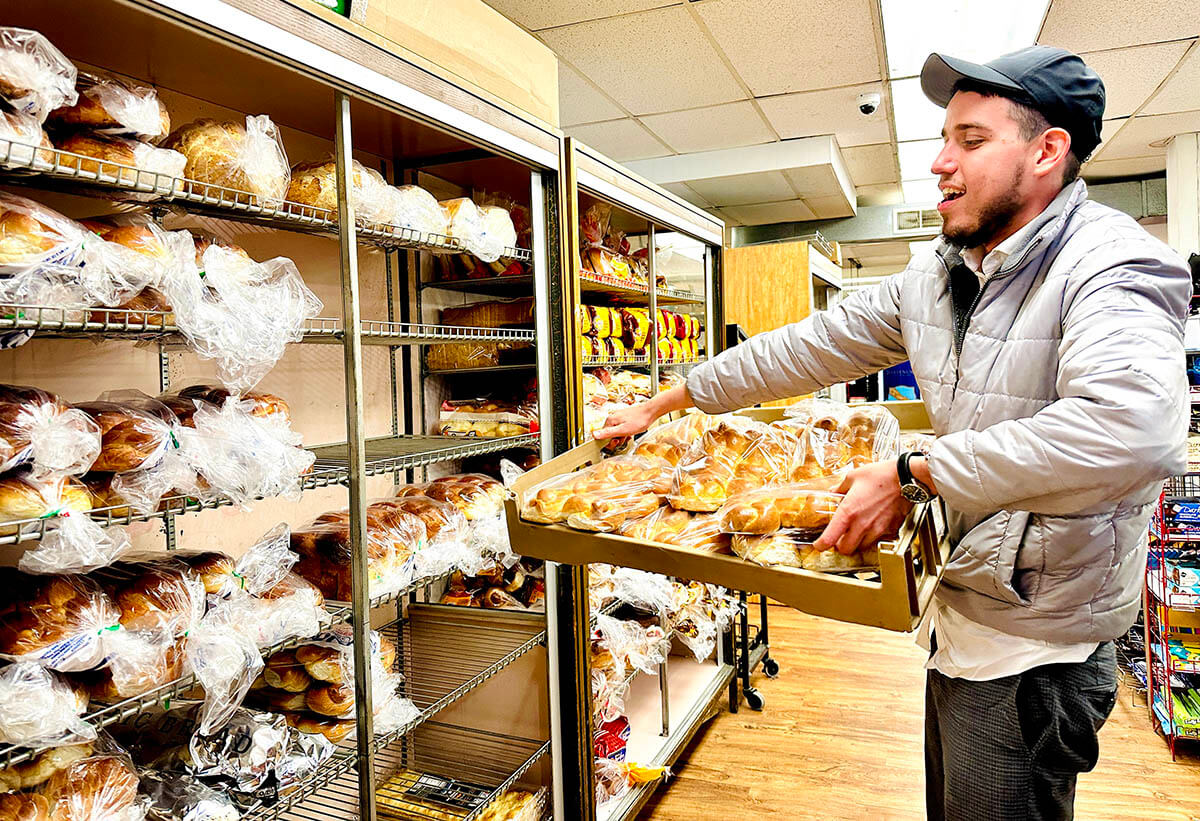
By midafternoon on a recent Thursday, Murray Avenue Kosher is deep into its weekly pre-Shabbat rush — cashiers ringing up customers as fast as they can, stockers racing to keep pace with what’s flying off the shelves. Behind the deli counter, a line of people wait while workers slice cold cuts and pack containers of whitefish and kugel.
On the front door hangs a sign reading “Israel — We Stand With You,” put up after the Hamas attack on Oct. 7, 2023. A few feet away, on a window, is a Steelers poster — a small reminder that this is a Jewish community that is also, unmistakably, a Pittsburgh one.
For Ellie Feibus, 39, who lives within walking distance, the store is less an occasional stop than a daily habit: coffee some mornings on her way to work at a synagogue preschool, lunch, dinner in the evening, a Thursday wine tasting. She often has her dog, Anschel — a blind, toothless, 12-year-old pug — with her. She greets people by name, wishing “Good Shabbos” to those she passes and “Hi, honey” to several others.

When Feibus got COVID during the pandemic, she called Aryeh Markovic, who runs the store with his parents, Saul and Beth. He personally delivered groceries to her doorstep. Without being asked, he added a container of chicken soup.
It’s that kind of care, she said, that would be hardest to replicate in a new store: “the part that’s going to be missing.”
Step outside and you’re in the heart of Squirrel Hill, home to a large swath of Pittsburgh’s roughly 50,000 Jews, three day schools and about a dozen synagogues across the denominational spectrum — a community that has been here, largely intact, for generations.
“In Squirrel Hill, everybody lives cheek by jowl,” said Mark Oppenheimer, who wrote a book chronicling how the neighborhood held together after the 2018 Tree of Life synagogue shooting. “Even the more liberal and Reform Jews will power-walk with the Orthodox on their lunch hour. In a lot of cities there’d be real distance between those worlds. Here, there isn’t.”
The neighborhood’s epicenter is the corner of Murray and Forbes avenues, adjacent to the Jewish Community Center, and the same intersection where the community gathered for a vigil the Saturday night after the shooting.
That corner was, until recently, home to a Rite Aid. But after the financially strapped drugstore chain declared bankruptcy in 2025, the building became available to lease.

Deal or no deal
Yitzchok Glassner, a transplant to Pittsburgh, wanted to get into the kosher supermarket business. The timing seemed fortuitous. Saul and Beth Markovic bought Murray Avenue Kosher in 1996; their son Aryeh joined as a partner in 2021. By last year, Saul and Beth were ready to retire — just as Glassner came looking for a store to buy.
In June 2025, Glassner expressed interest in Murray Avenue Kosher, and the two sides signed a non-disclosure agreement. Over the course of several weeks, the Markovic family handed over the store’s tax returns and profit-and-loss statements.
Glassner wanted to put his supermarket — with the name Murray’s Market — in the former Rite Aid building. Doing so meant winning approval from a bankruptcy judge working with Rite Aid, who needed proof the new venture could pay the rent. The Markovics allege that without their permission or knowledge, Glassner submitted their financial records along with a declaration stating that Murray’s Market was, in Glassner’s words, “acquiring Murray Avenue Kosher.” No such acquisition existed.

The Markovics say that they had yet to reach a deal with Glassner when he told the court he was acquiring Murray Avenue Kosher. They also claim that Glassner broke the non-disclosure agreement by sharing their private financial information, which is now in the public record as part of a filing in the Rite Aid bankruptcy case.
“Nobody is going to buy the business now if there’s a competing store opening 200 feet down the block,” said Shaya Markovic, Aryeh’s brother. “Had we known he intended to use the documents to open a competing store, my parents would never have given them.”
Talks between the Markovics and Glassner broke down.
Brandywine Communities, the owner and landlord of the former Rite Aid building, announced in August that Murray’s Market was granted the lease. Renovations are expected to begin in the coming months with a planned opening in 2027.
Whether it gets there without further complications is an open question. The underlying fight — over whether Glassner owes the Markovics anything and what should be done if he does — is now headed to the Beth Din of America, a rabbinical high court.
A different kind of court
Few outside the Orthodox Jewish world have ever heard of the Beth Din of America, let alone know that a fight like this one could end up decided there, by a panel of rabbis rather than a judge or jury.
Murray Avenue Kosher’s Markovic said what he wants is straightforward: financial compensation from Glassner for damages he believes were caused to his business.
Glassner struck a different note: “In the interest of peace, we attempted to reach an understanding with another establishment, but sadly, those efforts were unsuccessful,” read a statement he sent to the Forward. “Nevertheless, throughout the process, we have acted properly, and we remain confident that all matters will be settled amicably.”
The Beth Din of America functions much like private arbitration in the secular world. Both sides have to agree to bring a dispute there, and once they do, the ruling is binding. A losing party can’t simply refile the same case in civil court and abide by that ruling instead.
Cases like this one are typically decided by a panel of three rabbinic judges. The Beth Din of America, modeled after the rabbinical courts in ancient times, maintains a roster of rabbis it works with, each with different specialties — one might have more experience with family law, another with contracts and business disputes. Some of the rabbis are lawyers themselves.
The arbitration can take place at the Beth Din of America’s Manhattan offices, or any other location that the parties and the Beth Din agree to, with follow-up sessions sometimes held over Zoom.
Sources who have previously worked with the Beth Din of America expect a case like this to be litigated in the coming weeks — with perhaps a slight delay due to Yom Kippur and Sukkot. A written ruling can take additional weeks to finalize.
Rabbi Yitzi Genack of the Vaad Harabonim of Pittsburgh, which certifies kosher establishments in the city, did not respond to multiple requests for an interview. A spokesperson for Brandywine Communities, the landlord and owner of the former Rite Aid building, declined a request for an interview.
A street with history
The new Murray’s Market is not facing off only against one other kosher option.
Directly across the street from Murray Avenue Kosher, the local Giant Eagle — a large regional supermarket chain — runs its own in-house kosher bakery and stocks a decent selection of kosher meat: cold cuts, chicken, beef, steak and brisket. There was already competition, in other words, long before Glassner decided to open a new store.
“For over a century, many important kosher establishments have served Pittsburgh’s diverse Jewish community, including Adler’s Delicatessen and Grocery, Kosher Mart, Murray Avenue Kosher, and Prime Kosher,” read a statement from Glassner. “For many years, these establishments — often operating side by side — contributed greatly to the Jewish community.”
In the 1940s, Murray Avenue supported at least 10 kosher butchers, a handful of kosher poultry stores, two fish stores, six bakeries and 14 grocery stores, according to Eric Lidji, director of the Rauh Jewish History Program & Archives at the Heinz History Center. Rabbi Bernard Poupko, who led Congregation Shaare Torah in Squirrel Hill from 1942 to 1996, once called the street the yidisher gas, the Jewish street, even as the businesses lining it kept changing hands.
Adler’s Delicatessen is a case study in how the markets have changed. Founded in the late 1910s, it became a Murray Avenue fixture — until the Adler family sold it, in 1974, to U-Se Chu, a Korean immigrant. Under Chu’s ownership, the deli kept its kosher-style menu and its Jewish character for decades, before the family retired and sold it in 1997.
On Murray Avenue, in other words, a kosher institution outliving — or even changing hands entirely from — its founding family is not a new story.
A larger trend
Kosher shopping in Squirrel Hill does not even require a storefront anymore. Evergreen, a kosher supermarket chain with locations in New York and New Jersey, makes bulk kosher deliveries to eight cities across the Midwest as well as to Pittsburgh — part of a broader pattern of national and regional players reaching smaller Jewish communities that, until recently, only had access to whatever their local grocer carried.
Customers have noticed. Feibus, a devoted Murray Avenue Kosher shopper, said some of Pittsburgh’s newer transplants from the northeast have grown used to bigger, more polished kosher chains like Seasons and want the same thing locally. The Grove, a South Florida-based kosher supermarket chain, has added locations in Ohio and Michigan in recent years. Many Costco and Trader Joe’s locations across the country stock kosher chicken and other products for Jewish customers.

This fight is bigger than one grocer and one new competitor. Mom-and-pop kosher stores no longer have these smaller Jewish communities to themselves.
Not everyone in the neighborhood sees a second kosher store as a threat. Ronna Harris Askin, 78, a longtime Squirrel Hill resident, said she plans to shop at both.
“Competition is always good,” she said. She’s fond of Murray Avenue Kosher — it “mostly meets my needs,” she said — but doesn’t think one store should have to carry the whole neighborhood. “It’s good for the economy to have two places. It makes everybody be on their toes to do a good job.”
Harris Askin has seen the alternative firsthand. Her daughter and son-in-law live in Toco Hills, a heavily Jewish Atlanta neighborhood, where both Kroger and Publix stock kosher meat and other products alongside two dedicated kosher markets — evidence, to her, that a bigger Jewish community can support more kosher retail without strain.
What comes next
Markovic isn’t waiting around to find out what the Beth Din of America decides.
He’s already working on what comes next at Murray Avenue Kosher. In the coming months, he plans to move the deli counter to a new space in the store and expand its offerings to include restaurant menu items like chicken sandwiches and hamburgers. He’ll be adding tables for seating. He has also hired a chef to make fresh sushi daily.
A year ago, Markovic was contemplating getting out of the business. Now he is doing the opposite: pouring money into the same store he nearly sold, betting that the surest answer to a rival two blocks away isn’t a rabbinical court, but a better rotisserie chicken.
“It’s imperative to get it done quickly,” Markovic said. One of his brothers is flying in to help him push through the vendor calls and the small decisions that used to take him weeks to get to. “I have ninety-seven phone calls in between everything I want to do,” he said, and laughed, a little wearily, before picking up to answer another one.
The post A new grocer is moving into Squirrel Hill. Its rival says the deal isn’t kosher. appeared first on The Forward.

You must be logged in to post a comment Login