


Uncategorized
For author Ben Moser, writing about anti-Zionism is an act of sanity
Benjamin Moser thinks that Theodore Herzl, the acclaimed founder of political Zionism, was mentally ill and that his delusional ideations underlay his theory of the Jewish state.
Lest anyone think that this startling claim emanates from a crank or an antisemite, it’s worth noting that the last time Moser wrote about someone’s life, including its warts, his subject was Susan Sontag and the book won a Pulitzer prize. His new book opens with harsh critiques of Herzl. Then it progresses to biographies of a dozen Jewish anti-Zionists, none of whom Moser considers crazy. As a Jew and staunch activist in the international movement for Palestinian rights, he sees his writing about Jewish anti-Zionists as an act of imminent sanity.
Anti-Zionism: A Jewish History is barely out, but it has already racked up critiques, including a review in The New Yorker that accuses him of being ahistorical about different periods of Zionism; and of sloppy, even ideologically driven errors — particularly when he characterizes Zionists after Hitler’s rise to power as having worked with Nazis out of rank racism and opportunism.
The alleged errors may truly be errors. But in conversations that I had with Moser recently, after reading a review copy of his book, he entertained historical nuance regarding the one chapter we focused on. The events it describes in a small, obscure, American Jewish community were directly experienced two generations ago by members of both of our families. Those events, and the history they nod to, are now mostly mothballed from contemporary Jewish memory. They need airing out, far beyond our families.
This is what Moser and I share: Our immigrant, Ashkenazic great-grandparents in the late 19th and early 20th centuries settled not on the East Coast but instead in a tiny Jewish enclave in the South — in Houston, Texas. Later, their children — our grandparents — became members of Beth Israel, a local Reform temple. Like almost all Reform congregations back then, Beth Israel followed a national set of principles known as the 1885 Pittsburgh Platform. It denied that Jews were a nation or should become one. Instead they were deemed members of a religion, tasked by God to spread humanistic ethics and morality to all people everywhere.
But in 1943, Beth Israel suffered a schism that made national news, including in The New York Times. The congregation’s leadership wanted new members to sign a pledge opposing the creation of a Jewish state — and if they refused, they would be ineligible to vote on decisions affecting the temple. But some of the congregation by then were Zionists. Months of bitter fighting ensued, culminating in a temple-wide vote on the pledge requirement. When the anti-Zionists won handily, dozens of families bolted — including Moser’s grandparents and mine. In fact, my grandfather was a leader of the split. The renegades started a new Reform temple, Emanu El. My grandfather was a core founder, and my family lore has it that when Moser’s father was a little boy at Emanu El, his religious school teacher was my mother.
Moser devotes a chapter to the schism at Beth Israel, framing it through a biography of Hyman Judah Schachtel, the congregation’s rabbi at the time. Schachtel was then a national leader in the American Jewish Reform movement against Zionism — until, rather suddenly, he wasn’t. Almost immediately after Israel declared statehood, he publicly embraced Zionism.
But was that the end of the story, or even the whole of it? Moser’s grandfather had been a lawyer in Berlin before fleeing the Nazis in the 1930s, ending up almost randomly in Houston, marrying a Texan Jewish woman, having children including Moser’s father, and dying before Moser was born. Moser told me he assumes that both of these grandparents were Zionists. But, though he often spoke with his grandmother, who lived until he was in college, “I don’t remember her ever talking about Israel or Zionism,” he said.
I recall something more pointed than silence. Before he died in the late 1970s, my grandfather wrote in a memoir sketch that he had not broken away from Beth Israel because he’d been a Zionist. Rather, he’d felt offended by the idea of creating a membership apartheid, with anti-Zionists privileged over Zionists. He said he thought loyalty tests were undemocratic, especially among Reform Jews. Moser acknowledged that he’d seen evidence of the same attitude among Beth Israel members when he was researching the split. Meanwhile, I shared with him a total lack of memory of any of my large, extended Texas Jewish family talking about Israel during my childhood, much less going there to live or as tourists.
If there was an error in Moser’s account of the schism, I pointed out, it was one of omission. Though he devotes much space in his chapter about the split, he neglects to mention that by the time it happened, the 1885 Pittsburgh Platform was defunct. It had vigorously rejected the establishment of a Jewish state, but a revision in 1937 contained a hint of Zionism. It endorsed “the rehabilitation of Palestine” as “the promise of renewed life for many of our brethren.” And it cited “the obligation of all Jewry” to help Palestine’s “upbuilding as a center of Jewish cultural and spiritual life.” True, it spoke of a “homeland,” not a state. Still, it privileged the idea of Jews’ settling in what would later become Israel.
I asked Moser if the new platform had rendered Beth Israel’s anti-Zionist pledge requirement functionally obsolete by the time the fight broke out. Wasn’t the temple’s anti-Zionism by then a Reform dinosaur — particularly because of growing fear and horror among American Jews about the spotty news they were already getting in the early 1940s about what would later be revealed as a genocide?
He said he thought the Reform movement nationally in the 1930s had been “trying to kick the can [of the Zionism controversy] down the road” and that “After Israel was created, everyone went over to the Zionist side. Because it was already there.” His chapter about Rabbi Schachtel in Houston is instructive, he said, “because he shows what happened nationally. Among Jews a huge controversy about Zionism raged for 50 years. Then, after 1948, the temperature got turned down, and after the 1967 war the Reform movement formally scrapped anti-Zionism altogether. To me, the story is about how Zionists wrested control of the institutions that organized American Jewry, and how that made it possible for me to grow up in a world where we didn’t even know that anti-Zionists had existed.”
So what was it like, I asked him, to be a child and teenager amid this historical amnesia, including, in Houston, at Congregation Emanu El where he’d been bar mitzvahed? He called being at Emanu El “a waste of time.”
“I remember drawing pictures of menorahs — way past the time I should have,” he said. “It was age inappropriate. It felt anti-intellectual. I remember wondering, ‘What is there of substance about Jews?’ In retrospect, if I was going to answer the question, ‘‘What were we really doing at Emanu El?’ I would say, ‘Learning about the Holocaust.’ Though we did that in my regular, secular school, too.”
“When I was writing the chapter about Beth Israel and Rabbi Schachtel,” Moser added, “I was reading all this Reform history from the 19th century. I was fascinated. It seemed so smart. It was a real ideology. At Emanu El there was no ideology. People weren’t religious. I knew people who on Yom Kippur regretted an email they’d sent: ‘Gosh, what have I done bad this year? Well, I should have called Marjorie on Tuesday.’ But consider what Yom Kippur is, if you really do have a religious background.
“Emanu El was just a cultural community which didn’t have more than that. And because there was no ideology, it was kind of empty. So you could fill it up with nationalism. With Zionism.” Meanwhile, he said, “Nobody ever told me that the majority of Jews historically have been anti-Zionist, and for a very long time.”
As a child at Emanu El a generation before Moser, I recall no lessons whatsoever about the Holocaust (I discovered The Diary of Anne Frank by accident in my dad’s study when I was nine years old; I found US military photos of Buchenwald and Auschwitz in a book on his shelves and told no one I’d read any of this.) I abandoned synagogue attendance when I left for college — before the Six Day War — and didn’t go back for decades.
Still, I think I got something from my childhood at Emanu El. A lot, even. And looking at Moser’s book I thought I saw some of that inheritance in him. His epigraph page features twelve quotations from the Old Testament: from Leviticus, Jeremiah, Amos, Obadiah, Malachi, Zephaniah, Nahum, I Chronicles, and Habakkuk (example: “Because you have plundered many nations, all the remnant of the peoples shall plunder you.” ) Wasn’t finding and honoring this material a legacy of his Reform upbringing?
He wasn’t having it, though he did give a nod to Jewishness. “I studied Hebrew in college,” he said. “I love Biblical Hebrew and reading the Bible in Hebrew. The Hebrew of religion, and poetry. And I love, love reading the prophets.”
“You can go on practically every page of the prophets,” he added, “and see that the idea that we have now, that Jews are uniquely virtuous — which a lot of Jews, as well as Christians, think — is completely foreign to Jews. The Jewish idea is, “We got it comin’.” Meaning, “If you don’t watch your step, you’re going to get kicked out of the land.” For Jews today, he said, the secular translation is that if we do not work for equality and against racism, we, too, have it coming.
So what can be done to prevent that vengeance? I reminded Moser that on his Substack he has written about the disastrous situation in Israel vis-à-vis Palestinians: “What can we do about it?” he asked, then answered his own question: “Nothing…except insist on using real words.”
What, I asked, does he hope that the words in his book will do? Even if those words meet with corrections? Or rancor?
“First of all,” he said, “give Jews a sense of their genealogy with anti-Zionism so they can realize, ‘I’m not the first person to think this way.’ And I hope to strengthen the people who are doing all sorts of work in all sorts of ways. We still don’t have the organization. We don’t have the AIPAC. We certainly don’t have the White House and the Pentagon. We’re just people who are fighting a sense of outrage, of futility that is demoralizing and depoliticizing. If you say, ‘Oh, there’s nothing you can do,’ it’s a self-fulfilling prophecy.”
He said it was hard to pick the 12 people who ended up in his book, ranging from a long dead, 19th-century rabbi in Eastern Europe to New York City photographer Nan Goldin, who is alive and politically active: “There have been so many anti-Zionist Jews in history. I wanted them to be chronological. I wanted a fair representation: Latin Americans, women, gays, and other kinds of people,” he said. “I wanted everybody to have a different take on anti-Zionism. I wanted to tell the story of what happened in Iraq, for instance. In Houston. Johannesburg. I wanted Orthodox people to read it, feminists, people whose background is Sephardic or Mizrahi and not just Ashkenazic or Reform. I wanted people who don’t know this story to have a way into it.
Moser said he hopes that readers can use his book to “say to the people who are claiming that they’re doing this to the Palestinians in Jews’ name, ‘No, that’s not true.’ By creating a Jewish voice against that claim, eventually we can maybe stop sending bombs to Israel, maybe stop killing people. Everybody’s probably going to be dead by the time that happens. We might not live to see it. But it does matter. And we’re still working.”
.
The post For author Ben Moser, writing about anti-Zionism is an act of sanity appeared first on The Forward.
Uncategorized
Robert Kraft pledged $2M to aid Palestinians amid Macklemore row. How will he do it?
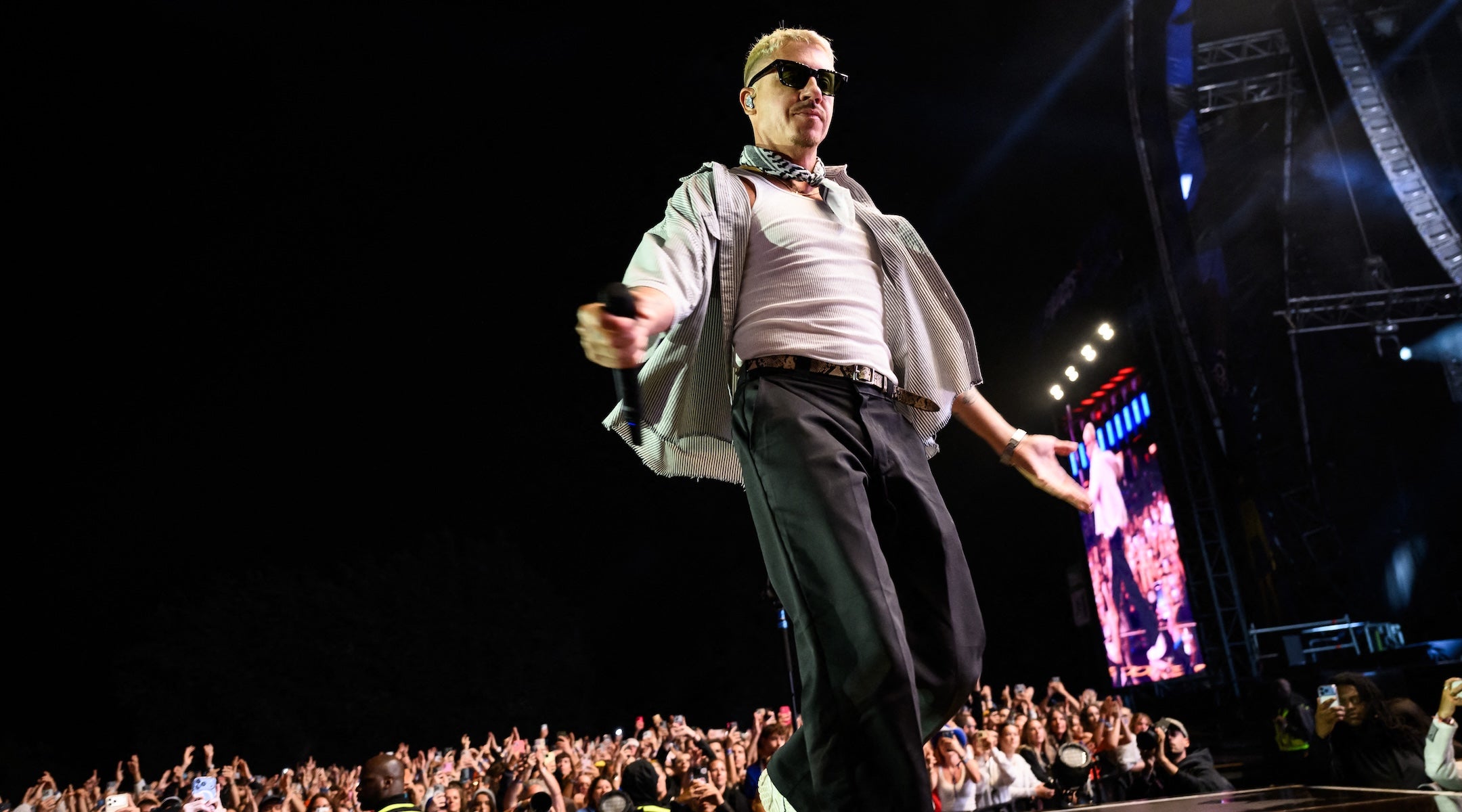
(JTA) — Robert Kraft has found himself in an unusual position: nixing the rapper Macklemore’s appearance at a stadium he owns for what he said was hateful behavior — and then taking up the performer’s charity challenge.
Macklemore challenged the Jewish pro-Israel billionaire to make a donation in support of the Palestinians days after pressuring singer Ed Sheeran to drop Macklemore from his tour over the latter’s pro-Palestinian comments. Kraft responded by announcing that he would donate $2 million to “fight this humanitarian crisis” in the Middle East.
“I have dedicated much of my life to building bridges between all people,” Kraft wrote in a statement posted by Gillette Stadium, which he owns and where Sheeran and Macklemore had been scheduled to play. “I believe deeply that all lives are worth protecting.”
Kraft’s statement Wednesday came in response to challenges from both artists: a public call from Macklemore to match his own $1 million donation to a group of six pro-Palestinian organizations; and what Kraft described as private conversations with Sheeran to commit twice that amount to unspecified groups. Kraft said his own donation was meant to match Sheeran’s.
Kraft’s gift comes as the controversy has prompted questions about how pro-Israel Jews in positions of power choose to wield their influence to combat what they see as antisemitism. His pledge carries additional, politically fraught implications, as Jewish groups have been divided on whether, or how, to donate directly to Gaza relief efforts.
In his public comments, Kraft has insisted that he does not object to pro-Palestinian advocacy or aid as long as it does not cross the line into advocating for Hamas.
But where will Kraft donate? The New England Patriots owner didn’t specify in his public statement, and a representative didn’t immediately respond to questions from the Jewish Telegraphic Agency.
In Macklemore’s own post issuing the donation challenge, he said the $1 million he was giving constituted his entire net earnings from Sheeran’s tour. He named six beneficiaries: the Palestine Children’s Relief Fund, HEAL Palestine, Medical Aid for Palestinians, American Near East Refugee Aid, Gaza Soup Kitchen and UNRWA USA, a nonprofit supporting the United Nations Agency for Palestinian Refugees.

UNRWA itself has proven particularly contentious among the Jewish community. After an investigation revealed that agency members had participated in Hamas’ Oct. 7, 2023, attacks on Israel, the Trump administration led a successful effort to slash the agency’s funding.
In his posts, Kraft offered clues to where he has given in the past.
“I’d like the people who are speaking in support of the Palestinian people to know that for decades, I have supported efforts that create opportunity for Palestinians and have brought young Palestinians and Israelis together to build businesses, create jobs, and forge relationships,” he wrote on Wednesday. In an earlier statement, Kraft said he has “created athletic and entrepreneurial opportunities for Palestinians who I admire and respect.”
One well-known organization that fits Kraft’s description of bringing Palestinians and Israelis together, Seeds of Peace, has a documented relationship with the businessman. In 1994, the year after the peacebuilding initiative launched, Kraft hosted more than 100 teenagers from Israel, Gaza, the West Bank, Jordan, Egypt and Morocco at a Patriots game.
Seeds of Peace did not immediately respond to a JTA request for comment about whether Kraft would be giving to the group as part of his new pledge.
Kraft has also invested heavily in a push to bring American football to Israel via the Kraft Family Israel Football League. In that context, Palestinians have played for league teams — including for the Judean Rebels, a team based in an Israeli settlement in the occupied West Bank.
Steven Koltai, a Jewish onetime entrepreneurship liaison for former U.S. Secretary of State Hillary Clinton and author of “Peace Through Entrepreneurship,” said he welcomed Kraft’s commitment.
“I would love to see, as a Jew who believes in the two-state solution and particularly in humanitarian relief to the millions of Gazans who are completely blameless, if we could show that side of who we are,” Koltai told JTA. “I think that he would be doing an incredible mitzvah for the whole Jewish world, especially the American Jewish community, if he could leverage his money towards something like this.”

Jeremy Burton, CEO of the Jewish Community Relations Council of Greater Boston, told JTA that Kraft “deserves kudos for leaning in with his philanthropy.” Prior to the pledge, Burton had praised Kraft’s actions against Macklemore, saying in a statement that Kraft “drew a clear moral line in the sand about the demonization and offensive conduct that he will not allow in ‘his home’.”
“One can work to end Palestinian suffering without being antisemitic,” Burton wrote to JTA in a text Thursday.
Kraft has said he pressured Sheeran to drop Macklemore because he thought the latter’s conduct at a recent show, in which the rapper had accused Israel of genocide and broadcast footage from Columbia University’s encampments, crossed the line into “hate speech.” According to The Wall Street Journal, other NFL team owners had also voiced objections to Macklemore performing in their stadiums after witnessing one of his sets.
The Journal also reported that Kraft, in his conversation with Sheeran, recalled that Macklemore had performed in a costume with antisemitic signifiers in 2014. Sheeran, whose tours have grossed nearly $2 billion since 2008, and Kraft are friendly: The singer performed at Kraft’s 2022 wedding.
Backlash has been swift, with Sheeran distancing himself from the decision to drop Macklemore, and the singer’s other opening acts and supporting band leaving the tour in protest. Some of them named Kraft specifically in public comments. Figures including children’s entertainer Ms. Rachel and U.S. Rep. Alexandria Ocasio-Cortez, a New York Democrat, have also defended Macklemore, with Ocasio-Cortez additionally criticizing Kraft.
“When you see what Robert Kraft did to line up all of the stadiums to censor speech in that one specific way, it’s become clear that this is not just about one music artist or two music artists, but this is about how just a handful of stadium owners and the elite can prevent an entire massive issue, in this case, the genocide in Gaza,” the congresswoman told TMZ.
Others, including singer Pink and Barstool Sports mogul Dave Portnoy, have criticized Macklemore or defended Kraft’s decision.
Much of Kraft’s philanthropy has gone to fighting antisemitism and to Jewish organizations. He recently gave $10 million to Brandeis University to endow a new center for Jewish life at the school.
Koltai, who himself has not worked with Kraft, said it’s possible for Jewish donors to distribute money to Gaza through “vetted, kosher organizations” that are “clearly not Hamas.” He suggested that Kraft look beyond his past donations to peacebuilding and sports efforts in order to address the current need.
“Sewage, water, housing, medical care and child care are all much more important than a summer camp or a football team,” he said.
This article originally appeared on JTA.org.
The post Robert Kraft pledged $2M to aid Palestinians amid Macklemore row. How will he do it? appeared first on The Forward.
Uncategorized
Hundreds of Michigan Jews pledge to vote for Abdul El-Sayed
(JTA) — ANN ARBOR – More than 600 Michigan Jews have signed a new open letter pledging to vote for Abdul El-Sayed for U.S. Senate, seeking to grow the Democratic candidate’s rocky Jewish support in what is expected to be a close and pivotal election.
The coalition, “Michigan Jews for Democracy,” includes several liberal and progressive Jewish figures in the state, though they signed in personal capacities. Signatories include father and son former U.S. Reps. Sander and Andy Levin, progressive attorney general nominee Eli Savit, Michigan Democratic Jewish Caucus chair Decky Alexander, Detroit Jews for Justice executive director Lisa Tencer and former “Uncommitted” organizer Eleanor Gamalski.
“Some of us are enthusiastic supporters of El-Sayed,” the open letter reads. “Some of us have reservations: there are disagreements with El-Sayed on important issues, including aspects of his approach to Israel and the language used by some of his allies.”
The letter continues, “We understand that a vote is not a valentine; it’s a strategic chess move.”
El-Sayed’s campaign promoted the letter Thursday morning.
Jewish clergy who signed include Rabbi Alana Alpert of the Reconstructionist Congregation T’chiyah in Ferndale; Rabbi Nate DeGroot, who serves congregations in Jackson and Flint and directs the Shalom Center; and retired Cantor Annie Rose of Reform Temple Beth Emeth in Ann Arbor. Other notable signers include University of Michigan Jewish Studies professor Deborah Moore and Danny Fenster, the Jewish journalist who was imprisoned in Myanmar for five months in 2021.
El-Sayed has sought to mend relations with Jewish voters in the state in recent months, though his opposition to a two-state solution in Israel, along with past controversies involving anti-Israel streamer Hasan Piker and his response to the attack on the Detroit-area Temple Israel, have rendered his candidacy polarizing to the community. Recently El-Sayed held an unpublicized meeting with rabbis at Temple Israel, weeks after apologizing for his earlier remarks in which he appeared to equivocate about condemning the March attack, according to a report in Jewish Insider.
The new letter in favor of El-Sayed also comes in contrast to other Jewish open letters in the state. One pledging to vote for his GOP opponent, former U.S. Rep. Mike Rogers, has collected 478 names since launching in August. Another, urging El-Sayed to respond to Jewish “non-negotiables” including “Jewish sovereignty in Israel,” has been promoted by several rabbis in the state.
National Democrats see retaining Michigan’s Senate seat as essential to their hopes of retaking the chamber this fall and instituting checks on President Donald Trump. The Michigan Democratic Jewish Caucus has not endorsed El-Sayed, despite its chair’s presence on the new letter. The Jewish Democratic Council of America, whose CEO Halie Soifer is a Michigan native, has also not endorsed him, telling Jewish Insider this week that the organization does “not endorse all Democrats.”
This article originally appeared on JTA.org.
The post Hundreds of Michigan Jews pledge to vote for Abdul El-Sayed appeared first on The Forward.
Uncategorized
Jewish radio host Sid Rosenberg says he ‘charmed’ JD Vance, after slamming his stances on Israel
(JTA) — Conservative radio personality Sid Rosenberg, a vocal critic of JD Vance’s positions toward Israel, left a meeting with the vice president on Thursday giddy with optimism.
“I went in there with very low expectations,” Rosenberg told the hosts of WABC Radio’s Cats & Cosby.
Noting that multiple people had assured him Vance would win him over, Rosenberg confirmed that “he did.”
“I think I charmed him more,” he said.
The highly publicized meeting occurred amid Vance’s attempt to make overtures to the Jewish community following a series of controversial remarks about Israel, in order to shore up its support for a possible 2028 presidential run.
Rosenberg, a Jewish New Yorker and friend of President Donald Trump, has faulted Vance for not being “strong enough on Israel.” He has also called for Vance to distance himself from Tucker Carlson, a right-wing commentator who regularly condemns U.S. military support for Israel and has been accused of amplifying antisemitic tropes.
“Honestly, I’ve been very critical of JD, very critical,” said Rosenberg, who hosts his own WABC show, Sid & Friends In The Morning.
He told Rita Cosby and her co-host John Catsimatidis that he was “really surprised” to receive an invitation to meet with the vice president, after they both spoke last month at a Republican Jewish Coalition meeting in Las Vegas.
“The talk was that I was going to grill JD Vance on Tucker Carlson and the Israel comments he’s been making as of late,” Rosenberg said. “This was more of a get-to-know-each-other session.”
While Rosenberg explained that most of their conversation would remain off the record, he emphasized that “it went well” and they “hit it off,” adding that the two men would likely have “many more meetings about very substantial things” in the future.
Though he remained outspoken about his preference for Secretary of State Marco Rubio as a 2028 presidential nominee, Rosenberg said that if Vance is “going to be our guy,” he left Thursday’s meeting feeling like he could work with him.
“He is willing to listen,” Rosenberg said. “I don’t think by any stretch that JD Vance hates Israel, hates the Jewish people.”
Just a few hours before Rosenberg’s meeting with the vice president, i24 News reported that Vance was also planning to host a Shabbat dinner this week as a method of outreach to Jewish Republicans.
“Vice President Vance is making considerable outreach efforts to the American Jewish community, particularly with this Shabbat dinner,” Shabbos Kestenbaum, a pro-Israel campus activist who spoke at the Republican National Convention in 2024, told The Jewish Telegraphic Agency.
Kestenbaum, who filed a Title VI lawsuit against Harvard University for ignoring antisemitism in 2024, added that he looks “forward to working together on our common interests while also expressing our concerns.”
Despite the rosier outlook shared by Jewish Republicans on Thursday, the meeting between Rosenberg and Vance came just two days after the vice president told participants at a technology conference that Trump does not shy away from opposing Israeli Prime Minister Benjamin Netanyahu in order to advance the interests of the American people.
The president “has shown a willingness to actually part ways with ‘Bibi’ Netanyahu when he feels like the interests of the American people are different from the interests of the government of Israel,” Vance said in a virtual address at the All-In Summit.
In response to those remarks, Sam Markstein, national political director for the RJC, told JTA in a statement that “the vice president has said, time and again, that Israel is a close and important ally of the United States.”
Markstein recalled how at last month’s RJC meeting — where both Vance and Rosenberg also spoke — Israel’s former minister for strategic affairs, Ron Dermer, said he’d be “forever grateful” for Vance’s role in the June 2025 conflict with Iran.
“All true partnerships between proud, independent, sovereign nations have room for disagreement — that is the mark of the alliance’s strength,” Markstein added.
Vance’s address at the RJC meeting was seen across the media as a chance to mend ties with Jewish conservatives, particularly regarding his views toward Israel and his connection to Carlson. The vice president spoke at a closed-door session, during which he reportedly described Israel as “extremely important to America’s national security,” according to Axios.
Regarding another right-wing podcaster, Joe Rogan, Vance argued that “the best approach is to actually go in there, and talk to him, and make the best argument you can,” The Wall Street Journal reported. Although the vice president denounced a third podcaster, Nick Fuentes, as someone who “really does hate Jews,” he did not offer an opinion on Carlson, per the Journal.
After the address, Rosenberg slammed Vance for foregoing “a chance to hammer” Carlson and for blaming antisemitism on immigration, which the radio host called “silly.”
But following what he described as “a great meeting” with the vice president on Thursday, Rosenberg appeared to have changed his tune.
Asked by Cosby if he walked away optimistic about Vance’s stance on Israel, Rosenberg responded, “The answer is yes.”
This article originally appeared on JTA.org.
The post Jewish radio host Sid Rosenberg says he ‘charmed’ JD Vance, after slamming his stances on Israel appeared first on The Forward.

You must be logged in to post a comment Login