



Uncategorized
Jewish federations are losing my generation — and future ones — over Israel and Netanyahu
When my father Norm Gordon was six years old, the Jewish Federation of Cleveland helped rescue him. Recent immigrants from Poland, his parents were already living precariously when his mother died and his father gave him up. The Jewish Children’s Bureau, funded by the JFC, found a home for him and his brothers and kept them all together under one roof. That’s the sort of thing Jewish federations across America were founded to do, going all the way back to the “Stuyvesant Promise” of 1655: pool the resources of Jewish communities to help the helpless. My first jobs were for JFC-funded camps. My mother, a social worker, spent her career working with agencies like Bellefair Jewish Children’s Bureau, funded by JFC. After my father Norm himself died young and my mother married my adoptive father James Ratner, our family’s ties to JFC grew even stronger. My father James was deeply involved with JFC for decades, serving on their Executive Committee and as Chair of their Overseas Connections Committee.
Now all those ties have been cut. My experience isn’t unique. Federations have been alienating constituents who don’t align ideologically with Israeli Prime Minister Benjamin Netanyahu. It’s been happening all over the country. For three decades, I’d kept a portion of my assets with JFC in a donor-advised fund. I made gifts to my preferred charities out of the fund while the principal remained with JFC as part of the “community chest” they use to finance their operations. But JFC recently told me, in so many words, I should take my money elsewhere. So I did.
Their point of contention was that I wished to give some money from my donor-advised fund to Physicians for Human Rights. After the unprecedented and barbaric terror attacks in Israel on Oct. 7, 2023, Jewish federations raised a lot of money for Israel. They also made lists of human rights organizations that were critical of the Israeli government. The JFC Donor-Advised Fund Committee notified me that this year, for the first time, my pledge to PHR would not be honored.
PHR is not the only cause I give to, but it’s vitally important to me. I’m an M.D., an editor of The American Psychoanalyst, and I’ve served on the PHR board for years. I am privileged to know their fine work in detail. Their physicians risk their lives in conflict zones and take on powerful autocratic regimes around the globe, using medical evidence to expose harms to civilians. In 1997, PHR shared the Nobel Peace Prize as a founding member of the International Campaign to Ban Landmines. Their work is especially important to me as I watch leadership in the U.S. subjugating science, reason, and the rule of law to executive power. PHR represents a commitment to precisely those threatened values that the majority of Jews hold dear, values that hadn’t previously conflicted with JFC’s. Very little of what PHR does relates to Israel at all. I saw no reason to choose between the two organizations until JFC asked me to.
Clearly, JFC’s Donor-Advised Fund Committee sees its decision as a laudable act — that they’re standing up to antisemitic bias even if doing so means losing a constituent and his capital. But that does not describe what happened here. The DAF Committee, on the contrary, rushed to judgment against PHR and alienated a longtime backer of JFC’s community chest with false claims of antisemitism, unsupported by evidence.
,
In an email sent to some of my family members, who have also sadly withdrawn their support from JFC, JFC’s DAF Committee devoted just 130 words to its judgment against PHR. Echoing Netanyahu’s incendiary talking points about the medieval “blood libel,” the DAF Committee accused PHR of falsely blaming Israel for the destruction of Al-Ahli al-Arabi Hospital in Gaza City. Ironically, as NPR reported, PHR was a lone voice that did not rush to blame Israel before the facts were in: “By contrast, the advocacy group Physicians for Human Rights put out a call on the day of the blast for the protection of civilian life and for the incident to be the subject of an independent investigation. It notably did not project blame.”
The only piece of evidence the DAF Committee email provided for their claims was exactly that innocuous PHR press release that called on “all parties to abide by international law.” The JFC DAF Committee also claimed, without providing evidence, that PHR does not acknowledge or condemn Hamas’ use of tunnels to store weapons and shield warriors under hospitals. In a joint report on the devastating impact of the war in Gaza on Palestinian mothers and infants, PHR and the Global Human Rights Clinic at the University of Chicago Law School do, on the contrary, explicitly call on Hamas not to militarize hospitals. The DAF Committee provided no evidence at all of PHR’s conflicts with the JFC mission.
Some may ask, “So what?” The JFC’s priority is defending Israel when it’s under attack. It’s not as though PHR is out there helping Israel. In fact, in highlighting the suffering of Palestinian civilians in their report instead of the victims of Oct. 7, and in documenting that the Israeli military has prevented medicine and baby formula from reaching Gaza without considering the larger reasons for Israel’s blockade, PHR shows clearly enough whose side they’re on. JFC is entitled to decline support to organizations that don’t support Israel and it doesn’t owe you a reason.
I don’t question JFC’s right. I question its wisdom. I’m not trying to persuade them to value PHR’s work the way I do, though I hope I’ve made a reasonable case for why I value it. I’m trying to say JFC is making a mistake in alienating constituents like me over a difference of opinion — alienating people who have long considered themselves allies, supported JFC for years, and care about Israel. There has to be room for rational disagreement in a community organization. If not, the federations will hemorrhage constituents and support and become politicized. The majority of American Jews are highly critical of the current Israeli government and its campaign in Gaza. Younger people even more so. JFC may disagree with the rest of us, but it’s not as though we’re making stuff up out of thin air. Israel’s own ex-generals are accusing West Bank settlers of “ethnic cleansing.”
By refusing to accommodate our views, do the federations hope to change our minds? Is this how the federations want to advertise themselves to the majority of American Jews who dare to question Netanyahu? Telling us there’s no room for us, and justifying their conclusions with sloppy assumptions, naive parroting of Netanyahu, and wanton disrespect for others’ views and expertise?
I have no sympathy for Hamas. Human rights organizations like PHR do not support Hamas. Most of the 2 million people living in Gaza, however, are not terrorists. They are human beings and half of them are children. Before Oct. 7, 2023, there were 30,000 Hamas fighters in Gaza, according to the Israeli Defense Forces, a tiny fraction of the Gaza population. I don’t see the harm in trying to insure mothers’ and infants’ access to medicine and baby formula. Nor in documenting the Israeli government’s violations of the rules of warfare when they deny medicine and baby formula to Palestinian mothers and infants who were not perpetrators of Oct. 7. Is our own government here in the U.S. always beyond reproach? No government is. Only authoritarian regimes consider themselves beyond reproach. Again, I don’t expect JFC’s DAF Committee to see it my way.
I would, however, ask them to consider the possible long-term consequences of purging people who think as I do. If protecting Palestinian mothers and infants is really such an affront to JFC’s mission, what does that say about its mission and its priorities? Quashing criticism of the Israeli government is a dramatic departure from JFC’s founding principles. The leaders of the social welfare agencies that depend on JFC’s support will be dismayed to learn that JFC worries more about defunding PHR reports on baby formula than they worry about maintaining the Bellefaire Jewish Children’s Bureau. JFC has been a national leader among the federations from the beginning in caring for their community’s most vulnerable, including children and the elderly. The founders of United Way emulated JFC when in 1913 they began organizing their own community chests. If JFC’s central aim is still the thing they were always best at — maintaining a community chest to help people, as they once helped my father and his brothers — then pushing me out for supporting PHR hardly seems like a good way to serve that aim.
What is most shocking to me is that the federations really don’t seem to care what the majority of American Jews think, or how many constituents they lose by purging those who refuse to equate criticism of the Israeli government with antisemitism. Like Netanyahu, they seem quite comfortable without us. But they’re losing this generation and the next one.
The post Jewish federations are losing my generation — and future ones — over Israel and Netanyahu appeared first on The Forward.
Uncategorized
Abdul El-Sayed insists that Israel should not be a Jewish ‘ethno-state’
(JTA) — Democratic Sen.-elect Abdul El-Sayed of Michigan said on Sunday that the United States should expect countries it supports to uphold principles of equality and suggested that Israel could not exist as both a democratic and Jewish state.
“I don’t believe in ethnostates,” El-Sayed said on NBC’s “Meet the Press” on Sunday. “I believe in equal rights to peace, dignity and self-determination.”
Moderator Kristen Welker had asked him whether Israel, which was founded as a Jewish state, should no longer exist in that capacity. Prior to the question, she had shown footage from a Tuesday interview in which El-Sayed had told The Atlantic that Israel must uphold “equal rights for all of its citizens” and should “not identify itself with a culture or a faith.”
“We dignify the fact that though our skin color might be different, that we may pray in different ways, that America and American laws respect us all the same,” the senator-elect said on “Meet the Press.” “The idea that any government that we are supporting ought to uphold those very basic, same ideals is not a far stretch.”
El-Sayed then accused Gadi Eisenkot, who is trying to form a new government in Israel, of “doing everything he possibly can to form a government in exclusion of predominantly Arab parties.” Eisenkot is in negotiations with the Arab-led parties, among others, to form a coalition and has consistently denounced efforts by parties in the outgoing right-wing government to delegitimize the Arab-led parties.
“We’ve been told for a very long time that Israel is a Jewish, democratic state,” the senator-elect said. “I think folks are having to choose – is it a Jewish state or a democratic state? And I would argue, based on our principles, that we should always be putting democracy over everything else.”
Weeks after the elections, El-Sayed has continued to challenge Israel’s existence as a Jewish state. His position aligns with a small but outspoken contingent of anti-Zionist voices in Congress.
During the “Meet the Press” interview, NBC’s Welker pushed back on his remarks, pointing out that 43 countries identify with a particular religion, citing Pakistan as an Islamic republic, and describing Denmark as constitutionally Christian. She then asked El-Sayed why the world’s only Jewish state should abandon its national identity.
El-Sayed responded that he opposes ethnostates in general, noting that the U.S. shouldn’t “be in the business of funding the military of Pakistan either” and that he’s trying to apply his ideals evenly.
“There are also Palestinian people whose families have been in the Holy Land for generations,” he said. “Those folks have been told that they are going to have a state of their own, only to watch as the Israeli state is expanding and we are supporting it.”
El-Sayed stressed the importance of supporting “the principles of democracy, the principles of justice and the principles of equal rights to peace, dignity and self-determination for Palestinians and Jewish Israelis alike.”
“It’s not opposing any one group of people,” he added. “This is about upholding a set of principles under which all people can have equal rights.”
This article originally appeared on JTA.org.
The post Abdul El-Sayed insists that Israel should not be a Jewish ‘ethno-state’ appeared first on The Forward.
Uncategorized
Eisenkot exerts control over the Knesset, seeks to undo Netanyahu’s judicial reform
(JTA) — Yashar leader Gadi Eisenkot is not yet prime minister but he is already using his power as the favored candidate of the majority of Knesset members to tackle a topic that preoccupies Israelis and American Jews: preserving Israeli democracy.
Eisenkot, who has at least until Dec. 6 under his initial mandate to form a government in the aftermath of Israel’s Oct. 27 election, has yet to clear a path to replacing Prime Minister Benjamin Netanyahu. Should he fail, Netanyahu would likely be given the option to form a government.
During this period there is an unusual balance of political forces in Israel, in which Netanyahu remains prime minister with a lame duck government while Eisenkot, informally controls a bloc of 67 legislators out of the 120 member Knesset, a situation that places him in an unusually powerful position.
That gives Eisenkot a chance to act on one of his bloc’s campaign promises before a government is formed by moving to undo Netanyahu’s judicial reform program, which was controversial both in Israel and in the Diaspora. Its proponents saw it as an essential plan to preserve Israeli democracy, while its opponents believed it would transform Israeli democracy into an autocracy.
To push the issue forward, the opposition “change” bloc named lawmaker Gilad Kariv of the left-wing Democrats Party to chair a special Knesset committee charged with repealing the judicial overhaul legislation.
“For four years, we fought in the Constitution Committee, in the Knesset, and above all in the streets, against a series of laws that threatened to destroy Israeli democracy,” Kariv said in an interview with the Jewish Telegraphic Agency on Sunday, alluding to the weekly Saturday night mass protests that drew hundreds of thousands into the streets and attracted the support of American Jews, including major mainstream groups.
“Repealing those laws is one of our most important commitments to voters, and one of my most important personal commitments. I am determined to see it through,” he added.
Dr. Guy Lurie, a research fellow at the Israel Democracy Institute, described the decision to move quickly to repeal legislation as soon as the Knesset convened, even before a government had been formed, as an “unusual act” on the part of Eisenkot and his political allies, known as the “change bloc.”
They view Netanyahu’s judicial reform plan as “catastrophic for the future of Israeli democracy. And so they want to prevent this catastrophe from happening,” he told JTA.
In a statement earlier this month, Yashar identified six laws it intends to repeal, only some of which fall within the scope of Kariv’s committee. All six were passed by the previous Netanyahu controlled Knesset as part of the judicial overhaul.
The judicial reform legislation included laws weakening the authority of the attorney general, politicizing the process of appointing judges, significantly changing the regulation of media organizations in ways critics said would weaken a free press, and overhauling the operations of the Police Internal Investigations Department.
Kariv told JTA that the change bloc’s top legislative priorities include repealing the laws that sought to overhaul the judicial selection process, weaken the institution of the attorney general, and place the Police Internal Investigations Department under political control.
Simcha Rothman of the Religious Zionist Party, one of the architects of the judicial overhaul program, criticized the change bloc’s attempt to rush through the repeal of the laws before a new government has been formed.
He said the “speed and urgency” with which the bloc was moving to repeal the legislation, before a government had been sworn in and the Knesset’s permanent committees had been established, showed that “they are not acting with sound judgment — they are acting out of hysteria, frenzy and in a legislative blitz.”
The speed of the process showed that it was a “political power grab for election purposes,” said Rothman who is aligned with Netanyahu’s bloc. “They accused us of doing things quickly and in a power grab, but we passed the laws over the course of a year, while they are doing it in a week or two. By any standard, they are not doing things right,” Rothman said.
Kariv explained the urgency, saying that the laws he prioritizes “are set to take practical effect within the coming weeks, making it imperative to repeal them now to prevent legal and operational instability in Israel’s judicial and law enforcement systems.”
Some of the laws targeted by the change bloc are set to take effect very soon, Lurie explained, including those weakening the attorney general’s powers, changing the operations of the Police Internal Investigations Department and altering the process for appointing judges.
Rothman warned that the speed of the changes could set a damaging precedent for the Knesset. “Once you have a temporary majority in the Knesset, you push through a blitz of legislation repealing the previous government’s laws. That will become the norm in the Knesset. It will turn the Knesset into a farce. This is not serious lawmaking, and it will further undermine the standing of the Knesset and its laws,” he said.
On the substance of the legislation, he added: “If they pass laws that return the judicial system to its dark days of backroom deals with the Israel Bar Association and a system of personal connections, they will do great damage to the State of Israel.” The Bar had a determinative say in naming judges; Rothman sought to increase involvement of political parties in the naming.
Lurie said the change bloc believes these laws “will be very harmful for the checks and balances of the Israeli regime.” He described the legislation targeted by the bloc as the most important institutional changes enacted as part of the judicial overhaul.
“The assumption is that they can undo these changes right now in a quick fashion, in a matter of a few weeks, simply because it should just return to the status quo,” Lurie said.
Other laws passed as part of the overhaul, however, are not currently among the bloc’s immediate priorities, Lurie noted. These include legislation allowing gender segregation in Israeli academia and a law expanding the authority of rabbinical courts, both of which critics say undermine individual rights.
Kariv said that “There are many other laws that do not carry the same immediate urgency in terms of timing, and we will repeal them after a new government is formed. These include laws expanding the powers of the rabbinical courts, among others.”
If a new government ultimately fails to materialize, it will become much harder for the change bloc to use its parliamentary majority to reverse the legislation, Lurie said. Changing laws in the wake of the failure to form a government would break with parliamentary convention and would lack the same public mandate during an election period.
Beyond repealing the judicial overhaul legislation, the change bloc has also pledged to advance two other campaign promises: establishing a state commission of inquiry into the Oct. 7 Hamas attack and imposing a term limit on the prime minister.
The latter is unlikely to affect Netanyahu in the immediate term, as any legislation seeking to apply the limit to him retroactively would likely face significant legal challenges. Netanyahu has already served 19 years as prime minister in his political career.
Eisenkot can move forward on the legislation in part because parliamentarians from the change bloc voted in a Knesset speaker from the Yashar party, Matan Kahana, replacing Amir Ohana of Netanyahu’s Likud party. It’s a move that will make it easier for the change bloc to pass and advance legislation.
But moving forward with the bills will require the bloc to make political choices that could come at a significant cost.
The four Zionist parties in the change bloc hold 48 seats in the 120-member Knesset. The Arab parties, which also oppose Netanyahu and could support repealing the legislation, hold another 19 seats. Netanyahu’s coalition has 53 seats, including seven held by the ultra-Orthodox United Torah Judaism party, which has signaled a willingness to switch sides and cooperate with the change bloc instead.
To pass the legislation, Eisenkot will need to secure the support of either the ultra-Orthodox lawmakers or the Arab parties, a decision that could carry a heavy political price. If he succeeds, it would represent a major political victory for the change bloc — and an encouraging sign of the possibility of forming a new government in Israel.
Rothman, for his part, vowed that the opposition would not make it easy for the change bloc to advance its legislation. “We won’t make their lives easy. We won’t let them run wild,” he said.
This article originally appeared on JTA.org.
The post Eisenkot exerts control over the Knesset, seeks to undo Netanyahu’s judicial reform appeared first on The Forward.
Uncategorized
In a triumphant, life-affirming documentary, a Jewish virtuoso looks back on his astounding career
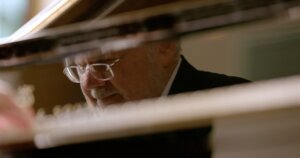
Joseph Levy’s documentary All the Music in the World, is a wonderful, loving tribute to concert pianist Emanuel Ax, an iconic figure in the world of classical performance. Devoid of airs or pretensions, Ax is a remarkably likable musician who still suffers from stage fright. He does not view himself as a “virtuoso” or “maestro.” Everyone, at least in this flick, calls him “Manny.”
Though the film grapples with the passage of time — Ax, inevitably, has been slowing down of late — it is at once triumphant, gentle and life-affirming. I loved it.
Born in 1949 in what is now Ukraine, Ax is the son of Polish Holocaust survivors who never talked about their World War II experiences, short of acknowledging that each had immediate family members who perished in concentration camps. Both his parents, who met after the war, had been married before; his mother had had a child. Ax’s father managed to escape the camps when he jumped off the train carrying him to a camp. He made his way back to his hometown and was ultimately hidden in a church by a local priest.

When Ax was six, the family moved to Warsaw, where his dad took him to the Tchaikovsky opera Eugene Onegin. Young Emanuel was transfixed. To this day he has a special affection for the opera, he says. His formal training started almost as a fluke. The family had inherited an old upright piano from earlier tenants who had abandoned the instrument in the apartment.
Ax continued his musical studies when the family emigrated to Winnipeg and later New York, where they lived across the street from Carnegie Hall. It’s an evocative scene watching him, now in his late 70s, in front of the legendary building and still viewing it with wonder.
“I heard all the greats,” Ax marvels. “I came three or five times a week. I remember in May of 1965 how the line for tickets went around the block because Horowitz was playing. My great regret is that my father was not alive to hear me play at Carnegie Hall or anywhere else except Juilliard. My mother lived to 101 and went to a lot of my concerts.”
Ax studied at Juilliard from the ages of 12 to 26. Along the way, he earned a degree from Columbia University, where he majored in French. He participated in competitions, which he abhorred and dreaded, he says. Although he won several prizes, he never got first place until the Arthur Rubinstein International Piano Master Competition in 1974. Rubinstein served as one of the judges. In addition to earning $5,000 in prize money, Ax landed engagements with the BBC Orchestra and the Israel Philharmonic and got his first recording contract.
“I knew I would never have to do another competition,” he says, sounding slightly stunned and humbled.
For more than half a century the multiple Grammy-winning pianist has played close to a hundred concerts yearly. He has made dozens of albums — some solo performances, others collaborations with such luminaries as Itzhak Perlman, Leonidas Kavakos and, most frequently, Yo-Yo Ma, with whom Ax has enjoyed a 50-year friendship and artistic collaboration.
To celebrate Ax’s 50th anniversary on the world stage, director Levy spent two years filming Ax just living his life — preparing fresh pasta with his grandchildren; conducting master classes; recording a new album; touring and performing Mozart, Chopin, Beethoven and Liszt.
The doc’s two central narrative threads feature Ax rehearsing for a premiere piano concerto that movie composer John Williams wrote for him, and a special concert at Carnegie Hall to commemorate his half-century career.
Interwoven throughout are testimonials offered by his legendary colleagues, including composers Williams and Anders Hillborg and conductors Esa-Pekka Salonen and Andris Nelsons who extol his humility, perfectionism, and artistry.
Despite all this praise, Ax says he never feels he has rehearsed enough and that whatever piece he is about to perform is the most difficult ever. He routinely suffers tremendous anxiety that his performances won’t be up to snuff. Still, he is compelled to play.
“I dream about piano all the time,” he said. “My relationship to music is all- consuming. All the music in the world exists to express what you can’t put into words.”
Besides his passion for great music, what emerges most forcefully is his compassionate nature. In his master classes there is none of the condescension or even cruelty that one sometimes witnesses in these sessions. By contrast, Ax makes modest suggestions on how a student can perhaps improve an already fine performance.
This film could easily have become claustrophobic. Much of it is set in studios and theaters. It’s to Levy’s credit that he seamlessly opens it up to nature. We frequently see Ax practicing on a stage at Skidmore College whose backdrop is a massive floor-to-ceiling window that faces a landscape awash in trees. Later Ax is seen driving through forested dirt roads in the Berkshires on his way to performing the premiere of Williams’ piano concerto at Tanglewood.
Perhaps Levy, who was at one time a cellist himself, is suggesting that great music and pastoral scenes are somehow connected if not synonymous. Either way, the visuals offer a welcome counterpoint to the many enclosed spaces.
The sections featuring Ax and Ma rehearsing or engaging in post-rehearsal analysis are especially delightful. The two met at Juilliard when Ax was about 20 and Ma was 15. Their long-term mutual affection is evident as Ax picks nonexistent pieces out of Ma’s hair and Ma, grinning, teasingly provokes Ax about his performance being too slow.
Ax also met his wife Yoko, a pianist too, when they were students at Juilliard. Their beginning was not auspicious. In fact, on their first date, she brought along a friend. “I didn’t know it was a date,” she says. In the end, Ax’s persistence paid off and they have now been married for more than 50 years and have two adult children. The time spent away from home has been challenging for everyone in many ways, not least Ax’s inability to help with, well, virtually everything, he admits.
The transitional moment that he’s struggling with now, and it will be seismic, is when he should step away from the limelight. His fear that he will disappoint his audience is constant. Performing new pieces has become especially arduous. Still, he can’t imagine not making music. He will always look forward to collaborating with Ma, if not for an audience, then at least for themselves.
In one of the film’s final, and most touching, scenes Ax listens to a recording of his debut concert at Carnegie Hall. His attention is fixed and intent, his expression a marriage of assessment, wonder, and nostalgia. “It’s not bad,” he said. “I’m astounded.”
All The Music in the World is screening online through Nov. 29 as part of DOC NYC festival. It is slated to be theatrically released in 2027.
The post In a triumphant, life-affirming documentary, a Jewish virtuoso looks back on his astounding career appeared first on The Forward.
