



Uncategorized
I’ve been chanting my bar mitzvah Torah portion annually for 40 years. It keeps me grounded in a polarized world.
The Phantom of the Opera had a run of 13,981 Broadway shows across 35 years. Baltimore Orioles legend Cal Ripken Jr., played in 2,632 consecutive baseball games over 17 seasons. The District of Columbia has voted for a Democratic candidate for president in 15 consecutive presidential elections. And this Thanksgiving weekend, I will chant my bar mitzvah Torah parsha (the weekly Torah portion), Vayishlach, for the 40th straight year.
As streaks go, mine certainly will not make a list of history’s greatest. Yet for four decades, I have leined (chanted) it in Israel, the Czech Republic, Vermont, California, Tennessee, Illinois, New York, D.C., and many other international and domestic cities. Whether home or away, every synagogue and Jewish community where I read Torah welcomed me as a fellow Jew as I chanted the ancient words: “וַיִּשְׁלַ֨ח יַֽעֲקֹ֤ב מַלְאָכִים֙ לְפָנָ֔יו אֶל־עֵשָׂ֖ו אָחִ֑יו אַ֥רְצָה שֵׂעִ֖יר שְׂדֵ֥ה אֱדֽוֹם – Jacob sent messengers ahead to his brother Esau in the land of Seir, the country of Edom.”
This 40th year will be particularly memorable because I will return to the place my streak started – Kesher Israel in Washington, D.C. – where I will read Vayishlach as my 94 year-old father sits in the front row of the synagogue and corrects any mistakes I make. After 40 years, I do not make many, but he still catches every one.
Vayishlach recounts the reunion of estranged brothers Jacob and Esau, as well as the failed unification of the children of Jacob and Hamor after a son of Hamor raped a daughter of Jacob. The parsha’s themes resonate strongly today. The first lesson is that brothers, no matter the distance between them, should never forget the family ties that bind them. The second lesson is that when one community commits an act of extreme violence against another, it is extraordinarily difficult to forget and make peace. These stories teach us that we Jews must always welcome our brothers and also protect ourselves from others who would do us harm.
Three chantings in my streak best reflect Vayishlach’s lesson of brotherly love: my second anniversary when I was living in Northern Israel on a kibbutz; my eighth anniversary when I was a college senior in rural Vermont; and my approximately twentieth anniversary when I was traveling with my father in the Czech Republic.
When I was 15 years old, I lived for a year on Kfar Blum in Israel’s Hula Valley. There was a small non-denominational synagogue on the kibbutz which struggled to get a minyan. I approached the lay leader of the synagogue – there was no rabbi – and asked if I might be permitted to chant my bar mitzvah portion on Shabbat. He seemed skeptical – after all, what American Jew knew enough Hebrew and the Torah “trope” (the musical melody used when chanting Torah) to read an entire parsha? Fortunately, my on-the-spot practice for him proved my credentials, and he permitted this young American to lead their Shabbat minyan. While I cannot say that I became a regular attendee, whenever I saw the older synagogue members around the kibbutz, they always had a smile and a nod for the young American Jew who could chant Torah.
Six years later, as a student at Middlebury College in Vermont, there was no Shabbat minyan on campus or in the nearby towns. So I called the historic Ohavi Zedek Synagogue (“OZ”) in Burlington, Vermont. OZ was founded in 1885 and is one of Vermont’s oldest and largest Jewish congregations. Again, after convincing the synagogue chazan (prayer leader) that I could read Torah, I drove an hour from Middlebury to Burlington to chant Vayishlach before a much larger congregation than I was used to. When I finished and briefly joined the kiddush after services, I awkwardly accepted Mazel Tovs from my Jewish elders. They expressed pride in my chanting and their hope that I would read Torah again in their shul.
About a decade later, I traveled with my father to the Czech Republic. It was a business trip for him and a vacation for me. Early on a Thursday morning, we went to the Old-New Synagogue in Prague’s Jewish Quarter for morning minyan. I knew this might be my only chance to keep my bar mitzvah streak alive, so before the Torah service, my father and I approached one of the leaders to ask if I might lein. In the spirit of detente, we negotiated an agreement: They would let me chant as long as one of their members stood next to me in case I could not, in fact, read Torah. I surprised them again, reading smoothly and earning an invitation to another post-service kiddush and a l’chaim.
Today, when Jews neither feel safe in our communities nor welcome in others, my 40-year bar mitzvah Torah reading streak motivates me to build bridges across our Jewish faith and with others. After all, our survival throughout history depended on maintaining our Jewish traditions while also being thoroughly engaged in contemporary society. When I chant this verse – “וַיָּ֨רׇץ עֵשָׂ֤ו לִקְרָאתוֹ֙ וַֽיְחַבְּקֵ֔הוּ וַיִּפֹּ֥ל עַל־צַוָּארָ֖ו וַׄיִּׄשָּׁׄקֵ֑ׄהׄוּׄ וַיִּבְכּֽוּ; Esau ran to greet Jacob, embraced him, fell on his neck, kissed him, and they wept” – I choose the uplifting interpretation that the two brothers reunited in love. I will continue to be inspired by the lessons of Vayishlach that have never been more important to our Jewish communities, in cities and countries, large and small.
The post I’ve been chanting my bar mitzvah Torah portion annually for 40 years. It keeps me grounded in a polarized world. appeared first on The Forward.
Uncategorized
NFL suspends star wide receiver Puka Nacua following allegations of antisemitism, assault
(JTA) — The NFL suspended Los Angeles Rams star wide receiver Puka Nacua for three games on Thursday, months after he faced a lawsuit from a woman who alleged that he had made an “unprovoked antisemitic statement.”
But Nacua — who led the league in receptions last season — won’t miss any additional games, as the league is allowing him to serve the suspension while he recovers from an injury.
Madison Atiabi, who is Jewish, alleged that Nacua, 25, said “f— all the Jews” at a dinner in L.A. last New Year’s Eve. According to the lawsuit, Atiabi said she “immediately felt uncomfortable and emotionally distressed.”
Atiabi also alleged that Nacua “forcibly” bit her on the left shoulder, “leaving a circular imprint of his teeth on her body,” and that he bit her friend’s thumb “with such force that her companion screamed in acute pain.”
Nacua’s attorney, Levi McCathern, said in a statement at the time that Nacua denied the antisemitism allegations “in the strongest possible terms.” McCathern characterized the biting as “horseplay.” No charges were filed, and the civil case is ongoing.
The NFL allows players to serve suspensions while on the injured list. But the timing of the suspension for Nacua — who previously got in trouble for making an antisemitic gesture on a livestream — raised questions about whether the NFL intended for one of its brightest young stars to miss any game time.
After Nacua sustained a knee injury Nov. 8, the Rams placed him on injured reserve, stipulating that he would miss at least four games but leaving open the possibility of a return before the playoffs. He underwent surgery to repair a sprained MCL on Tuesday, ruling him out until next season.
By waiting until Nacua returned from injury to announce its decision, the NFL could have ensured that Nacua missed games he would otherwise have played. The league also could have levied a more significant fine.
Nacua, who is still on his rookie contract, will reportedly lose $950,000 in lost game checks. He is expected to sign a lucrative free-agent contract after the season, meaning that he would have been in line to forfeit a much heftier sum — potentially several million dollars — had the league levied the suspension upon his return.
The NFL also reportedly told Nacua that future violations of the league’s personal conduct policy could lead to significant discipline, including a permanent ban.
The March lawsuit came a few months after another high-profile antisemitism scandal involving Nacua.
Last December — roughly two weeks before the alleged New Year’s Eve incident — Nacua appeared on Jewish influencer Adin Ross’ livestream show, where he was encouraged by Ross to perform an antisemitic touchdown dance during his next game. The dance recreates an infamous gesture known as “The Happy Merchant” that depicts Jews as greedy. Nacua performed the dance on the livestream, but never during a game.
After facing backlash — including calls for the Rams to cut Nacua — the wide receiver apologized in an Instagram post that featured the branding of the “Stand Up To Jewish Hate” campaign, the advocacy group founded by New England Patriots owner Robert Kraft. That post is no longer visible.
“When I appeared the other day on a social media livestream, it was suggested to me to perform a specific movement as part of my next touchdown celebration,” Nacua wrote in the now-removed post. “At the time, I had no idea this act was antisemitic in nature and perpetuated harmful stereotypes against Jewish people.
“I deeply apologize to anyone who was offended by my actions as I do not stand for any form of racism, bigotry or hate of another group of people.”
The NFL and the Rams also released statements at the time, neither of which named Nacua.
This article originally appeared on JTA.org.
The post NFL suspends star wide receiver Puka Nacua following allegations of antisemitism, assault appeared first on The Forward.
Uncategorized
Why this Jewish reporter takes bagel journalism seriously
When I tell people I’m a reporter at the Forward, they usually ask what I cover. I could say something like “all things Jewish news,” but that’s a little boring. So I’ve come up with a one-liner that packs a punch: “I cover bagels one day and neo-Nazis the next.”
The statement is meant in jest, but there’s some truth to it, too. For example, I wrote these two stories on the same day: Schmear campaign: Andrew Cuomo’s bacon bagel blunder bothers NY Jews and Holocaust survivor burned in Boulder attack speaks out.
As a very scholarly and schmearious journalist, why devote my energy to bagel coverage? The case for writing about antisemitism is straightforward, but the mandate for a Jewish reporter to cover bagel business is less so.
Still, I’ve returned to the subject more than a few times. Back in June 2025, I ranked the New York City mayoral candidates based on their bagel orders. Last December, I reported on the reopening of Absolute Bagels on the Upper West Side, a year after the shop’s closure had caused New York Jews to sit shiva. Most recently, I trekked out to Park Slope to report on Brooklyn’s new “lard bagel” — delicious sacrilege.
I’d be lying if I said I hadn’t occasionally questioned whether spending hours coming up with bagel puns was the best use of my journalism school degree. (Though I do think I’m on a roll.)
I have my personal reasons. Growing up, my local bagel shop was Bethesda Bagels. I have fond memories of biking there on Sundays with my parents, then sitting on a bench to enjoy everything bagels and sip orange juice out of cartons. Bagels and lox were the food of choice at bat mitzvah luncheons, holidays and family gatherings. To me, they conjure memories of all things Jewish and warm and toasty.
But nostalgia isn’t the only reason I write about bagels. There are journalistic reasons to cover them, too.
For one, the range in my coverage reflects the breadth of Judaism. Jewish life is religion, food, humor, antisemitism and everything in between.
More symbolically, the evolution of the bagel speaks to one of the central tensions in modern American Jewish life: How does a diaspora community preserve its history and identity while also becoming a part of the broader culture?
The bagel, in particular, offers an opening through which you can see the American Jewish experience of assimilation.
Bagels had humble beginnings in the U.S. The boiled-then-baked comestible, whose name derives from the Yiddish word beygl, meaning ring or bracelet, was brought to the U.S. in the late 1800s by immigrant Polish Jews. For decades, bagels remained largely confined to immigrant Jewish communities. That began to change in the 1950s and 1960s, when Lender’s Bagels in New Haven, Connecticut, began freezing bagels and shipping them across the country. The company marketed what it called the “Jewish English muffin” to the masses.
Today’s trendiest bagels are stuffed with bacon, egg and cheese, owned by private equity — and yes, sometimes even contain lard.
These bagels may make purists’ eyes roll, but they’re also a testament to just how ubiquitous the bagel has become.
I won’t pretend that all of my bagel stories carry profound symbolism. Sometimes, writing about bagels is just plain fun.
“News fatigue” describes the mental burnout that comes from constantly following current events. Readers feel it, and reporters like me do, too. That exhaustion can be especially acute while reporting on tragedies in your own community.
The bagel beat is a welcome reminder that meaningful journalism isn’t always about chasing the most dense stories. Sometimes, you just have to follow the dough.
The post Why this Jewish reporter takes bagel journalism seriously appeared first on The Forward.
Uncategorized
This Jewish writer was the toast of Bohemia — how did he wind up murdered in a sordid room off the Bowery?
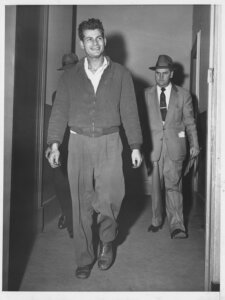
He was murdered on Feb. 6, 1954, in a sordid room near the Bowery, which was, as the New York Daily News put it at the time, “a few blocks’ walk from Bohemia, a million miles from it”

Bohemia: that mysterious early 20th-century mecca, where so many Jews shaped the avant-garde by abandoning traditional life. Aka The Village.
Homeless, Bodenheim, 61, known as “Bogie,” and his 35-year-old wife Ruth Fagan, had been crashing with a mentally ill dishwasher named Harold Weinberg. In one version of the story, the 25-year-old Weinberg killed Bogie because the poet tried to stop him from putting the moves on his wife. In another, he did so because Bogie called him a Communist. Inside Detective reported that Ruth said she would tell the cops that Weinberg slipped Bogie a “goofball in his wine.”
Weinberg shot Bogie twice in the chest with a shotgun, then beat Ruth and stabbed her four times. One day later, when the police arrived on the scene, Rachel Carson’s The Sea Around Us, lay open on Bogie’s chest, covering the bullet holes.
The police did not make Weinberg’s confession public. But, at his arraignment, he screamed: “Bodenheim was nothing but a no good Communist rat.” The court declared him mentally incompetent and shipped him to the Matteawan State Hospital for the Criminally Insane. He was later diagnosed with schizophrenia.
The tabloids pronounced the murder as the end of Bohemia. But you have to go back decades to see how Bogie figured in it.
The epitome of the ‘Lost Generation’
Published a few months after the murder, Ben Hecht’s memoir, A Child of The Century, described his friend Maxwell Bodenheim at the height of his fame as a “golden haired youth with pale eyes and the look of a pensive Christ.”
He was also emblematic of the first generation of 20th-century American Jewish writers to reject their immigrant parents. When the self-proclaimed outcast wrote, in a 1922 essay on Jewish writers for The Menorah Journal, “at present they are sadly scattered,” he could have been writing about himself.

This epitome of the Lost Generation knew everyone. The Catholic activist Dorothy Day met him at The Golden Swan, the dive bar at 6th Avenue and West Fourth Street, where he wrote poems on “the backs of old envelopes,” she recalled. Among those he crashed into were William Carlos Williams, Marcel Duchamp, Hart Crane, Edna St. Vincent Millay and Eugene O’Neill, whom he profiled for The New Yorker in 1925. (And criticized for forsaking the common man).
He shot across the literary scene with the same defiance of cant and hypocrisy that Roth, Bellow, Algren, and for that matter Lenny Bruce would become famous for. His willful self-destructiveness anticipated that of Bruce too. Herman Spector, editor of New Masses, seemed frightened of him. In The Bastard in the Ragged Suit, a posthumous collection of his writing, Spector describes Bogie as a ghoul: “Many times I saw Max Bodenheim, the poet ruined by alcohol, striding hatless in the cold, with a strange glitter in his stony eye, an envelope of poems under his arm, muttering through clenched teeth.”
It’s hard to set a specific date to Bogie’s downfall but it may have started in the spring of 1925 at the very apex of his fame. His novel Replenishing Jessica, published in the same season as The Great Gatsby, recounts the love affairs of a promiscuous young woman, Jessica Maringold. “She knew much about sex; and its devices and perversions, but little about life and the people in it,” is a typical breathless sentence. Some critics compared it to The History of Tom Jones. But after The Society for the Suppression of Vice, which censored Joyce’s Ulysses, declared it obscene, Jessica became a bestseller And three years after that, in 1928, the trial started. The judge ordered the prosecutor to read the book out loud. According to one source, after one day, the jury yawned or nodded off. Bogie was acquitted.
The trial made him a celebrity. “He is one of our few sincerely colorful literati,” The New Yorker declared. Part of that was attracting groupies with literary aspirations and death wishes. Virginia Drew, an aspiring writer who said she was in love with him, threw herself into the river after he called her poetry “sentimental slush,” and drowned.
Initially, the police investigated Bogie and rumors of a suicide pact. But there wasn’t enough evidence and they dropped the case. Then another woman in Bogie’s orbit died by suicide and one tried but failed. The police found his love letters in the handbag of Dorothy Dear, who died in a subway crash en route to see him. Outraged by it all, H.L. Mencken wrote that Bogie, who had written one piece for The American Mercury on literary cliques in Chicago and New York, was “a faker and a stupid clown.” (Later, after Bogie’s death, Mencken would add an even harsher judgment: “He had been a failure all his life and with sound reason.”)
Was he a perv? His biographer Jack B. Moore, probably the most authoritative source, refers to these women as “girlfriends.” But Bogie said he was only “acquainted” with them and claimed that the Hearst papers were persecuting him.
Replenishing Jessica faded. In 1949, S.J. Perelman, writing in The New Yorker about books that had seemed racy in his youth and now were passé, noted that the novel “vibrates with the tension of high speed oatmeal.”
A touch of the Dadaist
The details of Bogie’s early life are thin. On his maternal side, the Hermans emigrated from Germany in the early 1880s to a tiny Mississippi community with a railroad depot. It would be renamed Hermanville. The Bodenheimers, also Ashkenazi Jews, emigrated shortly thereafter. Maxwell was born in 1892 or 3. His father was a traveling salesman and clerk — a failure in business apparently. After the family moved to Chicago around 1900, he worked menial jobs on the South Side.
Bogie was expelled from Hyde Park High (for reasons unknown) around 10th grade. What happened next is murky. He seems to have enlisted under a fake name. But the army didn’t suit him. The story that he hit an officer with the butt of his musket for saying something antisemitic and was discharged may not have happened. But what did happen was that to get discharged he swallowed lye and destroyed his teeth and mouth.

In 1912, he returned to Chicago where he began writing poetry. He met Ben Hecht, with whom he produced preposterous avant-garde one acts in the so-called Art Colony, a row of tumbledown storefronts on 57th Street in Hyde Park. He wrote a satirical account of military recruitment for Emma Goldman’s radical publication, Mother Earth, and he published poems in Margaret Anderson’s Little Review and Poetry Magazine. One of these, “The Old Jew,” begins:
An old Jew munches an apple
With conquering immersion…
At first Harriet Monroe, Poetry’s formidable editor, called him a genius. But by 1925, the two would fall out. As she would write: “What Freudian tragedy of suppression and deprivation through this poet’s childhood may have turned his blood to gall, and the wine of his satire to vinegar?”
He fell out with everyone. After Ezra Pound became foreign editor of The Little Review, Bodenheim attacked him. An anonymous piece of doggerel ran in the magazine (most scholars attribute it to Pound).
Bury bloody Bodenheim
Bury bloody Bodenheim…
In Letters from Bohemia, Ben Hecht recalls that he was “more disliked, denounced, derided, beaten up and kicked down a flight of stairs then any poet of whom I heard or read.”
The two Midwestern Jewish writers started as friends. They staged a futurist debate at the Dill Pickle Club in Tooker Alley in Chicago on the topic: “Resolved: People Who Attend Literary Debates Are Imbeciles.”
Hecht walked on stage and said: The affirmative rests.
Bodenheim followed and rebutted him: You win.
They both exited.
But their friendship soured after Hecht published Count Bruga, a satirical novel about Bogie, in 1926. The bildungsroman about a Bogie-like character, a “leering, prancing, gutter Dionysus” who gets thrown out of parties and arrested for “pawing” women received rave reviews. One review in The Chicagoan led Bogie to threaten to sue for libel.
Perhaps Hecht felt that he had gone too far. In the 1940s, after he made it in Hollywood, he sent his friend weekly checks. On the other hand, his semi-romantic 1958 play, Winkelberg, produced after Bogie’s death, is only half an elegy. “Winkelberg makes it difficult for a playgoer to decide whether Bodenheim was a rebel…or a bore,” Brooks Atkinson wrote in The New York Times.

When critics and reporters bother with Bodenheim these days, they fall into two camps. Rick Schober’s Tough Poets Press has republished some of his work, with new introductions by Kerouac biographer, Paul Maher Jr. But others treat Bogie as harshly as his modernist frenemies. In his 2013 The Village, 400 Years of Beats and Bohemians, Radicals and Rogues, John Strasbaugh writes: “Reading his facile, gaudy verses now, it’s easy to think that it was the brute force of his sociopathic presence, rather than the poetry, that convinced the best poets in the Village at the time that he was one of them, potentially even the best of them.”
It’s true that Bogie is harder to love than your average bellicose mid-century Jewish male writer. He stuttered unless he was reciting his own poetry. He smoked a four-foot-long pipe. He drank excessively. But mostly he was impossible. In 1914, he showed up at the New York poet Alfred Kreymborg’s house, his arm in a sling, (according to William Carlos Williams, a fake, to avoid chores). Kreymborg, who had published Bogie’s poems in his magazine, Others, put him up and he quickly became a fixture, telling stories, hanging out at the Village Vanguard. According to Williams, his “tragic posturing” amused Marcel Duchamp.
Duchamp and Williams were part of the Arensberg Circle, so-called for Walter Arensberg, who was funding Others. “I know of no one who lives so completely in his pretenses as Bogie does,” Williams wrote.
Some of Bogie’s writing from this time has a touch of Dada. The plays he wrote for The Provincetown Players, also home of Eugene O’Neill, were heavier on dreams and shrieks than plot or story. Even his throwaway lines, such as those written in the guestbook of the Harlem salon of Alexander Gumby — “when you mix black and white the color is gray, the color of unassuming mediation” — evoke the phantasmagoric.
At a certain point his real-life antics became less funny. As a guest at Amy Lowell’s Massachusetts estate in 1916, Bogie was attacked by her English sheepdogs, who apparently mistook him for a bum. She did pay for a new suit and put $10 under his plate. But he asked for $90. This might seem insufferable. But in a letter, the Mandarin Lowell also seems insufferable, encouraging him to seek work at the shipping houses of publishing companies: “…I think if you went to any one of them and knocked at the door you could get a job. Let me recommend it to you as not beneath your notice.”
Bogie rejected her advice. In 1918, he married Minna Schein, a suffragist and labor activist. After the coffee shop they ran failed, they went to England to see if he could make it there. “There is an odd American Jew here named Bodenheim; rather pathetic, foolish,” T.S. Eliot wrote to his mother, adding that he told the Chicagoan that succeeding in literary London was like “breaking open a safe.”
A son, Solbert, was born and the couple returned to New York. Bogie went back to excoriating the literati, famously describing the critic Edmund Wilson as “a fatuous policeman, menacingly swinging his club.” He also separated from Minna.
Still, Bodenheim kept scoring literary successes. He guest edited an issue of Others. Lowell put him in an anthology she compiled of best American poets alongside Vachel Lindsay and H.D. People were drawn to the “slender moth eaten Lohengrin,” as the Brooklyn Eagle called him. In the New York Tribune, Burton Rascoe wrote that “he is the Rimbaud of our day”
Ben Hecht lured him back to Chicago to found The Chicago Literary Times, which would nuke New York literary life at 800 miles. The New Republic and The Nation were “two waltzing poodles, bombinating humorlessly,” they wrote, casting themselves as prophets. “We are the best hated men in American literature,” Hecht wrote his friend. The New York Times noticed the paper’s rage.
By 1923, Bogie was back in New York where he published an autobiographical novel, Blackguard: Carl Felman defies his lower middle-class parents — “middle-aged Jews with starved imaginations” — by becoming a writer. His mother is fearful, his uncle, though wealthy, is indifferent to literature. The young Jewish literary rebel plot anticipates Bogie’s later auto-fiction, (and many other Jewish sons, such as Biff in Arthur Miller’s Death of a Salesman.) Bogie kept returning to this character, who is, as he put it in another novel “hated… because of his skillful-tongued independence.”
These Jazz Age novels, which sag with gloom — the Felman’s apartment stands “like factory boxes awaiting shipment but never called for” — are also full of antisemitism. “Guess you’re goin’ out with that Jew-kike uh yours,” one character says.
Blackguard received rave reviews. But Bogie was falling apart. The poet Elinor Wylie refused to sleep in the same bed he had used at The MacDowell Colony. He swung into a bitter feud with Marianne Moore, the editor of The Dial. When she rejected his poetry, he wrote letters to the editor complaining about “the harshly exacting, complete-perfection-or-rejection attitude” Moore responded tartly “in returning your ‘Poetic Essay,’ The Dial congratulates you upon lines nine to fourteen inclusive.”
After the Crash, the downswings got bigger. For years a heavy drinker, Bogie was arrested in 1935 and taken to Bellevue, where he was diagnosed with alcoholism. In 1938, he and Minna divorced.
His second wife, Grace Fawcett Finan, an editor and researcher and the widow of the artist Robert Finan, saved him. They married in 1939 and lived in Brooklyn Heights. Bogie got and then lost a job at the WPA because he lied about never having been a member of the Communist Party. But then Grace deteriorated, first from diabetes, then cancer.
His last novel, the 1934 Slow Vision, is about Ray, a working-class guy who becomes enamored of Communism, and his Jewish girlfriend, Allene Baum, the daughter of his landlady. The system crushes everyone, including Allene’s working-class Jewish parents.
But the novel does not see Communism as a panacea. And, although Bogie contributed to The Daily Worker and The New Masses, even attacking William Randolph Hearst, as Dorothy Day recalled, he grounded his politics in his own deprivation. “He had lived long with hunger,” she wrote.
And, although he often gets written off as a deadbeat, his letters show he did feel responsible for Minna and Solbert. In a 1940 letter, the destitute poet seems torn up about not being able to send money to his ex-wife and estranged son..
Looking at Bodenheim’s letters from the 1940s in the Newberry Library in Chicago, it surprised me that he, like his friend Ben Hecht, championed Zionism and railed against antisemitism. He wrote at least one sonnet on the topic. Many of his letters to Hecht complain about the cruelty Jewish refugees faced and the cowardice of American Jews: “I recognize the whip scarred heritage that separates us from other people, the heritage we are so prone to forget when we are surrounded by a surface amiability that does not single us out.” But Bogie’s agony never went beyond letters. It couldn’t.
The most bedraggled of the lot
In 1950, Grace died and Bogie fell apart. The toothless poet swilled gin, stole books, and panhandled with a sign that said: “I am blind.” His ankles swelled. He smelled, he used twine for a belt. He did not seek medical help, having seen first-hand, during Grace’s decline, how doctors mistreated indigent patients.
A year later, selling poems in Washington Square Park, he met Ruth Fagan, a teen arsonist, occasional prostitute, Michigan State dropout, and graduate of mental institutions. It was a volatile relationship. According to columnist Dorothy Kilgallen, “Ruth used to work herself up to a point of furious anger.” But Ruth tried to protect Bogie too, bringing him to Chicago in the hopes that he could stay out of trouble. (He didn’t.) But they had to go back, anyway.

Bars and nightclubs banned him. He slept on subway cars and was arrested for vagrancy. When the police picked him up with five other bums, he burst into tears. He was the most bedraggled of the lot. Ruth wanted him to stay in jail because he would be safer there.
A new generation of anti-bourgeois young people flooding the Village was fascinated by him. Jack Kerouac, Allen Ginsberg. Judith Malina, co-founder of the Living Theatre, who met him two years before his death in the San Remo café, seemed both horrified by him and drawn to him. She writes in her diaries: “What we admire is Bodenheim’s refusal to resist” even as she wonders if there is something wrong with her adulation of him.
Destitute, his leg broken, Bogie spent two months with Ruth at Maryfarm, Dorothy Day’s refuge for the indigent in Newburgh, NY.
Just before Bogie died, Samuel Roth, the antisemitic porn publisher, began paying him to write his memoir. (After his death, Roth hired a ghostwriter to finish but slapped Bogie’s name on My Life and Loves in Greenwich Village.)
In a note to Roth, one of the few people who helped him at this stage, Bogie wrote:
“To Samuel Roth Who tweaks the grimly lascivious nose of the Philistine, and somehow manages to escape his vengeance. Only a Jew can adroitly maneuver toward the stars, without losing his smile.
From another Jew, Maxwell Bodenheim”
It’s not clear if Bogie meant it sincerely.
Two hundred people attended his funeral at Riverside Chapel on Feb. 11, 1954. The poet Alfred Kreymborg read a eulogy comparing Bodenheim to Heinrich Heine and Edgar Allan Poe. “He was a great lover and wit…His work will be read.” Rabbi Edward E. Klein from the Stephen Wise Free Synagogue said he was “unconquerable.” Ben Hecht paid for some funeral expenses but Minna chipped in too. Bodenheim is buried in her plot in Cedar Park Cemetery in New Jersey.
The post This Jewish writer was the toast of Bohemia — how did he wind up murdered in a sordid room off the Bowery? appeared first on The Forward.
