



Uncategorized
The New York Jewish Week’s 10 most-read stories of 2022
(New York Jewish Week) — Before we turn the page on 2022, the New York Jewish Week is looking back at the calendar year that was.
Throughout the year, Jewish New Yorkers displayed a relentless creativity, continually redefining what being Jewish can look like in this diverse city. From a for-hire “hot rabbi” to a brand new synagogue founded after a painful ouster, from a pop-up Hanukkah cocktail bar to new appreciations of the Jewish deli, there was something for everyone.
And 2022 was a crucial year for us, too: After joining the 70 Faces Media family in 2021, the New York Jewish Week took a huge step forward this year — most notably with the exciting new look we launched in February. We unveiled a new logo, fresh branding and a completely redesigned website to make our storytelling shine.
Thanks for coming along for the ride with us in 2022. Here are the stories you read the most this year.
10. A new exhibit on Jewish delis explores the roots and rise of a uniquely American phenomenon by Lisa Keys (Nov. 10)
A view of the new exhibit at the New-York Historical Society, “‘I’ll Have What She’s Having’: The Jewish Deli.” (Lisa Keys)
Nothing says New York quite like an authentic Jewish deli. This November, the New-York Historical Society presented its new exhibit, “‘I’ll Have What She’s Having’: The Jewish Deli,” which traces the mouthwatering history of the Jewish deli, beginning with the first waves of Ashkenazi Jewish immigrants in the late 19th and early 20th centuries.
9. Why this Holocaust survivor wears the same hand-knit sweater every Passover by Tanya Singer (March 29)
Holocaust survivor Helena Weinstock Weinrauch, 97, models the hand-knit sweater that she’s worn to the first Passover seder every year for the past 75 years. (Karen Goldfarb)
Helena Weinstock Weinrauch, a 97-year-old Holocaust survivor, has worn the same hand-knit sweater every Passover for the past 75 years. It was made by her friend Anne Rothman, who stayed alive during the Holocaust by knitting for Nazis while a prisoner in the Lodz Ghetto.
8. Junior’s, NYC’s iconic Jewish cheesecake emporium, buys back guns to protect the city it loves by Julia Gergely (May 27)
People stand in line outside Junior’s restaurant to pick up food to go on March 16, 2020 in the Brooklyn Borough of New York City. (Photo by ANGELA WEISS/AFP via Getty Images)
When Junior’s Restaurant owner Alan Rosen saw the headlines about gun violence in New York City, he “took it upon myself to do something.” Rosen worked with the New York City Police Foundation to run a gun buyback program at a local church. Rosen donated $20,000 toward the effort.
7. Rabbi ousted from Park East Synagogue announces new congregation on the Upper East Side by Julia Gergely (Feb. 16)
Rabbi Benjamin Goldschmidt and his wife, journalist Avital Chizhik-Goldschmidt, announced the name of their new congregation via social media on Feb. 16. (Screenshot from Instagram)
Rabbi Benjamin Goldschmidt announced his new congregation “Altneu” in February. Goldschmidt made headlines when he was abruptly fired from Park East Synagogue last year. “I feel like it is a tremendous opportunity to start a new synagogue in Manhattan; it’s not something that happens too often,” Goldschmidt told the New York Jewish Week.
6. This private, on-demand ‘hot rabbi’ may soon be the star of her own reality TV show by Julia Gergely (May 25)
Eisenstadt is a non-denominational rabbi who describes her observance as “hipsterdox.” (Alex Korolkovas)
Rabbi Rebecca Keren Eisenstadt — or “Rabbi Becky” as she’s known to most — is a private rabbi-for-hire for dozens of New York City families, mostly on the affluent Upper East Side. She goes by @myhotrabbi on social media, and Reese Witherspoon’s media company is making a documentary series about her life as a single rabbi looking for love.
5. Meet the bartender behind New York’s new Hanukkah-themed cocktail bar by Julia Gergely (Nov. 29)
Naomi Levy, 36, founded the Maccabee Bar in Boston in 2018. This year, Levy, who was named “Best Bartender” by Boston Magazine in 2019, brought the pop-up Hanukkah-themed cocktail bar to New York. (Ezra Pollard)
Bartender Naomi Levy was sick of feeling like a tourist during the holiday season, so in 2018, she launched the Maccabee Bar, a Hanukkah-themed pop-up in Boston. This year, Levy brought her cocktail bar to New York City, featuring drinks like the Latke Sour (apple brandy, potato, lemon, egg white, bitters) and an Everything Bagel Martini (“everything” spiced gin, tomato water, dill, vermouth), as well Jewish- and Hanukkah-adjacent small bites, such as latkes, sufganiyot and Bamba.
4. The New York Jewish Week’s 36 to Watch 2022 by NY Jewish Week staff (June 28)
These individuals constitute the New York Jewish Week’s 36 to Watch for 2022. (Photos courtesy of the winners and Getty Images/Design by Grace Yagel)
Our signature annual project, 36 to Watch honors remarkable Jewish New Yorkers for their contributions in the arts, religion, culture, business, politics and philanthropy. Our list of changemakers returned in 2022 — but without the age restrictions of years past. This year’s group includes athletes, storytellers, politicians, comedians and more.
3. Passengers say Lufthansa threw all visible Jews off NYC-Budapest flight because some weren’t wearing masks by Jacob Henry (May 9)
Jewish passengers were greeted by the police once they arrived in Frankfurt. (Courtesy)
A group of Orthodox Jews was kicked off a Budapest-bound Lufthansa flight at JFK airport in May after allegedly refusing to comply with the airline’s mask mandate. A Lufthansa supervisor was seen on video saying “It’s Jews coming from JFK. Jewish people who were the mess, who made the problems.”
2. New York Yankees get Jewish pitcher at MLB trade deadline by Jacob Gurvis (Aug. 1)
Jewish pitcher Scott Effross wears a Star of David necklace on the mound. (Screenshot from YouTube)
The New York Yankees acquired Jewish relief pitcher Scott Effross at Major League Baseball’s trade deadline this past summer. Effross, a self-described “Seinfeld enthusiast,” wears a Star of David necklace when he pitches.
1. A Holocaust survivor spends her 110th birthday knitting — the craft that was key to her survival by Tanya Singer (Jan. 26)
Rose Girone celebrates her 110th birthday on Jan. 13, 2022. (Courtesy of Dina Mor)
Rose Girone celebrated her 110th birthday in January in the most fitting way possible: by knitting. Girone’s passion for knitting has made her well known in the New York-area knitting community in recent decades, but it also played a critical role in her family’s survival earlier in her life. “Rose cannot imagine her life without knitting,” Girone’s daughter, Reha Bennicasa, 83, told the New York Jewish Week.
And here are five more stories that made an impact this year:
An afternoon with Shayna Maydele, possibly the most Jewish dog in New York by Lisa Keys
A Jewish group’s tip led to arrest of suspects who wanted to ‘shoot up a synagogue’ by Jacob Henry
A moving memoir of Jewish Brooklyn, told tchotchke by tchotchke by Andrew Silow-Carroll
Some Jews ‘do not comply’ with New York gun laws to protect their synagogues by Jacob Henry
Marc Chagall’s Catskills house is for sale — for $240,000 by Andrew Silow-Carroll
~~
From all of us at the New York Jewish Week, thank you for reading, and we wish you a Happy New Year! We look forward to covering the next chapter of the unfolding New York Jewish story in 2022. As always, feel free to reach out with tips, questions, or feedback, and if you’re so inclined, support our journalism.
—
The post The New York Jewish Week’s 10 most-read stories of 2022 appeared first on Jewish Telegraphic Agency.
Uncategorized
I wanted a Jewish future that didn’t force me to choose between Zionism and anti-Zionism. Here’s how I found it.
Like many people I know, I found myself after Oct. 7 observing my communities splintering before my eyes.
The Jewish institutions I once loved dug their heels deeper into Zionism, affirming it as the key to a unified Jewish future and castigating those who were less certain. The secular leftist spaces that had nurtured my political values demanded proof of anti-Zionism, rejecting Zionist Jews and insisting they had no future in their movements.
Suddenly, I was confronted with opposing visions of the future so narrow I would have to contort myself and cut myself off from one or the other to fit in. I began searching for places where leftist politics and Jewish tradition could coexist, rather than being seen as mutually exclusive categories. Three and a half years later, I found the Judeofuturism Project, which uses art as a creative launch pad to unite Jews across differences and explore how we can employ ancient wisdom to prepare for and respond to modern-day issues.
Drawing on her experience in democracy work and her formal liturgical training at the Harvard Divinity School, founder Becca Leviss also began exploring Jewish futures after Oct. 7.
“October 7 happened, and all the questions I was wrestling with … in my own studies became really proximate to my own life,” Leviss told the Forward.
She had previously worked for Democracy 2067, an organization that uses long-term thinking and strategy to protect democracy from authoritarianism and move people to action.
“I had learned about the ways that long-term thinking can bring people who are very disparate towards articulating some kind of shared vision, and also the ways that communities who have faced what seems like insurmountable amounts of violence and oppression have been able to envision different worlds,” Leviss told the Forward.
Seeing parallels between Democracy 2067’s goals and her own aspirations for her Jewish communities and institutions, Leviss mapped Democracy 2067’s work onto the Judeofuturism Project with hopes that she could move Jews to demand more than the Zionist or anti-Zionist futures being presented to them.
She quickly connected with Aimee Rubensteen, a curator and artist with an archivist background who had been grappling with many of the same questions.
The pair understood that art could provide the perfect entry point for the tough conversations that were yet to come.
“Art is a rare platform for people to learn something new without feeling threatened,” Rubensteen said.
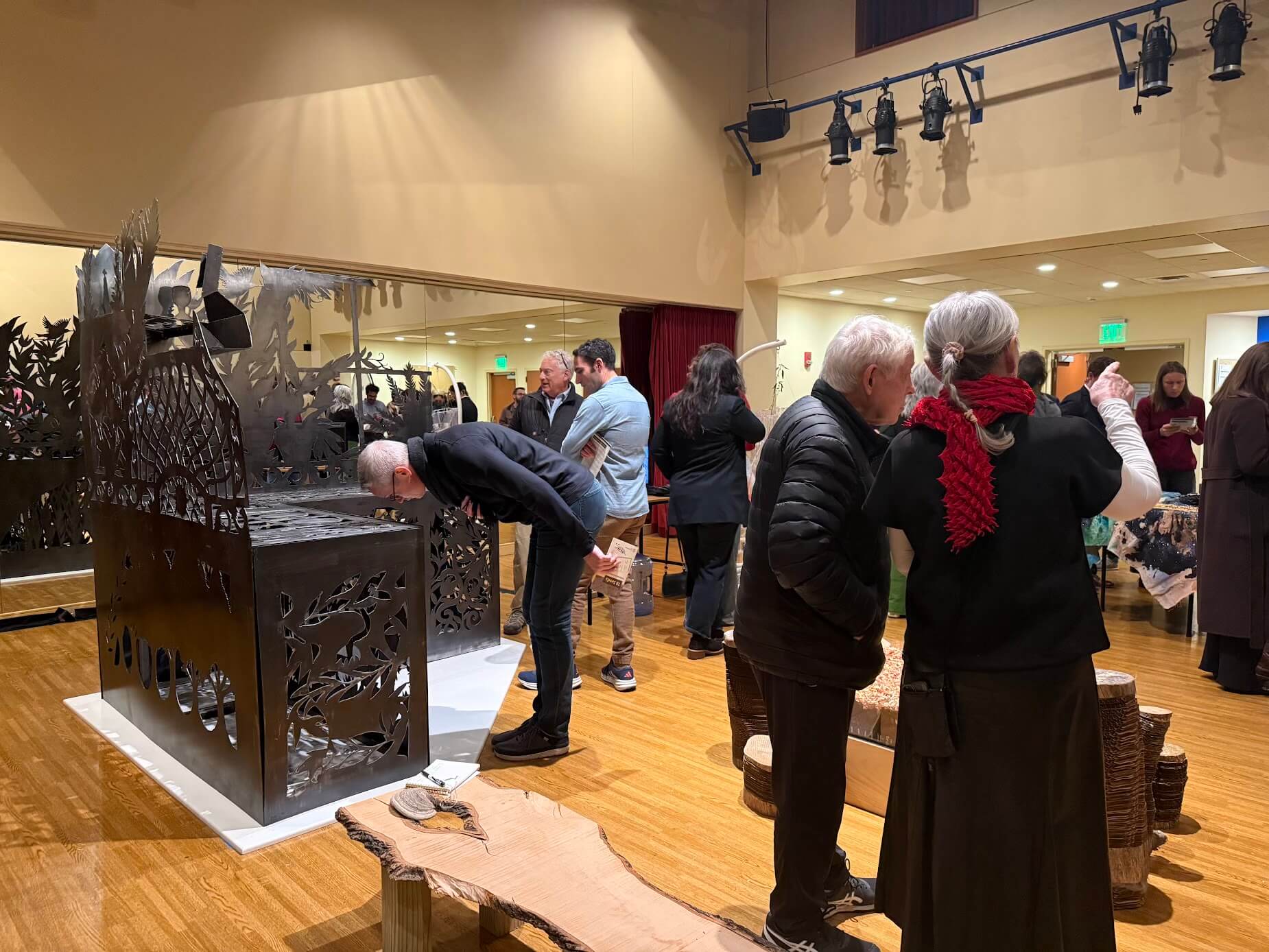
Leviss and Rubensteen launched the 70 Seeds exhibition in Boston’s South End. The exhibition ran from Oct. 27 to Nov. 8, and integrated panel discussions, immersive Shabbat rituals, theater performances, and artist workshops to engage community members and place them at the center of imagining a shared Jewish future beyond a Zionist/anti-Zionist binary.
The 70 Seeds opening was the first Judeofuturism event I attended, and it quickly became clear to me that this project was more than a typical Boston art opening: It was a newly emerging movement that encouraged collective visioning rather than the top-down compliance I’d seen controlling my communities since Oct. 7.
That night, I came upon Nicki Green’s soft-sided pickle fermentation jar, which offered a future where, regardless of belonging to a specific nation-state, Jews can continue to prepare the iconic diasporic food and transport it with them.

I sat on the wooden bench next to Beverly Sky’s reimagined genizah (sacred repository for old texts containing the word God), and was pushed to consider what traditions will continue to fuel Jewish culture and what no longer serve us.
As I moved from installation to installation, among about 100 attendees on opening night, the work created a balm for the festering wound of disconnection and division brought on by increased global turmoil.
These approaches to Jewish futures stood in stark contrast to the binary futures I had previously felt forced to choose between. Their grounding in Jewish ritual and history brought me closer to Jewish culture and to my own identity.
As the night drew on, Rubensteen and Leviss posed the same question to attendees as they had to the show’s artists: “What is your dreamed future of American Jewish life in 2070?”
The date marks two thousand years since the fall of the Second Temple, an event that prompted Jews to radically reimagine Jewish life.
At a moment today when our world is shifting dramatically, Rubensteen and Leviss’ question prompted me and my peers to consider how we might respond to growing pressures using Jewish knowledge. I parsed through the proposed futures laid before me by the exhibition’s artists, and, over the next week and a half, I participated with dozens of people in workshops and panels to see what other possible futures we had not yet considered.
The following night, at a workshop titled “Schism or Realignment? Emerging Identities in Jewish Life,” we negotiated our beliefs about Jewish life and spirituality by placing ourselves along a continuum, engaging with disagreement head-on.

Leviss posed questions to us, debating how open or closed Jewish practice should be to non-Jews, or what role Jewish institutions should play in attending to the needs of their communities. In hearing my peers’ perspectives, I found my own beliefs shifting and observed other participants experiencing the same changes. Rubensteen and her husband, Dr. Josh Eisenberg, even found themselves on opposite sides of the spectrum at times, demonstrating how, even in our most intimate relationships, we see the fractures of our increasingly polarized world emerging.
And yet, while disagreement occurred, our conversations seemed to bring us closer to one another, and closer to a shared vision of what Jewish life can look like outside of the narrow Zionist/anti-Zionist futures that are so well represented.
I realized that, at its core, the Judeofuturism Project was answering the call for a newly emerging Jewish identity, one defined by leftist politics and invested in reimagining ancient Jewish ritual to meet the present moment.
Isabel Mattia — whose work, “Amulet far der Kikh,” examines the kitchen as a site of solidarity, diversity, and potential intercultural connection — encapsulates this growing religious political moment. Drawing on ancient amulets that Jews used for protection and prayer, she examines how, when we turn our prayer towards our families and communities, we might recognize that the source of Jewish life is already within our own ovens and mixing bowls, rather than in a far-away place.
“In my conversations with others, I see a trend that we are sometimes made to feel that to oppose [Palestinian destruction] is somehow radical within Jewish culture. I don’t believe that it is radical at all. My opposition to this has brought me so much more deeply connected to my identity and values as a Jew and to my commitment to keeping Judaism alive and rich for my daughter,” Mattia told the Forward.
As I immersed myself in the Judeofuturism Project’s programs, I began to see Mattia’s sentiment reflected in my experience as well.
While the leftist spaces I previously frequented encouraged me to cut myself off from Judaism in order to access progressive theologies, and the Jewish institutions demanded that I couldn’t access Judaism without identifying as a Zionist, the Judeofuturism Project carved out a path for me and my peers where Jewish values could inform our politics and connect us more deeply to Jewish ritual and culture in the process.
And so, I returned, night after night, along with a handful of community members, to continue down this path.
“The Judeofuturism Project is really vital because it’s something that feels distinctly helpful right now,” Miriam Pellegrino, a design researcher and strategist, told the Forward. “It’s rooted in tradition, but also very imaginative … We’re in a kind of polycrisis, and I think people are hungry for community that helps them collectively parse out how to live a good life.”

And although the Judeofuturism Project’s November programming by no means provided a clear-cut answer to what a “good life” looks like, it placed the power to define a “good life” into the hands of community members, empowering them to build a dynamic, culturally responsive definition together. And, more than anything, it gave me and my fellow attendees the reassurance that we aren’t alone in wanting more than the two options currently on the table.
While the 70 Seeds exhibition concluded on Nov. 8, a digital version of the exhibition is now available for anyone to access and take the work of imagining new Jewish futures into their own hands.
Along with traditional installation photos of each artist’s work, Eisenberg has configured the site with additional resources and commentary, Talmudic-like, to welcome viewers into conversation with each artwork, rather than remaining passive onlookers.
Renderings of each artist’s workspace transport you into the artist’s shoes. Accompanying text offers each artist’s vision of American Jewish life in 2027. An attached workbook invites communities to utilize the exhibition as a tool and framework for their own future-visioning needs.
For Leviss’ part, she already has plans to present on the Judeofuturism Project at the upcoming annual Association for Jewish Studies conference, with the goal of bringing a multi-week exhibition with programming to other cities in the future.
And she’s sure to find more artists to imagine the futures that prompt these important conversations. Already the structures that Leviss and Rubensteen have provided are fueling future work.
“We’re navigating turbulent times, and I feel like we are all grasping for a way through it,” said artist Amalya Megerman, whose imaginative challah amulets draw on ancient Jewish challah rituals for contemporary use as protection against global crises. Finding the Judeofuturism Project was a turning point for Megerman and her creative process.
“The Judeofuturism Project gives me a guiding light to keep the work moving.”
The post I wanted a Jewish future that didn’t force me to choose between Zionism and anti-Zionism. Here’s how I found it. appeared first on The Forward.
Uncategorized
It shouldn’t be dangerous to wrap gifts at the mall for charity – but for Jews in North Carolina, it is
When news reports say antisemitism is rising, it can be hard to know what that means for each of us. As a Jewish American and North Carolinian active in my community, for a long time, nothing in my world seemed different. Now, it does.
Last December, I helped organize a gift-wrapping table at the Crabtree Valley Mall in Raleigh to raise funds for charity. The table was staffed by a group of Jewish women who wrap gifts to raise money for Hadassah, The Women’s Zionist Organization of America, a storied organization that brought modern healthcare to pre-state Israel and created one of the region’s leading hospital systems. Hadassah’s hospitals care for all, regardless of race, religion or nationality, treating more than one million patients a year – Jews and Arabs, Israelis and Palestinians, side by side. Staffed by physicians, nurses and researchers from diverse nationalities, they were once nominated for a Nobel Peace Prize for building bridges to peace through medicine.
Hadassah volunteers have been running the gift-wrapping table for 50 years. For me, this has always been a wonderful example of neighbors reaching out to neighbors during the holidays. But last year, this usually happy event became a dangerous one that put a target on the backs of our volunteers.
Just before Christmas, protesters stood outside the Hadassah booth, stopping customers to tell them, “You are giving money to kill babies in Gaza” and “You are paying for Israel to kill Gazans.” Mall security was called and asked the protesters to leave, but they came back, entered the booth yelling, and confronted our volunteers. At one point, a protester reached into their backpack to pull out something, which was a megaphone, not a weapon, but security escorted this individual out of the mall.
This year, we will not return to the gift-wrapping table. But we are not retreating. Hadassah volunteers have found another way to continue raising funds for healing, because antisemitism does not determine whether Jewish women participate openly in our community.
Amid a nationwide rise in antisemitic violence, including the murder of three people as the result of incidents last year in Washington, D.C., and Boulder, Colorado, we no longer feel it is safe to return to our gift-wrapping table. Being a Jew wrapping holiday gifts at a mall in North Carolina feels just too dangerous right now.
In January, a man who had traveled from South Carolina defaced Charlotte’s Shalom Park Jewish community center, a Jewish day school and a Holocaust memorial with flyers bearing a swastika and a noose. And two months ago, in our own Triangle community, someone identifying himself as the leader of the Goyim Defense League, whose stated goal is to remove Jews from the United States, broke into a Chapel Hill High School Zoom meeting and put up an antisemitic image before being removed. Worse, it happened during the Days of Awe between Rosh Hashanah and Yom Kippur, the holiest period on the Jewish calendar.
Since Oct. 7, 2023, antisemitism has surged across the U.S. and around the world to record levels, and it is not slowing down. This is not an abstract debate. A Hadassah report, From Fear to Resilience: Women Facing Antisemitism, found that nearly two-thirds of Jewish women surveyed said antisemitism affected their daily lives, and more than half of the respondents have taken steps to hide their Jewish identity in public.
Hadassah has not stayed silent in the face of these acts of hatred. We have advocated in Congress for legislation, including the Jewish American Security Act, which would allocate one billion dollars to secure houses of worship and nonprofit organizations, and hold social media platforms accountable for antisemitic content. We have also built local and national partnerships to advance interfaith dialogue and to fight antisemitic misinformation in schools and other community spaces.
These bills matter but are not enough. Laws alone will not change what happened at Crabtree Valley Mall and Shalom Park and on the Chapel Hill Zoom call. What is missing is leadership, and that starts at home.
Our experience highlights an important challenge for our communities: Our response to antisemitism cannot just be adding more security – though we certainly do need that. We checked to see what additional security would cost to keep our volunteers safe at the mall. It was over $20,000. That’s more than we raise with our annual event.
If we want to prevent antisemitism from becoming the new normal, we need a multi-pronged plan of action to push back against hate nationally and locally. Federal legislation isn’t enough. We stand ready to do this work. We also need North Carolina’s elected officials and community leaders to speak out against antisemitism and to back up their statements with action. Otherwise, we will see more incidents like those we’ve experienced – and perhaps worse.
The post It shouldn’t be dangerous to wrap gifts at the mall for charity – but for Jews in North Carolina, it is appeared first on The Forward.
Uncategorized
We are still drawn to holy ground, even as it shifts beneath us
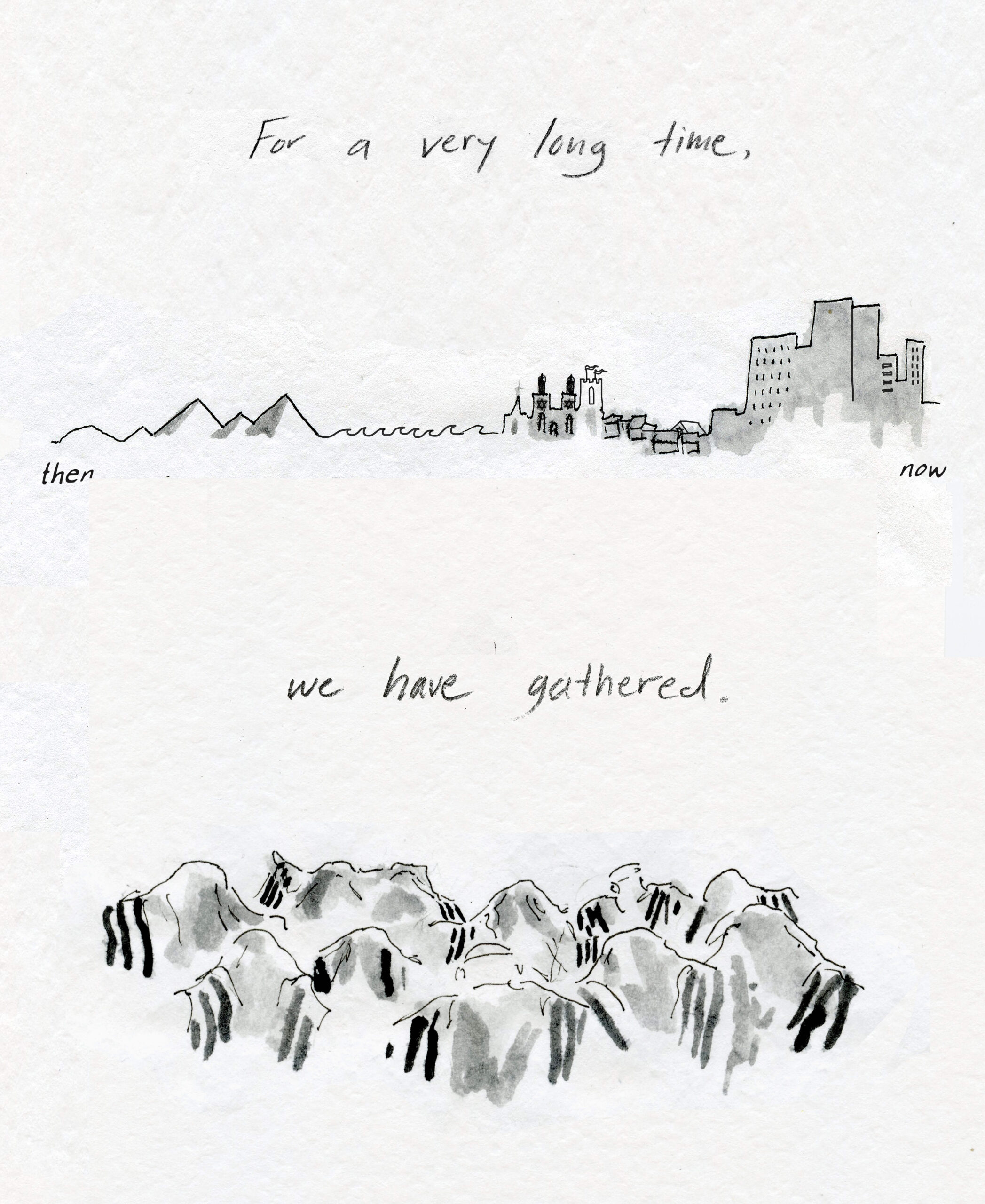
Cartoonist Mia Rose Kohn, inspired by our Holy Ground series about Jewish resilience and reinvention, considers what keeps us craving sacred spaces — even as we change.


The post We are still drawn to holy ground, even as it shifts beneath us appeared first on The Forward.
