German rabbi at center of ongoing scandal plagiarized his dissertation, newspaper finds
BERLIN (JTA) — The prominent German rabbi who was found to have abused his authority at the seminary he ran also appears to have plagiarized a portion of his 1992 dissertation.
That’s according to a new investigation into Rabbi Walter Homolka published this week in the Frankfurter Allgemeine Zeitung, a German newspaper.
More than 60 pages of Homolka’s 240-page dissertation, “From Essence to Existence. Leo Baeck and Religious Identity as a Problem of Continuity and Change in liberal Jewish and Protestant Theology,” consisted of verbatim translation of a German scholarly article – pages 43 to 106, according to the newspaper.
The doctoral dissertation at Kings College London did not include attribution or acknowledgment of the author, the Protestant German theologian Dorothee Schlenke. Only in 1994, when Homolka published his dissertation as a book in English and German, did he explicitly thank Schlenke, now a professor at the University of Education in Freiburg, the newspaper reported.
Kings College London removed public access to the dissertation the day that a reporter asked Homolka’s attorney about allegations of plagiarism, the newspaper reported.
Those allegations were among the long-simmering criticisms of Homolka that burst into public view after a different newspaper, Die Welt, published a blistering report last May about Homolka’s leadership at the Abraham Geiger College, the liberal seminary he founded in 1999, two years after he was ordained in a private ceremony.
Following the report’s revelations of a possible coverup and abuse of power by Homolka, both the University of Potsdam, which houses the seminary, and the Central Council of Jews in Germany initiated investigations. Homolka, who has vigorously contested all accusations, has since stepped back from virtually the Jewish institutions in which he played a formative role.
In its investigation report, released last October, the university said it had not found evidence of criminal actions, thus affirmed Homolka’s position as a professor there.
But the report did confirm abuse of power and noted that accusations of plagiarism, specifically his use of “an unpublished work by the Freiburg professor Dorothee Schlenke (‘Normativity and History,’ 1986),” required further investigation.
University spokesperson Silke Engel confirmed to the Jewish Telegraphic Agency that the university has asked Kings College London to clarify the status of Homolka’s 1992 dissertation. She added that, while the “abuse of power” report is final, allegations of “scientific misconduct are currently under investigation” and the results will be presented in a second report.
According to the new report, Homolka’s attorneys responded last June to their query about his dissertation, saying that “the unpublished work of Dorothee Schlenke was not the main source for the dissertation at Kings College London, nor does everything about the ‘essence debate’ [a theological thesis] go back to this work.” The lawyers added that “Schlenke’s research was helpful for our client’s dissertation, which is why it is mentioned in both the German and English book editions.”
On Jan. 26, responding to renewed questions, the lawyer confirmed that their client “stands by his previous statements in this regard.”
Neither Kings College nor Dorothee Schlenke have yet replied to queries from JTA.
The Central Council’s final report on allegations of abuse of power is expected to be released in the coming weeks.
The civil war in the far-right is coming down to Jews
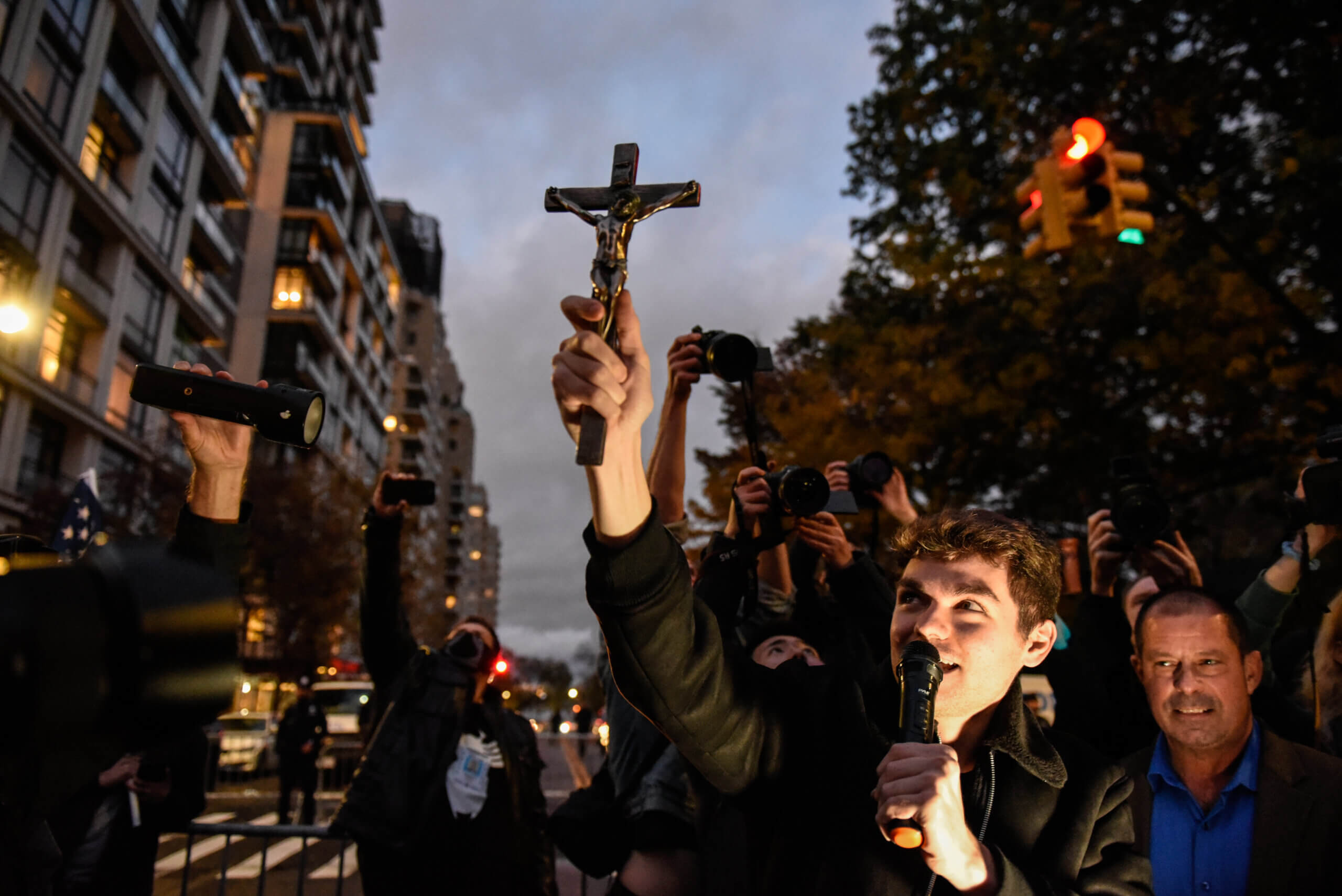
On 9/11 of this year, far-right extremist and Jan. 6 agitator Jake Lang led a protest against New York Mayor Zohran Mamdani’s attendance at the memorial service. Lang referred to his protest as a “crusade” and brandished a wooden cross at Ground Zero.
Among the many counter-protesters who showed up to oppose Lang was a group of neo-Nazis carrying a banner reading “Jake Lang is a Jew” and screaming that Lang is leading a “psyop” — an attempt to sway public opinion secretly backed by a government, presumably Israel’s.
Just as confusingly, in between shouts of “We are the real Nazis! We are the real racists!” and rants about removing Jews from the American government, the small group of Nazis chanted “Free, free Palestine” and “Heil Hitler, free Palestine!” Perhaps most bafflingly of all, alongside the seven men in swastika armbands stood someone in a full Elmo suit wearing a Palestinian flag as a cape.
Lang has a Jewish mother and was bar mitzvahed. But he has decisively renounced Judaism to embrace an extreme form of Christian nationalism. He has burned a Koran and a Talmud, performed a Heil Hitler salute outside of AIPAC headquarters and regularly screams “Christ is King” at his protests, which are usually directed against Muslims — he protested Mamdani on 9/11 as well as in March outside Gracie Mansion, and targeted the large Arab population in Dearborn, Mich. with another “crusade” protest in August.
The Nazis protesting Lang epitomize an issue increasingly splitting the far-right: Jews.
From the outside, the far-right appears relatively united in its support for extremist ideas about Christian and white nationalism, as well as its openly expressed racism. They are virulently anti-immigration and anti-women, suspicious of science and education and in favor of building an ethnically and theologically homogenous society. They are almost always antisemitic, spreading false conspiracy theories about Jewish control. Yet internal battles on the right are breaking out with increasing regularity over just what form of antisemitism they endorse.
Take Lang. He is, by his statements and actions, a staunch Christian nationalist. Though he focuses his ire mostly on Muslims — Lang advertised the Dearborn protest with videos captioned “Americans against Islamiphication” [sic], and his protests against Mamdani have focused on the New York City mayor’s Muslim identity — he is far from friendly to Jews.
He regularly proclaims that “America is a Christian country.” And he has endorsed antisemitic conspiracy theories, stating, on erstwhile Trump ally and conspiracy theorist Laura Loomer’s podcast, “I will be the first one to call out this liberal, woke Jewish mafia that controls Hollywood and is brainwashing the white women to all fall in love with Black men and they’re poisoning and they’re not real Jews.” That’s a real litany of antisemitic conspiracy theories all rolled efficiently, if somewhat incoherently, into a single sentence — the Great Replacement Theory and Jewish cabals with a dash of some Medieval-era well-poisoning.
Still, he hedged his antisemitism a little bit: “We have been psyoped into blaming everything on the Jews, that’s ridiculous,” he said in the same podcast with Loomer.
That statement, along with his Jewish ancestry marks him as an outsider to the other wing of the far-right — including the Nazis opposing him. “We’re pro the white race,” said one at the protest last week. “Whites and everyone in this world who opposes Jewish power, in one struggle against the Jews.”
It’s not just the handful of Nazis. Other far-right influencers have also called out Lang.
Dan Bilzerian, another rightwing influencer who spread antisemitism during his run for Congress, pointed out Lang’s Jewish background in a tweet saying “This is what jews do, they pretend to be white to spread white, black and Muslim hate.”
Antisemitic streamer Nick Fuentes, who has also led a crucifix-brandishing march in New York, said the same of Lang in another tweet: “This guy is a Jewish operative and his entire campaign is a psyop to instigate conflict between Whites and Muslims.”
The rift on the right
Nick Fuentes also brandishes a cross at a protest in New York city. Photo by
Lang is not the only face of his almost-but-not-quite-antisemitic side of the far-right aisle, nor the only target of neo-Nazi ire. It was perhaps best embodied in Charlie Kirk, who espoused open anti-Black racism, anti-LGBTQ hate, Islamophobia and anti-immigrant sentiments — but also on a few occasions attended Shabbat dinners with Jews.
Opposing them are those for whom antisemitism isn’t one of many extremist or bigoted beliefs, but the guiding ideology. This side is characterized by the “groypers,” or followers of Nick Fuentes, though it’s certainly not limited to them.
These political views are common in MAGA circles; Vice President JD Vance and Secretary of Defense Pete Hegseth regularly reference Christian nationalism in their conception of what makes the U.S. great, and aggressively oppose immigration. Hegseth brought the leader of his church movement, Doug Wilson, to lead prayers at the Pentagon; Wilson has stated that women should not have the right to vote and that the U.S. should be a Christian country governed by the Bible.
But most of these figures also support Israel, even if it is often out of a desire for Christian control over the Holy Land. And they try — with somewhat limited success — to sidestep open antisemitism.
Yet open antisemitism is no longer just limited to the far fringe of the right and self-identified groypers. Today, politicians like former congresswoman Marjorie Taylor Greene and once-mainstream media figures like Tucker Carlson have openly embraced the ideology, as well as groypers themselves, even interviewing and “mm-hmming” along with Fuentes.
In this political framework, hating Jews is a core part of being a true Christian and a true American. This is justified by theological ideas including but not limited to supersessionism, but those religious concepts are mixed inextricably with conspiracy theories about Jewish devil-worship and outsize Jewish influence over world events. For those believers, there is no good country with Jews in it. And they reject anyone who is friendly toward Jews or Israel, or even remotely associated; Fuentes claimed Wilson was “in bed with the Jews” despite his Christian nationalism.
This was obvious immediately in the wake of Kirk’s death; groypers had been warring with Kirk, showing up to events put on by his conservative youth organization Turning Point USA to disrupt and push Kirk even further to the right. After Kirk’s murder, they celebrated and some even referred to his death as a “shitpost,” or form of trolling.
The cultural power and inspiring heroic image that the mainstream right attempted to construct from Kirk’s death never quite came to be; a statue of Kirk arrived in Times Square this month, but the Turning Point USA founder has been turned into a mocking meme by the far-right young men he once courted. Kirk’s politics, which managed to toe the line of acceptable rhetoric on the mainstream right, have been abandoned for open neo-Nazism and antisemitic conspiracy theories.
This hate for Jews has grown so strong that it can even override Islamophobia, despite the movement’s foundational white, Christian nationalism; the groypers’ and neo-Nazis’ antisemitism is so virulent that it sometimes turns, incongruously, into pro-Palestine activism, particularly when combined with suspicion of the government’s alliance with Israel.
Carlson interviewed a Palestinian archbishop, using the conversation more as a way to emphasize the idea that Israel was bombing Christians. The Nazis opposing Lang chanted “Free Palestine” on several occasions. Marjorie Taylor Greene regularly posts about children in Gaza. Even Fuentes seems warmer to Muslims than he is to Jews. “My enemy’s enemy is my friend,” appears to be the guiding principle.
In many ways, both sides of the rift in the far-right share a vision of America as a white, Christian nation. They even share some antisemitism — but one side at least still keeps it somewhat veiled. The other will abandon its commitment to white Christian nationalism if it means ridding the country of Jews.
That rift could fracture the extremist right entirely and leave it weakened or even destroyed. Or we could be seeing more than a handful of neo-Nazis out on the street next time.
And each Yom Kippur, as worshippers attend the last prayers of the day, they might well ask: “Why is this closing service different from all other services?”
The Book of Life
Throughout the High Holidays, the 10-day period that begins with Rosh Hashanah and ends with Yom Kippur, Jews pray to be “inscribed” in the Book of Life – that God grant them life, livelihood, health and moral growth in the coming year.
The holidays culminate in Yom Kippur, the Day of Atonement: a day dedicated to reflection, fasting and repairing each person’s relationship with others – and through that, their relationship with God.
According to Jewish tradition, the Book of Life is sealed as Yom Kippur draws to a close, as is each person’s fate for the coming year. During the fifth and final service, one prays to be “sealed,” which on this Day of Judgment entails being forgiven. This last service is thus titled “Ne’ilah,” or “the closing,” reflecting the idea that the gates of heaven are closing. It also alludes to the gates of the ancient Temple in Jerusalem, where the holiday was once celebrated.
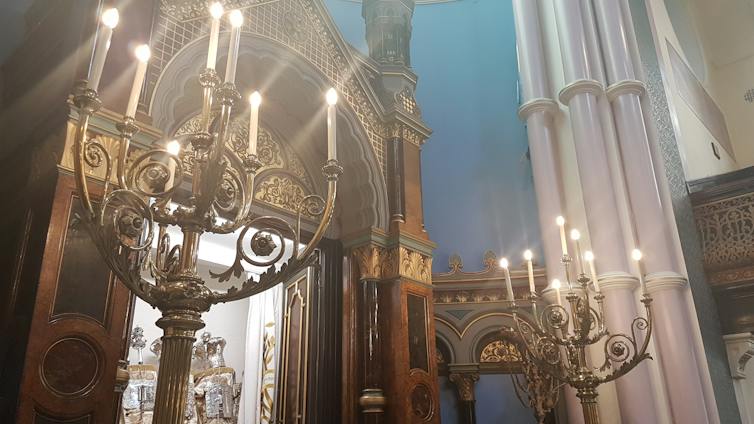
Ne’ilah prayers are accordingly recited at the closing of the day – just at sunset, adding nature’s drama to the closing of the day. The ambience is enhanced by keeping open the ark of the Torah, the usually closed chamber at the front of the synagogue that protects the scrolls of scripture. Many congregants remain standing, using this final chance to plead their case as the day slips by.
Yom Kippur is a day reserved for repentance, expressed through confession – and, in many ways, it is a day of repetition. The confessional prayer is recited up to 10 times over the course of five services.
It begins with the congregation asking God for forgiveness “for the sin that I have committed before You.” Yet what follows is an extended list of ethical sins, with a focus on the sins of abusive speech, such as slandering, slurring, slighting and smearing the reputations of others. A foundational concept of Judaism is that humanity is made in the image of God, meaning that in wronging others, we offend God as well.
After reciting the confessional, the Ne’ilah service adds one more prayer, not used in other services. This addendum focuses not on the specifics of confession but the dynamics of repentance: underscoring that belief that each person’s relationship with God is correlated with their relationship with other people.
Ne’ilah thus focuses on the sin of fraud, echoing a passage from the biblical Book of Jonah read in the preceding afternoon service: “Let everyone repent of their evil way by giving back the stolen goods in their hands.” To return to God, then, it is important to return what is owed to other people: emotionally, spiritually and materially.
Whereas the oft-repeated confessional focuses on offenses of the lips, such as slander, here the focus is on offenses of the hands: taking what does not belong to us, such as by exploiting the vulnerable or committing fraud.
“You give space” – literally, you give a hand – “to the sinner, but You extend Your right hand to penitents,” it begins. “You have taught us … to confess to You every one of our sins so that we cease handling unlawful goods.”
Judaism holds that God won’t forgive you for a sin if you haven’t made amends with the person you wronged. During the Days of Awe leading up to Yom Kippur, Jews are taught to ask each other for forgiveness, apologizing for the ways we wronged one another in the past year.
Repent and repair
Rather than browbeating people into repentance, the Ne’ilah service’s strategy is to boost them up into it, playing upon the biblical idea of the grandeur of humanity. “You have distinguished humanity from the beginning, privileging it to stand before You,” the liturgy says.
Judaism sees sin as a rupture that can be healed, not an inherent condition. The liturgy’s message is this: Live up to your greatness, your divinely endowed potential, as a being made in God’s image.
For Ne’ilah, the eminence of humanity consists in the ability to repent and set things right before man and God. This is what Yom Kippur is all about.
At Dartmouth, Jewish and Middle Eastern Studies refuse to stay apart
Immediately after the Oct. 7 attacks and the start of the Israel-Gaza War, Dartmouth College student Jackson Weinstein was “extremely outspoken” on campus about his support for Israel.
But by his sophomore year, he had largely withdrawn from discussing the conflict with other students.
“It felt like I was losing friends and just making things harder for myself,” said Weinstein, now a senior at the Ivy League university in New Hampshire.
This past school year, he enrolled in a new course, Difficult Conversations on the Middle East, developed by the college in response to debates over Israel and Gaza that have divided campuses across the country.
For the first several weeks, the class, jointly offered by Dartmouth’s Middle East and Jewish Studies departments, avoided delving into the conflict. Instead, students started by studying topics like groupthink, mindfulness, emotional regulation and academic freedom.
Only by the fifth week did they plunge into subjects like Palestinian armed resistance, women’s rights in the Middle East, the accusation of genocide in Gaza and the role of colonialism in the region.
“In the first class, students come in with this idea of, ‘How do I win the debate? How do I show that I’m right?’’” said Jonathan Smolin, a professor of Middle Eastern Studies. “That’s categorically not what we’re doing in the class.”
Smolin teaches the course alongside Ezzedine Fishere, a former Egyptian diplomat who spent five years posted in Israel.
The hope is that students learn to take an argument seriously enough to understand it before deciding whether they reject it.
The unusual course, offered again this school year, is the product of an experiment Dartmouth began long before Oct. 7. For roughly a decade, its Jewish and Middle Eastern Studies programs have deliberately intertwined themselves: professors co-teach and cross-list courses, serve on each other’s steering committees, co-sponsor visiting professors and even occupy neighboring offices in the same building. It’s just as much for the faculty as it is for the students.
“I want to understand why some people hold positions that I may find horrific,” said Susannah Heschel, chair of Jewish Studies at Dartmouth. “I’m not here to just condemn something; I want to understand the complexity of it.”
An unusual partnership
For Darcy Rochkind, a Middle Eastern Studies major modifying her degree to include Jewish Studies, the partnership is what drew her to Dartmouth.
Rochkind was applying to college in the fall of 2023, as campuses across the country were convulsed by protests and arguments over universities’ responses to Oct. 7. Her dream school was Columbia, but after watching congressional hearings on antisemitism in person and videos her mom sent her of Dartmouth’s Jewish Studies and Middle Eastern Studies professors discussing the conflict side by side, she changed her plans and enrolled at Dartmouth.
“You’d have a very hard time being a Middle Eastern Studies or Jewish Studies major without taking a class from the opposite department,” she said.
The experiment also extends beyond the classroom. In the immediate aftermath of the Oct. 7 attacks, Heschel and her colleagues in Middle Eastern Studies organized two public forums to discuss what had happened and opened it to students. The room was so packed that Dartmouth needed an overflow space, and Heschel said another 1,600 people watched via livestream.
After those initial forums, Dartmouth launched Middle East Dialogues, a series of events organized by faculty in Jewish and Middle Eastern Studies to explore challenging topics related to the region. Rather than foster safe spaces, Dartmouth leaders aspired to create what they call “brave spaces,” where students are encouraged to actively engage with disagreement.
To make it work, Smolin, who has organized many of the program’s events, deliberately avoids inviting speakers who are political activists on either side.
“We’re not interested in people declaring who’s right and who’s wrong,” he said. “That’s not what we do in higher education.”
Instead, they have hosted Israeli and Palestinian political commentators, think tank experts, and public-opinion researchers.
Professors have also facilitated meetings between students to expose them to different viewpoints. Weinstein and several other Jewish students went to dinner with a group of Muslim students, including two Palestinians and a student who had grown up in Gaza. His professor, Fishere, facilitated the gathering.
The students sat together at Pine, a Dartmouth restaurant, and talked for hours about the war, the accusation of genocide in Gaza and the experiences of Gazan civilians.
Weinstein had never before met someone who had spent his entire life in Gaza. He described the dinner as “one of the most human experiences I’ve had at Dartmouth.”
A national flashpoint
Dartmouth’s approach has become increasingly distinctive as Middle East studies programs have become flashpoints in campus battles over Israel, antisemitism and academic freedom.
Since Oct. 7, critics — including Jewish students, alumni, and watchdogs — have accused some Middle East studies programs across the country of teaching about Israel through a hostile ideological lens and creating an inhospitable environment for Jewish and pro-Israel students.
Some professors in the field, meanwhile, have argued that accusations of antisemitism in higher education are being used to police scholarship that could be critical of Israel.
Under similar pressure, Harvard’s Center for Middle Eastern Studies removed the center’s director and associate director from their leadership posts, though they kept their jobs. The Trump administration later demanded that the school’s Middle East Studies Department, among others, be audited by a third party to ensure a diversity of viewpoints.
The interventions prompted outrage from professors, students, and academic-freedom advocates arguing that the government was seeking to exert control over how universities teach about Israel and the Middle East.
According to Heschel, the climate has contributed to driving a wedge between Jewish Studies and Middle East Studies departments on some college campuses.
“I know that at some universities, faculty in Middle East and Jewish Studies don’t even talk to each other; they don’t respond to each other’s emails, for example,” she said. “That I find appalling. That’s unacceptable.”
Not everything is about conflict
For Heschel, the intellectual case for faculty in Jewish and Middle Eastern Studies to collaborate goes beyond teaching students how to talk about the current conflict.
“We want our students to know not just about the conflict that they read about in the newspapers today,” Heschel said. “We want them to know about a period where there was religious tolerance and respect for one another, to see that it’s possible we don’t have to live in a condition of anger and enmity.”
She co-teaches a course with a Middle East Studies professor examining how Jews in Europe and Arabs in the Middle East responded to modernity during the 19th century.
In one lesson, students learn about the Lebanese intellectual Butrus al-Bustani, who founded a school in Beirut in 1863 for Christian, Muslim and Jewish boys — and hired a cook to prepare kosher food for his Jewish students.
Engineering major Oguz Kurt, a rising junior who was born and raised in Turkey, took the course last semester.
“Building trust week over week” with classmates and professors, he said, brings people like him into the room who might otherwise be “intimidated” by the prospect of tense encounters in a class focused explicitly on the Israeli and Palestinian conflict.
Kurt wants to be there, which points to one obvious limitation to Dartmouth’s experiment: Students have to want to participate.
A 2025 survey of graduating seniors by the university’s campus newspaper, The Dartmouth, found that nearly 70% described themselves as liberal or very liberal, compared with roughly 12% who identified as conservative or very conservative. More than 70% said most of their closest friends shared their political beliefs.
Additionally, a 2025 Gallup poll conducted on the Dartmouth student body in 2025, found only 38% reported feeling comfortable sharing unorthodox ideas in class.
Weinstein wonders whether this degree of homogeneity is why courses like Difficult Conversations succeed – the people least willing to engage with opposing points of view don’t take the class.
“Everyone was there to learn. Everyone could be persuaded,” he said. “In some ways that’s a problem,” adding that the class might benefit from “a wider range of ideologues.”
“Not all of Dartmouth is like this,” Smolin acknowledged. “No doubt there are professors in other units that think it’s up to faculty to lead liberation and that this approach is stifling.”
On the other end of the spectrum, Heschel said some right-wing Jewish faculty members outside the Jewish Studies program have criticized the approach she and her colleagues take.
“I understand the anxiety that Jews feel today about university campuses, but I think they’re underestimating their own students,” she said. “Kids will encounter viewpoints that they will find disturbing and offensive, not just about Israel… they need to learn how to handle such a situation, how to respond.”
Heschel said faculty and administrators at other universities have approached Dartmouth to ask how to replicate what they did.
“I was surprised that we received so many requests from deans and presidents of colleges and universities to come and talk about what we had done,” she said.
From Dartmouth to Damascus
One of the people thinking about what could be replicated outside Hanover comes from much farther away.
Before flying to New Hampshire this May, Ibrahim Imre El-Khalid Bethlen asked ChatGPT a question he had never needed answered before: What is proper Shabbat etiquette?
Heschel and Bethlen at Dartmouth Courtesy of Ibrahim Imre El-Khalid Bethlen
Bethlen, a Syrian political scientist who teaches at Damascus University, met Heschel when she traveled to Damascus with a delegation of Jewish Americans in December 2025. She invited him to come to Dartmouth for 10 days and packed his schedule with jointly taught courses like Difficult Conversations, and a seminar about Jews in Algeria. Bethlen also lectured about the current political situation in Syria and attended his first ever Shabbat at the campus’ Chabad.
Just as new to him was seeing Jewish Studies and Middle Eastern Studies professors teaching together.
“With every professor we had some brainstorming about how we could bring the people closer,” he said. “How could we demystify” Jews to Syrians. Most of them have never met a Jewish person since the millennia-old Syrian Jewish community left en masse in the mid-20th Century.
Now, Bethlen hopes to connect faculty at Damascus University to their counterparts at Dartmouth. He is realistic about political sensitivities. Bringing an Israeli or Jewish Studies professor into a Syrian classroom to discuss the contemporary conflict, he says, could be a nonstarter. But having an Arab professor in the classroom as well could help.
“We don’t want to jump too high,” he said.
He imagines beginning somewhere Dartmouth itself often begins: with classes focused on shared history and culture rather than contemporary politics. Perhaps a jointly taught course that introduces students to the literature and poetry of Jews and Arabs once shared across the Middle East. Classes like Difficult Conversations can come later.
As a part of that Dartmouth class’s final assignment, students are asked to have a conversation with someone on campus they disagree with about the region, applying what they have learned.
Weinstein chose a friend and fraternity brother whose views on Israel differed sharply from his own. They talked for several hours.
“I ended by congratulating Eli on being ‘the only close friend I’ve ever had that wasn’t pro-Israel,’” Weinstein wrote in his reflection afterward. “I sure hope he isn’t the last.”