Local News
Former Winnipegger Ezra Glinter to discuss his new biography of Rabbi Schneerson at upcoming Limmud Winnipeg

By MYRON LOVE The Chabad-Lubavitch movement is one of the world’s largest and best-known Hasidic groups. Driven by the belief that we are on the verge of the messianic age. Lubavitch, under the leadership of the charismatic Rabbi Menachem Mendel Schneerson , has, over the past 70 years. engaged in an outreach program to the Jewish world which may bemunprecedented in Jewish history. Wherever there is a Jewish community in the world, no matter how small, you will find a Lubavitcher Rebbe.
I have seen one survey that more younger American Jews – almost 40% -have developed a connection with Chabad than another branch of Judaism.
Last October, former Winnipegger Ezra Glinter published “Becoming the Messiah: The Life and Times of Menachem Mendel Schneerson,” the first biography of Rabbi Schneerson to combine a nonpartisan view of his life, work, and impact with an insider’s understanding of the ideology that drove him and that continues to inspire the Chabad-Lubavitch movement today.
On Sunday, March 23, Glinter will be introducing his biography to his home town as one of the presenters at the 15th Limmud Winnipeg Festival of Jewish Learning.
(Limmud was founded in England in 1980 with the aim to build bridges between professional and nonprofessional educators and between those of differing religious commitments. Today, the Limmud Festival is held in more than 90 Jewish communities in over 40 countries around the world.)
The New York-based son of Nancy and Harry Glinter has had an interesting life journey of his own – a journey that has included his own immersion for several years in the Orthodox world – making him an ideal individual to explore the Rebbe’s life and work and impact on Judaism.
“It was helpful hat I could apply the skills that I learned in Yeshiva to the research,” Glinter notes.
The fact that he is also self-taught in Yiddish was also helpful.
Glinter in a graduate of Talmud Torah. At the age of 16, Glinter chose to pursue a more religious lifestyle. With his parents’ support, he enrolled in Ner Yisroel in Batimore.
In 2004, after four years in yeshiva, he enrolled at McGill, graduating with a BA in English (in 2008), followed by a year at New York University. Since then, he has pursued a career as a freelance journalist. For five years, he served as deputy arts director for the Jewish Daily Forward. Over the past eight years, he has contributed book, theatre and arts reviews and lifestyle stories to numerous prestigious American publications, as well as the Israeli newspaper Haaretz,”and the Paris Review.
The Schneerson biography is his second book. In 2016, he published “Have I Got a Story for You” – a compilation of 42 stories – published in Yiddish in The Forward over its almost 130—year history.
The stories are an assortment of wartime novellas, avant-garde fiction, and satirical sketches about immigrant life in New York – with short biographies of the contributors. Glinter served as editor of the project – with the stories being translated into English by leading Yiddish translators who were able to capture the sound of the authors and the subtleties of nuance and context.
Glinter notes that he spent four years doing the research for his current book. He reports that his Shneerson biography has been generally well-received – although, he adds, there haven’t been a lot of reviews.
“It seems that both followers of Chabad and secular readers appreciate the book,” he comments.
For the past two years, he has been working as the senior staff writer and editor for the National Yiddish Book Centre, which is located in Amherst, Massachusetts. “We have our own press and newsletter,” he points out. “We translate newly published Yiddish works into English.”
Readers who may be interested in attending Limmud this year can cal l204 557-6260 or email coordinator@limmudwinnipeg.org. Ticket prices are $55 for the full day (which includes lunch and snacks) and $30 for a half day attendance. Reduced rates are available for younnger adults (under 30), students and children.



Local News
Jewish Foundation Endowment Book Of Life program Sunday, November 1st
By BERNIE BELLAN The Jewish Foundation of Manitoba first launched its Endowment Book of Life legacy programme in 1998.
This charitable initiative allows donors to promise a future bequest to the foundation in exchange for having their personal history, family experiences, and philanthropic values permanently inscribed in a physical and digital archive.
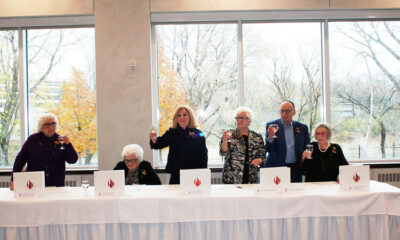
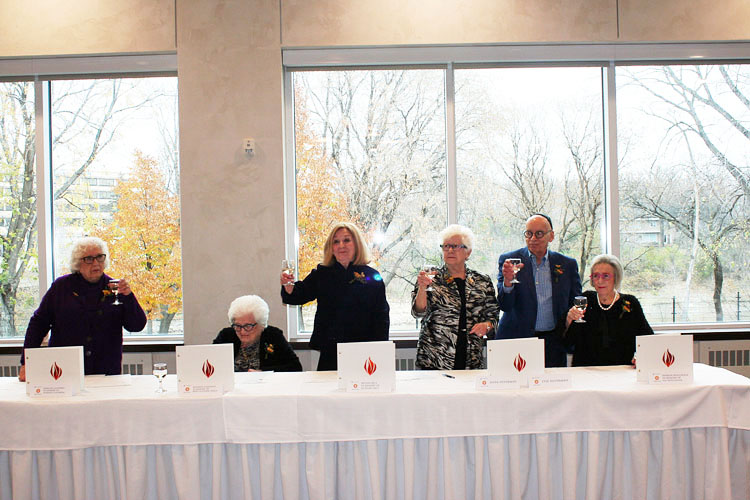
On Sunday morning, November 1, the Jewish Foundation held its most recent Endowment Book of Life event followed by a brunch at the Shaarey Zedek Synagogue. There were five new entries into the Book of Life, from: Brownie Fleishman – in memory of her parents, Beryl and Esther Pierce; Marilyn Goldberg – in memory of her husband, Dr. Norman Goldberg; Melissa Rice – in memory of her husband, Richard Rice; Sharon Wolchock, in memory of her husband, Sid Wolchock; and Anna and Lyle Silverman.
The signers were introduced by Jewish Foundation CEO John Diamond, who, in addressing the signers, said: “Your stories, your generosity, and your commitment to the future of our community will continue to inspire others for generations to come. Thank you for making this meaningful commitment.”
Diamond read excerpts from what the signers had written in the Book of Life or described what had led some of them to be motivated to want to be part of the Book of Life.
From Brownie Fleishman’s inscription about her parents, Beryl and Esther Pierce, Diamond read: “The story of the Pierce family began in Winnipeg in the early 20th century, when Beryl and Esther Pierce came to Canada to establish a new life for themselves and their children.
“Beryl Benjamin Pierce was born in 1883 in Poltova, then part of the Russian Empire, and now Ukraine. He immigrated to Canada in 1912 and settled in Winnipeg, where he became a pioneer in the fur industry. A skilled designer and cutter, he established Pierce Fur Company in the Exchange District. The building that housed that business was later designated a municipal historic building.”
From Marilyn Goldberg’s inscription about her late husband, Norman: “Norman had a deep connection to Judaism and to the Jewish community. He attended synagogue regularly and served on the boards of both the Rosh Pina and the Shaarey Zedek synagogues. He was a leader in the efforts to change the Shaarey Zedek cemetery rules to allow interfaith couples to be buried together. His commitment to Tikun Olam extended to reaching out to the larger world. He helped lead the community’s efforts to settle refugees from Darfur.
“Our children characterized his faith this way: ‘His was a Judaism that was not orthodox in practice, but deeply rooted in Jewish values, tradition, and faith. This led him to good deeds, good words, a good life.’ “
From Melissa Rice’s inscription about her late husband, Richard: “Richard was immensely proud of his Jewish faith and heritage. He celebrated his bar mitzvah, participated in Kadima and AZA, and formed friendships that would last a lifetime.
“His close friend circle included and many who shared countless adventures, misadventures, and laughs over the years. Their friendships endured because Richard understood something important. Relationships require time, loyalty, and commitment.”
John Diamond spoke about Anna and Lyle Silverman’s long commitment to the Jewish community: “Both Anna and Lyle have always been strong philanthropic supporters of the local Jewish community, of Israel, and of Holocaust education.
“A commitment that was reinforced a few years ago after they had participated in an emotionally draining and unforgettable March of the Living trip that took them to the gates of Auschwitz. Their ongoing support of the Jewish community is also inspired by Anna’s memory of the tremendous help that her family received from the Hebrew Immigrant Aid Society when they landed in Montreal as refugees. Their story goes on to say they have been lucky in love and in business, and now as they continue to enjoy a long, comfortable, and well deserved retirement, they are eager to share their good fortune with others. ‘We have a wonderful life and couldn’t ask for anything more,’ Lyle says, ‘so now it is time to give back.’
“Through hard work, a commitment to education, and a strong connection to their Jewish community, they built a family whose succeeding generations continue to benefit from the opportunities they created.”
Diamond said this about Sharon Wolchock’s inscription about her late husband, Sid: “Sid was Sharon’s biggest supporter. Her volunteer work with the National Council of Jewish Women and the Jewish Federation mattered as much to him as his own legal career, and he backed it fully. He wanted Sharon and their daughters rooted in the Jewish community in whatever way suited each of them. In 1983, on Sid and Sharon’s first trip to Israel, Sid’s lifelong connection with the Jewish state was born.
“Sid’s love of aviation and history and his pride in being a Jew emerged during that trip. He became a passionate supporter of Israel’s soldiers and donated club rooms on two Air Force bases named for his brothers Harvey and Bernie so that the hardworking and often underappreciated technical crews had somewhere pleasant to relax.”
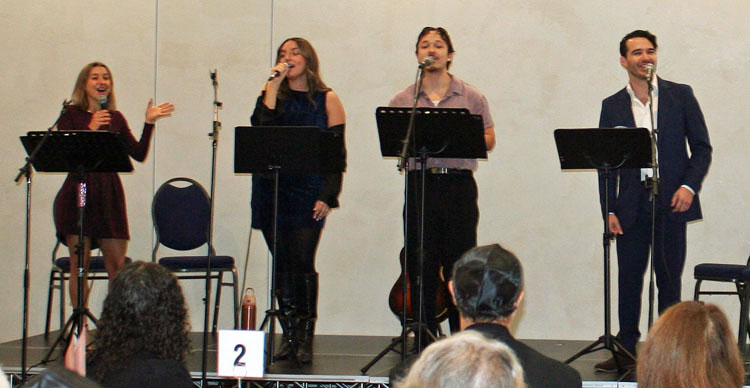
Following the ceremonial signing ceremony, guests in attendance were treated to entertainment by a quartet of talented singers: Julia Kroft, Josh Bellan, Alyssa Crockett, and Vinnie Alberto.
Closing out the day’s programme, current Jewish Foundation Board Chair Dafna Shore paid tribute to this year’s signers – and to the more than 800 signers of the Book of Life who had preceded them:
Shore said: “What makes this program so extraordinary and why it continues to resonate with so many people is the opportunity it gives us to share the stories that shape who we are, stories that might not otherwise have been told.
“Through the Endowment Book of Life, these stories are given a permanent home. Together, they form a living history of Jewish life in Manitoba, one filled with resilience, compassion, humor, and hope. These stories are more than a record of the past. They offer lessons for the future, showing generations to come, what it means to belong, to give, and to take responsibility for the strength of our community. Thank you for adding your voice and your vision.
“To this collection and for making a legacy commitment to the Jewish Foundation of Manitoba, your generation helps ensure that the programs, schools, and organizations that sustain Jewish life here will continue to thrive for generations to come.
“One of the great privileges of serving as chair is helping advance the Foundation’s mission, securing our community’s future while supporting its growth today. The Endowment Book of Life embodies that mission beautifully. It reminds us that each of us in our own way has the power to make a lasting difference.
“As we reflect on the importance of leaving a lasting legacy, I’d also like to take a moment to remember two valued members of the Jewish Foundation and Manitoba family who we lost this past year, Sheldon Berney and Lillian Neaman.
“Both served as governors of the Foundation, demonstrating their commitment to our community through their leadership and service. We are grateful for their contributions and the role they played in helping strengthen the foundation. Their memories remind us that a lasting legacy is built through the generosity, dedication, and commitment of those that came before us. May their memories be a blessing.
“As long as members of our community continue to invest in tomorrow, through their generosity, their readership, and their willingness to share their stories, Jewish life in Manitoba will continue to flourish. Thank you all for being part of that story.”
Local News
Application filed by two former members of Etz Chayim Congregation against the congregation to have their memberships restored dismissed by judge
The following is taken from the Canadian Jewish News website: “Manitoba’s Court of King’s Bench has dismissed Hadass Eviatar and David Hoult’s application challenging the termination of their membership at Congregation Etz Chayim. In his decision, Justice Vic Toews noted that, although Hoult’s letter describing a hypothetical attack on the synagogue may have lacked sensitivity given the political climate, he did not intend to threaten violence against congregants. However, the judge ruled that the court did not have jurisdiction to intervene in the membership dispute under Manitoba’s Corporations Act, finding that the couple had no financial, proprietary or economic interest that would entitle them to the remedies they sought. The judge concluded that religious organizations are generally free to determine their own membership rules and ordered each side to bear its own legal costs.”
If you would like to read the original article that broke the story about the battle between Hadaass Eviatar and David Hoult with Etz Chayim Congregation you can go to Epic Court Battle.”
Local News
Jewish Federation now says Jewish population of Winnipeg in 2021 (according to the census) was 13,940 – not the 16,000 figure that the Federation had been touting for years

By BERNIE BELLAN (Posted Oct. 27, 2026) Longtime readers of The Jewish Post & News (and this website) would probably know that I have long had a very strong interest in establishing as accurate figures as possible when it has come to reporting the size of Winnipeg’s Jewish community.
For years I argued that our Jewish Federation was exaggerating the size of our Jewish population. I heard the figure of 16,000 bandied about by leaders in our community quite often when it came to reporting the size of our Jewish population – without any empirical evidence to back that figure up.
I had long maintained that the only reasonably accurate figures when it came to reporting the size of Winnipeg’s Jewish population were those produced by the late Evelyn Katz, when she was the unofficial demographer for the Jewish Federation – over 30 years ago. What Evelyn would do is keep careful track of births, deaths, numbers of newcomers but, perhaps most important: the number of people who had left our community.
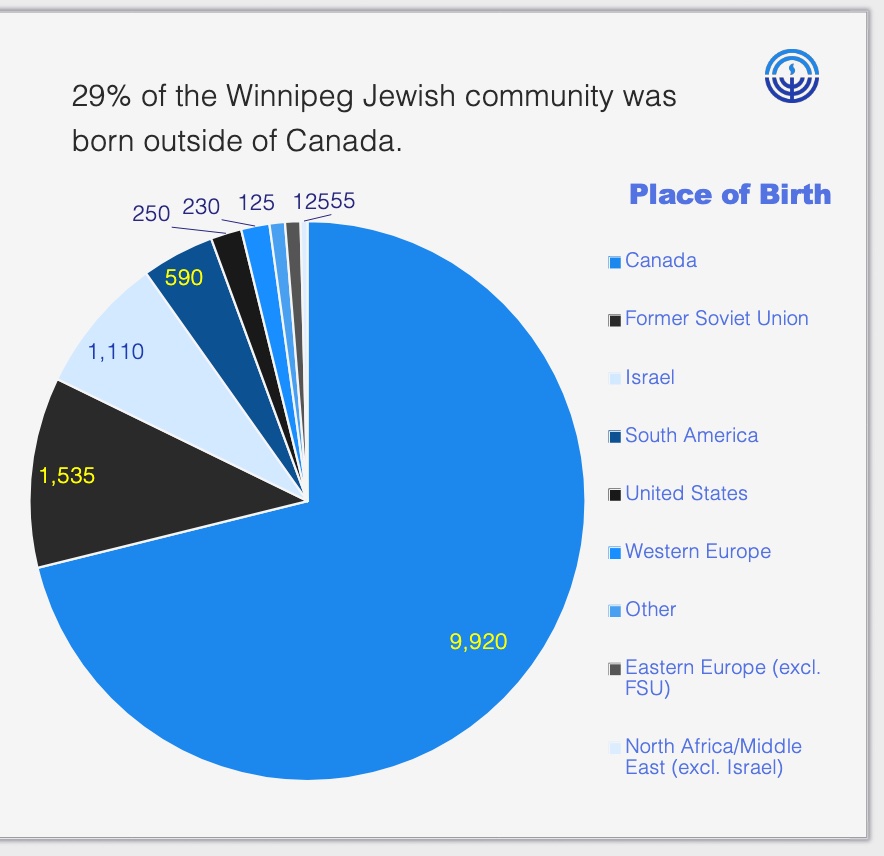
Thus, in August 2022 when I interviewed Faye Rosenberg Cohen who, at the time, was just about to retire as the Jewish Federation’s Chief Planning and Allocations Officer, I was somewhat astonished to hear Faye say, when I asked her what proportion of our Jewish community was made up of immigrants, she answered that “I can honestly say when I look at those numbers it’s somewhere around 1/3 of the community.”
In response, I asked: “So you’d say it’s somewhere between 4-5,000?”
Faye said: “I think it’s more than that.”
I wrote in that article, “I indicated my skepticism at that time, saying ‘You know that I’ve always been skeptical about the numbers that have been used by the Federation for the population of the Jewish community. I think though that it’s always been more of a case of identification – who identifies as Jewish.’ ”
Later, after the results of the 2021 census were released, I wrote that “if you take into account the results of the 2021 census, the Jewish community cannot be larger than 14,270 at a maximum. But that figure would also include anyone who had either said either their ethnic origin was Jewish or their religion was Jewish.”
Since many of the individuals who had said on the 2021 census that their ethnic origin was Jewish, but their religion was something else, I maintained that ascertaining the real size of our Jewish community was highly problematic.
Still, for the sake of argument I was willing to accept that, realistically, it was somewhere between 13,000-14,000 – but nowhere close to the figure of 16,000 that had come to be suggested by our then president of the Jewish Federation or by other leading figures in our community.
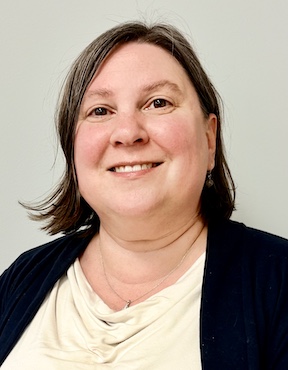
So, it was with a sense of satisfaction that I heard Sharon Graham, who is now the Jewish Federation’s Community Planning and Allocations Lead say to an audience of over 50 people who were at the Gwen Secter Centre on Thursday, October 22, that the Jewish community in 2021 was – at a maximum: 13,940.
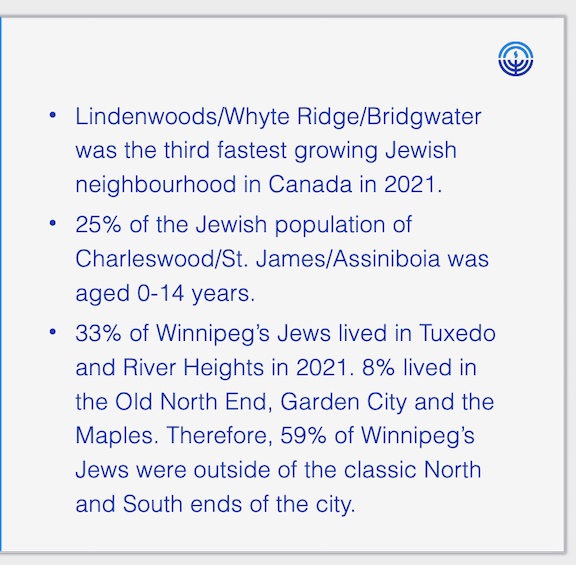
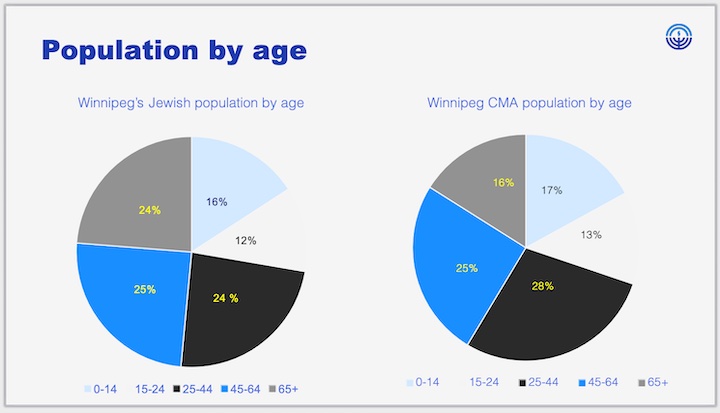
Sharon was at the Gwen Secter Centre to speak to Remis Lecture attendees. Her presentation preceded a presentation by Jewish Federation CEO Jeff Lieberman. Sharon used a PowerPoint presentation to provide some very interesting insights into where our Jewish community was at in 2021- and I’m offering some parts of her presentation here for you to read because I thought they were so interesting.
I had actually made many of the same observations about the results of the 2021 census in my own reporting back in 2022, but seeing what I had written confirmed by the Jewish Federation’s point person on planning told me that Sharon has a much more realistic view of our community than did Faye Rosenberg Cohen.
Here, for instance, is a slide that shows the proportion of our Jewish community that is made up of immigrants. It’s slightly under one fifth, not the one third percentage that Faye had suggested.
But, what really set Sharon’s presentation apart from anything else I’ve ever seen presented by someone from the Jewish Federation – other than the aforementioned Evelyn Katz, was the slide she projected which showed that, while there had been a large influx of newcomers to Winnipeg’s Jewish community between 2016-2021 there had also been a significantly high number of people who had left our Jewish community in those same years, as you can see in the following slide:
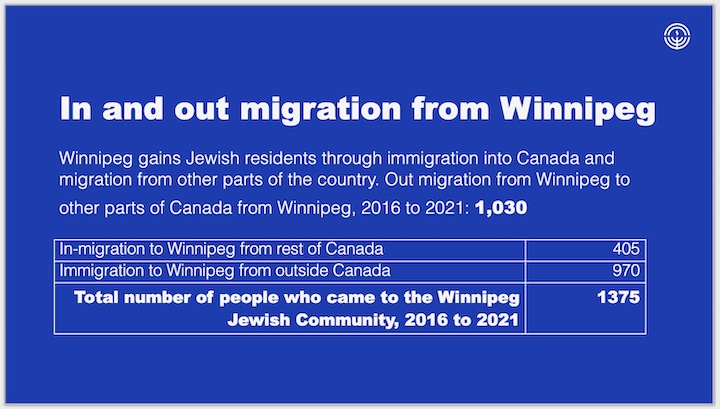
That is something we just don’t hear discussed by leaders of our Jewish organizations, but let’s be realistic: For many newcomers who came to Winnipeg and were counted as new members of our Jewish community, Winnipeg – for a variety of reasons, was a stepping stone to other communities. It may have been for reasons of better job opportunities, moving closer to other family members, or – the reason that we hear so often when it comes to people saying they want to leave Winnipeg: the weather.
But, whatever the reason, Sharon’s figures show that, as much as GrowWinnipeg may have been an abiding success when it’s come to attracting newcomers to our Jewish community here, getting them to stay long term is a different story.
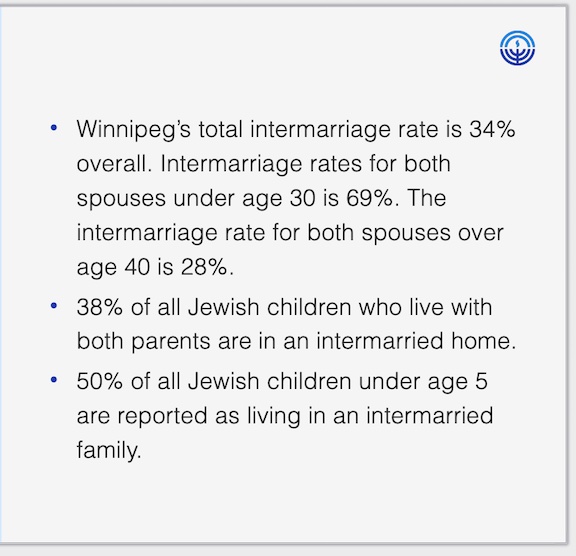
And, while there were other aspects of Sharon’s presentation that certainly merit discussion, especially the figures she produced about intermarriage, rather than delving into them here, I thought it useful simply to insert them for you, the reader, to see – and draw your own conclusions.