


Features
Recalling an unsung Winnipeg-born hero of the Manhattan Project: Louis Slotin
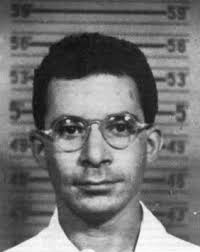
Introduction: The recent release of the movie, “Oppenheimer” has generated a renewed interest in the effort that led to the development of the atomic bomb: “The Manhattan Project.”
Readers of The Jewish Post & News are likely aware of the important role that a Winnipegger played in that project: Louis Slotin. In 1995, our own frequent contributor, Martin Zeilig, wrote a lengthy article about Slotin for the historical magazine, “The Beaver.” Later that year, the former editor of this paper, the late Matt Bellan, also wrote a piece about Louis Slotin’s life and immensely tragic death, in which Matt drew from Martin’s article, also from another essay that had been sent to this paper.
Here is Matt Bellan’s article about Louis Slotin, from the August 16, 1995 Jewish Post & News”
In the past few weeks, the media have presented a flood of stories tying in with the 50th anniversary of the explosion of atomic bombs over Hiroshima and Nagasaki.
For Winnipeg Jews, it’s also timely to commemorate the passing of a member of this community involved in the development of the first American A-bombs.
Louis Slotin sacrificed his life to save colleagues in 1946, while doing further research on the A-bomb at Los Alamos, New Mexico.
Two essays that arrived at The Jewish Post & News this month shed light on Slotin’s heroics and his life. Bernice Faintuch of Skokie, Illinois sent in “Tickling the Dragon’s Tail: A True Story”, a chapter in a book titled Time Bomb: Understanding the Threat of Nuclear Power, by Browne and Munroe, published by William Morrow and Company.
And Beth Slotin Shore, a niece of Lou is Slotin ‘s, forwarded an essay by Martin Zeilig that appears in the August/September issue of The Beaver, titled “Dr. Louis Slotin and ‘The Invisible Killer’’’.
Born here in 1910 to Yiddish-speaking immigrants Israel and Sonia Slotin, Louis Slotin grew up in the North End, attended Machray School and St. John’s Tech, and showed his brilliance at an early age. He specialized in science at the University of Manitoba, winning the gold medal in science and physics. After receiving his Masters Degree at the U of M, Slotin went on to study at King’s College in London, England, on a fellowship, and received a doctorate in biochemistry from London University in 1936.
In 1937, he was appointed a nuclear research associate at the University of Chicago, and over the next few years, did extensive pioneering research into the effects of radiation on cancer.
Slotin was recruited to work for the U.S. government’s A-Bomb Program, the Manhattan Project, in Los Alamos, New Mexico. He arrived there in 1944, and soon became a master of the dangerous science of assembling the critical firing mechanism for the atomic bomb.
In 1946, Slotin continued doing research on the bomb, as part of the U.S.’s effort to maintain military superiority over the Soviet Union. “His responsibility was to determine how much enriched uranium had to go into the core of the bomb to make sure there was a chain reaction,” Israel Ludwig, Slotin’s nephew, told The Jewish Post & News last week. Ludwig, who’s visited the Los Alamos site, notes that enriched uranium was scarce at the time, and guesses part of Slotin’s job was to see how little could be used to make an effective bomb.
In an experiment that year. the 34-year-old researcher was moving two hemispheres filled with plutonium together, a micro-inch at a time, to see how close he could move them to cause a chain reaction. A screwdriver he was holding to keep the hemispheres from touching accidentally slipped, and a chain reaction started, filling the room with deadly radiation.
Slotin quickly pried the hemispheres apart to stop the reaction. “He did more than pull the spheres apart,” adds Ludwig, who talked to a scientific witness to the event. “He threw himself on the experiment.”
Over the next nine days, the young Winnipegger died an agonizingly painful death from radiation sickness. Nearly 3,000 people showed up at his family’s Scotia Street home for the funeral, and heard Rabbi Louis S. Frank describe Slotin as “one of the most brilliant scholars ever to come out of this city,” Zeilig writes.
He was buried at Shaarey Zedek Cemetery, notes Beth Shore. Last year, at the initiative of Jewish Winnipegger Lawrence Lavitt, the city created a new park in Slotin’s name at Polson Avenue and Scotia Street, about half a block from his Scotia Street home.
Slotin’s tragic death was even more galling because he was planning to leave nuclear weapons research, and do further work on using radiation to kill cancer cells. How bitterly ironic it is that he died from an overdose of radiation, instead.







Features
How to read fixed, daily, and progressive jackpot labels at Betscore Casino

Modern casino lobbies feature distinctive jackpot tags designed for easy recognition across various game tiles. Browsing through Bet Score, you will see that the platform uses a consistent system to present fixed, daily, and progressive jackpot displays. This brief guide explains how these labels are typically formatted, offering visual cues so you can confidently interpret each jackpot category. Betscore Casino presents these markers in a clear and recognizable way.
Across the lobby, jackpot labels act as immediate visual indicators that separate one game’s prize structure from another. These tags use bold text, simple icons, and standard placements, which makes scanning for your preferred jackpot type quick and intuitive. While game tiles may share basic design language, the wording on a label—along with visual styling such as meters or timers—lets you know at a glance whether a jackpot is static, day-specific, or incrementally building. Familiarizing yourself with these UI elements helps you compare options in Betscore Casino without clicking through each game panel. Understanding the visual symbolism of these badges saves time and keeps your focus on how casino interfaces communicate essential details about their jackpot mechanics.
Decoding fixed and daily jackpot displays in casino lobbies
When you spot a “Fixed” jackpot label in the lobby, it indicates a set prize amount displayed the same way every time you encounter it. This number stays constant, appearing directly on the game’s tile or badge and often repeating on the game’s detail page, to minimize ambiguity. The layout generally favors a clean, uncluttered presentation, with the static number supported by an icon or highlighted term that reinforces its status as unchanging. In Betscore Casino, these design choices create a straightforward reading experience where the fixed amount sits front-and-center beside the badge, making it easy to identify among multiple game tiles.
For “Daily” jackpot displays, the interface uses visual cues to highlight the time-based nature of the prize. You’ll often see the jackpot label paired with a reference to days or a timer-style icon, sometimes in the form of a calendar symbol or a clearly defined time window. These elements are usually grouped with the label and placed at the top or side of the tile so you can instantly tell that the jackpot is awarded on a daily basis. The combination of wording and visual accompaniments ensures that the daily structure stands out. This consistent tagging makes daily jackpots particularly easy to sort when scanning the available offerings.
How progressive jackpot meters stand apart and quick display checks
Within the lobby, “Progressive” jackpot labels are closely linked with animated or meter-style visual treatments. The jackpot amount is shown as an ever-increasing figure, typically larger or highlighted in a contrasting color, to draw attention to its dynamic nature. Often, the progressive badge sits beside or above this meter, so the relationship between label and rolling number is obvious and direct. In Betscore Casino, this design philosophy visually distinguishes progressive jackpots from fixed or daily options at a glance, creating an immediate sense of anticipation around the changing prize amount each time you browse the lobby.
When identifying jackpot types quickly, three main cues make reading the tags straightforward. Fixed jackpots always feature a stable, non-animated number next to their badge, keeping things simple and clear. Daily jackpots consistently add a day-based timeframe indicator, which could be text or a countdown, usually positioned close to the label for easy association. Progressive jackpots, by contrast, are marked by a running total or animated meter, making them stand out as prize amounts increase. Paying attention to these conventions, you’ll find it much easier to compare options and navigate the jackpot categories provided with confidence and efficiency.
Features
Some random thoughts on the AMIA bombing, Operation Solomon, Arab migration to Palestine, and Jeffrey Epstein

By BERNIE BELLAN When I received an email from an Ethiopian Jew who is now living in Winnipeg who reminded me of the incredible efforts made by so many different people to help rescue Ethiopia’s Jewish population and bring them to Israel during Operation Solomon in 1991 (Operation Solomon) I began to ask myself why that particular event doesn’t get paid more attention within our own Jewish community here?
Recently our community held another commemoration of the AMIA bombing in 1994 in Buenos Aires, which claimed the lives of 85 people (not all Jewish) and injured over 300. Each year B’nai Brith holds a solemn ceremony during which 85 candles are lit and the names of the deceased are read out.
Yes, that was a horrific tragedy, but I wonder how much it still resonates with people. There have been so many other horrible events since that AMIA bombing, including of course the massacre of October 7, but more recently there was also the Bondi Beach attack in Australia last December, during which 15 people were killed and 40 injured. Are we also going to have commemorative events held here in Winnipeg going forward to mark that particular event?
Compare the solemnity with which tragic events such as the AMIA bombing and the October 7 massacre are remembered with the total lack of celebration of something that should be as uplifting as was Operation Solomon. Could it be because Operation Solomon happened in far away Africa and the people who were rescued were black – and seemed so foreign to those of us who can even remember what happened in 1991? I don’t know whether there’s an element of racism involved in the lack of recognition anywhere of Operation Solomon, but I thought it most interesting when I was rereading articles in The Jewish Post & News written by the one individual in our Jewish community who did more to help in the rescue of Ethiopian Jews than anyone else – the late Elliot Levine, and Levine noted the total lack of support from the Winnipeg Jewish Community Council for what was known as “The Committee for Ethiopian Jews,” I couldn’t help but wonder how much race has played a part in sidelining Operation Solomon as a momentous event in the recent history of the Jewish people.
When one considers how much attention is paid to the AMIA bombing, which affected people who, simply put, look more like us, to the lack of attention paid to Operation Solomon – well, I think you get my point.
The Ethiopian Jewish community now living in Israel has had a difficult time being accepted by mainstream Israelis, but over the years many members of that community have made significant contributions to Israeli society and the more recent descendants of the original Jews who were brought to Israel are now proud Israelis. It would be nice for our own community to hold some sort of event to mark Operation Solomon, since it is now the 35th year since that momentous achievement occurred.
Speaking of past achievements, the furor over the Nakba exhibit at the Canadian Museum for Human Rights has continued to spark heated discussion. I’ve received a number of emails from various members of our community responding to articles I’ve written about the Nakba exhibit (and in some cases articles written by others that have appeared in the Jewish Post). I don’t mind admitting that I’m not at all sure where I stand on the whole issue of the Nakba exhibit. I can see the merits of arguments that have been made on both sides of the issue and I try to keep an open mind as I hear different perspectives. But, no matter what argument is being made, I encourage everyone to listen to what people have to say and think carefully about the pros and cons of the particular points being made.
As I noted in an earlier column, rather than descending into an argument over which group has a more valid reason to feel aggrieved – Palestinians who were forced to leave their homes in Palestine (and I’m not going to debate whether the majority left willingly or not; that’s an issue that will never be resolved to anyone’s satisfaction) or Jews who were forced to leave their homes in Arab lands, I’d rather concentrate on thinking about where can we go from here?
Unfortunately, the clear consensus in Israel now seems to be that there can never be a Palestinian state and even those politicians who might have been willing to enter into at least some sort of discussion about the possible creation of a Palestinian state have moved so far to the right – in response to the clear shift in public opinion in Israel that sees no room for even contemplating a Palestinian state, that the issue of a future Palestinian state has been completely taken off the table.
At the same time though, as much as I’m generally sympathetic to the Palestinian aspiration to have a state of their own, just as I prefer to refer to historical evidence when it comes to debating what actually happened during the “Nakba,” I also like to look at the evidence surrounding just how many true Palestinians there are.
By that, I mean how many people who call themselves Palestinians can trace their roots back to the actual land which can be referred to as “Palestine.” Remember that there was no such thing as “Palestine” per se until the British Mandate over Palestine began officially in 1923. Prior to that what we now regard as “Palestine” was simply part of the Ottoman Empire.
According to figures compiled by one of the pre-eminent experts on demographic in the Ottoman Empire, Professor Justin McCarthy, there were approximately 500,000 Arabs in what is referred to as Palestine at the turn of the 20th Century, while there were approximately 23,000 Jews.
By 1945 the Arab population of Palestine had grown by over 600,000 to approximately 1,100,000 while the Jewish population had grown to over 550,000. There is much debate over whether a good part of the increase in the Arab population was due to the surge in economic activity brought on by the influx of Jews, but let’s leave that argument aside for the moment. A point that I made in another column about the Arab population of Palestine at the time when Israel was declared a state is that approximately 750,000 Arabs left what had been Palestine – but whether they left voluntarily or not was irrelevant to me. What was relevant to me, I emphasized, was that there could not have been a “Jewish” state with a majority Arab population.
I have heard nothing from those who would criticize the Nakba exhibit at the CMHR about that point.
Again – as I noted previously, I’m not arguing the morality of what happened to the Palestinians; I’m simply making the observation that Israel could not have come about had those 750,000 Arabs who did leave had chosen to stay. I don’t suppose my making that point makes one whit of difference to anyone who is criticizing the CMHR exhibit. I just wanted to reiterate my support for looking at what happened in 1948 objectively. And I’m well aware that even suggesting that one can be “objective” about such a contentious issue is up for debate – but can’t we even try for a little objectivity?
Finally, what about Jeffrey Epstein – and what’s he got to do with everything I’ve just written?
Well, it was the persistently nagging questions surrounding Epstein’s relationship with Trump that led directly to Trump deciding to join in with Netanyahu and attack Iran. Trump was desperate to “change the channel,” especially when so many of his diehard MAGA supporters kept asking questions about why Trump was so keen to put the Epstein issue aside. So now Trump is caught up in a war that he thought would divert attention from Epstein, but the most likely scenario is that he’ll end up trying to bring the war to a conclusion by ceding control over the Hormuz Strait to Iran and abandoning the notion of forcing Iran to give up its quest for a nuclear weapon. And if the only way to reduce Trump’s march toward total authoritarianism is to elect enough Democrats to at least take over the House of Representatives then what we’re going to see is a bunch of “woke” Democrats in Congress who will be wanting to end American support for Israel – and, they’ll be pushing for a Palestinian state.
Thank you, Jeffrey Epstein, for being the cause of this whole mess.
Features
35 years ago 14,000 Ethiopian Jews were rescued and brought to Israel in a short, but brilliant 36-hour operation
By BERNIE BELLAN My memory of an event that took place 35 years ago was jogged recently when I received an email from someone who himself was one of 14,000 Ethiopian Jews who were brought to safety in Israel during what was known as “Operation Solomon.”
That individual wrote that he wanted to thank me for articles I had written over the years, including about the rescue of Ethiopian Jews.
Here is part of what he wrote: “I am an Ethiopian Jew who live in Winnipeg. I recently came across Bernie Bellan’s articles and i was very fascinated by the depth of them and the fact they are informative and educational. I am not sure if he wrote anything about the thousands old dream of Ethiopian Jews who at the end reached their destination Israel. Thanks to operations Solomon and Moses that airlifted the Ethiopian Jews to become Israel’s citizens. I personally am grateful for the support i got from a couple of Jewish individuals in Winnipeg….My ancestors were hiding who they were in Ethiopia and i will never stop from telling who i am and my support for Israel. Please tell Bernie i said hello and i pray for his health so that he will continue sharing his knowledge. Little did he know that one day an Ethiopian Jew will read one of his articles.”
Reading that email led me to look back at articles that appeared in The Jewish Post & News around the time of Operation Solomon, also a later article that I wrote in 2013 about Israeli Brigadier General Eden Attias, who was deeply involved in Operation Solomon and who appeared at an event in Winnipeg that year.
I would be remiss, however, to write anything about Operation Solomon without mentioning the absolutely pivotal role that the late Professor Elliot Levine played in orchestrating support among some Winnipeg Jews to help in the rescue of Ethiopian Jews. I found two articles Levine had written around the time of that incredible rescue effort in which he described the clandestine work in which he – and several other Winnipeggers were involved in reaching out to Ethiopian Jews at a time when anyone in Ethiopia who openly announced they were Jewish put their lives in peril.
To begin with, here’s some background about what led to Operation Solomon – taken from my 2013 article about Israeli Brigadier General Eden Attias. General Attias had played a key role in Operation Solomon, including having been on the ground in Ethiopia during the actual rescue operation. He was introduced at that 2013 event by the late Yude Heneleff.
“Henteleff gave a brief overview of Operation Solomon: ”In 1991 the Ethiopian government was threatened with being toppled,’ explained Henteleff.
“For several years previous Israeli operatives had been secretly working in Ethiopia to procure the escape of as many ‘Falasha’ Jews as possible (whom Henteleff noted should be rightfully referred to as ‘Beth Israel’.)
“Concerned that a new government would put a stop to this ongoing exodus of Ethiopian Jews, the Israeli government decided to implement a bold plan to ferry out as many Jews as possible in a condensed period before the window of opportunity was closed.
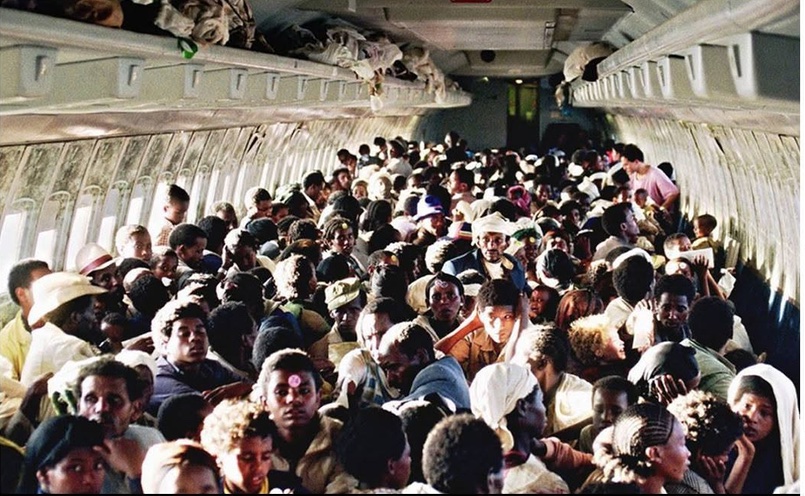
“Thus ‘Operation Solomon was born and carried out with precision. It involved the use of 34 aircraft, including several El Al passenger aircraft, as well as Israeli Air Force planes. In 36 hours the planes carried over 14,000 Ethiopian Jews to safety in Israel. In fact one Boeing 747 set the record for the most passengers ever transported on one aircraft when 1,122 passengers were crammed into the plane.
“During his talk Gen. Attias gave a detailed explanation of the events leading up to Operation Solomon, beginning as far back as 1862, when a group of Ethiopian Jews began the trek to Israel through the hostile territory of Sudan. Very few actually survived that journey, Attias noted.
“Through the years there had been various other attempts to bring Ethiopian Jews to Israel, with the most notable effort prior to Operation Solomon being ‘Operation Moses’, which was carried out in 1984. That operation was undertaken with the complicity of the Sudanese government and involved Mossad agents working to bring Ethiopian Jews to secret departure points in Sudan. Unfortunately members of the Israeli media learned of the operation and, even though they were asked to withhold revealing what they knew, went ahead and published details. That brought the operation to a sudden end, and with the rescue of only 7,000 Jews.”
Prior to Operation Solomon Ethiopia had been engulfed in a civil war that had contributed to mass starvation and brutal violence. In 1991 the Marxist regime that had been in power was threatened with being toppled and there was heightened concern within Israel – also in many communities in the diaspora, for the safety of Ethiopia’s Jewish population. As has already been noted, there had been other efforts to rescue Ethiopian Jews, but with mixed results. Thus, the bold plan to rescue as many Ethiopian Jews in one fell swoop was hatched. But in order to bring that rescue about contacts had to be made within the Ethiopian Jewish community.
How those many thousands of Ethiopian Jews were contacted is in itself a totally fascinating story. That’s where Elliot Levine’s description of the cloak and dagger nature of the work that was involved in making contact with those Jews was so vividly described in the two articles he wrote for us in 1991.
Levine noted that the vast majority of Ethiopian Jews – also known as “Falashas” (which is a derogatory term meaning stranger that was commonly applied to Ethiopian Jews by other Israelis) lived in Gondar province, which is in the north of Ethiopia.
As he wrote in the first of his articles describing the part that some Winnipeg Jews played in that rescue effort (published in the June 5, 1991 issue of The Jewish Post & News), “In April 1990 an agent if the American Association of Ethiopian Jews went into Ethiopia from North America….
“By May 1990 thousands of Ethiopian Jews had arrived in Addis Ababa with the help of a field worker placed by the American agent. A ‘truck stop’ outside of Gondar city was the rendezvous point. A few dollars a head paid for the road transport to the capital.
“By early June, however, an arrest had been made and a message had been sent out not to replace the field agent. Thereafter, those who made their way out of the hills had to make their own arrangements…
“With over 10,000 now in the capital (Addis Ababa), overburdened workers reported the weekly death tolls… By month’s end, emergency meetings and commitments had been made in Israel…
“In Winnipeg meanwhile, our Council of Rabbis was briefed on the situation and their response, among other things, funded an Ethiopian Jewish ‘agent’ we sent from Israel to assist families with particular problems.”
Levine went on to describe the invaluable assistance that agent played in helping Ethiopian Jews through “nighttime meetings, escorted tours that evaded security patrols and interviews with Ethiopian Jewish refugees.”
Levine noted, however, that the effort to help rescue Ethiopian Jews was organized entirely by a group of private individuals – with no assistance whatsoever from what was then the Winnipeg Jewish Community Council (later to become the Jewish Federation of Winnipeg). Further, the Committee for Ethiopian Jews – as the group was known, was an initiative led by members of Temple Shalom, Winnipeg’s Reform congregation.
At this point I want to return to that initial email I received from the Ethiopian Jewish individual who had reached out to me. In very dramatic fashion he described what happened when one father was approached by one of the agents who had been dispatched by the Israeli government to make contact with Ethiopian Jews and try to persuade them to flee their homes in Gondar:
“ ‘The silent call’ Operation Solomon
“ ‘good morning my name is …..i am here to tell you that we are on a mission to send a lot of people from Bet Israel( Ethiopian Jews) to Israel. And we know you are one of them. Are you interested’
“ ‘no I am not a Jew I went through horrible times I do not want to talk about myself and how would I know you are not a spy’
” ‘No I am not a spy please I know your family that is why I came to tell you about this mission’
“ ‘yes I am and please don’t tell anyone I am a Jew’
“This was a conversation that took place with the father of Anna and Jerusalem, 13 and 15 year olds who were sexually assaulted in front of their mother who took her own life the following day.
“That month in March 1991 preparation to evacuate 14000 Ethiopia Jews was planned secretly.
“In that same year 1991 bitter civil was raging in the Western part of Ethiopia, Just a month later the military junta was about to be overthrown.”
To return to Elliot Levine’s account of the role Winnipeg Jews played in the rescue of some Ethiopian Jews, in the follow-up article he wrote about that effort, he noted that Winnipeg Jews often responded quickly when told of specific urgent cases of individuals in need of direct help: “In the months preceding the airlift we had the luxury of responding to emergency appeals quickly….We in Winnipeg had arranged an especially prompt conduit – on most favourable terms. We also functioned as supporters of last resort for some of the inevitable cases that fell between the cracks. Recipients often confirmed receipt of our aid within a few days of our being notified of their plight.”
Ultimately, Operation Solomon helped rescue over 14,000 Ethiopian Jews in just 36 hours – from May 24-25, 1991. Non- stop flights of 35 Israeli aircraft were involved, including military and civilian planes. Almost all of Ethiopia’s Jewish population was rescued as a result.
