


Uncategorized
A border official mocked an attorney for observing Shabbat. Orthodox lawyers say the issue is not new.
Gregory Bovino, the Border Patrol official who led immigration raids in Minneapolis, reportedly mocked the Jewish faith of Minnesota’s U.S. attorney during a phone call with other prosecutors in mid-January. According to The New York Times, Bovino complained that Daniel Rosen, an Orthodox Jew, was hard to reach over the weekend because he observes Shabbat and sarcastically pointed out that Orthodox Jewish criminals don’t take the weekends off.
The call took place at a moment of extreme tension in Minneapolis, as federal agents under Bovino’s command carried out an aggressive immigration crackdown that had already turned deadly. It came between the fatal shootings of Renée Good and Alex Pretti, both killed during enforcement operations, and amid fierce backlash from local officials and residents.
Bovino made the remarks in a derisive, mocking tone, the Times reported, casting Shabbat observance as a point of ridicule. Bovino had already drawn national attention for frequently wearing an olive double-breasted greatcoat with World War II-era styling, leading some critics to call him “Gestapo Greg” and accusing him of “Nazi cosplay.” Bovino, who pushed back on those comparisons, has since been reassigned.
Rosen, a Trump nominee, was confirmed as Minnesota’s U.S. attorney in October 2025 after a career in private practice and Jewish communal leadership. He has said that rising antisemitism helped motivate his decision to take the job, and that prosecuting hate crimes would be a priority for his office.
For many Orthodox Jewish lawyers, Bovino’s alleged remarks were not surprising. They echoed a familiar challenge: explaining that Shabbat — a full day offline — is not a lack of commitment, but a religious boundary that cannot be bent without being broken.
In a profession that prizes constant availability, that boundary can carry consequences. Some lawyers say it shows up in subtle ways: raised eyebrows, jokes about being unreachable, skepticism when they ask for time off. Others say it has shaped much bigger decisions, including how visibly Jewish they allow themselves to be at work.
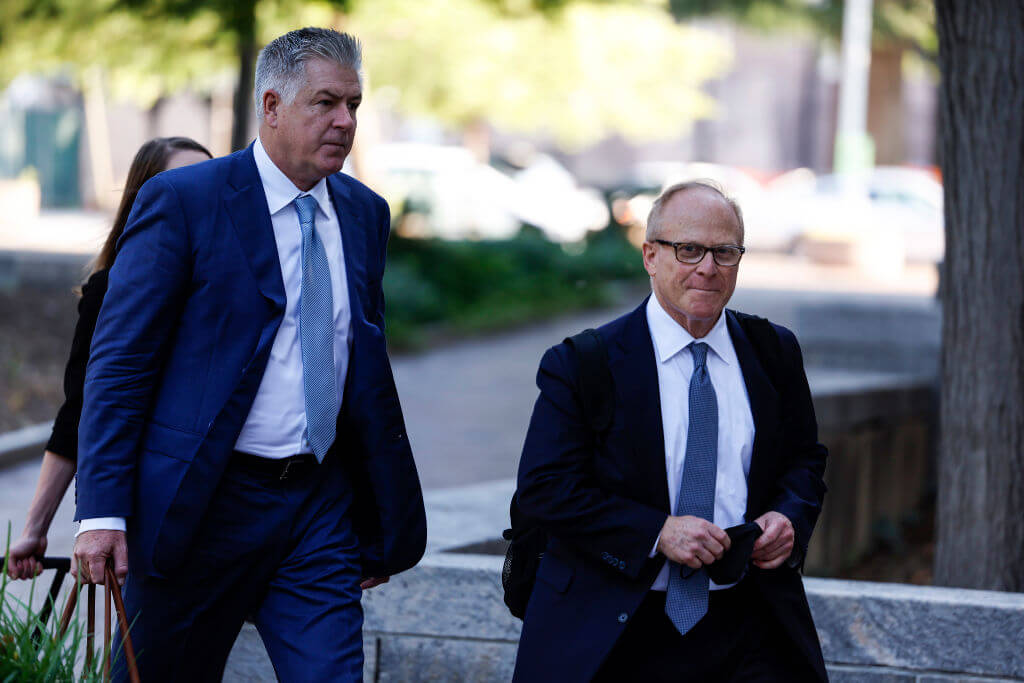
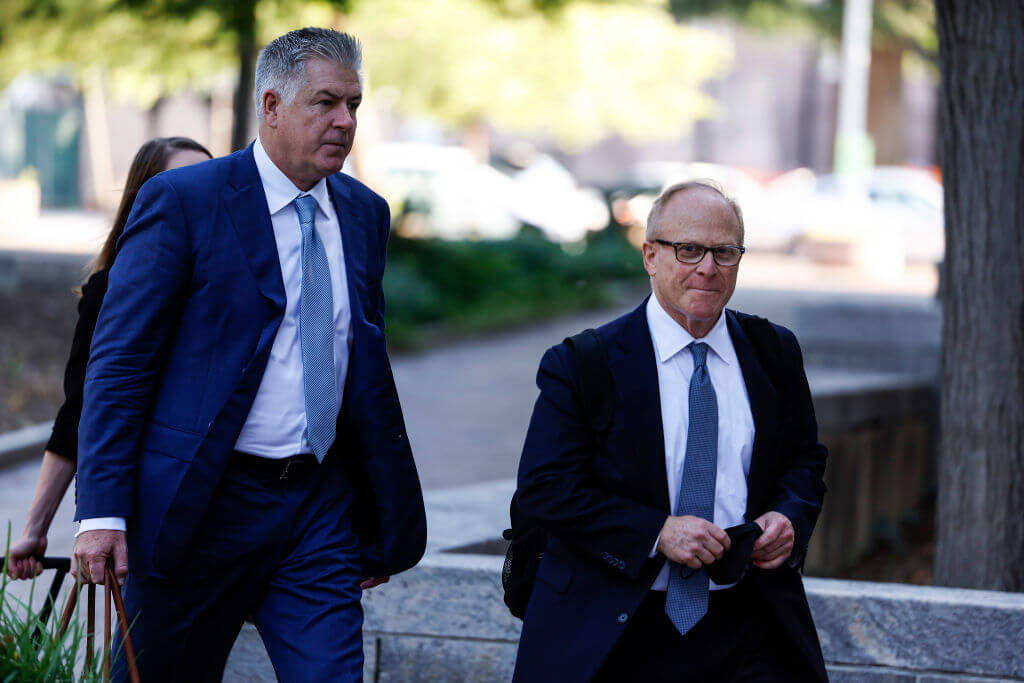
David Schoen, an Orthodox criminal defense attorney who served as lead counsel for President Donald Trump during his second impeachment trial, said he has long been mindful of how religious observance is perceived in the courtroom.
“I have made a conscious decision not to wear my yarmulke in front of a jury,” Schoen said, explaining that jurors often “draw stereotypes from what they see.”
Those concerns were reinforced by experience. Schoen said he has noticed a “definite difference in attitude” from some judges depending on whether he wore a yarmulke. In one case, he recalled, a Jewish judge pulled him aside during a jury trial and told him she thought he had made the right choice — a comment Schoen said he found disappointing.
For Sara Shulevitz, a criminal defense attorney and former prosecutor, the Bovino episode brought back memories from early in her career.
Orthodox and the daughter of a Hasidic rabbi — now married to one — Shulevitz said her unavailability on Jewish holidays was often treated as a professional flaw rather than a religious obligation. “It held me back from getting promotions,” she said.
In court, the scrutiny could be blunt. “I was mocked by a Jewish judge for celebrating ‘antiquated’ Jewish holidays,” she said, recalling requests for continuances for Shemini Atzeret and Simchat Torah. In another case, she said, a judge questioned her request for time off for Shavuot and suggested she had already “taken off for Passover.”
When another judge assumed Passover always began on the same day in April, “I had to explain the Jewish lunar calendar in the middle of court while everyone was laughing,” she said.
Not every encounter, Shulevitz added, was rooted in hostility. Sometimes judges simply didn’t understand Orthodox practice. When she explained she couldn’t appear on a Jewish holiday, judges would suggest she join the hearing by Zoom — forcing her to explain that Orthodox Jews don’t use electrical devices on Shabbat or festivals.
The misunderstanding often slid into a familiar assumption. “They think you’re lazy,” she said. “It’s not laziness. Any Jewish woman knows how much work goes into preparing for Passover.”
Rabbi Michael Broyde, a law professor at Emory University who studies religious accommodation, said that Bovino’s alleged “derogatory remarks” are “sad and reflects, I worry, the antisemitic times we seem to be living in.”
He added that the criticism of Rosen reflected a basic misunderstanding of how law offices operate, calling it “extremely rare” for a lawyer’s religious practices to interfere with their obligations, especially when senior attorneys delegate work and courts routinely grant continuances.
“No one works 24/7,” Broyde said.
The episode echoed a similar Shabbat-related incident during Trump’s first term. In his 2022 memoir, former Trump trade adviser Peter Navarro described how a group sought to undermine Trump son-in-law Jared Kushner’s role in the 2020 campaign by scheduling a key White House meeting with Trump on a Saturday, knowing Kushner — who is Shabbat observant — would not attend. Navarro titled the chapter recounting the episode, “Shabbat Shalom and Sayonara.”
The tension between Jewish observance and public life is not new. Senator Joe Lieberman, the first observant Jew to run on a major-party presidential ticket, famously walked to the Capitol for a Saturday vote and ate fish instead of meat at receptions. His longtime Senate colleague Chris Dodd joked that he became Lieberman’s “Shabbos goy.”
Still, Schoen said, visibility can cut both ways. During Trump’s impeachment trial, while speaking on the Senate floor, he reached for a bottle of water and instinctively paused. With one hand holding the bottle, he used the other to cover his head — a makeshift yarmulke — before drinking.
The moment was brief, but it did not go unnoticed. In the days that followed, Schoen said he heard from young Jewish men and businesspeople who told him that seeing the gesture made them feel more comfortable wearing their own yarmulkes at work.
The attention, he said, was unexpected. But for some in the Orthodox community, it became a source of pride.
“I felt honored,” Schoen said.
My guess in all seriousness is that he normally wears a yarmulke and this was reflex. Schoen is modern Orthodox so that would make sense. But I defer to @jacobkornbluh https://t.co/MkKx6W03v2
— Jake Tapper 🦅 (@jaketapper) February 9, 2021
Jacob Kornbluh contributed additional reporting.
The post A border official mocked an attorney for observing Shabbat. Orthodox lawyers say the issue is not new. appeared first on The Forward.
Uncategorized
High-Stakes US Special Forces Mission Rescues Airman From Iran After F-15 Crash

FILE PHOTO: A U.S. Air Force F-15E Strike Eagle aircraft takes off for a mission supporting Operation Epic Fury during the Iran war at an undisclosed location, March 9, 2026. U.S. Air Force/Handout via REUTERS/File Photo
US forces staged the audacious rescue of an airman behind enemy lines after Iran downed his fighter jet, officials said on Sunday, resolving a crisis for President Donald Trump as he weighs escalating the war, now in its sixth week.
The airman rescued by special operations forces, who Trump said was a colonel, was the weapons-systems officer on the downed F-15, a US official told Reuters.
“Over the past several hours, the United States Military pulled off one of the most daring Search and Rescue Operations in US History,” Trump said in a statement, adding that the airman was injured but “he will be just fine.”
The officer was the second of two crew members on the warplane that Iran said on Friday had been brought down by its air defenses. Iran’s Revolutionary Guards said several aircraft were destroyed during the US rescue mission, Tasnim news agency reported.
Reuters reported on Friday that the first crew member had been retrieved, triggering a high-profile search by both Iran and the United States for the remaining airman.
Iranian officials had urged citizens to help find him, hoping to gain leverage against Washington in the war Trump and Israel launched on February 28.
Trump has threatened to escalate the conflict in the coming days with attacks on Iran’s energy infrastructure.
Had Iran captured the airman, the ensuing hostage crisis could have shifted American public perception of a conflict that opinion polls show was already unpopular.
Trump said the airman was rescued “in the treacherous mountains of Iran” in what he said was the first time in military memory that two US pilots had been rescued, separately, deep in enemy territory.
The official told Reuters that as the weapons-systems officer was moved from near a mountain to a transport aircraft parked within Iran, US forces had to destroy at least one of the aircraft because it had malfunctioned.
U.S. AIRCRAFT HIT
The rescue effort, involving dozens of military aircraft, encountered fierce resistance from Iran.
Reuters reported on Friday that two Black Hawk helicopters involved in the search were hit by Iranian fire but escaped from Iranian airspace.
Separately, a pilot ejected from an A-10 Warthog fighter aircraft after it was hit over Kuwait and crashed, the officials said, though the extent of crew injuries was unclear.
Still, Trump was triumphant.
“The fact that we were able to pull off both of these operations, without a SINGLE American killed, or even wounded, just proves once again, that we have achieved overwhelming Air Dominance and Superiority over the Iranian skies,” he said in his statement.
US air crews are trained in what to do if they go down behind enemy lines, measures known as Survival, Evasion, Resistance and Escape, but few are fluent in Persian and face a challenge in staying undetected while seeking rescue.
The conflict has killed 13 US military service members, with more than 300 wounded, US Central Command says. No US troops have been taken prisoner by Iran.
While Trump has repeatedly sought to portray the Iranian military as being in tatters, they have repeatedly been able to hit US aircraft.
Reuters reported on US intelligence showing that Iran retains large amounts of missile and drone capability. Until just over a week ago, the US could only determine with certainty that it had destroyed about one-third of Iran’s missile arsenal.
The status of about another third was less clear, but bombings probably damaged, destroyed or buried those missiles in underground tunnels and bunkers, Reuters sources said.
The US and Israeli war on Iran has spread across the Middle East, killing thousands and hitting the global economy with soaring energy prices that are fueling fears of inflation.
Uncategorized
On Easter, Pope Leo Urges World Leaders to End Wars, Renounce Conquest

Pope Leo XIV waves from the main balcony of St. Peter’s Basilica after delivering his “Urbi et Orbi” (To the city and the world) message, on Easter Sunday at the Vatican, April 5, 2026. Photo: REUTERS/Remo Casilli
Pope Leo urged global leaders in his Easter message on Sunday to end the conflicts raging across the world and abandon any schemes for power, conquest or domination.
The pope, who has emerged as an outspoken critic of the Iran war, lamented in a special message to the thousands gathered in St. Peter’s Square that people “are growing accustomed to violence, resigning ourselves to it, and becoming indifferent.”
“Let those who have weapons lay them down!” the first US pope exhorted. “Let those who have the power to unleash wars choose peace!”
Leo did not mention any specific conflicts in the message, known as the “Urbi et Orbi” (to the city and the world) blessing. It was unusually brief and direct.
The pope said that the story of Easter, when the Bible says Jesus rose from the dead three days after not resisting his execution by crucifixion, shows that Christ was “entirely nonviolent.”
“On this day of celebration, let us abandon every desire for conflict, domination, and power, and implore the Lord to grant his peace to a world ravaged by wars,” Leo urged.
Leo, who is known for choosing his words carefully, has been forcefully decrying the world’s violent conflicts in recent weeks and ramping up his criticism of the Iran war.
In a sermon for the Easter vigil on Saturday night, he urged people not to feel numbed by the scope of the conflicts raging across the world but to work for peace.
The pope made a rare direct appeal to US President Donald Trump on Tuesday, urging him to find an “off-ramp” to end the Iran war.
In his address from the balcony of St. Peter’s Basilica on Sunday to the Square below, decorated with thousands of brightly colored flowers for the holiday, Leo offered brief Easter greetings in ten languages, including Latin, Arabic and Chinese.
The pope also announced he would return to the Basilica on April 11 to host a prayer vigil for peace.
Uncategorized
Temple Mount Set for Limited Reopening to Jews and Muslims

Israeli National Security Minister and head of Jewish Power party Itamar Ben-Gvir gives a statement to members of the press, ahead of a possible ceasefire between Israel and Hamas, in Jerusalem, Jan. 16, 2025. Photo: REUTERS/Oren Ben Hakoon
i24 News – Israeli authorities are preparing to partially reopen the Temple Mount in Jerusalem to both Jewish and Muslim worshipers for the first time since the start of the war with Iran, under a tightly controlled and highly restricted security arrangement, i24NEWS has learned.
According to details obtained by i24NEWS, the Israeli police, backed by National Security Minister Itamar Ben-Gvir, are also expected to permit limited access for Jewish worshipers to the Western Wall as part of the same phased plan.
Under the framework, access to the Temple Mount and surrounding holy sites would be restricted to small groups of up to 150 people at a time. In the event of a missile alert, all visitors would be immediately evacuated in accordance with emergency protocols.
The decision follows a recent Supreme Court ruling allowing demonstrations in a limited format. Police argue that a consistent standard must apply across both civic gatherings and religious sites, with Ben-Gvir insisting that “there cannot be one rule for demonstrations and another for the Temple Mount.”
However, the reopening contradicts recommendations from the Home Front Command, which has advised keeping sensitive sites closed due to the ongoing risk of missile attacks.
Israeli Justice Minister Yariv Levin has proposed transferring authority over such security-related decisions exclusively to defense officials, an initiative that could reshape the balance between the judiciary and security establishment regarding restrictions on public access.