


Uncategorized
A Jewish-American exile behind the Iron Curtain, he never lost his love for East Germany
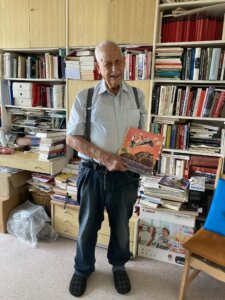
Three thousand miles from his New York City home, as the August dawn broke over the Austrian landscape, 24-year-old Army draftee Stephen Wechsler took off his shoes, waded into the Danube River, and began to swim. He struggled at first, then realized the current was carrying him toward his destination: the Soviet zone of occupied Austria.
Wechsler’s act of betrayal took place in 1952. The U.S. Army had discovered that the young Jewish private first class had lied on his induction papers, denying that he had ever belonged to the Communist Party or any affiliated organizations. In truth, he had belonged to several Communist groups, starting at age 14.
When a letter arrived ordering him to appear before a military judge in Nuremberg, it didn’t specify the charge. It didn’t need to. Wechsler understood immediately. And in his mind, there was only one path left: flee the American zone and seek refuge behind the Iron Curtain.
What followed is one of the more improbable personal odysseys of the Cold War. Starting a new life in Communist East Germany, Wechsler remade himself as Victor Grossman — establishing himself as a columnist, interpreter for visiting American leftists like Jane Fonda, defender of his adopted homeland, crusader against fascism, and sharp critic of American capitalism.
In his final years, Victor/Stephen wrote an online newsletter called Berlin Bulletin, warning about the threat to German democracy posed by the far-right Alternative for Germany, and to American democracy posed by Donald Trump.
Victor/Stephen died last week in Berlin at age 97, bringing to a close a 73-year exile.
I came to know him through a cousin of his in Portland, Oregon, where I live. I interviewed him by phone last year, reaching him at his apartment on Karl Marx Allee, in the formerly Communist half of Berlin. He had just turned 96. I call him Victor/Stephen because he was known as the former in Germany and the latter among his friends and relatives in the U.S.
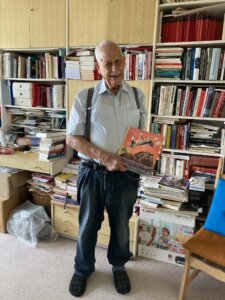
Victor/Stephen’s story is as much about love as it is about betrayal — perhaps more so. It was love for Renate, the East German woman he married soon after his desertion, that anchored him.
“I was homesick. But I was very much in love, and that made up for it,” he told me about Renate, who died some years ago.
He sometimes wondered whether he was like Don Quixote, jousting with windmills. But his ideals were so deeply rooted that he fought for them until his final years, writing his Berlin Bulletin with the same passion he had carried since adolescence.
From his teen years through Harvard and in factory jobs after graduation, Stephen Wechsler had been deeply involved in Communist causes. In the infamous 1949 riot that disrupted a Paul Robeson concert in Peekskill, N.Y., young Wechsler was among the leftists on buses attacked by stone-throwing white mobs while police stood by and did nothing.
His activism was interrupted by the Korean War, when he was drafted into the Army. He was relieved to be sent to West Germany rather than to the front lines. But his radical past caught up with him. Facing a possible five-year sentence in a military prison for lying on his induction papers, he decided to desert.
After his swim across the Danube, Wechsler didn’t know what to expect from Austria’s Soviet occupiers. Would they suspect he was a spy? He soon found himself in Bautzen, East Germany, where the Soviets had established a kind of halfway house for Western deserters. He found work in a factory, joined the German-Soviet Friendship Society, and so impressed his hosts that they appointed him culture director of a clubhouse for foreign deserters — organizing dances, ping-pong tournaments, chess matches, billiards, and other diversions from the temptations of Bautzen’s bars.
He fell in love with Renate, enrolled in the journalism program at Karl Marx University in Leipzig, married her, and after graduation went to work for an East Berlin publishing company, as he later wrote in his autobiography Crossing the River: A Memoir of the American Left, the Cold War, and Life in East Germany. He and Renate started a family, raising two sons.
Victor/Stephen caught the attention of John Peet, a British expatriate who published the German Democratic Report, an English-language newsletter sent abroad from East Berlin to counter negative portrayals of the German Democratic Republic. He worked for Peet for four years, helping publish reports that embarrassed West Germany by using Nazi-era documents to reveal how deeply the Federal Republic’s judiciary and bureaucracy were staffed by former officials of the Third Reich
He next worked for East Germany’s state radio network. A unique opportunity arose when East Germany’s Academy of Arts asked him to create an archive dedicated to Paul Robeson. Freelance work followed: articles on U.S. affairs for fellow Karl Marx University graduates now in senior media positions, dubbing dialogue for East German films, writing English subtitles.
He began writing his own books, including a history of the United States that emphasized the roles of women, Black Americans, peace movements and unions — themes that aligned with the ideals of Communist East Germany, at least partly because of their propaganda value against the West.
The opening of the Berlin Wall tossed him into a predicament. While he welcomed the end of travel restrictions on East Germans, he feared it would lead to the demise of East Germany as an autonomous state. Of course, he was right.
When West Germany formally merged with East Germany on Oct. 3, 1990, it was a stab in the heart for him. His wish was not to see “little GDR,” as he called it, swallowed by the capitalist West, but to take a middle path — allowing political freedom to bloom while preserving socialism and what he saw as the virtues of the East German state.
“I had always made clear that I was against the boils and carbuncles,” he wrote of the GDR’s abuses, “but wanted to cure, not kill the patient.”
When I interviewed him last year, he spoke wistfully about the GDR: child care, university education, dental care, eyeglasses, and hospital stays were free; rents were cheap; there was virtually no joblessness, he said; crime was practically nonexistent. While East Germans couldn’t travel to the West, they enjoyed inexpensive vacations in Prague, Budapest, and other Eastern Bloc cities.
“Life was not what people in the West imagined,” he told me.
In his recent writings and interviews, Victor/Stephen argued that the East German state took better care of its citizens than the U.S. does of its own. In a 2019 interview with the socialist magazine Jacobin, he said, “I shine a light on issues that Americans face: evictions, homelessness, mass incarceration, food banks, and the lack of access to food, healthcare, education, maternity leave, and childcare. I draw on some truly ghastly yet upsettingly commonplace examples.”
Although Victor/Stephen could sound like an ideologue, from my phone and email communications with him I got the distinct impression that love was a factor in his decision not to move back to the States. It was love not just for Renate, but also for East Germany, for its people, and for a dream he pursued until his final days: of trying to improve the lot of all humankind.
In our times, with authoritarianism on the rise around the world, with human rights and social justice slipping away, who is to fault Victor/Stephen for never abandoning such a dream?
The post A Jewish-American exile behind the Iron Curtain, he never lost his love for East Germany appeared first on The Forward.
Uncategorized
AIPAC couldn’t stop Michigan’s El-Sayed in the primary. Now it’s trying again.
AIPAC’s super PAC has re-entered Michigan’s closely watched U.S. Senate race less than a month before the general election, spending nearly $100,000 on mailers attacking Abdul El-Sayed, despite earlier concerns by allies of his Republican opponent, Mike Rogers, that it would boost the Democratic nominee.
The spending of $94,620 by United Democracy Project (UDP) on direct mailers was disclosed in a Friday campaign finance filing. It comes after Rogers publicly welcomed AIPAC’s support during a televised debate last week, reversing the position initially taken by people close to his campaign who worried the pro-Israel group’s involvement could hurt his chances.
A spokesperson for the group told Jewish Insider that the mailers target 130,000 identified Jewish voters in the swing state. It focuses on El-Sayed’s response to an attack on Temple Israel in West Bloomfield earlier this year. El-Sayed drew criticism for saying “hurt people hurt people” when discussing the attacker, whose brother was reportedly a Hezbollah commander killed in an airstrike on Lebanon. El-Sayed later apologized, saying he had been trying to provide broader context for the attack.
UDP spent more than $30 million trying to defeat El-Sayed in the Democratic primary this summer and in support of Rep. Haley Stevens, who lost by about one percentage point.
Following the primary, allies of the Republican nominee reportedly asked AIPAC not to run ads to boost him, fearing that the group’s involvement would give El-Sayed the same political foil that helped him overcome its massive spending in the primary. Axios reported that AIPAC officials didn’t take that rejection easily.
But Rogers appeared to change course last Thursday when asked whether he’d welcome AIPAC’s support.
“Anybody that wants to help my campaign stop a guy who can’t condemn terrorism in our own country because he’s so close to the people who are supporting the Muslim Brotherhood, again, I’ll take all of that help,” Rogers said at Thursday’s televised debate. El-Sayed interrupted to say he had condemned terrorism.
A new super PAC, Together for Michigan, aired an ad during the debate featuring Taylor Weintraub, whose child attends the Temple Israel preschool that was attacked in March.
Rogers went further on Friday at a campaign event with Sen. John Kennedy of Louisiana, accusing El-Sayed of being “so anti-Jewish” that a single mailer had upset him. Rogers said he welcomed help from Jewish supporters seeking to defeat his opponent. Kennedy also attacked El-Sayed, saying AIPAC would not be involved in the race if the Democrat did not “sleep in a Bin Laden jersey.”
El-Sayed, an Israel critic who has made opposition to AIPAC a central part of his campaign, responded by accusing Rogers of desperation. “You know Mike Rogers is in trouble when he begs AIPAC to start spending against me,” he wrote on X.
Some Jewish Democrats are publicly supporting Rogers, saying El-Sayed has failed to assuage concerns in his outreach to Jewish voters and in campaign appearances in recent months. If elected, El-Sayed would become the first Muslim member of the U.S. Senate.
Recent polls show El-Sayed with a narrow lead in the race to replace retiring Democratic Sen. Gary Peters. Recent elections in Michigan have been decided by narrow margins. Trump won the swing state in 2024 by about 80,000 votes, while Democratic incumbent Elissa Slotkin defeated Rogers in the Senate race that year by fewer than 20,000 votes. Four years earlier, Joe Biden won Michigan by about 2.8 percentage points.
The post AIPAC couldn’t stop Michigan’s El-Sayed in the primary. Now it’s trying again. appeared first on The Forward.
Uncategorized
In Israel’s election, Netanyahu faces a reckoning over Oct. 7 failure
With barely two weeks remaining before Israel’s Oct. 27 election, the country has been consumed by an extraordinary confrontation between Prime Minister Benjamin Netanyahu and senior former aides over what he knew before the Hamas massacre of Oct. 7, 2023, what he did with that knowledge and whether his office subsequently sought to rewrite the historical record.
The immediate catalyst was a bombshell television interview in recent days with Maj. Gen. (res.) Avi Gil, Netanyahu’s former military secretary, who served alongside him before and during the attack that killed approximately 1,200 people and saw 251 taken hostage. Gil had remained largely silent for three years, expecting to present his evidence to a state commission of inquiry. But with Netanyahu blocking such an inquiry, amid transparent scheming to deflect blame, Gil decided to speak publicly.
What he described went considerably beyond the failures of intelligence and military preparedness that have already been extensively documented. Gil accused Netanyahu’s office of attempting to falsify an official record from the morning of the attack. He challenged the prime minister’s account of early warnings he received. He confirmed that Netanyahu rejected recommendations for preventive military operations against Hamas. And he described how political considerations influenced decisions over hostage negotiations, potentially prolonging the captivity of people who could have been brought home earlier – and alive.
His testimony is particularly consequential because it directly challenges a 55-page document Netanyahu released in February, presenting his version of the events preceding Oct. 7. Submitted to Israel’s state comptroller, the document portrayed Netanyahu as having repeatedly advocated tougher action against Hamas while security officials underestimated the threat. It has become central to his defense against accusations that his longstanding policy of containing Hamas helped create the conditions for the catastrophe.
Gil, who attended the relevant meetings and recorded his experiences in 16 notebooks, described the published document as a profoundly incomplete and misleading account, containing lies and half-truths. It failed to reflect even half of what he witnessed.
A separate investigation published Friday by Yedioth Ahronoth, comparing Netanyahu’s account with original records of security deliberations, reported significant omissions and distortions, including instances in which Netanyahu allegedly rejected proposals to target Hamas leaders that his February document presented as initiatives of his own.
Most explosive was Gil’s account of an alleged attempt by Netanyahu’s then-chief of staff, Tzachi Braverman, to change the official time of a telephone conversation on Oct. 7 from 6:40 a.m. to 6:29 a.m. Moving the time backward could create the impression that Netanyahu had been issuing instructions from the first moments of the assault. Gil said a stenographer told him she had been instructed to alter the record, prompting him to notify the attorney general.
Nitzan Alon, another retired general who headed the government’s hostage release operation, and took part in negotiations throughout much of the war, also told reporters that “it was possible to end the war a year earlier” and save the lives of numerous hostages who eventually died in captivity.
Another remarkable confrontation involves Ronen Bar, the former head of the Shin Bet domestic security agency, whom Netanyahu has repeatedly blamed for the failures of Oct. 7. In late September, Bar announced plans to sue Netanyahu for defamation, accusing him of conducting a campaign of false allegations about his conduct before the massacre. Bar said he had warned Netanyahu about a looming security disaster and demanded disclosure of the original records of security meetings, communications and warnings, including the prime minister’s contacts with foreign officials.
Those demands have acquired additional significance amid reports that senior officials from Egypt and the United Arab Emirates warned Netanyahu about Hamas preparations shortly before the attack. Netanyahu categorically denies receiving such warnings and has threatened legal action over the reporting.
Gil’s revelations arrived alongside another striking intervention from a former Netanyahu confidant. Yoav Horowitz, , once Netanyahu’s chief of staff and director-general of the Prime Minister’s Office, told Kan’s Reshet Bet radio last week that he had gradually come to understand that Netanyahu’s decisions were driven primarily by considerations of personal political survival rather than the national interest.
Now a senior aide to leading opposition figure Gadi Eisenkot, Horowitz attributed that transformation to the corrosive effects of prolonged power, observing that “too much time in power corrupts,” and framed the approaching election as being about saving the country.
Horowitz now heads the team preparing its first 100 days in government. His criticism therefore comes from a former trusted aide who has become an active political opponent, adding another dimension to the dispute over Netanyahu’s leadership.
The question of political survival also figured prominently in Gil’s account of the hostage negotiations. Asked whether coalition pressures had influenced decisions that delayed agreements to free hostages, Gil said some hostages could have returned earlier and that political calculations had played a role in the decisions that kept them in captivity.
Netanyahu has rejected Gil’s allegations, and his Likud party has characterized the latest revelations as politically motivated propaganda. Netanyahu and his supporters maintain that senior security officials failed to recognize the imminent danger.
The country is still struggling to establish a common factual account of its most traumatic day in decades, while the officials who participated in the crucial decisions offer sharply conflicting versions of what happened. Meanwhile, the families of those killed on Oct. 7, survivors of the massacre and former hostages continue demanding answers about the decisions that shaped their lives.
The public appetite for an inquiry into the disaster is overwhelming. A September 2025 survey by the Israel Democracy Institute found that 74 percent of Israelis supported establishing a state commission of inquiry, including 68 percent of Jewish respondents identifying with the political right. A subsequent survey conducted in February 2026 found that 92 percent of Israelis considered it important to investigate the events.
The absence of such an inquiry has left journalists, former officials, politicians and bereaved families conducting an increasingly contentious public investigation of their own. Documents appear selectively, witnesses offer competing recollections, and allegations that might otherwise be tested through sworn testimony and access to classified evidence become weapons in an election campaign. With spiraling suspicions being leveled at Netanyahu, the election will take place amid unresolved questions – and a rage that grows more toxic by the day.
The post In Israel’s election, Netanyahu faces a reckoning over Oct. 7 failure appeared first on The Forward.
Uncategorized
Archaeologists uncover a 300-meter section of ancient aqueduct in Jerusalem
(JTA) — JERUSALEM — Israeli archaeologists have uncovered a 300-meter (984-foot) section of Jerusalem’s ancient Lower Aqueduct, providing another window into how engineers about 2,000 years ago ensured that the city would have an adequate supply of water for residents and pilgrims.
The Israel Antiquities Authority (IAA) began the dig three months ago in advance of the planned construction of a new neighborhood in East Jerusalem, at the city’s edge. Such “salvage excavations” are often carried out prior to major construction projects in Israel to ensure that any ruins discovered at the site can be mapped and protected even if they aren’t excavated at the time.
Believed to have been built in the Hasmonean period in the second and first centuries B.C.E., this engineering system carried spring water from the Gush Etzion region of the West Bank, through Solomon’s Pools south of Bethlehem, to Jerusalem and the Temple Mount. It remained in intermittent use until the early 20th century.
Although parts of the aqueduct have been uncovered in previous excavations, this is the first time such a large section will be made permanently accessible to the public, Benyamin Storchan, an IAA archaeologist and the excavation’s co-director, told the Jewish Telegraphic Authority.
Based on earlier discoveries and a wide range of research, archaeologists had strongly suspected where the newly uncovered section was located.
“We were able to work with municipal urban planners to ensure that the shape of the new neighborhood will be determined not only by its natural topography, but based on the antiquities found there,” Storchan said.
The aqueduct, the discovery of which was made public on Sunday, will be preserved as a promenade/archaeological park at the entrance to the future neighborhood by the IAA and Israel Land Authority.
Bringing Water to Jerusalem
Before the aqueduct was built, the landlocked city of Jerusalem relied on the Gihon Spring and rainfall runoff for its entire water supply, Storchan said. Under Hasmonean rule, Jerusalem’s population grew and the need for water increased. That was especially true during Jewish festival times, when pilgrims doubled or even tripled the population.
The solution involved transporting water from springs in the Gush Etzion region, a hilly area more than 800 meters above sea level. Spring water had to be channeled to collection areas, and then toward Solomon’s Pools, an extensive water-storage complex built south of Bethlehem. From there, two major aqueducts, the Lower Aqueduct and the Upper Aqueduct, carried water toward Jerusalem – a distance of more than 20 kilometers (12 miles).
The Lower Aqueduct, which appears to predate the Upper Aqueduct, “is an engineering marvel,” Amit Re’em, the IAA’s Jerusalem district archaeologist, said in a press statement. “Even today, with all our modern technology, building such a system would require extensive planning and effort. The thought that, about 2,000 years ago, they managed to bring water to Jerusalem this way is astonishing.”
Its route had to follow the contours of the rugged topography while maintaining a gentle gradient for the water to flow by gravity alone, without mechanical pumps. Along most of its route, the water dropped just one meter in elevation per kilometer.
“The newly exposed section reveals the various stages in the history of the water system,” the IAA said. “Initially, the water flowed in a built, plastered channel. Then, about 500 years ago, during the Ottoman period, ceramic pipes were installed within the original channel, the outer face of the aqueduct wall was plastered and small stones were pressed into the plaster while still wet.”
Used for about 2,000 Years
One of the aqueduct’s most remarkable characteristics was its longevity. Believed to be constructed during the Hasmonean period, it was repaired and reused through successive eras, including the Roman, Byzantine, Umayyad, Crusader, Mamluk and Ottoman periods.
The fact that various kingdoms and rulers decided to repair and not replace the water system “is one of the most fascinating parts,” Storchan said of the waterway. Rather than repurposing an older structure for a different use, successive rulers retained the aqueduct’s original purpose.”, “here we see a single installation being reused again and again for its original function.”
The aqueduct was used until about a century ago, when modern water infrastructure, including electric pumping stations, proved more efficient. Its long history of repairs, however, complicates archaeological dating, Storchan said. Those who repaired it over the millennia added plaster, repaired collapsed sections and modified the channel, sometimes obscuring evidence of the original construction.
Utilizing modern technology
Still, the latest excavation gives researchers an opportunity to reexamine longstanding questions with advances in scientific dating methods.
“Today, technology is more advanced than it was then. We’re working with all kinds of specialists to pinpoint the dating of the original construction,” Storchan said.
One such method is optically stimulated luminescence (OSL), which can estimate when mineral grains in sediment were last exposed to sunlight. Combined with the analysis of mortar, plaster and archaeological layers, the technique may help narrow the dates associated with different stages of the system’s development.
For Storchan and his colleagues, every new insight is a cause for celebration.
“Our job as archaeologists,” he said, “is to fill in another piece of the puzzle.”
This article originally appeared on JTA.org.
The post Archaeologists uncover a 300-meter section of ancient aqueduct in Jerusalem appeared first on The Forward.
