


Uncategorized
ADL calls for antisemitism questions as NYC mayoral candidates debate for a 2nd and final time
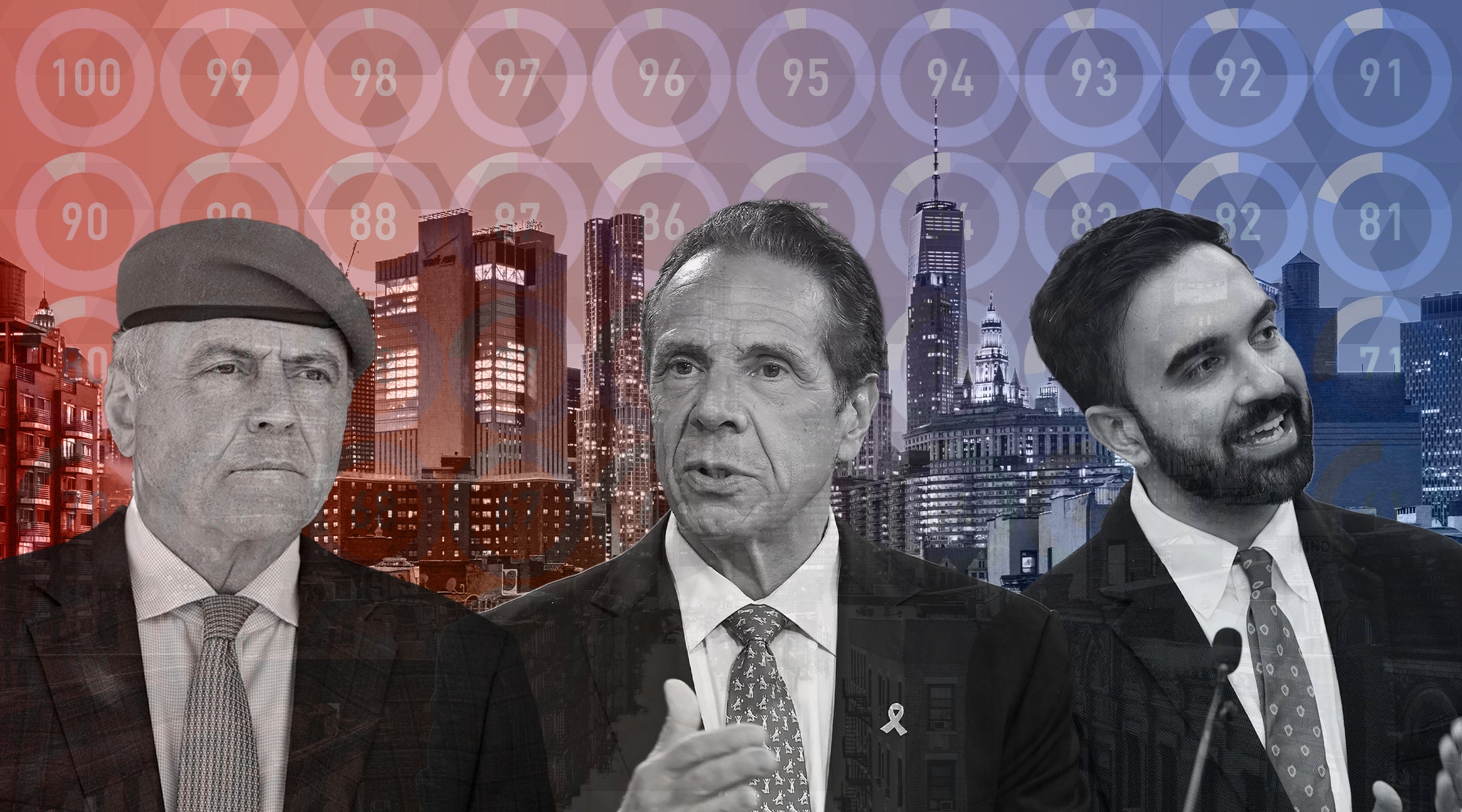
This piece first ran as part of The Countdown, our daily newsletter rounding up all the developments in the New York City mayor’s race. Sign up here to get it in your inbox. There are 13 days to the election.
 Tonight’s debate
-
The candidates will reunite for a second and final debate tonight, just days before early voting starts on Saturday.
-
It’s the last chance for Andrew Cuomo and Curtis Sliwa to take the stage with Zohran Mamdani, who has held a double-digit polling lead for months.
-
Jonathan Greenblatt, head of the Anti-Defamation League, called for the moderators to ask candidates about their approach to antisemitism. “It is vital all candidates get on the record and publicly lay out their strategy for how they will keep Jewish New Yorkers safe during this unprecedented time,” he said.
-
His demand came as the ADL released a report this morning that found “hundreds of incidents of harassment, vandalism and physical violence targeting members of New York’s Jewish community” in 2025. The report did not include a number of incidents, but said they are growing in “both frequency and intensity.”
-
The ADL told us they want the candidates to answer three questions: how they will ensure the safety of Jewish constituents; what message they give to Jewish New Yorkers who are anxious about rising antisemitism; and what response they give to Jews who “consider the phrase ‘globalize the intifada’ to be a call for violence against Israelis/Jews worldwide.”
-
The last question targets Mamdani, who declined to condemn the protest slogan during the primary, but has since said he would “discourage” the term and acknowledged that it incited fear in some Jewish New Yorkers. Greenblatt has attacked Mamdani for his stance on Israel and previously said the candidate would not condemn the phrase because “he believes it.”
-
You can catch the debate live at 7 p.m. Eastern time on Spectrum News NY1 and WNYC radio. There will also be a livestream on YouTube. In the first debate last week, antisemitism and Israel figured prominently.
 Following the money
-
Neighborhoods with large Jewish communities funneled money into Cuomo’s campaign over the two days after incumbent Mayor Eric Adams quit the race, according to a POLITICO analysis of campaign contributions.
-
Cuomo’s largest concentration of donors came from a ZIP code covering Gravesend in Brooklyn, with more than 90 individual donors, followed by Midwood with more than 80 donors, the data showed.
-
Gravesend and Midwood are both home to dense Jewish populations. Some may have rallied around Cuomo as he became the principal competitor to Mamdani, whose views on Israel alienated many older, Orthodox and more moderate or conservative Jews.
-
Gravesend is the epicenter of a movement to get Syrian Jews to vote, which has included requirements for voter registration to enroll in yeshivas or attend synagogue.
-
Many voters in the area supported President Donald Trump in 2024 and are Sephardic Jews with roots in Syria or originate from the former Soviet Union, which could influence their views of Mamdani as a democratic socialist.
-
Cuomo also received contributions from nearly 200 people across three ZIP codes on the Upper East Side and 175 people in two Upper West Side ZIP codes.
 Endorsement tracker
-
Rep. Dan Goldman, a Jewish Democrat who represents swaths of Manhattan and Brooklyn, said on Tuesday that he was “not ready” to endorse Mamdani as Election Day approaches.
-
Asked by CNN’s Kasie Hunt if he was going to vote for Mamdani, Goldman said, “I don’t know what I’m going to do, to be honest.”
-
Goldman elaborated, “I am very concerned about some of the rhetoric coming from Zohran Mamdani, and I can tell you as a Jew in New York, who was in Israel on Oct. 7, I and many other people are legitimately scared because there has been violence in the name of anti-Israel and anti-Zionism. And I’ve asked him to speak out on that and to condemn that and I frankly haven’t really seen him do much on that.”
-
In August, Goldman said he had a “good conversation” with Mamdani but would not endorse the party nominee until he took “concrete steps” to assuage the fears of Jewish New Yorkers.
-
Meanwhile, Rabbi Michael S. Miller, the longtime head of New York’s Jewish Community Relations Council, has backed Cuomo in his first political endorsement, joining multiple rabbis in departing from their past practices to weigh in.
-
Miller cited Mamdani’s Israel views, saying the frontrunner “would put at risk the residents of the city with the largest Jewish population outside of Israel.”
 Cuomo says he would give Sliwa a job
-
Cuomo suggested he would give Sliwa a job in his mayoral administration if the Republican nominee dropped out to help him beat Mamdani, when asked by the Jewish conservative radio host Sid Rosenberg yesterday.
-
“That would be something that I would be interested in. We need a coalition to run this city. We need New Yorkers to come together,” Cuomo told Rosenberg.
-
It’s the kind of scenario that attendees at a synagogue meeting on Sunday pitched to Sliwa in an effort to convince him to exit the race. Sliwa rebuffed them and remains defiant against mounting pressure from Cuomo and anti-Mamdani New Yorkers. “Let’s be very clear: I am not dropping out, under no circumstances,” he said at a press conference on the Upper West Side on Tuesday. “I’ve already been offered money to drop out. I said, ‘No.’”
 Mamdani attacked over imam meeting
-
Cuomo and Sliwa are attacking Mamdani over his recent photo of a meeting with Siraj Wahhaj, a well-known imam in Brooklyn.
-
The New York Post covered Wahhaj’s opposition to homosexuality and his characterization as an “unindicted co-conspirator” in the 1993 World Trade Center bombing, though Wahhaj was never charged and the list he appeared on was criticized as overly broad.
-
Political experts told Jewish Insider that the backlash to Mamdani’s meeting with Wahhaj is unlikely to influence the election amid a generational shift. “Dead cops and firefighters don’t seem to matter much these days,” said Hank Sheinkopf, a Democratic consultant who leads an anti-Mamdani super PAC.
-
Mamdani has said the criticism is discriminatory. “The same imam met with Mayor Bloomberg, met with Mayor De Blasio, campaigned alongside Eric Adams, and the only time it became an issue of national attention was when I met with him because of the fact of my faith and because I’m on the precipice of winning this election,” he told reporters, according to the Brooklyn Daily Eagle.
—
The post ADL calls for antisemitism questions as NYC mayoral candidates debate for a 2nd and final time appeared first on Jewish Telegraphic Agency.
Uncategorized
Trump Says Gas Prices May Remain High Through November Midterm Election

U.S. President Donald Trump takes questions from reporters while Vice President JD Vance and Secretary of State Marco Rubio look on, as they attend a meeting with oil industry executives, at the White House in Washington, D.C., U.S., January 9, 2026. REUTERS/Kevin Lamarque
US President Donald Trump said on Sunday that the price of oil and gasoline may remain high through November’s midterm elections, a rare acknowledgement of the potential political fallout from his decision to attack Iran six weeks ago.
“It could be, or the same, or maybe a little bit higher, but it should be around the same,” Trump, who is in Miami for the weekend, told Fox News’ “Sunday Morning Futures With Maria Bartiromo” when asked whether the cost of oil and gas would be lower by the fall.
The average price for regular gas at US service stations has exceeded $4 per gallon for most of April, according to data from GasBuddy. Trump’s comments on Sunday came after weeks of asserting that the spike in prices is a short-term phenomenon, though his top advisers are cognizant of the war’s economic impacts, officials have said.
Earlier on Sunday, Trump announced on social media that the US Navy would blockade the Strait of Hormuz and intercept any ship that paid a crossing fee to Iran, after marathon talks between the US and Iran in Pakistan over the weekend did not yield a peace deal.
“No one who pays an illegal toll will have safe passage on the high seas,” he wrote on Truth Social.
Any US blockade is likely to add more uncertainty to the eventual resolution of the conflict, which is currently subject to a tenuous two-week ceasefire. The new tactic is in response to Iran’s own closure of the strait’s critical shipping lanes, which has caused global oil prices to skyrocket about 50%.
UNPOPULAR WAR HITS TRUMP’S APPROVAL
The war began on February 28, when the US launched a joint bombing campaign with Israel against Iran. The scope quickly expanded as Iran and its allies attacked nearby countries, while Israel targeted Hezbollah with massive strikes in Lebanon.
The war has buffeted global financial markets and caused thousands of civilian deaths, mostly in Iran and Lebanon.
Trump’s political standing at home has suffered, with polls showing the war is unpopular among most Americans, who are frustrated by rising gasoline prices.
The president’s approval rating has hit the lowest levels of his second term in office, raising concern among Republicans that his party is poised to lose control of Congress in the midterm elections. A Democratic majority in either chamber could launch investigations into the Trump administration while blocking much of his legislative agenda.
US Senator Mark Warner of Virginia, the ranking Democrat on the Senate Intelligence Committee, questioned the strategy behind Trump’s planned blockade.
“I don’t understand how blockading the strait is going to somehow push the Iranians into opening it,” he told CNN’s “State of the Union” on Sunday.
In a separate appearance on CBS’s “Face the Nation,” Warner said the blockade would not undermine Iranian control of the waterway.
“The Iranians have hundreds of speedboats where they can still mine the strait or put bombs against tankers in closing the strait,” he said. “How is that going to ever bring down gas prices?”
Although Trump has repeatedly said that the war would be over soon, Republican US Senator Ron Johnson of Wisconsin told ABC News’ “This Week” on Sunday that achieving US aims in Iran “could take a long time.”
“It’s going to be a long-term project,” said Johnson, who was not asked about Trump’s proposed blockade. “I never thought this would be easy.”
Uncategorized
Israel’s Ben-Gvir Visits Flashpoint Al-Aqsa Mosque Compound

Israeli politician Itamar Ben-Gvir walks inside the Knesset, in Jerusalem, Oct. 13, 2025. Photo: Chip Somodevilla/Pool via REUTERS
Israel’s far-right police minister Itamar Ben-Gvir visited the flashpoint Al-Aqsa Mosque compound in Jerusalem on Sunday, saying he was seeking greater access for Jewish worshipers and drawing condemnation from Jordan and the Palestinians.
The compound in Jerusalem’s walled Old City is one of the most sensitive sites in the Middle East. Known to Jews as Temple Mount, it is the most sacred site in Judaism and is Islam’s third-holiest site.
Under a delicate, decades-old arrangement with Muslim authorities, it is administered by a Jordanian religious foundation and Jews can visit but may not pray there.
Suggestions that Israel would alter the rules have sparked outrage among Muslims and ignited violence in the past.
“Today, I feel like the owner here,” National Security Minister Ben-Gvir said in a video filmed at the site and distributed by his office. “There is still more to do, more to improve. I keep pushing the Prime Minister (Benjamin Netanyahu) to do more and more — we must keep rising higher and higher.”
A statement from the Jordanian foreign ministry said it considered Ben-Gvir’s visit to be a violation of the status quo agreement at the site and “a desecration of its sanctity, a condemnable escalation and an unacceptable provocation.”
The office of Palestinian president, Mahmoud Abbas, said such actions could further destabilize the region.
Ben-Gvir’s spokesman said the minister was seeking greater access and prayer permits for Jewish visitors. He also said that Ben-Gvir had prayed at the site.
There was no immediate comment from Netanyahu’s office. Previous such visits and statements by Ben-Gvir have prompted Netanyahu announcements saying that there is no change in Israel’s policy of keeping the status quo.
Muslim, Christian and Jewish sites, including Al-Aqsa had been largely closed to the public during the Iran war. There was no immediate sign of unrest on Sunday after Ben-Gvir’s visit.
Uncategorized
Netanyahu Visits Troops Fighting Hezbollah in Southern Lebanon

Israeli Prime Minister Benjamin Netanyahu speaks during a press conference at the Prime Minister’s office in Jerusalem, Aug. 10, 2025. Photo: ABIR SULTAN/Pool via REUTERS
i24 News – Israeli Prime Minister Benjamin Netanyahu visited Israeli forces operating in southern Lebanon on Sunday as military operations against Hezbollah-linked targets continue.
Netanyahu toured forward positions alongside Defense Minister Yisrael Katz, Eyal Zamir, and Northern Command Commander Rafi Milo, meeting troops and receiving operational briefings from commanders on the ground.
Speaking to soldiers, Netanyahu praised their performance and said operations in the Lebanese security zone were ongoing.
“The war continues, including within the security zone in Lebanon,” he said, adding that Israeli forces were working to prevent infiltration attempts and neutralize threats such as anti-tank fire and missiles.
He described the northern campaign as part of a broader regional struggle involving Iran and its allies, saying Israel’s adversaries were now “fighting for their survival” following sustained Israeli military pressure.